| Catalog No | Package | Original Price | Price | Inventory | Quantity | Operating |
|---|---|---|---|---|---|---|
| BP4198-5mg | 5mg | $420.00 | Sign in |
|


Storage conditions:Short-term storage at 2~8℃, long-term storage at -20 ~ -80℃
109.5000
2.3917
2.3917
.0311
2.5696
3.6050
High
82.8405
5.3960
No
No
No
No
Yes
Yes
0.3
Yes
No
No
Yes
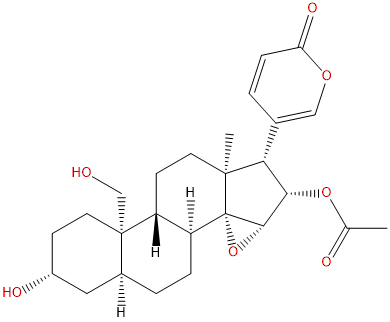
Cinobufaginol (CAS number: 6691-83-4) is a natural bufadienol compound isolated from toad venom. As a traditional Chinese medicinal herb, toad venom has a long history and is widely used in the treatment of various diseases, especially in the field of anti-tumor therapy, showing significant potential. In recent years, with the deepening development of natural product pharmacology, huperzine alcohol has become a hot topic in anti-cancer drug research due to its unique chemical structure and significant biological activity. This article aims to provide a systematic review of the chemical structure and physicochemical properties, sources and extraction methods, pharmacological activity, mechanism of action, pharmacological evaluation, and clinical application prospects of huperzine alcohol, in order to provide theoretical basis and reference for the in-depth research and drug development of this natural product.
Huachan toxin alcohol belongs to the class of toad dienol compounds, with a molecular formula of C27H38O7 and a molecular weight of 458.5510. Its structural characteristics include a typical steroid skeleton containing multiple hydroxyl and ester groups, endowing it with strong biological activity. The LogP value is 2.3917, indicating that it has moderate lipid solubility, which is beneficial for membrane penetration. The topological polar surface area (TPSA) is 109.5 Å ², indicating moderate polarity that may affect its absorption and distribution characteristics. Low water solubility (0.0311 mg/mL) suggests limited solubility in vivo and may require formulation improvement to enhance bioavailability. Huachan toxin alcohol has a high blood-brain barrier penetration ability, indicating its potential application value in central nervous system diseases. The negative result of hERG channel inhibition experiment indicates a low risk of cardiac toxicity. The Ames test result is 0.3, indicating low mutagenicity and good safety.
The main source of Huachan Poison Essence is the skin venom of toads (Bufo spp.). Toad venom, as the main component of the traditional Chinese medicine "toad venom", has a long history and is widely used in traditional Chinese medicine. Traditional extraction methods usually use organic solvent extraction combined with column chromatography separation technology. The specific steps include: first, drying the toad venom into powder, using methanol or ethanol for extraction, and extracting a mixture containing various toad dienols. Subsequently, high-purity huperzine alcohol was obtained through methods such as silica gel column chromatography and reverse phase high performance liquid chromatography (RP-HPLC) for separation and purification. Modern extraction techniques such as ultrasound assisted extraction and microwave-assisted extraction are gradually being applied to improve extraction efficiency and purity. In addition, with the development of biosynthetic technology, the chemical synthesis and semi synthesis methods of huperzine alcohol have also been reported, providing the possibility for its large-scale production.
The pharmacological activity research of Huachan toxin alcohol mainly focuses on its anti-tumor effect. In vitro cell experiments have shown that huperzine has significant inhibitory effects on various tumor cell lines, especially exhibiting strong cytotoxicity in nasopharyngeal carcinoma cell lines CNE-1 and CNE-2Z, with IC50 values of 803 μ M and 1.270 μ M, respectively, indicating its greater selectivity and efficacy towards CNE-2Z cells. In addition, cinobufagin has potential anti proliferation and pro apoptosis activities in many tumor models, such as breast cancer, lung cancer, liver cancer, etc.
In addition to its anti-tumor effect, Huabufotalin also exhibits certain anti-inflammatory, antioxidant, and immune regulatory functions, which may synergistically enhance its anti-tumor effect. In animal experiments, huperzine can effectively inhibit tumor growth, prolong the survival of experimental animals, and have minimal side effects, demonstrating good safety and therapeutic potential.
The anti-tumor mechanism of Huachan toxin extract involves multiple signaling pathways and molecular targets, mainly including:
Regulation of anti apoptosis related proteins
Huachan toxin alcohol promotes tumor cell apoptosis by downregulating the expression of anti apoptotic proteins MCL1 and BCL2. MCL1 and BCL2 are key regulatory factors in the apoptotic pathway, and their inhibition helps to restore programmed cell death.
Regulation of signal transduction pathways
This compound can inhibit the activity of STAT3, block the expression of downstream tumor promoting genes, and inhibit the proliferation and metastasis of tumor cells. STAT3, as a key oncogenic signaling molecule in various tumors, its inhibition is an important strategy for anti-tumor therapy.
Inhibition of matrix degrading enzymes
Huachan toxin alcohol can reduce the expression of matrix metalloproteinase MMP2 and inhibit the invasion and metastasis ability of tumor cells.
Inhibition of DNA Topoisomerase
By inhibiting TOP1 and TOP2A, huperzine interferes with DNA replication and transcription processes, hindering the proliferation of tumor cells.
Regulation of hypoxia inducible factors
Inhibiting HIF1A expression, reducing the adaptability of tumor cells in hypoxic environments, and inhibiting tumor angiogenesis.
MAPK signaling pathway regulation
By regulating MAPK1, it affects the signal transduction of cell proliferation and apoptosis.
Hormone related targets
Huachan toxin alcohol has regulatory effects on estrogen receptor ESR1 and aromatase CYP19A1, suggesting its potential application in hormone dependent tumors.
In summary, Huabufotalin exerts its anti-tumor effect through multi-target and multi pathway synergistic effects, and has a strong pharmacological basis.
The pharmacological parameters of Huachan toxin alcohol show that it has good potential for drug development. The molecular weight of 458.55 meets the requirements of Lipinski's rule, and the LogP value of 2.39 indicates moderate lipid solubility, which is beneficial for cell membrane permeability. The TPSA is 109.5 Å ², slightly higher than the ideal range, but still within an acceptable range, indicating moderate polarity that may affect oral absorption.
Low water solubility (0.0311 mg/mL) is a major challenge for its drug development, which requires improvement in solubility and bioavailability through formulation techniques such as nanoparticles, liposomes, or solid dispersions. The high blood-brain barrier permeability provides possibilities for its application in neurological related diseases, but potential toxicity to the central nervous system also needs to be considered.
The hERG channel inhibition experiment was negative, indicating a low risk of cardiac toxicity, which is beneficial for safety evaluation. The Ames test results showed low mutagenicity and good safety.
At present, there is limited research on the pharmacokinetics of huperzine alcohol. It is known that it has certain stability and wide distribution in vivo, but further systematic studies are needed on its metabolic pathway, half-life, and excretion mode to provide data support for clinical applications.
Huachan toxin alcohol, as a natural product with multi-target anti-tumor activity, has broad clinical application prospects. Its significant inhibitory effect on cancer cells such as nasopharyngeal carcinoma, combined with good safety indicators, makes it a strong candidate for the development of anti-tumor drugs. Future research should focus on the following aspects:
Pharmacokinetic and Toxicological System Research
To clarify its absorption, distribution, metabolism, and excretion characteristics through in vitro and in vivo studies, and evaluate the safety and potential toxic side effects of long-term medication.
Optimization of dosage form and exploration of administration route
To solve the problem of poor water solubility, improve bioavailability, and explore various administration methods such as oral, injection, and local administration.
In depth analysis of mechanisms and research on multi-target synergistic effects
Using modern molecular biology techniques to further reveal its mechanism of action, explore potential synergistic targets, and provide theoretical basis for combination therapy.
Conduct preclinical and clinical trials
Validate its anti-tumor effect and safety through animal models, gradually advance to the clinical trial stage, and evaluate its therapeutic efficacy and tolerability.
Expand indication research
In addition to tumors, considering its multiple biological activities such as anti-inflammatory and immune regulation, explore its potential applications in inflammatory diseases, immune related diseases, and neurological diseases.
In summary, as a natural product with unique structure and multiple pharmacological activities, Huachan toxin alcohol has the potential to become a new type of anti-tumor drug and deserves further in-depth research and development.
As an important active ingredient in toad venom, Huabufalin has become a hot topic in natural product pharmacology research due to its unique chemical structure and significant anti-tumor activity. Its multi-target and multi pathway mechanism of action provides new ideas and strategies for anti-tumor therapy. Although there are still certain challenges in pharmacokinetics and clinical application, with the deepening of research and technological progress, Huachanzhun alcohol is expected to become an important candidate for clinical anti-tumor drug development. Future research needs to focus on mechanism analysis, dosage form optimization, and clinical translation, promoting its transition from laboratory to clinical application and benefiting patients.
