


Product name: Linderalactone
Synonym name:
Catalogue No.: BP0869
Cas No.: 728-61-0
Formula: C15H16O3
Mol Weight: 244.29
Botanical Source: Lindera strychnifolia
Physical Description: Cryst.
Type of Compound: Sesquiterpenoids
Purity: 95%~99%
Analysis Method: HPLC-DAD or/and HPLC-ELSD
Identification Method: Mass, NMR
Packing: Brown vial or HDPE plastic bottle
Storage: Store in a well closed container, protected from air and light. Put into refrigerate or freeze for long term storage.
Whenever possible, you should prepare and use solutions on the same day. However, if you need to make up stock solutions in advance, we recommend that you store the solution as aliquots in tightly sealed vials at -20℃. Generally, these will be useable for up to two weeks.
The product could be supplied from milligrams to grams, up to kilograms
Inquire for bulk scale.
Descriptions:
Linderalactone shows significant inhibitory effects on superoxide anion generation by human neutrophils in response to fMLP/CB, the IC50 is 8.48 microg/mL.[1]
References:
[1] Chen K S, Hsieh P W, Hwang T L, et al. Nat Prod Res, 2005, 19(3):283-6.
[2] Shu J N, Ouyang R. Chinese Journal of Modern Drug Application, 2009, 3(8):7-8.
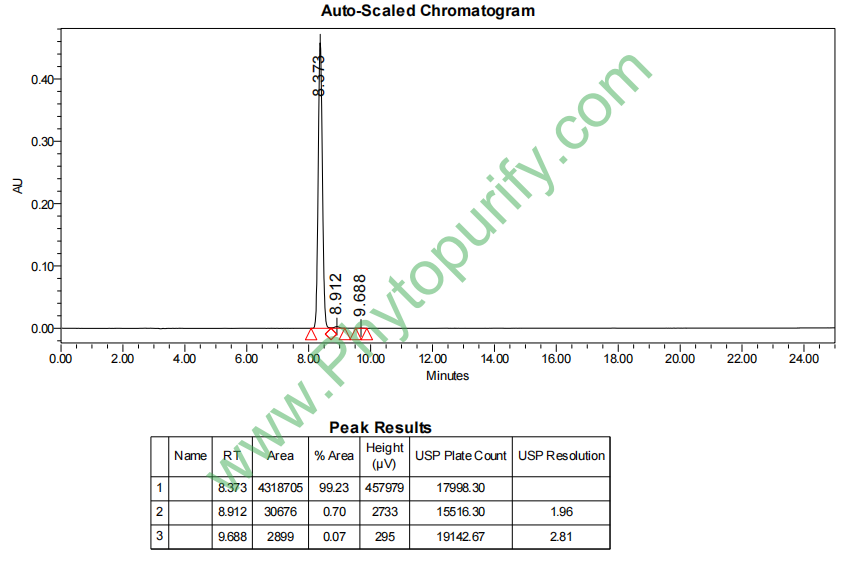
HPLC of Linderalactone
Storage conditions:Short-term storage at 2~8℃, long-term storage at -20 ~ -80℃
39.4400
3.2254
3.2253
.0430
6.1667
19.7485
High
83.5736
5.2205
No
Yes
No
No
No
No
0.0
No
Yes
Yes
Yes
Linderalactone (CAS number: 728-61-0) is a natural sesquiterpene lactone isolated from the traditional Chinese medicinal herb Lindera aggregata. As an important member of the sesquiterpene lactone family, wuyao lactone has attracted widespread attention in the field of natural product pharmacology in recent years due to its unique chemical structure and significant biological activity. Numerous studies have shown that wuyao lactone has multiple pharmacological activities, especially showing great potential in anti-tumor and anti-inflammatory aspects. It significantly inhibits the proliferation of various cancer cells, especially in lung cancer A-549 cells, by regulating the expression of apoptosis related proteins and inhibiting key cell signaling pathways such as the JAK/STAT signaling pathway, showing a low IC50 value (about 15 µ M) and strong cytotoxic activity.
In addition, wuyao lactone has regulatory effects on various targets related to inflammatory response, such as IL-6, STAT3, TNF, NOS2, etc., demonstrating its potential application value in the field of anti-inflammatory therapy. This article aims to provide a systematic review of the chemical structure, sources, pharmacological activity, mechanism of action, pharmacological evaluation, and future clinical application prospects of wuyao lactone, in order to provide theoretical basis and research direction for related research and new drug development.
Wuyao lactone is a sesquiterpene lactone with a molecular formula of C15H24O3 and a molecular weight of 244.29. Its structural features include a typical lactone ring and multiple unsaturated bonds, endowing it with unique chemical properties and biological activity. The LogP value of Wuyao lactone is 3.2254, indicating that it has moderate lipid solubility, which is beneficial for cell membrane penetration and in vivo distribution. Its polar surface area (TPSA) is 39.44 Å ², indicating low molecular polarity, further supporting its good cell membrane permeability.
Low water solubility (0.0430 mg/mL) suggests limited solubility in vivo, which may affect oral absorption and bioavailability. It is worth noting that wuyao lactone can penetrate the blood-brain barrier (BBB), which provides the possibility for its potential application in central nervous system related diseases. In addition, wuyao lactone does not exhibit hERG channel inhibitory activity, indicating a low risk of cardiac toxicity; The Ames test result is 0.0, indicating no significant genotoxicity and good safety.
Ulva lactone is mainly derived from the camphor plant Lindera aggrecata, which is widely used in traditional Chinese medicine to treat gastrointestinal diseases, rheumatic pain, and inflammatory diseases. As one of the active ingredients of sesquiterpenes in wuyao, although the content is not extremely high, its biological activity is significant and has become a research focus.
The traditional extraction method mainly uses organic solvent extraction combined with chromatographic separation technology. The general process includes:
In recent years, green extraction technologies such as supercritical CO2 extraction and microwave-assisted extraction have also been applied to the extraction of wuyao lactone, improving extraction efficiency and purity, reducing the use of organic solvents, and in line with the environmental trend of modern natural product extraction.
Wuyao lactone exhibits significant anti proliferative effects in various tumor cell lines. Especially in lung cancer A-549 cells, the IC50 of wuyao lactone is about 15 µ M, indicating strong cytotoxicity. Its anti-tumor mechanism mainly includes:
Ulva lactone exhibits good anti-inflammatory activity in various inflammatory models, with its main targets including:
These effects make wuyao lactone have potential therapeutic value in inflammatory diseases such as arthritis, neuroinflammation, and chronic inflammatory states.
In addition to anti-tumor and anti-inflammatory effects, wuyao lactone also exhibits certain analgesic, antioxidant, and neuroprotective effects. Some studies suggest that it may exert its effects by regulating neurotransmitters and oxidative stress-related pathways, but the relevant mechanisms still need further clarification.
The pharmacological activity of wuyao lactone is closely related to its regulation of multiple cellular signaling pathways and key molecules. The main mechanisms of action include:
Wuyao lactone activates mitochondrial dependent apoptosis pathway and induces programmed cell death in tumor cells by upregulating pro apoptotic proteins (such as Bax, Caspase-3, Caspase-9) and downregulating anti apoptotic proteins (such as Bcl-2). In addition, activation of Caspase-1 (CASP1) is also involved in the regulation of inflammation related cell death.
The JAK/STAT pathway is an important signaling pathway that regulates cell proliferation, differentiation, and immune response. Wuyao lactone inhibits JAK kinase activity, blocks STAT3 phosphorylation and nuclear translocation, suppresses STAT3 mediated gene transcription, weakens tumor cell proliferation and survival signals, and reduces the expression of inflammatory factors.
Overall, wuyao lactone exerts multiple pharmacological effects such as anti-tumor and anti-inflammatory effects through multi-target and multi pathway synergistic effects.
The physicochemical properties of Wuyao lactone show that it has good lipid solubility (LogP=3.2254) and low polarity (TPSA=39.44), which is beneficial for cell membrane permeation and in vivo distribution. Its low water solubility may limit oral absorption, and its bioavailability needs to be improved through formulation optimization.
Ulva lactone can penetrate the blood-brain barrier, indicating its potential advantages in the treatment of central nervous system diseases. In terms of safety, there is no hERG channel inhibition or genotoxicity, which reduces the risk of cardiac toxicity and carcinogenesis.
At present, there is limited systematic pharmacokinetic research on wuyao lactone. Preliminary studies have shown that oral administration of wuyao lactone results in rapid absorption and widespread distribution, particularly enriched in liver and lung tissues. Its metabolism is mainly carried out through the liver enzyme system, which may involve the metabolic transformation of CYP450 family enzymes. The main excretion pathways are bile and urine.
In the future, further research is needed on in vivo pharmacokinetics, metabolomics, and toxicology to clarify their absorption, distribution, metabolism, and excretion (ADME) characteristics, providing a basis for clinical development.
Ulva lactone, as a natural product with multiple pharmacological activities, has demonstrated broad clinical application potential. Its significant activity in anti-tumor and anti-inflammatory fields makes it a powerful candidate molecule for new drug development.
The high incidence and difficulty in treating solid tumors such as lung cancer have prompted researchers to focus on the anti-cancer potential of natural products. Wuyao lactone exhibits good anti-cancer activity by regulating tumor cell apoptosis and inhibiting key signaling pathways. In the future, chemotherapy drugs can be combined to explore their synergistic effects and develop them as adjuvant therapy drugs.
The regulation of various inflammatory factors and signaling pathways by wuyao lactone endows it with therapeutic potential in inflammatory diseases such as arthritis, inflammatory bowel disease, and neuroinflammation. Its good safety and blood-brain barrier penetration ability make it particularly suitable for research on neurological inflammatory diseases.
Given the low water solubility of wuyao lactone, it is necessary to improve its solubility and bioavailability through modern pharmaceutical technologies such as nano formulations and solid dispersions in the future. Meanwhile, structural modification and derivative design are also expected to enhance its pharmacological and pharmacokinetic properties.
At present, Wuyao lactone is still in the basic research and early pharmacological research stage, lacking systematic clinical trial data. In the future, preclinical safety evaluation should be strengthened, and efficacy verification of animal models should be carried out, gradually advancing to the clinical trial stage to evaluate its therapeutic effect and safety.
As an important active ingredient of sesquiterpene lactones in traditional Chinese medicine, wuyao lactone has become a hot topic in the pharmacological research of natural products due to its unique chemical structure and significant anti-tumor and anti-inflammatory activities. It exhibits good pharmacological activity and safety by regulating cell apoptosis and inflammatory response through multiple targets and pathways. Although there are still shortcomings in pharmacokinetics and clinical research, its excellent pharmacokinetic parameters and broad application prospects provide a solid foundation for the development of new drugs.
Future research should focus on in-depth analysis of its mechanism of action, optimizing extraction and formulation techniques, conducting systematic pharmacokinetic and toxicological evaluations, and promoting its translation into clinical applications. Ulva lactone is expected to become an innovative drug in the fields of anti-tumor and anti-inflammatory, providing new strategies and choices for the treatment of related diseases.
