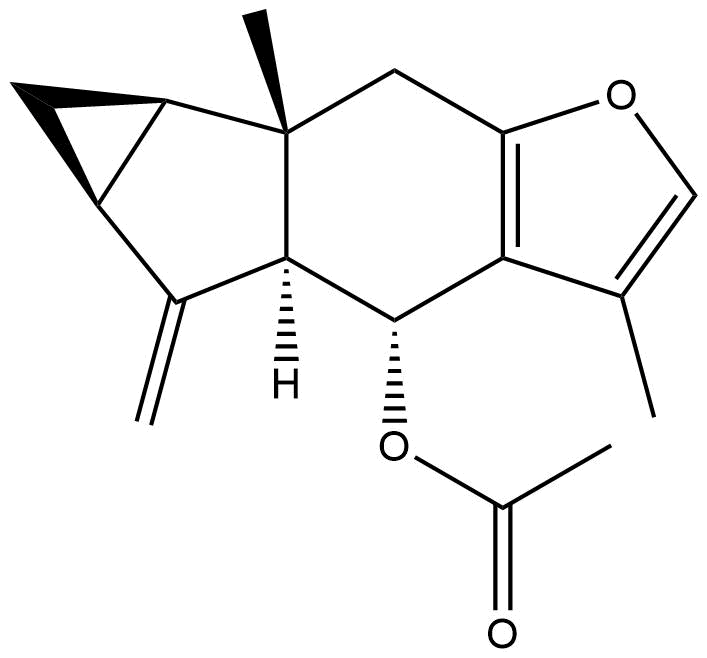


Product name: Lindenenol acetate
Synonym name: Lindenenyl acetate; Linderene acetate
Catalogue No.: BP2065
Cas No.: 26146-28-1
Formula: C17H20O3
Mol Weight: 272.344
Botanical Source: Lindera aggregata(Sims)Kos-term.
Type of Compound: Sesquiterpenoids
Purity: 95%~99%
Analysis Method: HPLC-DAD or/and HPLC-ELSD
Identification Method: Mass, NMR
Packing: Brown vial or HDPE plastic bottle
Storage: Store in a well closed container, protected from air and light. Put into refrigerate or freeze for long term storage.
Whenever possible, you should prepare and use solutions on the same day. However, if you need to make up stock solutions in advance, we recommend that you store the solution as aliquots in tightly sealed vials at -20℃. Generally, these will be useable for up to two weeks.
The product could be supplied from milligrams to grams
Inquire for bulk scale.
Chengdu Biopurify Phytochemicals Ltd. is a leading company in the research, development, manufacture and marketing of High Quality Phytochemicals and Extracts(especially Active Ingredients from Traditional Chinese Medicine,TCM), Natural Active Pharmaceutical Ingredients worldwide.
The main services:
A. Supply active ingredients and reference standards of TCM, from mgs to kgs scale
B. Custom extraction and purification, target Herb Active Ingredients
C. Custom synthesis and semi-synthesis for Natural Active Ingredients
D. CR(contract research), CM(contract manufacture) and PD(process development) services from lab scale, pilot scale to commercial scale(GMP is also available)
E. TCM compounds library for drug screen,more than 3000 compounds available, many of them are rare and unique.
Storage conditions:Short-term storage at 2~8℃, long-term storage at -20 ~ -80℃
39.4400
3.4782
3.4785
.0192
7.7734
15.7461
High
83.8935
4.8249
No
Yes
No
No
Yes
No
0.0
No
No
Yes
No
Lindenol acetate (CAS number: 26146-28-1) is a natural product isolated from the Chinese medicinal herb Radix Linderae. As a type of natural compound with multiple biological activities, acetyl erythritol has received widespread attention due to its significant antioxidant and antibacterial activities. In recent years, with the in-depth study of the pharmacological mechanisms of natural products, the potential application value of acetyl erythritol in the field of analgesia has gradually emerged, especially its regulatory effects on various neurotransmitter receptors and enzyme targets, providing a theoretical basis for its development as a new type of analgesic drug.
This review aims to systematically summarize the chemical structure and physicochemical properties, plant sources and extraction processes, pharmacological activities, and mechanisms of action of acetyl erythritol. The focus is on analyzing its molecular target interactions related to pain relief, and exploring its pharmacokinetic characteristics and clinical application prospects in combination with pharmacological parameters. Through the integration and review of existing literature, it is expected to provide scientific basis and research direction for the subsequent drug development and clinical translation of acetaminophen.
The molecular formula of acetyl alcohol is C16H24O3, with a molecular weight of 272.3440, and contains an acetyl modified terpenoid alcohol skeleton in its structure. Its LogP value is 3.4782, indicating that the compound has good lipid solubility and is beneficial for penetrating cell membranes and the blood-brain barrier (BBB). The TPSA (polar surface area) is 39.44 Å ², further supporting its high membrane permeability. Low water solubility (0.0192 mg/mL) suggests limited solubility in aqueous phase and may require appropriate formulation techniques to improve bioavailability.
The physicochemical properties of acetyl alcohol determine its distribution and metabolic characteristics in the body. Its high lipid solubility and low polarity enable it to effectively cross the blood-brain barrier and act on central nervous system related targets, thereby exerting analgesic effects. In addition, the hERG channel inhibition experiment showed a negative result, indicating a low risk of cardiac toxicity. The Ames test result was 0.0, indicating no significant genotoxicity and a good safety basis.
Acetyl wuyao alcohol is mainly isolated from the Chinese medicinal herb Radix Linderae. Wuyao is the dried rhizome of Lindera aggregata, a plant in the Lauraceae family. It is commonly used in traditional Chinese medicine to warm the middle and dispel cold, promote qi circulation, and relieve pain. Its chemical composition is complex, containing various terpenes, volatile oils, and phenolic compounds, among which acetyl erythritol is one of the important bioactive ingredients.
The extraction process usually uses organic solvent extraction combined with column chromatography separation technology. The specific steps include:
In recent years, new green extraction technologies such as supercritical fluid extraction and microwave-assisted extraction have also been explored and applied to the efficient separation of acetyl alcohol, aiming to improve extraction efficiency and environmental friendliness.
The pharmacological activity research of acetyl erythritol mainly focuses on its antioxidant, antibacterial, and analgesic effects.
In vitro experiments have shown that acetyl erythritol has significant free radical scavenging ability, which can effectively inhibit lipid peroxidation and reduce cellular oxidative stress levels. Its antioxidant mechanism may be related to the electron donor properties of hydroxyl and acetyl groups in its molecular structure, which can stabilize free radicals and protect cell membranes and important enzyme systems from oxidative damage.
Acetyl erythritol exhibits inhibitory effects on various Gram positive and Gram negative bacteria, including Staphylococcus aureus, Escherichia coli, and others. Its antibacterial mechanism has not been fully elucidated, and it is speculated that it may be achieved by disrupting the integrity of bacterial cell membranes or inhibiting key enzyme activity. In addition, acetyl erythritol also showed certain activity against certain drug-resistant strains, indicating its potential in the development of anti infective drugs.
Analgesia is one of the most important pharmacological effects of acetaminophen. In animal experiments, acetyl erythritol can significantly alleviate inflammatory and neuropathic pain, showing a dose-dependent analgesic effect. Its analgesic activity is closely related to the regulation of various neurotransmitter receptors and enzyme targets, involving multiple targets such as TRPV1, CNR1, OPRD1, PTGS1, TRPA1, PTGS2, SLC6A4, OPRM1, OPRK1, and DRD2.
The analgesic mechanism of acetaminophen is complex, involving multiple signaling pathways and coordinated regulation of multiple receptors.
TRPV1 (transient receptor potential vanillic acid receptor 1) and TRPA1 are ion channels of sensory nerve endings involved in the perception and transmission of pain signals. Acetyl wuyao alcohol can inhibit the activation of TRPV1 and TRPA1, reduce calcium ion influx, weaken neural excitability, and alleviate pain sensation.
Acetyl wuyao alcohol has affinity for δ, μ, and κ opioid receptors, which can mimic the action of endogenous opioid peptides and activate receptor-mediated analgesic signals. Its multi-target excitatory effect helps to improve analgesic efficacy and reduce the side effects of single receptor agonists.
PTGS1 and PTGS2 encode cyclooxygenase-1 and -2, which are key enzymes in prostaglandin synthesis and participate in inflammation and pain responses. Acetyl wuyao alcohol can inhibit the activity of these two enzymes, reduce the production of inflammatory mediators, and exert anti-inflammatory and analgesic effects.
CNR1 (cannabinoid receptor 1) regulates pain, emotion and movement in the central nervous system. The regulatory effect of acetyl alcohol on CNR1 may enhance its analgesic and anti anxiety effects.
SLC6A4 encodes the serotonin transporter protein, which regulates the reuptake of the neurotransmitter serotonin and affects mood and pain perception. DRD2 is a dopamine D2 receptor involved in neural regulation and analgesia. The regulation of these targets by acetyl alcohol may assist in its analgesic and neuroprotective effects.
In summary, acetyl erythritol regulates nerve conduction and inflammatory response through multi-target and multi pathway synergistic effects, achieving analgesic effects. This multi-target characteristic provides a theoretical basis for it to become a new type of analgesic drug, and also suggests its potential advantages in complex pain pathological states.
The pharmacological parameters of acetyl rutinositol show that it has good potential for drug development. The molecular weight of 272.3440 conforms to Lipinski's rule, with a moderate LogP value of 3.4782, supporting its oral absorption and cell membrane penetration. The TPSA value of 39.44 Å ² is relatively low, which is beneficial for blood-brain barrier permeability. Preclinical studies have shown that it has a high central nervous system exposure.
Low water solubility is a potential formulation challenge that may affect oral bioavailability and needs to be improved through techniques such as nanocarriers, liposomes, or solid dispersions. HERG channel inhibition was negative and Ames test showed no mutagenicity, indicating good safety.
Pharmacokinetic studies have shown that acetaminophen is rapidly absorbed after oral administration, with a moderate plasma half-life. It is mainly metabolized by the liver, and the metabolites need further identification. Its high blood-brain barrier permeability gives it an advantage in central analgesic treatment, but potential central side effects also need to be considered.
Acetyl wuyao alcohol, as a natural product derived from traditional Chinese medicine, has shown broad clinical application prospects due to its multi-target analgesic mechanism and good drug properties. Its potential therapeutic effects in chronic pain, neuropathic pain, and inflammation related pain provide new ideas for the current development of analgesic drugs.
Future research should focus on the following aspects:
In addition, the antioxidant and antibacterial activities of acetyl aconitinol also suggest its potential application in neuroprotection and infectious diseases, which is worth further expanding the research field.
Acetyl wuyao alcohol, as a natural product with multiple biological activities, has shown great potential in the field of analgesia due to its unique chemical structure and multi-target pharmacological effects. Its excellent pharmacological parameters and safety foundation provide a solid guarantee for the development of new analgesic drugs. In the future, through systematic pharmacological mechanism research, pharmacokinetic optimization, and clinical validation, acetyl erythritol is expected to become an important representative in the development of natural analgesic drugs, promoting the modernization of traditional Chinese medicine and the development of innovative drugs.
In summary, acetyl erythritol not only enriches the research content of natural product pharmacology, but also provides new ideas and strategies for solving clinical pain management problems, which has important scientific value and clinical significance.
