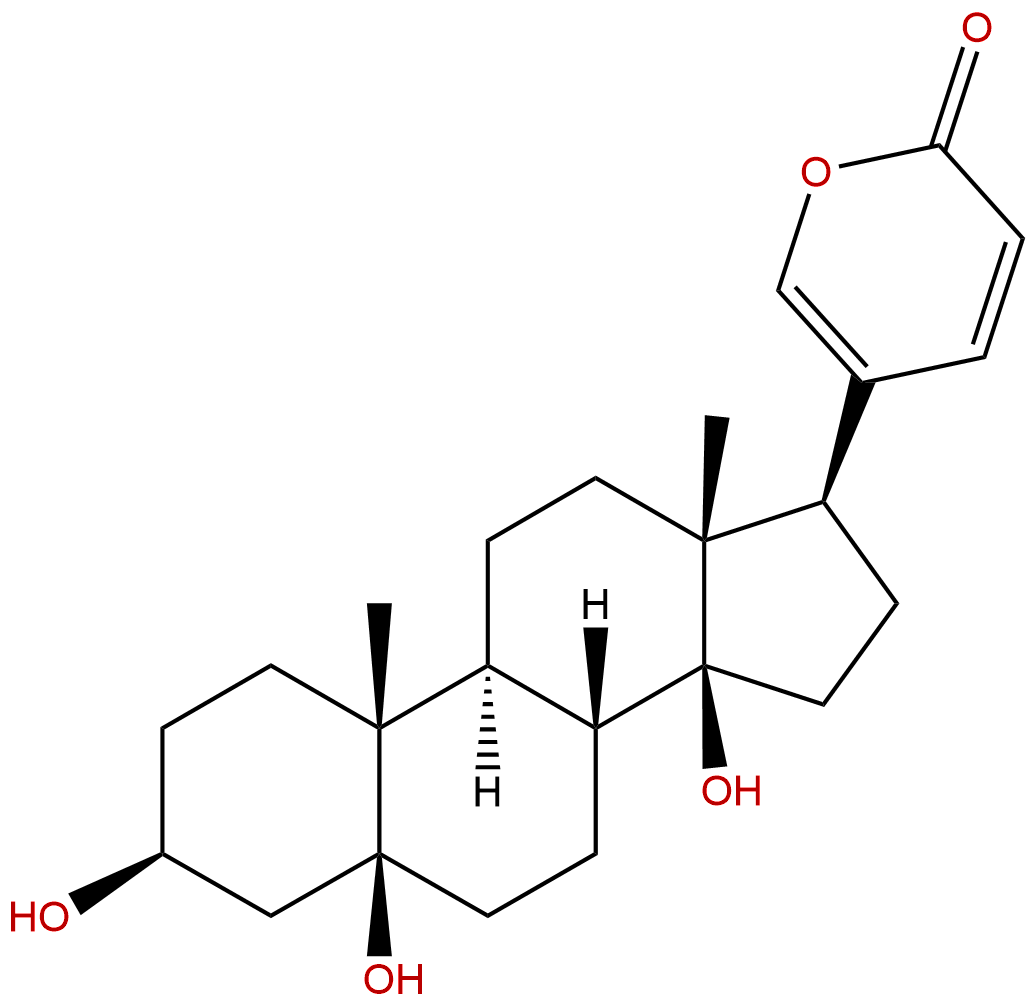


Product name: Telocinobufagin
Synonym name:
Catalogue No.: BP1370
Cas No.: 472-26-4
Formula: C24H34O5
Mol Weight: 402.531
Botanical Source: Ch'an Su and other toad poisons
Physical Description: Powder
Type of Compound: Steroids
Purity: 95%~99%
Analysis Method: HPLC-DAD or/and HPLC-ELSD
Identification Method: Mass, NMR
Packing: Brown vial or HDPE plastic bottle
Storage: Store in a well closed container, protected from air and light. Put into refrigerate or freeze for long term storage.
Whenever possible, you should prepare and use solutions on the same day. However, if you need to make up stock solutions in advance, we recommend that you store the solution as aliquots in tightly sealed vials at -20℃. Generally, these will be useable for up to two weeks.
The product could be supplied from milligrams to grams, up to kilograms
Inquire for bulk scale.
Descriptions:
Telocinobufagin (TCB), a bufadienolide extracted from Bufo paracnemis parotoid glands, shows a reversible local anesthetic action, similar to BUPI, however, without cardiac toxicity in vitro. [1]
Telocinobufagin is a novel endogenous digitalis, exhibits elevated plasma levels in patients with terminal renal failure.[2]
Telocinobufagin and marinobufagin have antimicrobial activity, the minimum inhibitory concentrations of telocinobufagin and marinobufagin were, respectively, 64.0 and 16.0 microg/mL for E. coli and both 128 microg/mL for S. aureus; they also promote an increase of the contraction force in isolated frog ventricle strips.[3]
Telocinobufagin has potential immune system regulatory effects, suggests that it could be developed as a novel immunotherapeutic agent to treat and other immune-mediated diseases, and it may become a new immunomodulatory agent in many regions.[4]
Telocinobufagin can enhance the Th1 immune response and protect against Salmonella typhimurium infection .[5]
Telocinobufagin can induce colon cancer cell apoptosis by oxidative stress and apoptosis pathway.[6]
References:
[1] Patrocínio B A, Claúdio M. Universidade Federal do Ceará, 2004.5.26.
[2] Komiyama Y, Dong X N, Masaki H, et al. Clin Biochem, 2005, 38(1):36-45.
[3] Cunha Filho G A, Schwartz C A, Resck I S, et al. Toxicon, 2005, 45(6):777-82.
[4] Cao Y, Song Y, An N, et al. Fund Clin Pharmacol, 2009, 23(4):457-64.
[5] Wu S C, Fu B D, Shen H Q, et al. Int Immunopharmacol, 2015, 25(2):353-62.
[6] Liang S T, Li X W, et al. Nan Fang Yi Ke Da Xue Xue Bao 2016, 36(7):921-6.
[7] Ma X C, Zhang B J, Xin X L, et al. Nat Prod Co, 2009, 4(4):179-84.
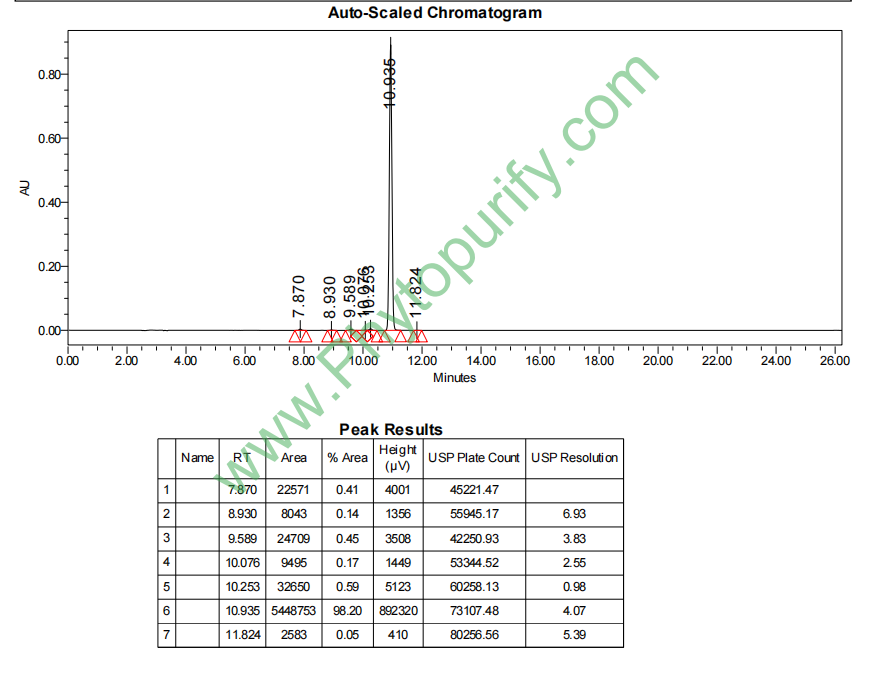
HPLC of Telocinobufagin
Storage conditions:Short-term storage at 2~8℃, long-term storage at -20 ~ -80℃
90.9000
2.5404
2.5404
.0126
3.0291
6.3281
Low
84.6399
4.5611
No
No
No
No
No
No
0.0
Yes
No
No
Yes
Natural products, as a treasure trove of drug discovery, play an irreplaceable role in the history of human disease treatment. Among them, bufadienolide compounds have attracted much attention due to their unique structure and wide range of biological activities. Telocinobufagin (also known as Telobufotoxin or Telocinobufogenin, CAS number: 472-26-4) is an outstanding representative of this type of compound. As an orally effective steroid compound, Far Eastern Toad Venom was initially recognized for its cardiotonic effect, and its mechanism of action is similar to classical cardiac glycosides, which enhances myocardial contractility by inhibiting Na+/K+- ATPase on the myocardial cell membrane. However, with the deepening of modern pharmacological research, its more remarkable anti-tumor activity has gradually become a research focus. Research has shown that Yuanhua Bufalin can exert significant anti proliferative and pro apoptotic effects in various malignant tumor models by intervening in multiple key signaling pathways such as STAT3, PI3K/Akt, mTOR, etc. In addition, its potential in immune regulation, anti infection, and non opioid analgesia is also beginning to emerge. This article aims to systematically review the chemical structure, plant origin, pharmacological activity, molecular mechanism of action, pharmacological characteristics, and clinical application prospects of Yuanhua Bufotalin, in order to provide comprehensive academic references for the deep development and transformation research of this natural product.
Yuanhua Bufotoxin is a C24 steroidal bufadienolide, whose basic skeleton consists of a steroid nucleus and an unsaturated hexagonal lactone ring (α - pyranone ring) connected at the C17 position. Its molecular formula is C24H34O5 and its molecular weight is 402.5310. Compared with many cardiac glycosides, their steroid nuclei usually contain multiple hydroxyl groups (such as C3, C5, C14 positions), which have important effects on their water solubility and biological activity. The unsaturated lactone ring in its structure is one of the key pharmacophores that exert Na+/K+- ATPase inhibitory activity.
From the analysis of parameters related to drug properties, the lipid water partition coefficient (LogP) of Yuanhua Bufotalin is 2.5404, indicating its moderate lipophilicity, which is beneficial for its penetration of cell membranes but may also affect its water solubility. Its topological polar surface area (TPSA) is 90.9000 Å ², which is relatively high, indicating the presence of more hydrogen bond donors and acceptors (mainly from hydroxyl and carbonyl groups) in the molecule. Its water solubility value is relatively low (about 0.0126 mg/mL), making it a poorly soluble compound, which may be one of the main challenges facing its oral absorption and formulation development. These physical and chemical properties collectively determine its lower blood-brain barrier permeability, limiting its potential applications in central nervous system related diseases, but may also reduce the risk of central side effects. In addition, preliminary pharmacological screening showed no significant inhibitory effect on hERG potassium channels (hERG inhibition: no), indicating a relatively low potential risk of arrhythmia; The Ames test result was 0.0, indicating that no mutagenicity was observed in this testing system, providing preliminary positive signals for its safety.
The poison essence of Yuanhua toad mainly comes from animals in the family Bufonidae, such as the Chinese toad(Bufo gargarizans)Or black eyed toad(Bufo melanostictus)In the dried secretion of the ear gland and skin (i.e. traditional Chinese medicine "toad venom"). Chansu is a mixture of various bufadienolactones. In addition to Yuanhua Bufalin, it also contains various active ingredients such as Huahua Bufalin, Bufalin, and Lipobufalin.
Its extraction and separation usually use organic solvent extraction combined with modern chromatographic techniques. The classic process is as follows: first, the dried toad venom powder is subjected to cold soaking or reflux extraction with polar organic solvents such as methanol or ethanol, and then concentrated to obtain the total toad venom extract. Subsequently, liquid-liquid extraction methods were used, such as segmented extraction with solvents of different polarities such as petroleum ether, chloroform, and ethyl acetate. Far Eastern toad venom was mostly concentrated in the chloroform or ethyl acetate parts. Further purification relies on column chromatography technology, often using silica gel column chromatography with gradient elution using chloroform methanol or petroleum ether ethyl acetate mixed solvents in different ratios. High performance liquid chromatography (HPLC), especially preparative HPLC, is the final key step in obtaining high-purity monomers of Far Eastern Toad Venom. A reverse phase C18 chromatographic column is often used with methanol water or acetonitrile water as the mobile phase. In recent years, new separation technologies such as high-speed countercurrent chromatography have also been applied to the efficient preparation of such compounds. During the extraction process, attention should be paid to the instability of such compounds, and strong light, high temperature, and acid-base environments should be avoided to maintain their activity.
Yuanhua Toad Venom Essence exhibits diverse and powerful pharmacological activities, and its research has expanded from traditional cardiovascular fields to multiple modern medical fields such as oncology, immunology, anti infection, and analgesia.
The multiple pharmacological activities of Yuanhua Bufotalin stem from its precise intervention in multiple key signaling pathways and molecular targets within cells.
The core mechanism of anti-tumor effect:
Heart strengthening mechanism Its classic target is Na+/K+- ATPase (sodium pump). Inhibition of enzyme activity is the molecular basis of its positive inotropic effect.
Mechanism of analgesic effect The specific molecular targets of non opioid analgesia are still under further investigation and may involve inhibiting the release of inflammatory mediators, regulating ion channels (such as sodium and calcium channels), or affecting other pain perception related signaling pathways (such as the MAPK1/ERK pathway).
Other Its promoting effect on renal fibrosis may be related to the activation of fibrogenic signals (such as TGF - β) after long-term inhibition of Na+/K+- ATPase in renal cells.
Despite the significant in vitro activity of Yuanhua toad venom essence, it faces many challenges on its path to commercialization.
The clinical application prospects of Yuanhua Toad Venom Essence are broad, but the transformation path needs to be cautious and strategic.
Antitumor therapy: is the main development direction. Given its multi-target mechanism of action, especially its effective inhibition of difficult to drug targets such as STAT3, it has unique advantages in overcoming tumor drug resistance and inhibiting metastasis. Possible future development paths include:
Analgesic application Its non opioid analgesic properties have important social value and clinical significance in the context of the global spread of the opioid crisis. Further clarification of its precise analgesic targets and mechanisms is needed to evaluate its efficacy and long-term safety for chronic pain.
As a pharmacological tool molecule Yuanhua Bufotalin is an excellent tool compound for studying the biological functions of Na+/K+- ATPase, STAT3 signaling pathway, and its role in diseases.
Challenges and Future Research Focus:
Yuanhua Bufotoxin, as a natural bufadienolide derived from traditional Chinese medicine, has shown new vitality in modern pharmacological research due to its unique chemical structure and multi-target, multi pathway pharmacological mechanism of action. Its outstanding activities in anti-tumor, immune regulation, and non opioid analgesia demonstrate its enormous potential for transformation from a "traditional toxin" to a "modern medicine". However, its inherent drug development bottlenecks such as poor water solubility, narrow treatment window, and potential organ toxicity are also scientific challenges that must be faced and overcome during the research and development process. In the future, through interdisciplinary cooperation and the comprehensive application of research methods in medicinal chemistry, pharmacy, pharmacology, and clinical medicine, the deep development of Yuanhua Bufotalin is expected to be developed into an innovative drug derived from nature and used in clinical practice, providing new weapons for the treatment of major diseases such as cancer and pain. The research process has once again confirmed that in-depth exploration of the treasure trove of natural products, combined with modern science and technology for innovative development, is an important source of inexhaustible drug discovery.
