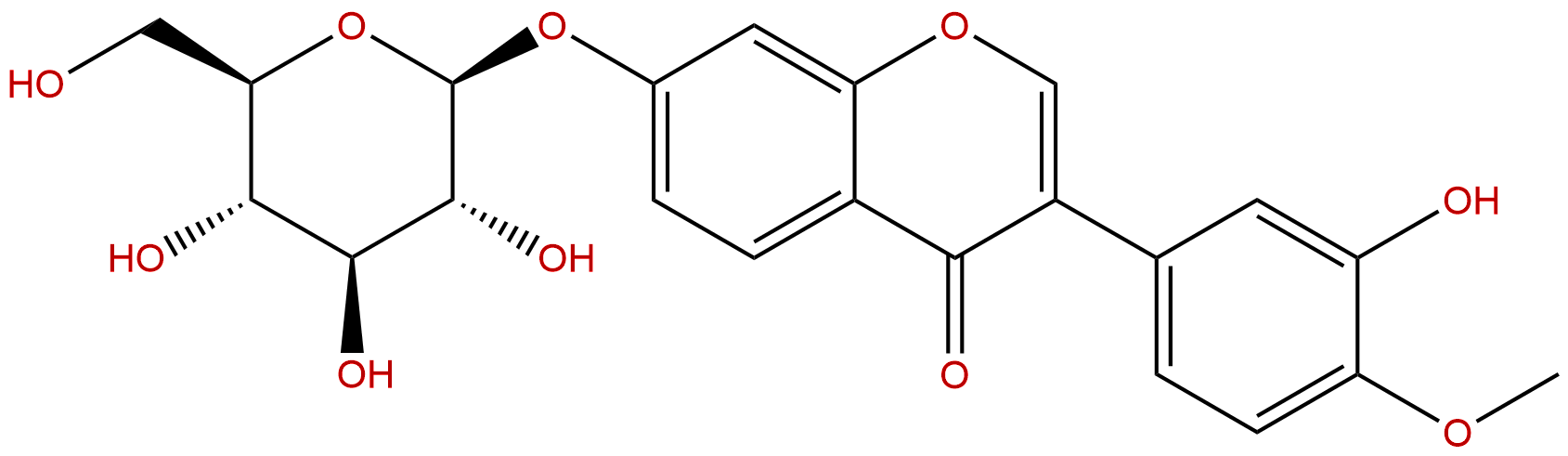


Product name: calycosin-7-O-beta-D-glucoside
Synonym name: Calycosin-7-O-β-D-glucoside; Calycosin 7-glucoside
Catalogue No.: BP0306
Cas No.: 20633-67-4
Formula: C22H22O10
Mol Weight: 446.408
Botanical Source: Baptisia and Thermopsis spp.
Physical Description: Powder
Type of Compound: Flavonoids
Purity: 95%~99%
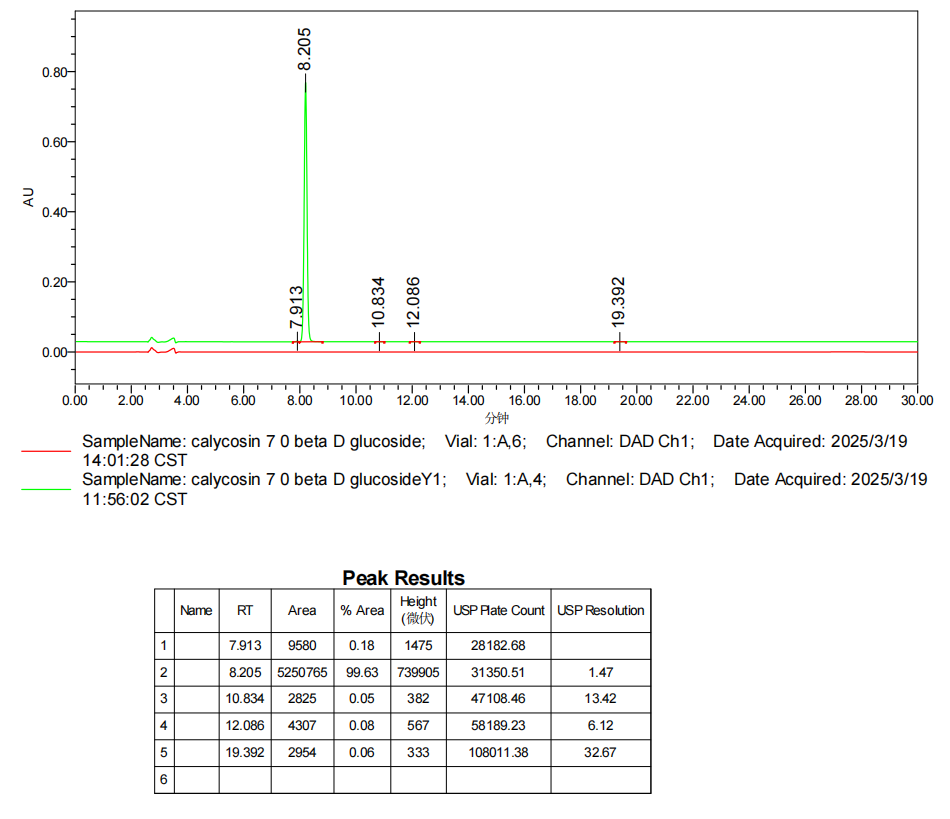
Analysis Method: HPLC-DAD or/and HPLC-ELSD
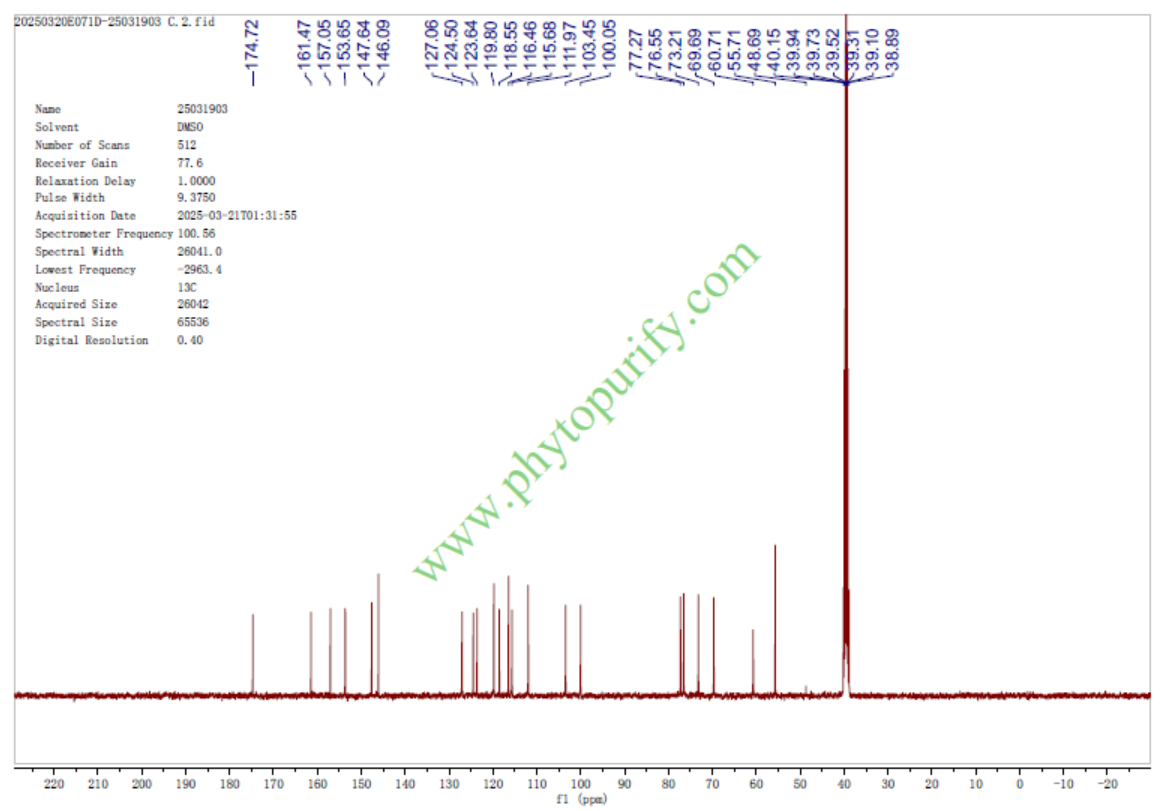
Identification Method: Mass, NMR
Packing: Brown vial or HDPE plastic bottle
Storage: Store in a well closed container, protected from air and light. Put into refrigerate or freeze for long term storage.
Whenever possible, you should prepare and use solutions on the same day. However, if you need to make up stock solutions in advance, we recommend that you store the solution as aliquots in tightly sealed vials at -20℃. Generally, these will be useable for up to two weeks.
The product could be supplied from milligrams to grams, up to kilograms
Inquire for bulk scale.
Descriptions:
Calycosin-7-O-β-d-glucoside(CG) treatment can significantly reduce infarct volume, histological damage and BBB permeability in the in vivo MCAO ischemia–reperfusion rat model; inhibit the expression and activities of MMPs, and secure the expression of cav-1 and tight junction proteins in the microvessels isolated from ischemic rat cortex; scavenge NO, inhibit the activities of MMP-2 and MMP-9, and attenuate cell death in the in vitro cultured brain microvascular endothelial cells under OGD condition; thus CG could protect BBB integrity in experimental cerebral ischemia–reperfusion injury via regulating NO/cav-1/MMPs pathway.[1]
Calycosin-7-O-β-D-glucoside can promote oxidative stress-induced cytoskeleton reorganization through integrin-linked kinase signaling pathway in vascular endothelial cells.[2]
Calycosin-7-O-β-d-glucoside attenuates ischemia-reperfusion injuryin vivovia activation of the PI3K/Akt pathway.[3]
Calycosin-7-O-β-D-glucoside has effects on cell apoptosis in cervical cancer HeLa cells and expression of Bcl-2/Bax.[4]
References:
[1] Fu S, Gu Y, Jiang J Q, et al. J Ethnopharmacol. 2014,155(1): 692–701.
[2] Jiang Y H, Sun W, Li W, et al. Bmc Compl Altern M, 2015, 15(1):1-11.
[3] Ren M, Wang XD, Du G Q, et al. Mol Med Rep, 2015, 13(1):235–45.
[4] Zhang D M. Chinese Traditional & Herbal Drugs, 2015, 46(10):1498-502.
[5] Song C Y, Feng J F. Chinese J Exp Trad Med Formulae, 2013, 19(11):115-7.
HPLC of calycosin-7-O-beta-D-glucoside
NMR of calycosin-7-O-beta-D-glucoside
Storage conditions:Short-term storage at 2~8℃, long-term storage at -20 ~ -80℃
Calycosin-7-O-beta-D-glucoside (hereinafter referred to as Calycosin-7-glucoside), as an important natural glycosylated flavonoid, has attracted widespread attention in the field of natural product pharmacology in recent years. This compound is a derivative formed by modifying the hydroxyl group at position 7 with a β - D-glucopyranose residue glycosidic bond, and has a unique chemical structure and biological activity. Mao Rui Isoflavonol Glycosides are widely present in various traditional Chinese medicinal herbs, especially in traditional medicinal plants such as Astragalus membranaceus, and are one of its main active ingredients. In recent years, with the in-depth study of its pharmacological effects and molecular mechanisms, flavonol glycosides have shown significant potential in antioxidant, anti-inflammatory, immune regulation, and neuroprotection, becoming important candidate molecules for the development of natural medicines.
This article aims to provide a systematic review of the chemical structure and physicochemical properties, plant sources, and extraction methods of flavonol glycosides, with a focus on their pharmacological activity and mechanism of action. Combined with pharmacological evaluation and pharmacokinetic data, it explores their clinical application prospects and development trends, providing theoretical basis and reference for subsequent basic research and drug development.
The molecular formula of Mao Rui Isoflavonol Glycoside is C22H2O_10, with a molecular weight of 446.40. Its structural feature is that the 7-hydroxyl group of flavonoids forms a glycosidic bond through β - D-glucopyranose residues, belonging to the 4 '- methoxy isoflavone class of compounds. This structure endows it with high polarity and water solubility, manifested by a low LogP value (-2.1), reflecting its strong hydrophilicity, which is conducive to absorption and distribution in the body.
The topological polar surface area (TPSA) of Mao Rui Isoflavonol Glycosides is 217.41 Å ², with 10 hydrogen bond acceptors and a large number of hydrogen bond donors. These physicochemical parameters suggest that they have strong hydrophilicity and binding ability in intermolecular interactions. Its structure contains multiple phenolic hydroxyl and methoxy groups, which are important foundations for its antioxidant activity.
From a pharmacokinetic perspective, the blood-brain barrier permeability of quercetin glycosides is relatively low, indicating that their direct effects in the central nervous system may be limited; At the same time, it has no hepatotoxicity, cardiotoxicity, or hERG channel inhibition effect, and the Ames test is negative, showing good safety and low mutagenic risk.
Mao Rui Isoflavonol Glycosides are mainly found in the leguminous plant Astragalus membranaceus and its related species, and are one of the representative isoflavone components in Astragalus membranaceus. Huangqi, as a traditional Chinese medicinal herb, has the effects of tonifying qi, stabilizing the surface, diuresis, and reducing swelling. Its pharmacological effects are closely related to active ingredients such as quercetin glycosides.
The commonly used methods for extracting flavonoid glycosides from pistil include solvent extraction, ultrasound assisted extraction, and high-performance liquid chromatography (HPLC) separation and purification. Generally, methanol or ethanol aqueous solution is used as the extraction agent, combined with ultrasound or reflux extraction technology to improve the extraction efficiency. After concentration, liquid-liquid distribution, and chromatographic separation of the extraction solution, high-purity flavonoid glycosides can be obtained.
In recent years, with the development of green extraction technology, emerging technologies such as supercritical fluid extraction and microwave-assisted extraction have also been applied to the extraction of flavonoid glycosides from pistil, significantly improving extraction efficiency and purity, reducing solvent use and environmental pollution.
Mao Rui Isoflavonol Glycosides have various pharmacological activities, especially outstanding in the field of antioxidant damage. Its main pharmacological effects include:
Antioxidant effect
Mao Rui Isoflavonol Glycosides can effectively eliminate free radicals and alleviate cell damage caused by oxidative stress. Cell and animal experiments have shown that flavonol glycosides significantly reduce reactive oxygen species (ROS) levels and protect cells from oxidative damage by enhancing the activity of antioxidant enzymes such as superoxide dismutase (SOD1, SOD2), catalase (CAT), and glutathione peroxidase (GPX1).
anti-inflammatory effect
Mao Rui Isoflavonol Glycosides can inhibit the release of inflammatory mediators and alleviate inflammatory reactions. It exerts anti-inflammatory effects by regulating the nuclear factor kappa B (NF - κ B) signaling pathway, reducing the expression of pro-inflammatory cytokines such as TNF - α and IL-6.
immunomodulation
Research has shown that flavonol glycosides can enhance the body's immune function, promote macrophage phagocytic activity and lymphocyte proliferation, regulate immune balance, and help resist pathogen infections.
Neuroprotective effect
Despite the low blood-brain barrier permeability of flavonol glycosides, they have a protective effect on nerve cells through antioxidant and anti-inflammatory mechanisms, reducing nerve damage and demonstrating potential value in the prevention and treatment of neurodegenerative diseases.
Cardiovascular protection
Mao Rui Isoflavonol Glycosides have certain cardiovascular protective effects by antioxidant, anti-inflammatory, and improving endothelial function, reducing the risk of cardiovascular disease.
The pharmacological effects of Mao Rui Isoflavonol Glycosides are mainly achieved by regulating intracellular antioxidant and anti-inflammatory signaling pathways. Its key molecular targets include:
NFE2L2/NRF2 (Nuclear factor erythroid 2-related factor 2)
Mao Rui Isoflavonol Glycosides can activate the NRF2 signaling pathway, promote its translocation from the cytoplasm to the nucleus, bind to antioxidant response elements (ARE), upregulate downstream antioxidant enzyme gene expression, such as SOD1, SOD2, CAT, GPX1, and HMOX1 (heme oxygenase 1), enhance cellular antioxidant capacity, and alleviate oxidative stress damage.
Antioxidant enzyme system
Mao Rui Isoflavones regulate the activity of antioxidant enzymes such as SOD, CAT, GPX directly or indirectly, clearing excess reactive oxygen species and protecting cell structure and function.
Anti inflammatory signaling pathway
By inhibiting the expression of NF - κ B and related pro-inflammatory factors, flavonol glycosides alleviate inflammatory responses and protect tissues from inflammation mediated damage.
Regulation of cell apoptosis
Mao Rui Isoflavonol Glycosides can also regulate the expression of Bcl-2 family proteins, inhibit cell apoptosis, and promote cell survival, especially in oxidative stress environments.
In summary, the flavonoid glycosides in pistil achieve a wide range of biological effects through multi-target and multi pathway synergistic effects.
The pharmacological evaluation of Mao Rui Isoflavonol Glycosides shows that they have good safety and ideal pharmacokinetic characteristics:
safety
In vitro and in vivo toxicology studies have shown that flavonol glycosides have no significant hepatotoxicity, cardiotoxicity, or hERG channel inhibition effects. Ames test results are negative, indicating low mutagenic risk and high safety.
pharmacokinetics
Mao Rui Isoflavonol Glycosides have good water solubility, but their high polarity and TPSA limit their oral bioavailability to some extent. Research has shown that quercetin glycosides can be partially hydrolyzed into quercetin in the gastrointestinal tract, which has good lipid solubility and bioavailability, indicating that its metabolic processes in the body have an important impact on the efficacy of the drug.
Blood-brain barrier permeability
Due to the low and high polarity of LogP, the ability of flavonoid glycosides to penetrate the blood-brain barrier is limited, which limits their direct application in central nervous system diseases. However, their metabolites may play a role.
Drug interactions
At present, there is limited research on the interaction between quercetin glycoside and other drugs, and further evaluation of its safety in multi drug combination therapy is needed in the future.
As a natural glycosylated isoflavone, Mao Rui Isoflavonol has broad application prospects in the prevention and treatment of various diseases due to its significant antioxidant and anti-inflammatory activities. Especially in the fields of chronic inflammation, oxidative stress related diseases, such as cardiovascular diseases, neurodegenerative diseases, diabetes and its complications, etc., the calycosin has shown potential therapeutic value.
Future clinical research should focus on the following aspects:
Pharmacodynamics and Formulation Optimization
To address the issue of low oral bioavailability of quercetin glycosides, a new drug delivery system (such as nanocarriers, liposomes, etc.) has been developed to improve their in vivo stability and targeting.
Clinical safety and efficacy evaluation
Conduct systematic clinical trials to clarify the efficacy and safe dosage range of flavonoid glycosides in different diseases, and provide scientific basis for their clinical application.
Research on multi-target mechanism
In depth analysis of the mechanism of action of flavonoids in the cell signaling network, exploration of their potential drug targets, and promotion of the development of precise treatment strategies.
Combination therapy strategy
Explore the synergistic effects of flavonoid glycosides from Scutellaria baicalensis and existing drugs, improve therapeutic efficacy, reduce side effects, and expand their clinical application scope.
As an important natural glycosylated flavonoid, Mao Rui isoflavone glycoside has become a hot topic in natural product pharmacology research due to its unique chemical structure and diverse biological activities. Its significant effects in antioxidant, anti-inflammatory, and immune regulation provide new ideas and potential drug candidate molecules for the prevention and treatment of various chronic diseases. Although its clinical application is still in its early stages, with the optimization of pharmacokinetics and the deepening of mechanism research, flavonol glycosides are expected to become an important direction for the development of natural medicines. In the future, with the combination of modern drug development technology and clinical validation, the medicinal value of flavonol glycosides will be more fully explored and applied.
