


Synonym name:
Catalogue No.: BP0747
Cas No.: 69039-02-7
Formula: C10H12O4
Mol Weight: 196.202
Botanical Source:
Purity: 95%~99%
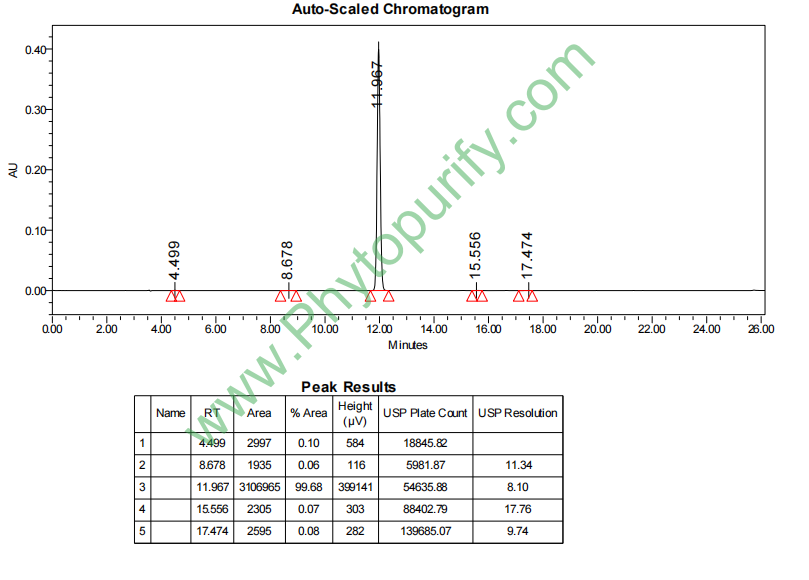
Analysis Method: HPLC-DAD or/and HPLC-ELSD
Identification Method: Mass, NMR
Packing: Brown vial or HDPE plastic bottle
Can be supplied from milligrams to grams.
For Reference Standard and R&D, Not for Human Use Directly.
Inquire for bulk scale.
HPLC of Hydroxytyrosol Acetate
Storage conditions:Short-term storage at 2~8℃, long-term storage at -20 ~ -80℃
66.7600
1.4870
1.4822
6.2397
5.0658
4.2714
High
59.6816
1.9634
Yes
Yes
No
No
Yes
No
0.0
No
No
Yes
Yes
In the field of natural product chemistry and pharmacology research, originating from olives(Olea europaea L. The phenolic compounds in olive oil and its primary product, olive oil, have attracted much attention due to their wide range of biological activities. Among them, hydroxytyrosol (HT), as one of the most important bioactive phenolic substances in olive oil, has been extensively studied and proven to have outstanding potential in antioxidant, anti-inflammatory, neuroprotective, cardiovascular protection, and anti-tumor effects. However, HT itself has certain pharmacological limitations, such as relatively insufficient chemical stability and rapid metabolism in vivo. To overcome these obstacles, prodrug strategies have emerged. Hydroxytyrosol acetate (HT Ac, CAS number: 69039-02-7) is a highly valued HT derivative in this context. As a prodrug of HT, HT Ac is converted into the active form of HT through esterase hydrolysis in vivo, which not only improves the stability and bioavailability of the parent compound, but also inherits its core pharmacological activity. This article aims to systematically review the chemical properties, sources, pharmacological activities, mechanisms of action, pharmacological properties, and application prospects of hydroxytyrosol acetate in various disease models, in order to provide comprehensive academic references for the in-depth research and potential clinical applications of this natural product derivative.
Hydroxytyrosol acetate, chemical name 4- (2-acetoxyethyl) -1,2-benzenediol, is an acetylated derivative of hydroxytyrosol. Its molecular formula is C10H12O4 and its molecular weight is 196.2020. Structurally, HT Ac introduces an acetyl group (- COCH3) on the side chain hydroxyl group of HT, forming an ester bond. This modification significantly altered its physicochemical properties.
Compared with HT, which has stronger hydrophilicity, acetylation increases the hydrophobicity of the molecule. Its calculated lipid water partition coefficient (LogP) is 1.4870, indicating that it has moderate lipophilicity, which may facilitate its penetration of cell membranes and biological barriers. The topological polar surface area (TPSA) is 66.7600 Å ², reflecting the size of the polar regions in the molecule. Its water solubility parameter is 6.2397 (usually expressed in LogS or mg/mL, which needs to be interpreted in conjunction with specific models, but overall indicates that it has a certain but not extremely high water solubility). The optimization of these physicochemical parameters may enable HT Ac to have better membrane permeability and in vivo distribution characteristics while maintaining its biological activity. The introduction of acetyl groups also improves the chemical stability of compounds and reduces the oxidative deactivation of free phenolic hydroxyl groups during storage and in vivo circulation.
Hydroxytyrosol acetate is not the most abundant phenolic substance naturally found in olives, and its main source is the derivative product of hydroxytyrosol. Hydroxytyrosol itself is widely present in olive fruits, olive leaves, and virgin olive oil, especially in the wastewater generated during olive oil production (olive factory wastewater) where the content is relatively high. Therefore, the acquisition of HT Ac mainly occurs through two pathways:
1. Separation and transformation from natural products Firstly, extract crude extracts rich in hydroxytyrosol from olive leaves, olive fruits, or olive factory wastewater. Extraction methods include traditional solvent extraction (such as using methanol, ethanol, or water alcohol mixed systems), ultrasound assisted extraction, microwave-assisted extraction, etc. After obtaining HT, acetylation reaction is carried out by chemical or enzymatic methods to generate HT Ac, which is purified by column chromatography, preparative high-performance liquid chromatography and other techniques.
2. chemical synthesis Using inexpensive and readily available raw materials such as 3,4-dihydroxyphenylacetic acid or tyrosol as starting materials, total synthesis is carried out through multiple chemical reactions (including reduction, acetylation, etc.). The chemical synthesis method can achieve large-scale and standardized production of HT Ac, which is the main way to meet the needs of pharmacological research and potential clinical applications.
It is crucial to conduct rigorous structural identification (such as nuclear magnetic resonance, mass spectrometry analysis) and purity testing on the final product, regardless of the method used, to ensure the reliability and reproducibility of subsequent research.
As a prodrug of hydroxytyrosol, HT Ac exhibits multiple pharmacological activities similar to HT and may be enhanced by pharmacokinetic improvements when converted to HT in vivo. Existing research (mainly based on pharmacological data of HT and direct studies of some HT Ac) has revealed its potential in the following core areas:
Antioxidant and Cellular Protective Activities This is the most classic activity of HT and its derivatives. HT Ac/HT can effectively eliminate various reactive oxygen species (ROS) and reactive nitrogen species (RNS), such as peroxyl radicals, hydroxyl radicals, hydrogen peroxide, and nitric oxide. Its antioxidant capacity is stronger than common antioxidants such as vitamin C and vitamin E. In cell models, HT Ac can significantly alleviate oxidative stress damage induced by toxins such as hydrogen peroxide and beta amyloid, and protect the vitality of various cell types such as neurons, endothelial cells, and cardiomyocytes.
Neuroprotective effect Based on its strong antioxidant and mitochondrial function improving abilities, HT Ac has shown protective effects in various neurodegenerative disease models. Research suggests that it has an improving effect on the toxicity of β - amyloid protein and tau protein hyperphosphorylation in Alzheimer's disease models, as well as dopaminergic neuron damage in Parkinson's disease models. Its high blood-brain barrier permeability (indicated by pharmacological parameters) is a key advantage for its central nervous system protective effect.
Antitumor activity HT Ac/HT showed growth inhibition and apoptosis promoting effects on many cancer cell lines (such as colon cancer, breast cancer, prostate cancer, leukemia cells). Its anti-tumor mechanism is not a single cytotoxicity, but involves inducing cancer cell cycle arrest, activating endogenous and exogenous apoptosis pathways, inhibiting invasion and metastasis, etc. It is worth noting that its toxicity to normal cells is relatively low, showing a certain degree of selectivity.
Cardiovascular protective effect: HT Ac/HT plays an anti atherosclerosis and cardiovascular protective role by protecting low density lipoprotein (LDL) from oxidative modification (which is a key step in the initiation of atherosclerosis), inhibiting vascular endothelial inflammatory reaction, improving vascular relaxation function, inhibiting abnormal platelet aggregation and other multiple ways.
Anti inflammatory and immune regulation HT Ac/HT can downregulate the expression of key inflammatory mediators such as nuclear factor kappa B (NF - κ B), cyclooxygenase-2 (COX-2), and inducible nitric oxide synthase (iNOS), reduce the release of pro-inflammatory cytokines (such as TNF - α, IL-1 β, IL-6), and exhibit anti-inflammatory effects in chronic inflammation related disease models (such as colitis and metabolic inflammation).
Antibacterial and antiviral activity Research has shown that HT has inhibitory effects on various foodborne pathogens such as Staphylococcus aureus, Escherichia coli, Listeria monocytogenes, as well as certain viruses such as rotavirus and respiratory syncytial virus. HT Ac, as a prodrug, may also have similar anti infective potential.
metabolic regulation In the research model of diabetes and its complications, HT Ac/HT shows beneficial effects such as improving insulin sensitivity, reducing blood sugar, alleviating the formation of advanced glycation end products (AGEs), and protecting pancreatic β cells.
The biological effects of hydroxytyrosol acetate are mainly mediated by the active molecule hydroxytyrosol released after hydrolysis in vivo. The mechanism of action of HT is complex and multi-target, with its core being the regulation of intracellular redox balance and signal transduction pathways.
Activate antioxidant response element (ARE)/Nrf2 pathway This is the central mechanism by which HT exerts antioxidant and cell protective effects. Under oxidative stress, HT promotes the dissociation of nuclear factor E2 related factor 2 (Nrf2, encoded by NFE2L2 gene) from cytoplasmic chaperone Keap1, causing Nrf2 to translocate to the nucleus. In the nucleus, Nrf2 binds to ARE, initiating the transcriptional expression of a series of phase II detoxifying enzymes and antioxidant proteins. The relevant targets include:
Regulating mitochondrial function HT can directly or indirectly improve the efficiency of mitochondrial electron transport chain, reduce the excessive production of ROS caused by electron leakage, stabilize mitochondrial membrane potential, prevent abnormal opening of mitochondrial permeability transition pore (mPTP), and thus inhibit the mitochondrial pathway of cell apoptosis.
Inducing apoptosis of tumor cells Its pro apoptotic effect is related to the induction of ROS production (a "dual effect" that causes oxidative stress in cancer cells), activation of caspase cascade reaction, regulation of Bcl-2 family proteins (upregulation of pro apoptotic Bax/Bak and downregulation of anti apoptotic Bcl-2/Bcl xL), and inhibition of survival signaling pathways such as PI3K/Akt and MAPK.
Inhibition of inflammatory signaling pathway Mainly achieved by inhibiting the activation of NF - κ B. HT can prevent the phosphorylation and degradation of I κ B protein, thereby inhibiting the nuclear translocation of NF - κ B p65 subunit and the transcription of downstream inflammatory genes.
Other targets and pathways This also includes regulating SIRT1 deacetylase activity, affecting AMPK energy metabolism sensing pathway, etc., all of which are closely related to their protective effects in metabolic diseases and age-related diseases.
Based on the provided pharmacological parameters and existing research, the preliminary evaluation of the pharmacological properties of hydroxytyrosol acetate is as follows:
Pharmacokinetic aspects, As a prodrug, HT Ac's core advantage lies in improving bioavailability. After oral administration, HT Ac is relatively stable in the gastrointestinal tract, and its absorption efficiency may be higher than that of free HT. After absorption into the bloodstream, HT Ac can be distributed to various tissues and hydrolyzed by esterases (such as acetylcholinesterase and carboxylesterase) in the blood and tissues during this process, releasing active HT. This "prodrug active drug" conversion mode can prolong the action time of HT in the body, provide more sustained blood drug concentration, and may achieve better target tissue distribution. The final metabolic pathways of HT mainly involve methylation, sulfation, and glucuronidation, and the metabolites are mainly excreted through urine. At present, further in vivo experiments (especially preclinical animal experiments) are needed to accurately elucidate the pharmacokinetic parameters of HT Ac, such as absolute bioavailability, half-life, and tissue distribution specificity.
Hydroxytyrosol acetate combines multiple biological activities and improved drug properties, showing broad clinical application prospects in multiple disease fields:
However, pushing it from the laboratory to clinical practice still faces challenges and future research directions:
* In depth study on the mechanism of action It is necessary to systematically validate the specific therapeutic effects of HT Ac in more complex disease animal models and organoid models, and fully reveal its network of action using omics techniques (proteomics, metabolomics).
* Formulation development To improve its stability and targeting, nanocarrier systems (such as liposomes, polymer nanoparticles) can be explored or other more efficient prodrug derivatives can be developed.
* Preclinical safety evaluation of the system Complete comprehensive GLP toxicology studies, including long-term toxicity, reproductive toxicity, carcinogenicity, etc.
* Clinical trial advancement Design and conduct rigorous clinical trials from Phase I to Phase III to confirm its safety, efficacy, and optimal dosing regimen in humans.
* Source and Sustainability Ensure stable and sustainable supply of raw materials (olive by-products), or optimize chemical synthesis processes to reduce costs.
Hydroxytyrosol acetate, as an innovative prodrug of the natural active molecule hydroxytyrosol, has successfully overcome some limitations of the parent compound in terms of stability and bioavailability while retaining or even enhancing its broad pharmacological activity. Its excellent antioxidant, anti-inflammatory, neuroprotective, cardiovascular protective, and anti-tumor effects are rooted in its precise regulation of key cellular signaling pathways such as Nrf2/ARE. The excellent preliminary drug parameters, especially high blood-brain barrier permeability and good safety warning, have laid a solid foundation for its application in major chronic diseases such as neurodegenerative diseases. Although there is still a long way to go from basic research to clinical translation, with the continuous elucidation of the mechanism of action, innovation in formulation technology, and gradual deepening of clinical research, hydroxytyrosol acetate is expected to develop from a highly anticipated natural product derivative into a new type of drug or functional ingredient for the prevention and treatment of various human diseases, bringing new hope to human health.
