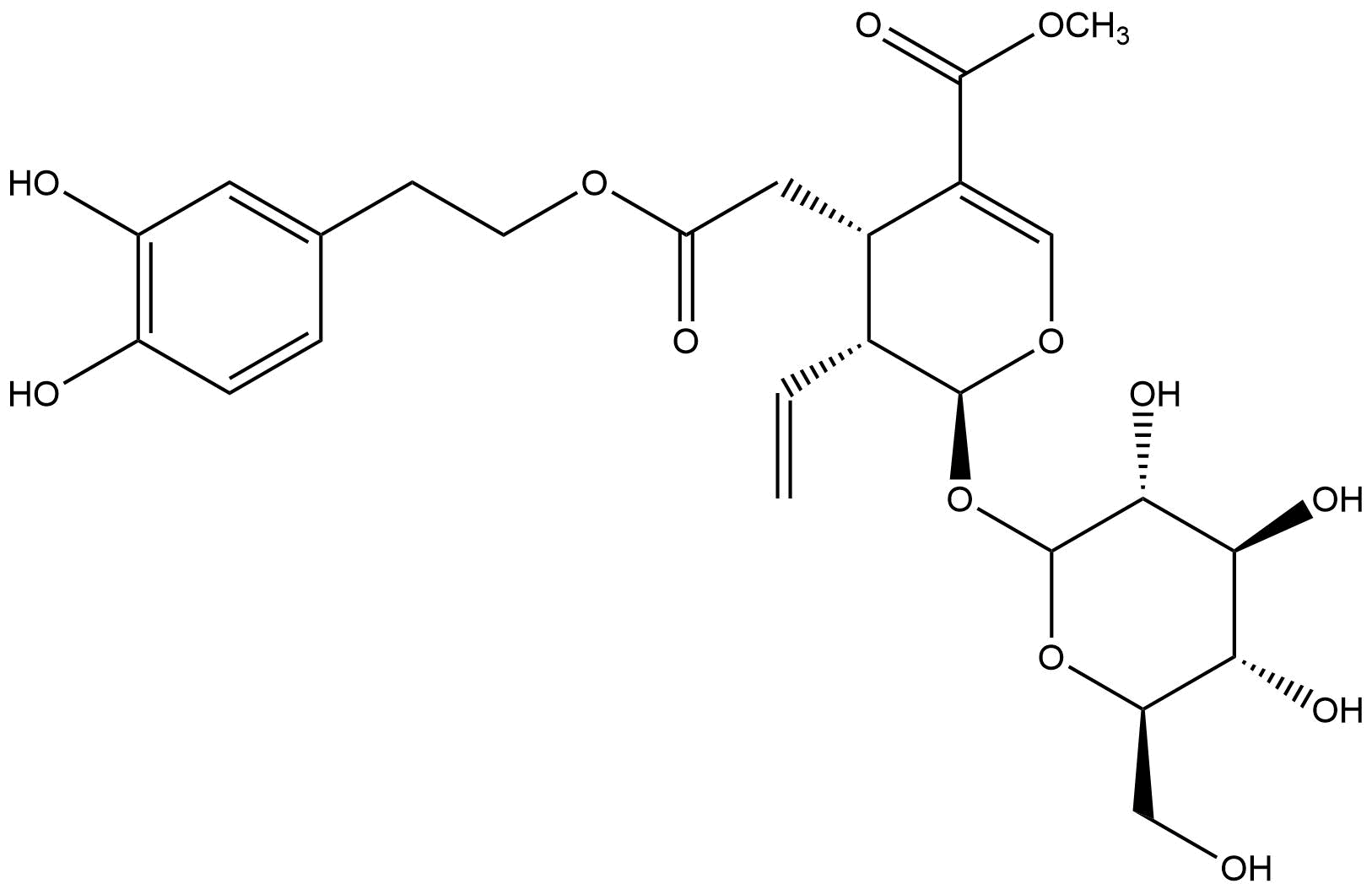


Product name: Oleuroside
Synonym name:
Catalogue No.: BP2059
Cas No.: 116383-31-4
Formula: C25H32O13
Mol Weight: 540.518
Botanical Source:
Type of Compound:
Purity: 95%~99%
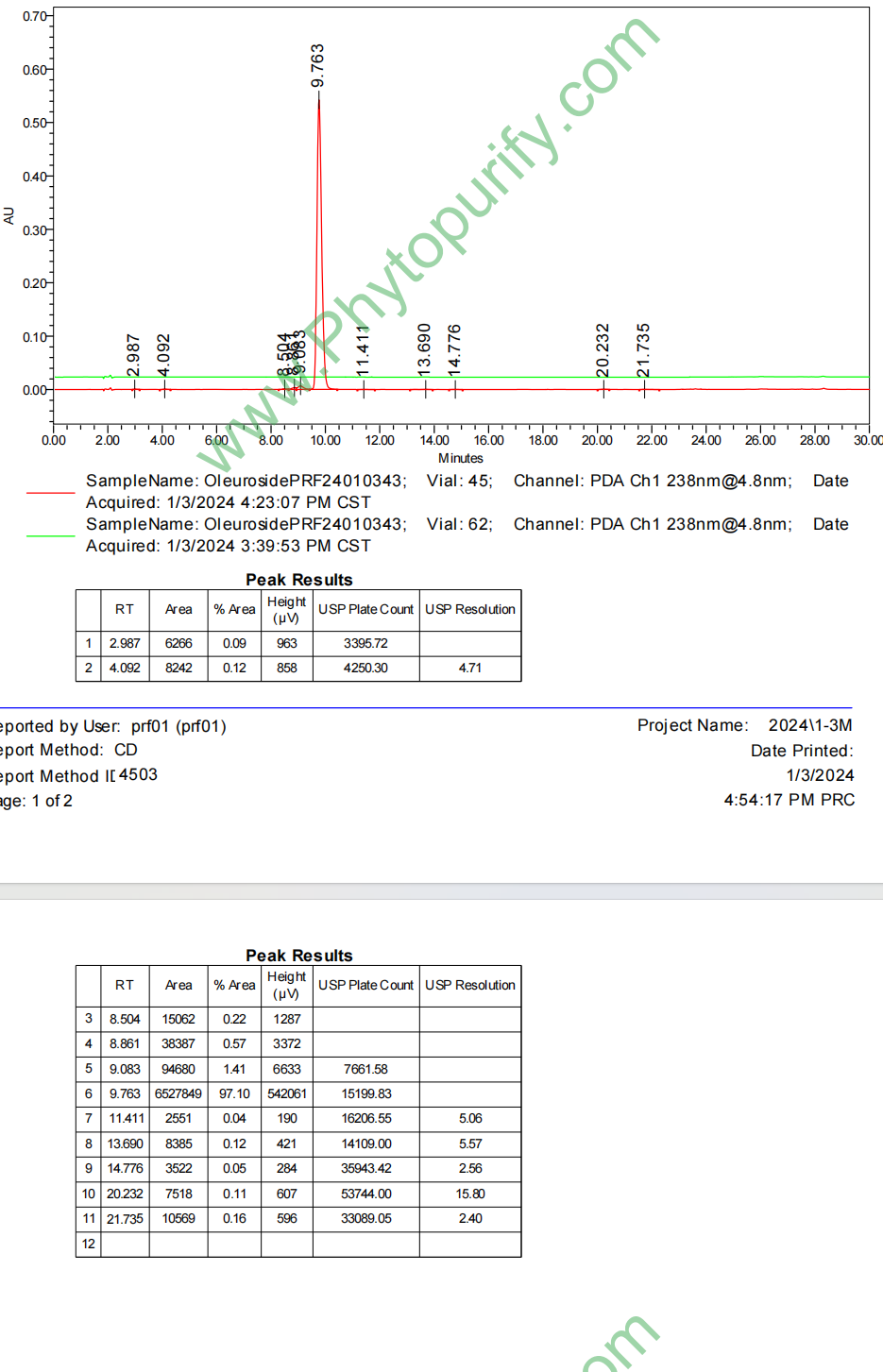
Analysis Method: HPLC-DAD or/and HPLC-ELSD
Identification Method: Mass, NMR
Packing: Brown vial or HDPE plastic bottle
Storage: Store in a well closed container, protected from air and light. Put into refrigerate or freeze for long term storage.
Whenever possible, you should prepare and use solutions on the same day. However, if you need to make up stock solutions in advance, we recommend that you store the solution as aliquots in tightly sealed vials at -20℃. Generally, these will be useable for up to two weeks.
The product could be supplied from milligrams to grams
Inquire for bulk scale.
Chengdu Biopurify Phytochemicals Ltd. is a leading company in the research, development, manufacture and marketing of High Quality Phytochemicals and Extracts(especially Active Ingredients from Traditional Chinese Medicine,TCM), Natural Active Pharmaceutical Ingredients worldwide.
The main services:
A. Supply active ingredients and reference standards of TCM, from mgs to kgs scale
B. Custom extraction and purification, target Herb Active Ingredients
C. Custom synthesis and semi-synthesis for Natural Active Ingredients
D. CR(contract research), CM(contract manufacture) and PD(process development) services from lab scale, pilot scale to commercial scale(GMP is also available)
E. TCM compounds library for drug screen,more than 3000 compounds available, many of them are rare and unique.
HPLC of Oleuroside
Storage conditions:Short-term storage at 2~8℃, long-term storage at -20 ~ -80℃
201.6700
-.2411
-.2435
10.5334
.5179
.2575
Low
68.5370
4.6571
No
No
No
No
Yes
No
0.0
Yes
No
Yes
No
With the aggravation of global population aging, the incidence rate of neurodegenerative diseases, especially Alzheimer's disease (AD) and brain aging related diseases continues to rise, becoming a major challenge in the field of public health. Although traditional medication can alleviate symptoms, it is difficult to fundamentally prevent disease progression, and there is an urgent need to find new treatment strategies. Natural products, as an important source of drug discovery, have received widespread attention in the fields of neuroprotection and prevention and treatment of cardiovascular and cerebrovascular diseases in recent years due to their structural diversity and biological activity.
Oleuroside is a phenolic allicin compound found in olives (Olea europaea), which has attracted the interest of researchers due to its unique chemical structure and significant biological activity. Previous studies have shown that Oleuroside can effectively prevent mitochondrial dysfunction in early Alzheimer's disease and brain aging models, demonstrating good neuroprotective potential. In addition, Oleuroside has shown certain regulatory effects on cardiovascular disease-related targets such as hypertension, indicating its potential applications in various chronic diseases.
This article will provide a systematic review of the chemical structure and physicochemical properties of Oleuroside, plant sources and extraction methods, pharmacological activity and mechanism of action, drug evaluation and pharmacokinetic characteristics, with a focus on exploring its potential application value in neurodegenerative diseases and hypertension. The aim is to provide a theoretical basis and research direction for further research and clinical translation of Oleuroside.
Oleuroside (CAS number: 116383-31-4) is a phenolic allicin compound with the molecular formula C25H32O13 and a molecular weight of 540.5180. Its structure contains multiple hydroxyl and ester groups, with high polarity and abundant redox active sites. The LogP value of Oleuroside is -0.2411, indicating its strong hydrophilicity. The TPSA (topological polar surface area) is 201.6700, indicating that the molecular polarity is high and may affect its cell membrane permeability and bioavailability.
The water solubility of Oleuroside is 10.5334 mg/mL, indicating good water solubility, which is beneficial for its absorption and distribution in vivo. The low permeability of the blood-brain barrier (BBB) suggests its limited ability to pass through the BBB, but this does not rule out its neuroprotective effect through indirect mechanisms. The hERG channel inhibition experiment showed that Oleuroside had no significant risk of cardiac toxicity, and the Ames test result was 0.0, indicating that it had no significant mutagenicity and high safety.
The chemical structural characteristics of Oleuroside endow it with strong antioxidant and anti-inflammatory activities, which are closely related to its potential roles in neuroprotection and prevention and treatment of cardiovascular diseases. Its multi hydroxyl structure helps to eliminate free radicals, alleviate oxidative stress, and protect cellular mitochondrial function.
Oleuroside is mainly present in the leaves and fruits of olives (Olea europaea) and is an important component of olivine phenolic compounds. Olive, as a traditional economic crop in the Mediterranean region, contains abundant polyphenolic substances in its leaves and fruits. Oleuroside, as a representative compound, has significant biological activity.
The extraction of Oleuroside is usually carried out using organic solvent extraction combined with column chromatography separation technology. The specific steps include:
In recent years, ultrasound assisted extraction and microwave-assisted extraction techniques have also been applied to the extraction of Oleuroside, improving extraction efficiency and purity, reducing solvent usage and extraction time, and having good industrial application potential.
Oleuroside's research in neurodegenerative disease models has shown significant neuroprotective effects. Especially in the early stages of Alzheimer's disease and brain aging models, Oleuroside can effectively prevent mitochondrial dysfunction, alleviate neuronal oxidative stress and inflammatory response, and protect neuronal survival.
Related in vitro studies have shown that Oleuroside can reduce the cytotoxicity induced by β - amyloid protein (A β), inhibit the expression of neuroinflammatory factors such as TNF - α and IL-1 β, and promote the recovery of mitochondrial respiratory chain function in neurons. In addition, Oleuroside enhances cellular antioxidant capacity and reduces oxidative damage by regulating the activity of intracellular antioxidant enzymes such as superoxide dismutase (SOD) and glutathione peroxidase (GPx).
The mechanism of action of Oleuroside in hypertension and related cardiovascular diseases is gradually being revealed. It mainly achieves blood pressure regulation and vascular protection by regulating multiple key targets, including:
In animal experiments, Oleuroside significantly reduced systolic and diastolic blood pressure in hypertensive model animals, improved endothelial function, inhibited vascular remodeling and inflammatory response, and demonstrated good cardiovascular protective effects.
The multi hydroxyl structure of Oleuroside endows it with strong antioxidant capacity, capable of clearing free radicals and reducing oxidative stress damage to cells. Meanwhile, Oleuroside exerts anti-inflammatory effects by inhibiting inflammatory signaling pathways such as NF - κ B, reducing the expression of pro-inflammatory factors. These effects not only contribute to the prevention and treatment of neurological diseases, but also have a positive impact on the pathological process of cardiovascular diseases.
The pharmacological mechanism of Oleuroside mainly involves multiple signaling pathways and molecular targets, including:
Mitochondrial function protection
Oleuroside enhances the activity of mitochondrial respiratory chain complexes, maintains mitochondrial membrane potential, reduces mitochondrial ROS generation, and prevents cell apoptosis. Its protection of mitochondrial function is a key mechanism for preventing Alzheimer's disease and brain aging.
anti-oxidative stress
Oleuroside activates the Nrf2/ARE signaling pathway, promotes the expression of antioxidant enzymes, enhances the ability of cells to clear free radicals, and reduces oxidative damage.
anti-inflammatory effect
Oleuroside inhibits the NF - κ B signaling pathway, reduces the expression of pro-inflammatory cytokines (such as TNF - α, IL-6, IL-1 β) and adhesion molecule (ICAM1), and alleviates inflammatory responses.
Regulating vascular function related targets
ADRA2A Regulating sympathetic nervous system activity, affecting heart rate and blood pressure.
Neural protection related signaling pathways
Oleuroside promotes neuronal survival and functional recovery by regulating signaling pathways such as PI3K/Akt and MAPK.
In summary, Oleuroside exerts its comprehensive neuroprotective and cardiovascular protective effects through multi-target and multi pathway synergistic effects.
The pharmacological parameters of Oleuroside indicate that it has certain potential for drug development:
At present, there is limited research on the pharmacokinetics (PK) of Oleuroside. Preliminary in vivo experiments have shown that Oleuroside is absorbed quickly after oral administration, but its bioavailability is limited, which may be related to its polarity and molecular weight. Its metabolism is mainly through the liver enzyme system, and the metabolites need further identification. The main excretion pathways are renal and biliary excretion.
Future research should focus on the pharmacokinetic optimization of Oleuroside, including structural modification, nanocarrier encapsulation, and other methods to improve its oral bioavailability and brain distribution.
Oleuroside, as a natural phenolic compound, exhibits broad clinical application prospects due to its dual activities of neuroprotection and cardiovascular protection
Prevention and treatment of Alzheimer's disease and brain aging
By improving mitochondrial function, antioxidant and anti-inflammatory properties, Oleuroside has the potential to become an intervention for early neurodegenerative diseases, delaying cognitive decline. It has high safety, is suitable for long-term use, and is suitable for the elderly population.
Adjuvant therapy for hypertension and cardiovascular disease
Oleuroside regulates multiple blood pressure related targets, has antihypertensive and vascular protective effects, and can be used as an adjuvant medication for hypertensive patients, especially suitable for patients with oxidative stress and inflammatory states.
Potential for combination therapy
Oleuroside can be used in combination with existing anti Alzheimer's or antihypertensive drugs to achieve synergistic effects, reduce monotherapy doses, and minimize side effects.
Development of functional foods and health products
Due to its natural origin and good safety, Oleuroside is suitable for development as a functional food or health supplement to promote healthy aging.
Future research should focus on addressing the pharmacokinetic limitations of Oleuroside, conducting systematic preclinical safety evaluations and clinical trials to validate its efficacy and safety. Meanwhile, exploring its structural optimization and dosage form innovation to enhance its clinical application value.
Oleuroside, as an important phenolic allicin in olives, has a unique structure and significant biological activity. Numerous studies have confirmed its mitochondrial protective role in preventing early Alzheimer's disease and brain aging models, as well as its multi-target regulatory potential in cardiovascular diseases such as hypertension. Its excellent safety and multiple pharmacological mechanisms make it a highly valuable candidate molecule for development in the field of natural product pharmacology.
Although the pharmacokinetics and clinical research of Oleuroside are still in the preliminary stage, with the development of extraction and purification technology and drug delivery systems, Oleuroside is expected to play an important role in the prevention and treatment of neurodegenerative and cardiovascular diseases. In the future, it is necessary to strengthen the in-depth analysis of its mechanism of action, optimize its drug properties, promote its clinical translation, and provide new ideas and examples for the development of natural product drugs.
