


Synonym name: 3,4-dihydroxyphenylethanol; Dopaol
Catalogue No.: BP0746
Cas No.: 10597-60-1
Formula: C8H10O3
Mol Weight: 154.165
Botanical Source: Present in olives. Reported from Lian Qiao (Syringa spp.)
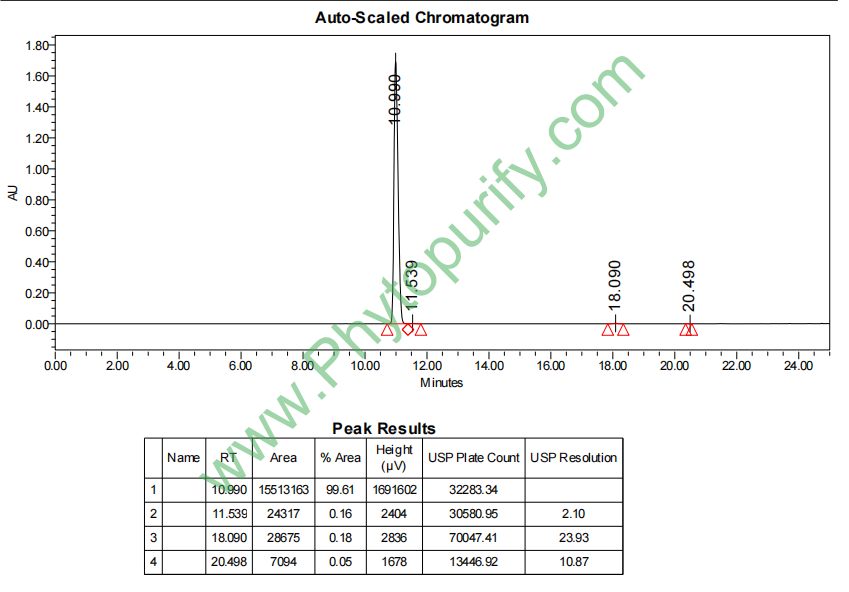
Purity: 95%~99%
Analysis Method: HPLC-DAD or/and HPLC-ELSD
Identification Method: Mass, NMR
Packing: Brown vial or HDPE plastic bottle
Can be supplied from milligrams to grams.
For Reference Standard and R&D, Not for Human Use Directly.
Inquire for bulk scale.
Description:
2-(3,4-Dihydroxyphenyl)ethanol has antioxidant properties; it is a potent specific inhibitor of lipoxygenase activities, it inhibits platelet 12-LO activity (IC50, 4.2 microM) and PMNL 5-LO activity (IC50, 13 microM) but not cyclooxygenase activity in cell-free conditions; it also inhibits 12-LO activity in intact platelets (IC50, 50 microM) and reduces leukotriene B4 production in intact PMNL stimulated by A23187 (IC50, 26 microM).
References:
Drug Chem Toxicol. 2014 Oct;37(4):420-6.Antioxidant role of hydroxytyrosol on oxidative stress in cadmium-intoxicated rats: different effect in spleen and testes.
Hydroxytyrosol (2-(3,4-Dihydroxyphenyl)ethanol, (DPE), a phenolic compound present in olive oil, is known to have antioxidant properties.
METHODS AND RESULTS:
The aim of this study was to investigate the effect of DPE on oxidative stress induced by cadmium injections (CdCl2 2.5 mg/kg body weight) in spleen and testes of adult male rats. Oxidative stress was evaluated by measuring lipid peroxidation by thiobarbituric acid reactive substances (TBARS) as well as superoxide dismutase (SOD) and catalase (CAT) activities in cytosol and mitochondria. We found that in spleen no TBARS formation was detected following CdCl2 injections; however, DPE induces decrease in TBARS level in treated and untreated rats. On the contrary, we observed that DPE showed no effect on cadmium-induced lipid peroxidation in testes. Cytosolic activities of SOD and CAT decreased significantly only in spleen, where DPE restores the values to the control levels. Noteworthy, mitochondrial activities of SOD and CAT were strongly reduced by cadmium treatment both in spleen and testes, and DPE was not be able to restore their activity.
CONCLUSIONS:
Overall, the results from this study indicated that the DPE has different antioxidant efficiency in spleen and testis of cadmium intoxicated rats.
HPLC of Hydroxytyrosol
Storage conditions:Short-term storage at 2~8℃, long-term storage at -20 ~ -80℃
Hydroxytyrosol (DOPET, CAS number: 10597-60-1) is a phenolic compound naturally present in olive oil. Due to its excellent biological activity and diverse pharmacological effects, it has attracted widespread attention in the field of natural product pharmacology in recent years. As one of the main phenolic antioxidants in olive oil, hydroxytyrosol not only plays an important role in delaying the oxidative deterioration of olive oil, but also has been widely studied for its significant antioxidant, anti-inflammatory, neuroprotective, and anti-tumor activities. Hydroxytyrosol has shown potential therapeutic value for various diseases, including cancer, metabolic disorders, neurodegenerative diseases, and cardiovascular diseases, by regulating oxidative stress, mitochondrial function, and multiple cellular signaling pathways.
This article aims to systematically review the chemical structure and physicochemical properties, plant sources, and extraction methods of hydroxytyrosol, deeply explore its pharmacological activity and mechanism of action, evaluate its pharmacological properties and pharmacokinetic characteristics, and prospect its potential and challenges in clinical applications, providing theoretical basis and reference for subsequent basic research and clinical translation.
The chemical name of hydroxytyrosol is 2- (3,4-dihydroxyphenyl) ethanol, with the molecular formula C8H10O3 and a molecular weight of 154.1650. Its structural features include two adjacent hydroxyl groups on a benzene ring (ortho diphenol structure) and one side chain ethanol group. The catechol structure endows hydroxytyrosol with strong free radical scavenging ability, which is the molecular basis of its antioxidant activity.
In terms of physical and chemical properties, the LogP value of hydroxytyrosol is approximately 0.7583, indicating its moderate lipophilicity, which facilitates membrane penetration. The polar surface area (TPSA) is 60.69 Å ², indicating good water solubility (approximately 27.94 mg/mL) and easy passage through the blood-brain barrier (BBB), providing a molecular basis for its neuroprotective effect. Hydroxytyrosol does not inhibit hERG channels, and the Ames test result is 0, indicating its high safety and no significant genetic toxicity risk.
Hydroxytyrosol is mainly found in the fruits of olive trees (Olea europaea L.) and olive oil, especially in high levels in extra virgin olive oil. Its content is significantly affected by factors such as olive variety, maturity, harvesting time, and processing technology. In addition to olives, small amounts of hydroxytyrosol are also present in some other plants, but olive oil remains the most important and economical natural source.
There are various extraction methods, traditionally using solvent extraction combined with liquid-liquid extraction technology to separate hydroxytyrosol from olive fruit or olive oil. In recent years, green and efficient methods such as supercritical CO2 extraction, ultrasound assisted extraction, and membrane separation technology have gradually been applied to the extraction and purification of hydroxytyrosol, significantly improving yield and purity, reducing solvent residue and environmental pollution. The purification steps typically involve liquid chromatography (such as high-performance liquid chromatography (HPLC)) separation to ensure the acquisition of high-purity hydroxytyrosol for pharmacological research.
Hydroxytyrosol is known for its strong antioxidant capacity, which can effectively eliminate free radicals and alleviate oxidative stress damage. Numerous in vitro and in vivo studies have shown that hydroxytyrosol activates the nuclear factor E2 related factor 2 (NFE2L2/NRF2) signaling pathway, inducing the expression of downstream antioxidant enzymes such as superoxide dismutase (SOD1, SOD2), catalase (CAT), glutathione peroxidase (GPX1), and heme oxygenase 1 (HMOX1), thereby enhancing cellular antioxidant defense capabilities. This mechanism is particularly critical in neuronal protection, as it can improve mitochondrial function, inhibit neuronal apoptosis, and slow down the progression of neurodegenerative diseases such as Alzheimer's disease.
Hydroxytyrosol exhibits significant anti-tumor activity in various cancer models. Its mechanism of action is complex, including inducing cancer cell apoptosis, inhibiting proliferation and migration. Hydroxytyrosol can induce the production of reactive oxygen species (ROS), activate mitochondrial mediated apoptosis, and regulate multiple signaling pathways such as NF - κ B, PI3K/Akt, and MAPK, thereby inhibiting the survival and invasion ability of tumor cells. Especially in digestive system tumors such as colon cancer, hydroxytyrosol shows good anti-cancer potential.
Research has shown that hydroxytyrosol has broad-spectrum antibacterial activity and can inhibit the growth of various Gram positive and negative bacteria, including common pathogenic bacteria such as Staphylococcus aureus and Escherichia coli. In addition, hydroxytyrosol also exhibits inhibitory effects on certain viruses such as influenza virus and herpes simplex virus, possibly by disrupting the virus envelope or interfering with the virus replication process.
Hydroxytyrosol can inhibit the release of inflammatory mediators and reduce inflammatory reactions. It reduces tissue inflammatory damage by downregulating pro-inflammatory cytokines (such as TNF - α, IL-6, IL-1 β) and inhibiting the NF - κ B signaling pathway. Meanwhile, hydroxytyrosol regulates immune cell function, enhances the body's immune defense, and demonstrates potential application value in immune related diseases.
Hydroxytyrosol has a positive effect on metabolic diseases such as diabetes, which can improve insulin sensitivity and reduce blood sugar and lipid levels. Its cardiovascular protective effects are mainly reflected in antioxidant, anti-inflammatory and improving endothelial function, inhibiting the occurrence and development of atherosclerosis, and reducing the risk of cardiovascular events.
The multi-target mechanism of action of hydroxytyrosol is the basis for its broad pharmacological activity. The main molecular targets and signaling pathways include:
Hydroxytyrosol has excellent drug properties, moderate molecular weight (154.1650), and a LogP value of 0.7583, indicating a good balance between lipid solubility and water solubility, which is beneficial for bioavailability. The TPSA is 60.69 Å ², indicating that its molecular polarity is moderate and it can penetrate the blood-brain barrier, supporting its neuroprotective effect. In terms of safety, hydroxytyrosol has no significant hERG channel inhibitory effect and the Ames test is negative, indicating a low risk of genetic toxicity.
Pharmacokinetic studies have shown that hydroxytyrosol has good oral absorption, moderate plasma half-life, wide distribution in the body, and particularly high accumulation in brain tissue. Its metabolism is mainly through hepatic phenolic hydroxylation and glucuronic acid binding, and the metabolites have good safety. The excretion of hydroxytyrosol is mainly completed through urine, with a high renal clearance rate.
However, hydroxytyrosol has poor stability in vivo and is easily degraded by metabolic enzymes, which limits its bioavailability and therapeutic efficacy. Therefore, strategies such as nanocarriers, liposomes, and structural modifications have been proposed to improve their pharmacokinetic properties.
Hydroxytyrosol, as a multifunctional natural product, has broad clinical application potential. It has increasingly significant therapeutic value in neurodegenerative diseases (such as Alzheimer's disease), cancer (especially colon cancer), metabolic syndrome (diabetes), cardiovascular diseases and infectious diseases. Currently, hydroxytyrosol has entered some preclinical studies and preliminary clinical trials, demonstrating good safety and efficacy.
Future research should focus on:
Hydroxytyrosol, as an important phenolic component in olive oil, has shown broad pharmacological application prospects due to its excellent antioxidant, anti-inflammatory, neuroprotective, and anti-tumor activities. Its multi-target and multi mechanism mode of action provides a valuable example for the pharmacological research of natural products. Despite challenges such as bioavailability and in vivo stability, with the development of drug delivery technology and structural optimization strategies, hydroxytyrosol is expected to become a new natural drug for the prevention and treatment of various diseases. The pharmacology, pharmacokinetics, and clinical research of future systems will lay a solid foundation for their clinical translation and promote their application and development in modern medicine.
