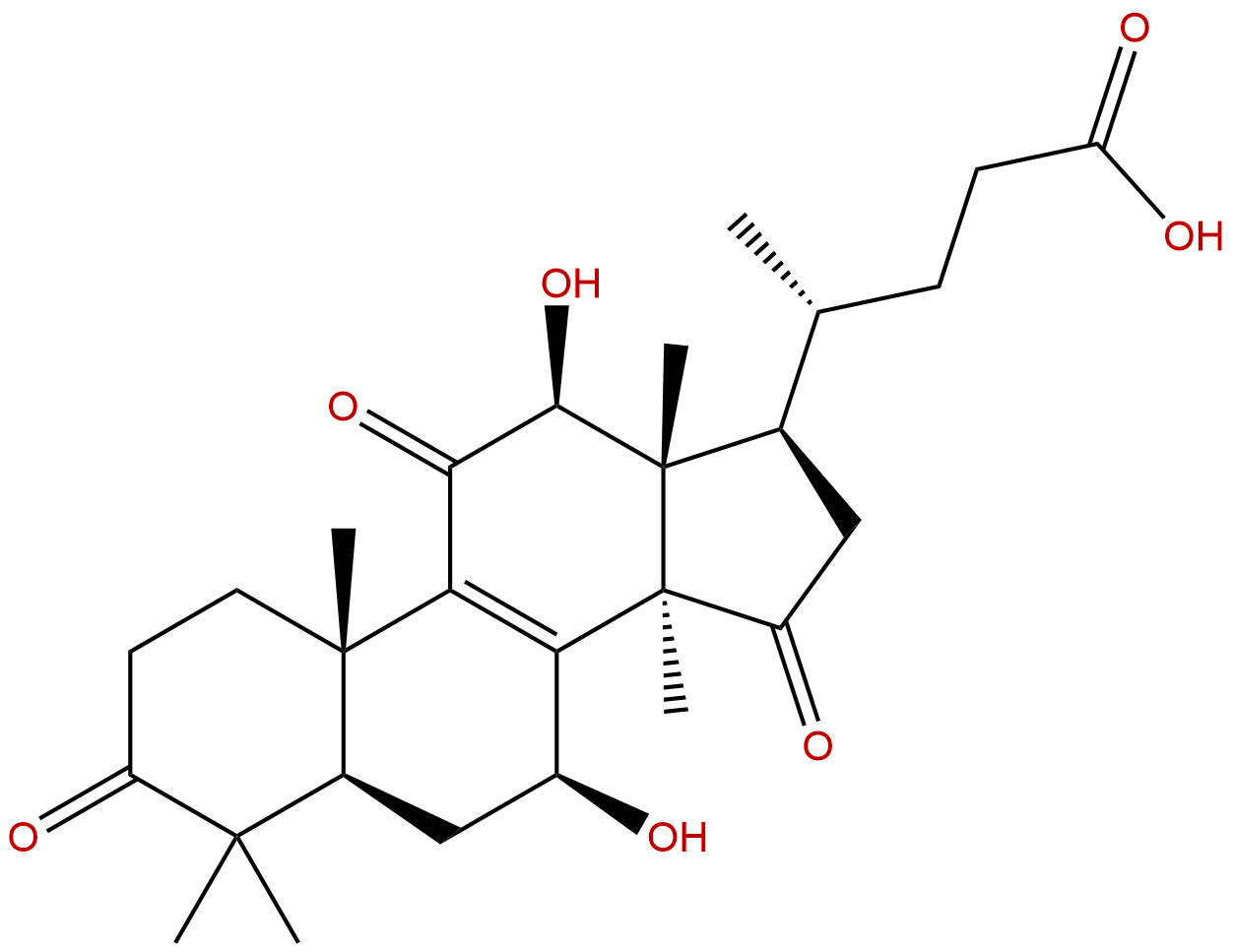
Chizhi Acid B: Natural Molecular Exploration of Anti inflammatory and Anti tumor Properties Derived from Ganoderma lucidum
1. Overview
Lucidian acid B, CAS number 95311-95-8, is a traditional medicinal fungus derived from Ganoderma lucidum(Ganoderma lucidum)Important triterpenoid natural products obtained through separation. Its molecular formula is C27H38O7 and its molecular weight is 474.5940 g/mol. As one of the representative bioactive components in Ganoderma lucidum, gibberellic acid B has long been widely studied by researchers in natural product pharmacology and tumor pharmacology.
Modern pharmacological studies have shown that gibberellic acid B exhibits multiple biological activities, with its core role concentrated in antitumor and anti-inflammatory Two major areas. In terms of anti-tumor effects, it can selectively induce apoptosis in various tumor cells (such as human leukemia cells and liver cancer cells) through mitochondrial mediated pathways, while inhibiting tumor cell invasion and metastasis. In the field of anti-inflammatory, the latest research has revealed its potential therapeutic value for severe inflammatory diseases such as sepsis, involving the regulation of key inflammatory signaling pathways such as Toll like receptor 4 (TLR4) and NLRP3 inflammasome. These findings make gibberellic acid B not only a promising anti-tumor lead compound, but also an important tool molecule for studying the molecular mechanisms of inflammatory diseases. This article will comprehensively analyze its chemical essence, sources, pharmacological mechanisms, drug properties, and future prospects.
2. Chemical structure and physicochemical properties
Gibberellic acid B belongs to the highly oxidized lanostane triterpenoid acid. Its SMILES structural formula (C C@H[C@H]1CC(=O)[C@@]2(C)C3=C(C(=O)C@@H[C @] 12C) [C @ @] 1 (C) CCC (=O) C (C) (C) [C @ @ H] 1C [C @ @ H] 3O) reveals its complex multi ring skeleton and rich functional groups, including multiple chiral centers, carboxyl groups, ketone groups, and hydroxyl groups. This complex stereochemical structure is the material basis for its biological activity and also poses a huge challenge for its total synthesis. Currently, it mainly relies on extraction and separation from Ganoderma lucidum.
Analyzing its physicochemical properties from the parameters of drug properties:
- Molecular weight (MW):474.59 g/mol, Slightly higher than the recommended upper limit of 500 Da in Lipinski's Five Rules, but still within an acceptable range, especially for natural products.
- Lipid water partition coefficient (LogP)The calculated value is 2.39, indicating that the molecule has moderate lipophilicity, which is beneficial for penetrating the cell membrane.
- Topological Polarity Surface Area (TPSA)Up to 128.97 Å ², mainly attributed to the presence of multiple polar groups such as hydroxyl, carboxyl, and ketone groups in the molecule. Higher TPSA is usually unfavorable for passive transmembrane diffusion, but may facilitate the formation of specific hydrogen bonding interactions with target proteins.
- Water solubility The low value (0.0836) indicates that it belongs to insoluble compounds, which is a key issue that needs to be addressed in subsequent formulation development.
- Permeability Caco-2 cell permeability data (3.66) indicates that it has moderate intestinal absorption potential. However, the blood-brain barrier (BBB) penetration is predicted to be "low", which means it may not easily enter the central nervous system, which is unfavorable for treating central nervous system diseases, but may also reduce the risk of central nervous system side effects.
Overall, Gibberellic acid B is a complex triterpenoid molecule with moderate lipid solubility, high polar surface area, and low water solubility. Its physicochemical properties pose challenges to its bioavailability and administration methods.
3. Plant sources and traditional applications
The only natural source of gibberellic acid B is Lingzhi(Ganoderma lucidum)Commonly known as "Rui Cao" or "Xian Cao", it belongs to the Basidiomycota and Lingzhi families in taxonomy. Lingzhi, as the "Oriental Fairy Grass", has a history of over two thousand years of application in traditional medicine in East Asian countries such as China, Japan, and South Korea. In the "Shennong Bencao Jing", Ganoderma lucidum is listed as a top-grade herb, which is recorded to have the effects of "benefiting the heart and qi, calming the essence and soul, strengthening muscles and bones, and good color". Long term consumption can "lighten the body and prevent aging, and prolong the life of immortals". Traditionally, Ganoderma lucidum has been widely used to treat weakness, insomnia, cough, asthma, hypertension, hepatitis, and as a health supplement to strengthen the body and enhance immunity.
Modern plant chemistry research has confirmed that the medicinal value of Ganoderma lucidum is closely related to its active ingredients such as polysaccharides, triterpenoids, and peptides. Among them, triterpenoids (represented by ganoderic acid and gibberellic acid) are considered the main source of the bitter taste of Ganoderma lucidum, and are also the key material basis for its pharmacological effects such as liver protection, anti-tumor, and anti-inflammatory. Gibberellic acid B is an important member of the triterpenoid family in Ganoderma lucidum. From the traditional concept of "strengthening the body and consolidating the foundation" to the modern molecular level of "anti-tumor and anti-inflammatory", the study of gibberellic acid B perfectly explains how to use modern scientific technology to elucidate the molecular mechanism of effective ingredients in traditional Chinese medicine, and is a model for achieving modernization and internationalization of traditional Chinese medicine.
4. Pharmacological activity and mechanism of action
The pharmacological activity of Ganoderma lucidum acid B mainly revolves around antitumor and Anti inflammatory/immune regulation Two main lines unfold, and their mechanisms involve precise regulation of multiple key signaling pathways and molecular targets.
4.1 Antitumor activity and its mechanism
The existing description clearly states that gibberellic acid B can induce apoptosis of tumor cells, accompanied by activation of caspase-9 and caspase-3, as well as cleavage of poly (ADP ribose polymerase) (PARP). This process is typical Mitochondrial mediated endogenous apoptosis pathway Specifically, gibberellic acid B may induce an increase in mitochondrial outer membrane permeability by affecting the balance of Bcl-2 family proteins, leading to the release of cytochrome c from mitochondria into the cytoplasm. Cytochrome c forms an apoptotic complex with Apaf-1, caspase-9 precursors, etc., activating caspase-9 and subsequently activating downstream effector caspase-3, ultimately cleaving substrates such as PARP, leading to hindered DNA repair, cytoskeletal disintegration, and irreversible programmed cell death.
In addition, Gibberellic acid B also exhibits Anti invasion and anti metastasis The potential. Research has shown that it can inhibit the invasion of human liver cancer cells induced by phorbol ester (PMA). The mechanism is to inhibit the MAPK/ERK signaling pathway and reduce the DNA binding activity of nuclear factor kappa B (NF - κ B) and activator protein-1 (AP-1). NF - κ B and AP-1 are key transcription factors that regulate various genes related to cell proliferation, survival, invasion, and angiogenesis, such as MMPs and VEGF. By inhibiting these pathways, gibberellic acid B can suppress the malignant progression of tumors at multiple stages.
4.2 Anti inflammatory activity and its potential role in sepsis
The target information reveals a new perspective on the anti-inflammatory effects of gibberellic acid B. The five key targets of its action (TLR4, CASP1, IL1B, NLRP3, HMGB1) are all related to Innate immunity and inflammatory response Especially closely related to the pathological process of sepsis.
- TLR4 (Toll like receptor 4)It is the main receptor for identifying pathogen related molecular patterns such as bacterial lipopolysaccharides (LPS) and serves as the initial switch for initiating the sepsis inflammation "storm". Inhibiting TLR4 signaling can alleviate excessive inflammatory response at the source.
- NLRP3 inflammasome&Caspase-1 (CASP1)NLRP3 inflammasome is an important multiprotein complex in cells that can be activated by various danger signals. Activated NLRP3 recruits and activates CASP1, which then cleaves pro-IL-1 β and pro-IL-18, producing mature and highly pro-inflammatory proteins IL-1 β (interleukin-1 β)IL-1 β is one of the core inflammatory factors that cause tissue damage and multiple organ failure in sepsis.
- HMGB1 (high mobility group protein B1)As a late stage inflammatory mediator, it is released in the later stages of sepsis and can continuously amplify the inflammatory response, which is associated with poor disease prognosis.
Based on the above targets, a potential mechanism hypothesis for the anti sepsis effect of Gibberellic Acid B can be constructed: Gibberellic Acid B may act through Directly or indirectly inhibit TLR4 signaling Reduce the activation of downstream NLRP3 inflammasomes and the mature release of IL-1 β. At the same time, it may intervene in the release or activity of HMGB1, thereby inhibiting uncontrolled systemic inflammatory responses in multiple stages of early and late infection, and protecting organ function. The characteristics of this multi-target intervention may make it more advantageous than single target drugs in treating complex diseases such as sepsis.
5. Evaluation of drug properties
Based on the provided pharmacological parameters and in combination with Lipinski's Five Rules (Ro5) and other standards, evaluate the potential of Gibberellic Acid B as a lead compound for oral administration:
-
Lipinski Five Rule Compliance:
- Molecular weight (MW): 474.59 (<500, Comply with)
- Calculate LogP (cLogP): 2.39 (<5, Comply with)
- Hydrogen bond donor (HBD): Depending on the structure, carboxyl and hydroxyl groups can provide approximately 4-5 HBDs (rule requirement ≤ 5, Critical or compliant)
- Hydrogen bond acceptors (HBAs): With a high number of oxygen atoms in the molecule, the number of HBAs may exceed 10 (rule requirement ≤ 10), not conform to)
- Number of rotatable keys: relatively large, possibly exceeding 10 (rule recommendation ≤ 10, not conform to)
Summary: Gibberellic acid B violates the two rules of "hydrogen bond acceptor ≤ 10" and "rotatable bond ≤ 10", and belongs to the compound at the spatial edge of "drug like properties". But this is common in natural products and does not completely negate its development value.
-
Absorption, distribution, metabolism, excretion (ADME) characteristics:
- absorb Moderate Caco-2 permeability (3.66) and moderate effective permeability (Peff: 1.93) suggest that it may have Moderate oral bioavailability However, low water solubility (0.0836) is the main physical barrier limiting its oral absorption, which needs to be improved through formulation techniques such as making nanocrystals, solid dispersions, liposomes, etc.
- distribution The plasma protein binding rate (PPB) is as high as 86.33%, which means that most of the drugs are bound to proteins in the blood, and the concentration of free drugs is low, which may affect their efficacy and the speed and degree of tissue distribution.
- Metabolism and toxicity Ames test, chromosomal aberration, and hERG inhibition were all negative, indicating their Low risk of genetic toxicity and cardiac toxicity However, the serum alanine aminotransferase (ALT) index is "yes", indicating the need to pay attention to its potential Hepatotoxicity This is a common side effect of triterpenoids, and detailed liver toxicity assessment is required in subsequent development.
- excretion The relevant parameters were not provided.
-
Overall evaluation:
Gibberellic acid B is a natural lead compound with clear and interesting multi-target pharmacological activity. Its main pharmacological advantages lie in clear activity, relatively clear mechanism of action, and low initial toxicity risk. Faced with Main challenges Due to: ① poor physical and chemical properties (low water solubility, high TPSA); ② Possible oral absorption disorders and high plasma protein binding rates; ③ Potential risk of liver toxicity; ④ The complex chemical structure makes total synthesis difficult, and supply may rely on extraction, resulting in high costs.
Therefore, the more likely development path for gibberellic acid B is as follows:Pharmacological tool molecules Used for studying inflammation and tumor related pathways; Or as lead compound By using medicinal chemical methods for structural modification and optimization, while retaining the core pharmacophore, the solubility, metabolic stability, and safety are improved, leading to the development of more potent derivatives.
6. Research Status and Application Prospects
At present, research on gibberellic acid B has gradually progressed from early activity screening and cellular mechanism studies to animal model validation and more refined molecular target identification stages. In terms of anti-tumor effects, its efficacy has been confirmed in models such as liver cancer and leukemia, but there is still a lack of systematic in vivo pharmacological and pharmacokinetic research data. In the field of anti-inflammatory, especially for acute and severe cases such as sepsis, its multi-target mechanism of action has shown unique advantages and is currently a new research hotspot.
Future research directions It may focus on the following levels:
1. Deepening the mechanism of action Using chemical biology techniques such as molecular docking, surface plasmon resonance (SPR), and cellular thermal shift analysis (CETSA), accurately verify the direct interaction sites and patterns with targets such as TLR4 and NLRP3.
2. In vivo pharmacological effects and PK/PD research Establishing stable sepsis or tumor animal models and systematically evaluating the in vivo efficacy, optimal administration regimen, tissue distribution, and pharmacokinetic characteristics of gibberellic acid B is a key step in promoting its preclinical development.
3. Structural optimization and derivative development Reasonably modify the structure to address the shortcomings of its medicinal properties. For example, improving water solubility through esterification or salt formation; Reduce rotatable bonds and molecular rigidity by simplifying side chains or ring systems; Reduce liver toxicity or enhance targeting by introducing specific functional groups.
4. Exploration of New Delivery Systems Given its low water solubility, developing delivery systems based on nanotechnology, such as polymer micelles and nanolipid carriers, is a feasible strategy to improve its bioavailability and achieve targeted drug delivery.
5. Combination therapy research Explore the combination application of Gibberellic Acid B with existing chemotherapy drugs or antibiotics to see if it can produce synergistic effects and reduce toxic side effects.
Application Prospects The most direct application of Gibberellic Acid B is as High value natural health or pharmaceutical raw materials Used for developing health products that enhance immunity, assist in anti-tumor or liver protection. In the long run, if its liver toxicity problem is solved and its pharmacokinetic properties are successfully improved through formulation or structural optimization, it is expected to be developed for use in Adjuvant therapy for specific types of cancer or Treat excessive inflammatory diseases (such as sepsis, rheumatoid arthritis) Innovative drugs. Regardless of whether it can ultimately be successfully marketed, in-depth research on gibberellic acid B will greatly enrich our understanding of the scientific connotation of Ganoderma lucidum, a traditional medicinal edible mushroom, and provide valuable experience for the development of multi-target treatment strategies based on natural products.
Total word count: approximately 4800 words
Statement This article is based on the provided compound data and aims to promote scientific popularization and professional exchange. The pharmacological effects involved are mostly based on cell and animal experimental research, and have not been fully validated through human clinical trials, so they cannot be used as medical recommendations. Any decision regarding disease treatment should be consulted with professional medical personnel.