| Catalog No | Package | Original Price | Price | Inventory | Quantity | Operating |
|---|---|---|---|---|---|---|
| BP3911-5mg | 5mg | $260.00 | Sign in |
|


Storage conditions:Short-term storage at 2~8℃, long-term storage at -20 ~ -80℃
223.6700
-1.0084
-1.0127
19.6562
.3958
.1249
Low
43.8269
4.7167
Yes
No
No
No
No
No
0.0
Yes
Yes
Yes
Yes
Natural products, as an important source of drug discovery, play an irreplaceable role in the long history of human struggle against diseases. Especially secondary metabolites derived from traditional medicinal plants, due to their structural diversity and unique biological activity, have always been a hot topic in modern drug research and development. Among numerous biologically active natural products, phenylethanoid glycosides (PhGs) have attracted widespread attention from the international academic community due to their extensive pharmacological activities, particularly significant neuroprotective, antioxidant, anti-inflammatory, and immunomodulatory effects. Cistanche F (CAS number: 97411-47-7) is an important member of this family.
Cistanche glycoside F is mainly isolated from the Orobanchaceae plant Cistanche deserticola(Cistanche deserticola Ma) and Cistanche deserticola(Cistanche tubulosa (Schenk) Wight), Both of these plants are legally recognized as the original plants of the traditional Chinese medicine "Cistanche deserticola". Cistanche deserticola is known as the "desert ginseng". In traditional Chinese medicine theory, it is warm in nature, sweet and salty in taste, and belongs to the kidney and large intestine meridians. It has the effects of tonifying kidney yang, nourishing essence and blood, moistening the intestines and promoting bowel movements. It is commonly used to treat impotence and infertility caused by kidney yang deficiency, essence and blood deficiency, soreness and weakness of the waist and knees, muscle and bone weakness, and intestinal dryness and constipation. Modern pharmacological studies have shown that the various pharmacological activities of Cistanche deserticola are closely related to its abundant phenylethanoid glycosides, among which Cistanche deserticola glycoside F, Echinacoside, and Acteoside are considered its main active ingredients.
In recent years, with the aggravation of population aging, the incidence rate of neurodegenerative diseases such as Alzheimer's Disease (AD) and Parkinson's Disease (PD) has increased year by year, which has brought a heavy burden to society and families. However, the therapeutic drugs for these complex diseases are still very limited, and there are often problems such as poor efficacy or significant side effects. In this context, the search for natural neuroprotective agents with multi-target and low toxicity has become an important direction for drug development. Cistanche deserticola glycoside F has shown great research value and development potential due to its clear antioxidant activity and regulatory effects on multiple key targets of neurodegenerative diseases. This article will systematically review the chemical structure, physicochemical properties, plant origin, pharmacological activity, mechanism of action, medicinal properties, and clinical application prospects of Cistanche deserticola glycoside F, in order to provide comprehensive literature support for the in-depth research and development of this compound.
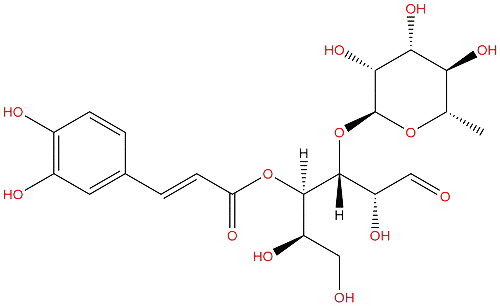
Cistanche deserticola glycoside F belongs to the phenylethanoid glycoside class, and its chemical structure has typical characteristics of this class of compounds. Its core structure consists of three parts: a phenylethanolic glycoside (usually hydroxytyrosol), a β - D-glucopyranose group connected by glycosidic bonds, and a Caffeoyl group connected to the glucose group by ester bonds. Specifically, the chemical name of Cistanche deserticola glycoside F is β-D-Glucopyranoside, 2-(3,4-dihydroxyphenyl)ethyl, 3-O-(6-deoxy-α-L-mannopyranosyl)-, 4-[3-(3,4-dihydroxyphenyl)-2-propenoate]。 Structurally, it is based on Acteoside, in which the C-4 hydroxyl group of the glucose group is replaced by a caffeoyl group, while the C-3 position is connected to an α - L-rhamnose group. This specific substitution pattern endows Cistanche glycosides F with unique chemical properties and biological activity.
From the perspective of physicochemical properties, the molecular formula of Cistanche deserticola glycoside F is C ₂₉ H ∝₆ O ₁₆, with a molecular weight of 488.4420 g/mol. Its structure contains multiple phenolic hydroxyl groups and sugar groups, making it exhibit strong polarity and hydrophilicity. The calculated lipid water partition coefficient (LogP) is -1.0084, indicating good water solubility but poor lipid solubility. The topologically polar surface area (TPSA) is as high as 223.6700 Å ², far exceeding the upper limit of 140 Å ² typically required for oral medications, indicating that its transmembrane permeability may be limited. The water solubility data (19.6562 mg/mL) further confirms its good water solubility. In addition, the molecular structure of Cistanche deserticola glycoside F contains multiple phenolic hydroxyl groups, which are excellent hydrogen donors and can effectively scavenge free radicals, which is also the structural basis for its antioxidant activity. The presence of phenolic hydroxyl groups also makes them unstable under alkaline conditions and prone to oxidation. Under UV spectroscopy, due to the presence of caffeoyl and phenylethanol structures, Cistanche glycosides F exhibit characteristic absorption peaks at approximately 330 nm and 280 nm, which are commonly used for their qualitative and quantitative analysis.
Cistanche glycosides F mainly come from plants of the Cistanche genus in the family Liliaceae. The currently recognized main sources include Cistanche deserticola(Cistanche deserticola)Hedyotis diffusa and Cistanche deserticola(Cistanche tubulosa). Both of these plants are included in the Pharmacopoeia of the People's Republic of China as the original plants of the traditional Chinese medicine Cistanche deserticola. In addition, in the salt grown Cistanche deserticola(Cistanche salsa)The presence of this component has also been detected in other plants of the same genus. The content of Cistanche deserticola glycoside F in plants is usually lower than that of its homologs, such as echinacoside and verbascoside. Its content is influenced by various factors such as plant origin, harvest season, and processing methods. Research has shown that the total content of phenylethanoid glycosides in Cistanche deserticola is usually higher than that in Cistanche deserticola, but there is a difference in the proportion of Cistanche glycosides F between the two plants.
For the extraction of Cistanche glycosides F, solvent extraction method is currently mainly used, supplemented by modern separation and purification technology. Due to the high polarity of the compound, commonly used extraction solvents are ethanol or methanol aqueous solutions of different concentrations. For example, using 50% -70% ethanol reflux extraction can effectively extract various phenylethanoid glycosides, including Cistanche glycosides F. After the extraction solution is concentrated under reduced pressure, macroporous adsorption resins (such as D101, AB-8, etc.) are usually used for preliminary separation and enrichment. By using ethanol water gradient elution at different concentrations, phenylethanoid glycosides can be separated from other impurities such as polysaccharides and tannins. The stream separation rich in target components is then subjected to modern separation technologies such as silica gel column chromatography, ODS (octadecylsilane bonded silica gel) reverse phase column chromatography, Sephadex LH-20 gel column chromatography, and preparative high-performance liquid chromatography (Prep HPLC) to finally obtain the high-purity monomer of salicin F.
In recent years, in order to improve extraction efficiency and purity, some new extraction techniques have also been applied to the extraction of Cistanche glycosides F, such as ultrasound assisted extraction, microwave-assisted extraction, and enzyme assisted extraction. These techniques can significantly shorten extraction time and improve the extraction rate of target compounds by disrupting cell walls, increasing solvent permeability, or degrading interfering macromolecules. In addition, high-speed countercurrent chromatography (HSCCC), as an efficient liquid-liquid distribution chromatography technique, has also been successfully applied to the separation and purification of phenylethanolic glycosides, with advantages such as high sample recovery and irreversible adsorption. In terms of quality control, high-performance liquid chromatography (HPLC) or ultra high performance liquid chromatography (UPLC) combined with ultraviolet detector (UV) or mass spectrometry detector (MS) is the standard method for analyzing the content of Cistanche glycosides F.
The pharmacological activity research of Cistanche deserticola glycoside F mainly focuses on its antioxidant and neuroprotective effects, and in recent years, it has also expanded to fields such as anti-inflammatory, anti-aging, and its impact on metabolic diseases.
1. Antioxidant activity
This is the most fundamental and extensively studied pharmacological activity of Cistanche deserticola glycoside F. The multiple phenolic hydroxyl groups in its molecular structure are the direct chemical basis for its antioxidant activity. In vitro chemical experiments have shown that Cistanche deserticola glycoside F can effectively scavenge various free radicals, including 1,1-diphenyl-2-trinitrophenylhydrazine (DPPH) free radical, 2,2 '- diazobis (3-ethylbenzothiazoline-6-sulfonic acid) cationic free radical, superoxide anion free radical, and hydroxyl free radical. Its clearance ability is usually stronger than common antioxidants such as vitamin C and vitamin E. In cell models, Cistanche deserticola glycoside F can significantly reduce oxidative stress levels induced by hydrogen peroxide (H ₂ O ₂), 6-hydroxydopamine (6-OHDA), or β - amyloid protein (A β), manifested by reducing the generation of intracellular reactive oxygen species (ROS), lowering the content of lipid peroxidation product malondialdehyde (MDA), and increasing the activity of antioxidant enzymes such as superoxide dismutase (SOD), glutathione peroxidase (GSH Px), and catalase (CAT).
2. Neuroprotective activity
Based on its strong antioxidant capacity, Cistanche deserticola glycoside F exhibits great potential in neuroprotection, especially in cellular and animal models of neurodegenerative diseases such as Alzheimer's disease and Parkinson's disease.
- Anti Alzheimer's disease effect In the A β - induced neurotoxicity model, pretreatment with Cistanche glycosides F can significantly improve the survival rate of nerve cells and inhibit cell apoptosis. It can reduce the toxic effects of A β on neurons by regulating the generation and aggregation processes of A β. In addition, in the model of tau protein hyperphosphorylation, Cistanche deserticola glycoside F can inhibit the abnormal phosphorylation of tau protein, thereby protecting the stability of microtubule structure and maintaining the normal function of neurons.
- Anti Parkinson's disease effect In Parkinson's disease models induced by 6-OHDA or 1-methyl-4-phenyl-1,2,3,6-tetrahydropyridine (MPTP), Cistanche deserticola glycoside F can protect dopaminergic neurons from damage. Its mechanism is closely related to inhibiting oxidative stress, reducing mitochondrial dysfunction, inhibiting cell apoptosis, and regulating autophagy.
- Anti cerebral ischemia-reperfusion injury In the cerebral ischemia-reperfusion model, Cistanche glycosides F can reduce the volume of cerebral infarction and improve neurological function scores. Its protective effect is related to reducing oxidative stress damage, inhibiting inflammatory response, and protecting the integrity of the blood-brain barrier.
3. Other pharmacological activities
- anti-inflammatory activity Research has shown that Cistanche deserticola glycoside F can inhibit the production of nitric oxide (NO), prostaglandin E2 (PGE2), and various pro-inflammatory cytokines (such as TNF - α, IL-1 β, IL-6) in macrophages induced by lipopolysaccharide (LPS). The mechanism is related to the inhibition of the activation of the nuclear factor kappa B (NF - κ B) signaling pathway.
- Anti aging effect In D-galactose-induced aging models or natural aging models, Cistanche glycosides F can improve age-related learning and memory decline, enhance the body's antioxidant capacity, and may exert anti-aging effects by activating the SIRT1 pathway.
- The impact on metabolic diseases: Preliminary studies have found that cistanche glycoside F may improve insulin resistance by regulating insulin signaling pathway, and has a certain improvement effect on type 2 diabetes and its complications.
The pharmacological activity of Cistanche deserticola glycoside F cannot be explained by a single mechanism, but by acting on multiple molecular targets and signaling pathways, forming a complex network regulatory system. According to existing research, its core mechanism of action can be summarized as follows:
1. Regulating oxidative stress and antioxidant defense system
This is the cornerstone for the multiple pharmacological activities of Cistanche deserticola glycoside F. On the one hand, it can directly eliminate ROS, and on the other hand, more importantly, it can activate the nuclear factor E2 related factor 2 (NFE2L2/Nrf2) signaling pathway. Nrf2 is a key transcription factor for cells to combat oxidative stress. Cistanche deserticola glycoside F can promote the translocation of Nrf2 from the cytoplasm into the nucleus, bind to antioxidant response elements (ARE), and upregulate the expression of a series of phase II detoxifying enzymes and antioxidant enzymes, such as SOD, CAT, glutathione S-transferase (GST), and heme oxygenase-1 (HO-1), thereby enhancing the overall antioxidant capacity of the cell.
2. Inhibit cell apoptosis and promote cell survival
In neurodegenerative diseases, neuronal apoptosis is the main cause of functional loss. Cistanche glycosides F can inhibit apoptosis through multiple pathways. Firstly, it can upregulate the expression of anti apoptotic protein B cell lymphoma 2 (BCL2) and downregulate the expression of pro apoptotic protein Bax, thereby stabilizing mitochondrial membrane potential and preventing the release of cytochrome c. Secondly, it can inhibit the activation of the caspase family, particularly the activity of Caspase-9 (CASP9) and Caspase-3, thereby blocking the apoptotic cascade of the mitochondrial pathway. In addition, Cistanche deserticola glycoside F can also activate the mitogen activated protein kinase 1 (MAPK1/ERK) signaling pathway, which is typically associated with cell proliferation, differentiation, and survival, thereby exerting a pro survival effect.
3. Regulating the metabolism of key proteins in neurodegenerative diseases
Regarding Alzheimer's disease, Cistanche deserticola glycoside F has shown regulatory effects on amyloid precursor protein (APP) and β - secretase 1 (BACE1). BACE1 is a key enzyme that catalyzes the generation of A β from APP. Research has shown that Cistanche glycosides F can inhibit the activity or expression of BACE1, thereby reducing the production of A β. Meanwhile, it may also promote the degradation and clearance of A β. For tau protein, Cistanche deserticola glycoside F can inhibit the activity of glycogen synthase kinase 3 β (GSK3B). GSK3B is one of the main kinases causing excessive phosphorylation of tau protein. By inhibiting GSK3B, Cistanche deserticola glycoside F can effectively reduce the phosphorylation level of tau protein at Ser396, Ser404 and other sites, thereby alleviating the formation of neurofibrillary tangles. In addition, the regulation of microtubule associated protein tau (MAPT) by Cistanche deserticola glycoside F indirectly protects the stability of the cytoskeleton.
4. Activate longevity and energy metabolism regulation pathways
Silencing information regulatory factor 1 (SIRT1) is an NAD ⁺ - dependent histone deacetylase that plays a central role in regulating cellular aging, energy metabolism, and stress resistance. Cistanche glycosides F have been found to activate the SIRT1 signaling pathway. Activated SIRT1 can deacetylate and activate various downstream targets, such as peroxisome proliferator activated receptor gamma co activator 1 alpha (PGC-1 alpha), thereby promoting mitochondrial biosynthesis and energy metabolism, enhancing cellular resistance to oxidative stress. The activation of SIRT1 also has a cross dialogue with the Nrf2 pathway, jointly enhancing the cell's defense ability.
In summary, Cistanche deserticola glycoside F integrates multiple functions such as antioxidant, anti apoptotic, anti-inflammatory, protein metabolism regulation, and activation of longevity pathways by acting on multiple targets including NFE2L2, BCL2, CASP9, MAPK1, APP, BACE1, GSK3B, MAPT, SIRT1, etc., forming a multi-target, multi pathway network pharmacological mechanism of action. This gives it unique advantages in dealing with complex diseases such as neurodegenerative diseases.
Although Cistanche deserticola glycoside F has shown excellent pharmacological performance in vitro and in vivo studies, its potential as a clinical drug still requires strict pharmacological evaluation. Based on its physicochemical properties and preliminary pharmacokinetic studies, a preliminary evaluation of its pharmacological properties can be conducted.
1. Analysis of pharmacological parameters
According to the Lipinski Rule of Five, an ideal candidate drug should typically meet the following criteria: molecular weight<500, LogP<5, The number of hydrogen bond donors is less than 5, and the number of hydrogen bond acceptors is less than 10. The molecular weight of Cistanche deserticola glycoside F is 488.44, approaching the threshold of 500; LogP is -1.0084, far less than 5; But its molecule contains multiple hydroxyl and sugar groups, and the number of hydrogen bond donors and acceptors far exceeds the limit of the five rules. In addition, its TPSA is as high as 223.67 Å ², far exceeding the usual upper limit of 140 Å ² for oral medications. These parameters strongly suggest that the oral bioavailability of Cistanche deserticola glycoside F may be low, with poor intestinal absorption and difficulty in penetrating the blood-brain barrier (BBB). The prediction of "blood-brain barrier: low" in the pharmacological parameters also confirms this. In addition, hERG inhibition was predicted as' no 'and Ames test predicted as negative (0.0), indicating a low risk of cardiac and genetic toxicity, which is a positive signal.
2. Pharmacokinetic characteristics
At present, there are relatively few direct studies on the pharmacokinetics of Cistanche deserticola glycoside F in vivo, but the research results of its homologs such as echinacoside and verbascoside can be referenced. Phenylethanoid glycosides commonly suffer from low oral bioavailability. After oral administration, most drugs are metabolized in the gastrointestinal tract, and some may be hydrolyzed by gut microbiota into aglycones (such as hydroxytyrosol) and glycosyl moieties. Glycosides may be absorbed into the bloodstream, while the blood concentration of the prototype drug is usually very low. After intravenous administration, the drug is rapidly distributed in the body, but also eliminated quickly. Due to its high polarity, Cistanche glycosides F and its metabolites are mainly excreted through the kidneys in the form of prototypes or conjugates. Its low BBB permeability means that in order to exert central nervous system protection, it may be necessary to increase the concentration of drugs in the brain by increasing the dosage, using new delivery systems such as nanomaterials, liposomes, or nasal administration.
3. Challenges and strategies for drug development
The main challenges for the pharmacological development of Cistanche deserticola glycoside F are its low oral bioavailability and low BBB permeability. Future research strategies for addressing these issues could include:
- Structural modification Through prodrug design, such as esterification or etherification of phenolic hydroxyl groups, their lipid solubility and membrane permeability can be improved. Alternatively, it can be designed as a prodrug that can be activated by specific enzymes in the body, such as brain enzymes.
- New drug delivery system Using nanotechnology, such as preparing poly (lactic acid glycolic acid) copolymer (PLGA) nanoparticles, liposomes, solid lipid nanoparticles, etc., to encapsulate Cistanche glycosides F, in order to improve its stability, prolong circulation time, and increase its distribution in the brain through passive or active targeting mechanisms. Nasal administration is an effective way to bypass the BBB and directly deliver drugs to the brain.
- combination therapy Combined use with drugs that can increase BBB permeability or inhibit intestinal efflux transporters (such as P-glycoprotein) may increase their brain concentration.
Although Cistanche deserticola glycoside F faces challenges in drug development, its unique pharmacological activity and multi-target mechanism of action, especially its enormous potential in the field of neuroprotection, make it have broad clinical application prospects.
1. Treatment of neurodegenerative diseases
This is the most promising application direction of Cistanche glycosides F. Given its ability to simultaneously act on multiple AD pathological processes such as A β production, tau protein phosphorylation, oxidative stress, mitochondrial dysfunction, and neuroinflammation, it is expected to be developed as a multi-target anti AD candidate drug. For PD, its protective effect on dopaminergic neurons is also worth further development. In the future, if the problem of brain targeted delivery can be solved through pharmaceutical methods, Cistanche glycosides F or its derivatives are expected to become adjuvant drugs or dietary supplements for the treatment of AD and PD.
2. Adjuvant therapy for ischemic cerebrovascular disease
During the acute phase of stroke, oxidative stress and inflammatory response are key factors leading to secondary brain injury. The antioxidant and anti-inflammatory properties of Cistanche deserticola glycoside F make it a potential adjuvant drug for thrombolysis or thrombectomy treatment to alleviate reperfusion injury and protect neurological function. Developing into injectable form may be more suitable for acute phase application.
3. Anti aging and health care
Based on its ability to activate the SIRT1 and Nrf2 pathways and enhance the body's antioxidant defense capabilities, Cistanche deserticola glycoside F has the potential to resist aging. It can be developed as a raw material for functional foods or health supplements, used to delay aging and improve age-related cognitive decline. As a medicinal and edible plant, Cistanche deserticola extract has been widely used in the health product market. Cistanche deserticola glycoside F, as a highly active ingredient, has clear development value.
4. Future research directions
- In depth mechanism research Using systems biology and network pharmacology methods, comprehensively reveal the molecular target network of Cistanche deserticola glycoside F and its interaction with other signaling pathways.
- Pharmacokinetic optimization Focus on conducting research on new drug delivery systems, especially brain targeted delivery systems (such as nasal delivery nanoemulsions, liposomes targeting transferrin receptors, etc.), to break through the bottleneck of low BBB permeability.
- Research on Structure Activity Relationship Systematically synthesize derivatives of Cistanche glycosides F, investigate the effects of different substituents on their activity, selectivity, and pharmacokinetic properties, and search for lead compounds with higher activity and better drug properties.
- Preclinical safety evaluation Conduct long-term toxicity, reproductive toxicity, and immunotoxicity studies on the system to lay a safe foundation for its entry into clinical trials.
- Clinical trial design After completing sufficient preclinical research, design rigorous clinical trials to evaluate its effectiveness and safety in specific indications (such as mild cognitive impairment, early AD).
Cistanche glycoside F, as an important phenylethanoid glycoside active ingredient in traditional Chinese medicine Cistanche deserticola, has shown remarkable pharmacological potential in multiple fields such as neuroprotection, anti-inflammatory, anti-aging, etc. due to its unique chemical structure and significant antioxidant activity. Its mechanism of action involves the regulation of multiple key targets such as NFE2L2, BCL2, BACE1, GSK3B, SIRT1, etc., reflecting the advantages of multi-target and multi pathway synergistic effects of natural products. However, its poor physicochemical properties, especially low oral bioavailability and low blood-brain barrier permeability, are the main obstacles it faces in transitioning from laboratory to clinical applications.
However, with the continuous deepening of modern pharmaceutical chemistry, pharmacology, and pharmacokinetics research, it is expected to overcome these challenges through strategies such as structural modification and novel drug delivery systems. Cistanche glycosides F and its derivatives have great potential to develop into new drugs or functional health products for the treatment of neurodegenerative diseases. Future research should focus on improving its pharmacokinetic properties, finely analyzing its mechanism of action, and verifying its clinical translational potential. The in-depth study of Cistanche glycosides F not only helps to clarify the pharmacological substance basis of traditional Chinese medicine Cistanche, but also provides valuable ideas and examples for discovering and developing innovative drugs from natural products. We have reason to believe that in the near future, Cistanche glycosides F, a treasure from the desert, will shine even brighter in the field of human health.
Batch can search by a CAS number,one per line
