


Product name: Acteoside
Synonym name: Verbascoside; Kusaginin
Catalogue No.: BP0124
Cas No.: 61276-17-3
Formula: C29H36O15
Mol Weight: 624.592
Botanical Source: Cistanches herba
Physical Description:
Type of Compound: Phenylpropanoids
Purity: 95%~99%
Analysis Method: HPLC-DAD or/and HPLC-ELSD
Identification Method: Mass, NMR
Packing: Brown vial or HDPE plastic bottle
The product could be supplied from milligrams to grams
Inquire for bulk scale.
Description:
Acteoside is a lipase inhibitor, has neuroprotective, anti-obesity,anti-inflammatory, antioxidant, anticancer, cytotoxic,antihypertensive, analgesic, and antimetastatic activities. Acteoside can promote nerve growth factor and tropomycin receptor kinase A expression, inhibit arachidonic acid release and prostaglandin E2 production induced by 0.5 microM melittin. Acteoside can protect the cells from X‑ray induced damage through enhancing the scavenging activity of ROS, decreasing the Bax/Bcl-2 ratio and downregulating the activity of procaspase-3, as well as modulating the mitogen‑activated protein kinase signaling pathways.
References:
Int Immunopharmacol. 2015 May;26(1):23-9.
Acteoside attenuates TSLP-induced mast cell proliferation via down-regulating MDM2.
Acteoside (verbascoside) is extensively distributed in Abeliophyllum distichum and has antimicrobial and anti-inflammatory properties. Thymic stromal lymphopoietin (TSLP) has a pivotal function in the pathogeneses of inflammatory diseases through increasing the mast cell proliferation via the activation of murine double minute 2 (MDM2). Here, we investigate whether Acteoside attenuates the MDM2 expression in a TSLP-stimulated human mast cell line (HMC-1 cells).
METHODS AND RESULTS:
In these cells, TSLP induced the up-regulation of MDM2 and the down-regulation of p53; however, in the TSLP-stimulated HMC-1 cells, the Acteoside down-regulated the MDM2 and up-regulated the p53. Increases in the phosphorylation of the single transducer and activation of transcription 6 and 5 via TSLP are decreased by Acteoside. The interleukin (IL)-13 (a mast cell growth factor), IL-6, tumor necrosis factor-α, and IL-1β levels are significantly reduced by the Acteoside in the TSLP-stimulated HMC-1 cells, and the Acteoside significantly induces the activation of caspase-3, the cleavage of poly-ADP-ribose polymerase, and the reduction of the procaspase-3 and Bcl2. Furthermore, the mRNA expressions of the TSLP receptor and IL-7 receptor that increase due to TSLP are reduced by the Acteoside.
CONCLUSIONS:
In conclusion, these results indicate that Acteoside is a specific regulator of MDM2 activation in TSLP-stimulated mast cells, which indicates its potential use for the treatment of mast cell-mediated inflammatory diseases.
Mol Med Rep. 2015 Apr 16.
Protective effects of acteoside against X‑ray‑induced damage in human skin fibroblasts.
METHODS AND RESULTS:
To investigate the protective effects of Acteoside against apoptosis induced by X-ray radiation in human skin fibroblasts (HSFs), the cells were divided into the following groups: Control group; X-ray radiation group; Acteoside group, in which the confluent cells were preincubated with 50 μg/ml Acteoside for 2 h followed by radiation; and positive control group, in which the cells were preincubated with 50 μg/ml paeoniflorin followed by radiation. For the radiation, HSF cells preincubated with Acteoside or paeoniflorin were exposed to X-ray beams at a dose-rate of 3 Gy/min (16 Gy in total). Cell viability, apoptosis and intracellular alteration of redox were monitored by MTT and flow cytometry. Compared with the radiation group, the number of cells arrested at the G0/G1 phase was significantly reduced in the Acteoside and paeoniflorin groups, respectively (P<0.05). X-ray radiation induced marked apoptosis in HSF cells and Acteoside reversed this effect. Compared with the radiation group, the generation of intracellular reactive oxygen species (ROS) was abrogated by pre-incubation with Acteoside or paeoniflorin (P<0.05). In addition, the upregulation of pro-caspase-3 induced by radiation was reversed by Acteoside or paeoniflorin. Radiation could induce upregulation of Bax and downregulation of Bcl-2; however, it was reversed completely after administration of Acteoside or paeoniflorin. Furthermore, the enhanced expression of ERK and JNK induced by radiation was reversed by Acteoside or paeoniflorin.
CONCLUSIONS:
Acteoside could protect the cells from X-ray induced damage through enhancing the scavenging activity of ROS, decreasing the Bax/Bcl-2 ratio and downregulating the activity of procaspase-3, as well as modulating the mitogen-activated protein kinase signaling pathways.
Life Sci. 2004 Jan 9;74(8):1051-64.
Protective effect of acteoside on carbon tetrachloride-induced hepatotoxicity.
This study investigated the protective effects of Acteoside, a phenylethanoid glycoside, on the carbon tetrachloride-induced hepatotoxicity as well as the possible mechanisms involved in this protection in mice.
METHODS AND RESULTS:
Pretreatment with Acteoside prior to the administration of carbon tetrachloride significantly prevented the increased serum enzymatic activities of alanine and aspartate aminotransferase in a dose-dependent manner. In addition, pretreatment with Acteoside significantly prevented the increase in hepatic malondialdehyde formation and the depletion of the reduced glutathione content in the liver of carbon tetrachloride-intoxicated mice. Carbon tetrachloride-induced hepatotoxicity was also essentially prevented, as indicated by a liver histopathologic study. The effects of Acteoside on cytochrome P450 (P450) 2E1, the major isozyme involved in carbon tetrachloride bioactivation were also investigated. Treatment of the mice with Acteoside resulted in a significant decrease in the P450 2E1-dependent pnitrophenol and aniline hydroxylation in a dose-dependent manner. Consistent with these observations, the P450 2El protein levels were also lower. Acteoside exhibited anti-oxidant effects on FeCl2-ascorbate induced lipid peroxidation in a mouse liver homogenate, and on superoxide radical scavenging activity.
CONCLUSIONS:
These results suggest that the protective effects of Acteoside against the carbon tetrachloride-induced hepatotoxicity possibly involve mechanisms related to its ability to block the P450-mediated carbon tetrachloride bioactivation and free radical scavenging effects.
Bot. Stud., 2012, 53(4):421-9.
Antioxidant and antihypertensive activities of acteoside and its analogs.
Acteoside (Act), a phenylethanoid glycoside, is an active compound in several plants and traditional herbal medicines. Act along with its structural isomer, isoActeoside (Isoact), and an analog, 6-O-acetylActeoside (6-O-acetylact), were used in the study to investigate the antioxidant, anti-angiotensin-converting enzyme (ACE), and hemolysis inhibitory activities in vitro and antihypertensive activity against spontaneously hypertensive rats (SHR) in vivo.
METHODS AND RESULTS:
We showed that Act, Isoact, and 6-O-acetylact effectively scavenged 1,1-diphenyl- 2-picryl-hydrazyl radicals (with IC50 at 11.4, 9.48, and 9.55 μM, respectively) and superoxide radicals (with IC50 at 66.0, 38.5, and 39.1 μM, respectively). As Isoact and 6-O-acetylact had similar radical-scavenging activities, only Act and Isoact were used for following studies. Both Act and Isoact inhibited xanthine oxidase activity with IC50 at 53.3 and 62.2 μM, respectively. Both Act and Isoact also significantly inhibited ACE activity and the hemolysis induced by 2,2'-azo-bis(2-amidinopropane)dihydrochloride, but the effects of Act were stronger than Isoact. We then orally administered a single dose of Act or Isoact (10 mg/Kg body weight) to SHR and measured the changes of systolic blood pressure (SBP) and diastolic blood pressure (DBP) over 24 h. Act, but not Isoact, showed antihypertensive activity in lowering SBP and DBP.
CONCLUSIONS:
The results suggest the potential usefulness of Act as a health food product for antioxidant protection and blood pressure regulation.
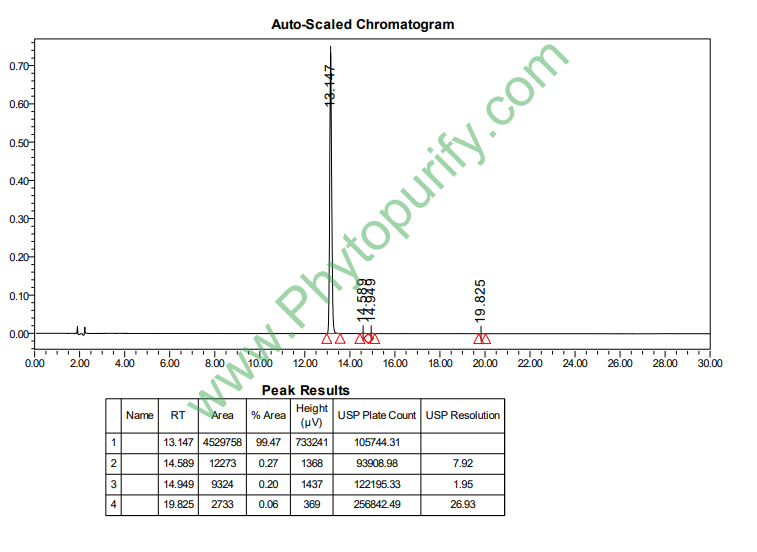
HPLC of Acteoside
Storage conditions:Short-term storage at 2~8℃, long-term storage at -20 ~ -80℃
245.2900
.1156
.1042
5.2979
.5106
.0709
Low
77.0991
4.7273
No
No
No
No
No
No
0.0
Yes
No
Yes
Yes
Acteoside, also known as sesquiterpenoid glycoside or ergosterol glycoside, is a natural product of phenylethanoid glycosides widely found in various medicinal plants. Since its chemical structure was elucidated, this compound has attracted the attention of pharmacological researchers due to its diverse and significant biological activities. As a complex polyphenolic disaccharide derivative formed by the connection of hydroxytyrosol and caffeic acid through glycosidic and ester bonds, verbascoside combines multiple pharmacological effects such as antioxidant, anti-inflammatory, neuroprotective, and anti-tumor, reflecting the characteristic of "multi-component, multi-target" action of natural products. In recent years, with the development of modern molecular biology and network pharmacology techniques, research on the mechanism of action of verbascoside has been continuously deepened. Its interactions with various disease-related targets (such as APP, ESR1, PTGS1, etc.) have been gradually revealed, especially in the fields of neurodegenerative diseases, metabolic syndrome, inflammatory diseases, and tumor prevention and treatment, showing great potential for application. This article aims to provide a systematic review of the chemical properties, plant sources, pharmacological activities, molecular mechanisms of action, and pharmacological research progress of verbascoside, and to explore its future research directions, in order to provide scientific references for the deep development and clinical application of this natural product.
The chemical name of verbascoside (CAS number: 61276-17-3) is 2- (3,4-dihydroxyphenyl) ethyl-O - α - L-pyranosyl - (1 → 3) - β - D-glucopyranosyl-4-O-trans caffeic acid ester. Its molecular formula is C29H36O15 and its molecular weight is 624.5920.
Structurally, the compound consists of three core components: 1)Catechol mother nucleus (hydroxytyrosol portion)Provide basic antioxidant and neuroprotective activities; 2)Disaccharide linking arm (α - L-rhamnose - (1 → 3) - β - D-glucose)Enhanced the water solubility of molecules and their ability to recognize biomolecules; 3)Trans caffeoyl group Connected to the 4-hydroxy group of glucose through ester bonds, it is a key pharmacophore that contributes to its strong antioxidant, anti-inflammatory, and enzyme inhibitory activities. This unique structure gives it both hydrophilic (glycosyl, multiple phenolic hydroxyl groups) and lipophilic (phenethyl, caffeoylphenylpropene structure) regions, with a calculated lipid water partition coefficient (LogP) of approximately 0.1156, indicating good amphiphilicity. Its topological polar surface area (TPSA) is as high as 245.29 Å ², which is closely related to the large number of hydrogen bond donors and acceptors (phenolic hydroxyl groups, hydroxyl groups on sugar rings, ester bonds, and ether bond oxygen atoms) present in its molecule.
In terms of physical and chemical properties, verbascoside is usually a pale yellow amorphous powder or crystal. The predicted value of its water solubility is about 5.30 mg/mL, which is above average, mainly due to the sugar moiety. It also has good solubility in organic solvents such as methanol, ethanol, and acetone. The abundant phenolic hydroxyl groups in the molecule make it easily oxidized and unstable under light, high temperature, or alkaline conditions. Therefore, attention should be paid to avoiding light, low temperature, and inert gas protection during extraction, separation, and storage. Its UV absorption characteristics are obvious, with maximum absorption peaks around 330 nm (caffeic acid portion) and 290 nm (phenylethanol portion), which can be used for qualitative and quantitative analysis.
Mariascoside is widely distributed in the plant kingdom and is one of the main active ingredients in many traditional medicinal plants. Its main plant sources include:
1. Ledanceae plants Like Cistanche deserticola(Cistanche deserticola)Guanhua Cistanche deserticola(Cistanche tubulosa)Among them, verbascoside is often used as a hallmark component for quality control.
2. Scrophulariaceae plants Like Rehmannia glutinosa(Rehmannia glutinosa)Mao paulownia(Paulownia tomentosa)Wait.
3. Lamiaceae plants Like rosemary(Rosmarinus officinalis)Perilla frutescens(Perilla frutescens)Wait.
4. Plantago asiatica plants Like in front of a big car(Plantago major)。
5. Other It has also been found in various plants such as the Oleaceae and Verbenaceae families.
The extraction method follows the general principles of natural product chemistry and is optimized based on the characteristics of its phenolic compounds
- Solvent extraction method The most commonly used method. Usually, methanol, ethanol, or their aqueous solutions (such as 70% ethanol) are used for heating reflux or ultrasound assisted extraction. Ethanol aqueous solution has become the preferred choice due to its low cost, low toxicity, and high extraction efficiency.
- Purification and Separation: After enrichment by macroporous adsorption resins (such as AB-8 and D101), the crude extract is further separated and purified by silica gel column chromatography, reverse phase silica gel column chromatography (such as ODS), Sephadex LH-20 column chromatography and high performance liquid chromatography (HPLC). Preparation HPLC is currently the most reliable method for obtaining high-purity verbascoside standards.
- emerging technologies Microwave assisted extraction and supercritical fluid extraction techniques have also been applied to improve extraction efficiency, shorten time, and reduce solvent usage.
Numerous in vitro and in vivo pharmacological experiments have confirmed that verbascoside has a wide range of complex biological activities, and its main pharmacological effects are summarized as follows:
The multiple pharmacological effects of verbascoside stem from its diverse regulation of cellular signaling pathways and interactions with multiple molecular targets. Based on existing research, its core mechanism of action and key targets can be summarized as follows:
Regulating key signaling pathways:
Targeting specific disease-related targets(Taking obstructive sleep apnea related targets as an example):
Apoptosis and autophagy regulation By downregulating the pro apoptotic protein Bax, upregulating the anti apoptotic protein Bcl-2, inhibiting the activation of Caspase-3 precursor (as mentioned earlier), and regulating the expression of autophagy related proteins LC3-II and p62, cell homeostasis is maintained.
Despite the excellent pharmacological activity of verbascoside, its drug liking faces certain challenges, mainly due to its poor pharmacokinetic properties.
To improve its medicinal properties, current research strategies include:
1. Development Prodrug Prepare ester derivatives with higher lipid solubility to enhance absorption and BBB penetration.
2. Adopt New drug delivery system Such as nanoparticles, liposomes, microemulsions, phospholipid complexes, etc., to improve their stability, solubility, membrane permeability, and targeting.
3. Explore Structural modification On the premise of retaining the pharmacophore, optimize its sugar or phenolic hydroxyl moiety to balance hydrophilicity and oleophilicity.
The clinical application prospects of verbascoside are broad, but the road to transformation is long and arduous.
Potential clinical application directions:
1. Adjuvant therapy for neurodegenerative diseases As a multi-target neuroprotective agent for Alzheimer's disease and Parkinson's disease, or for the prevention and treatment of vascular dementia and cerebral ischemia-reperfusion injury.
2. Management of metabolic diseases As a functional food or drug ingredient, it is used as an auxiliary treatment for obesity, hyperlipidemia, nonalcoholic fatty liver and type 2 diabetes, and plays a comprehensive role in regulating metabolism.
3. Anti inflammatory and immune related diseases Develop topical or oral formulations for the treatment of chronic inflammatory diseases (such as arthritis, colitis) and skin inflammation.
4. neoadjuvant therapy As a sensitizer and detoxifier for chemotherapy or radiotherapy, utilizing its antioxidant, anti metastatic, and cell protective properties to improve the comprehensive treatment effect of tumors.
5. Special fields Its potential in radiation protection, pain relief, and anti infection is also worth exploring.
Future research prospects:
1. In depth mechanism research By utilizing proteomics, metabolomics, and gene editing technologies, we aim to more accurately elucidate its direct targets and signaling networks, particularly its systemic pharmacological mechanisms in complex disease models.
2. Pharmacokinetic optimization This is the top priority of current research. It is necessary to increase research investment in its new drug delivery system and structurally modified derivatives, and systematically evaluate their pharmacokinetic behavior, tissue distribution, and final efficacy in vivo.
3. Preclinical and clinical research On the basis of completing the system toxicology evaluation, promote high-quality and standardized preclinical pharmacological studies and subsequent clinical trials to confirm its safety and effectiveness.
4. Sustainable supply of raw materials Strengthen plant cultivation, cell culture, or synthetic biology technology research to ensure the stable, green, and sustainable supply of verbascoside raw materials.
As a natural phenylethanolic glycoside with unique structure and diverse pharmacological activities, verbascoside is a star molecule in modern natural product pharmacology research. Decades of research have painted a profound and complex pharmacological picture for it, from chemical structure to biological activity, from molecular targets to signaling pathways. Its outstanding performance in neuroprotection, anti-inflammatory and antioxidant effects, metabolic regulation, and anti-tumor effects has demonstrated unique value in the prevention and treatment of various major chronic diseases. However, its inherent pharmacokinetic deficiencies, especially low oral bioavailability and low blood-brain barrier permeability, are the main obstacles on its path from "active compounds" to "candidate drugs". Future research needs to adhere to the concept of "inheriting the essence, maintaining integrity and innovation", and actively use modern pharmaceutics and pharmaceutical chemistry to solve its delivery problems while deeply excavating its scientific connotation. Only through interdisciplinary collaboration can this chemical treasure gifted by ancient plants be truly transformed into modern medicines that benefit human health.
