


Synonym name:
Catalogue No.: BP0629
Cas No.: 509-15-9
Formula: C20H22N2O2
Mol Weight: 322.408
Botanical Source: Alkaloid from Gelsemium sempervirens, Gelsemium elegans and Mostuea stimulans (Loganiaceae)
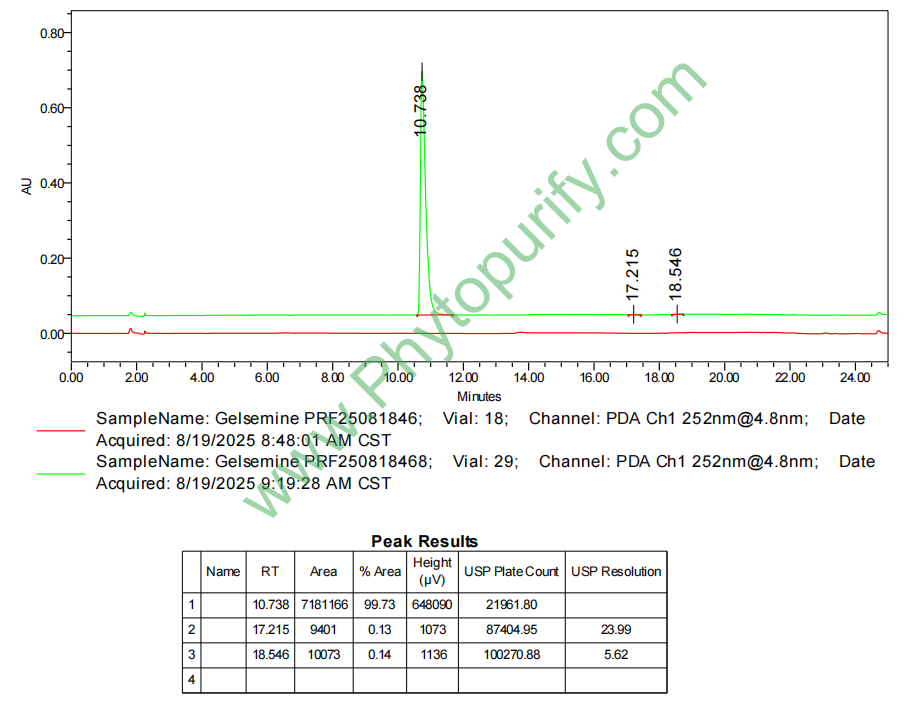
Purity: 95%~99%
Analysis Method: HPLC-DAD or/and HPLC-ELSD
Identification Method: Mass, NMR
Packing: Brown vial or HDPE plastic bottle
Can be supplied from milligrams to grams.
For Reference Standard and R&D, Not for Human Use Directly.
Inquire for bulk scale.
Description:
Gelsemine is a highly toxic compound and may be a glycine receptor agonist. Gelsemine has antitumor, anti-hyperlipidemic,anti-oxidative activities,it also has marked antinociception in inflammatory, neuropathic and bone cancer pains without inducing antinociceptive tolerance.
References:
J Asian Nat Prod Res. 2010 Sep;12(9):731-9.
Antitumor activity of two gelsemine metabolites in rat liver microsomes.
Gelsemine is one of the major alkaloids from Gelsemium elegans Benth., which has been used as an antitumor remedy in clinic.
METHODS AND RESULTS:
In this paper, metabolism of Gelsemine has been investigated in vitro in phenobarbital-treated rat liver microsomes. The metabolites of Gelsemine were separated and evaluated using the flash silica gel column, preparative HPLC, using NMR and MS methods. According to the spectral data, two metabolites, M1 and M2, were identified as 4-N-demethylGelsemine and 21-oxoGelsemine, respectively. By the MTT method in vitro, the antitumor activities between Gelsemine and its metabolites were compared in the HepG2 and HeLa cell lines. Moreover, the main metabolic pathway was further proposed.
Cell Biochem Biophys. 2015 Jan;71(1):337-44.
Anti-hyperlipidemic and anti-oxidative effects of gelsemine in high-fat-diet-fed rabbits.
The present study investigated the anti-hyperlipidemic proprieties of a natural alkaloid, Gelsemine, in a high-fat-fed rabbit model.
METHODS AND RESULTS:
Animals were randomly divided into five groups and fed normal diet, hypercholesterolemic diet (1% cholesterol), or hypercholesterolemic diet (1% cholesterol) supplemented with Gelsemine (1, 5, or 25 mg/kg). After 60 days, serum concentrations of total cholesterol (TC), LDL-C, HDL-C, triglycerides, apolipoproteins A and B, SGOT, SGPT, glucose, and insulin were measured in all experimental groups. Hypercholesterolemic diet resulted in significantly elevated levels of TC, TG, LDL-C, SGOT, and SGPT, and reduced HDL-C compared to the normocholesterolemic diet group. Gelsemine treatment significantly improved lipid profile parameters, affected by hyperlipidemia, while having no effect on the levels of apolipoproteins, glucose, and insulin. Furthermore, Gelsemine treatment decreased hyperlipidemia-induced oxidative stress in a dose-dependent manner, as indicated by the increased activity of superoxide dismutase and catalase, and reduction in serum nitric oxide, and malondialdehyde concentrations in hyperlipidemic animals that received Gelsemine supplementation.
CONCLUSIONS:
Dietary supplementation with Gelsemine may, therefore, reverse the effect of the lipogenic diet on lipid profile and hepatic enzymes in hyperlipidemic rabbits, and protect tissues from oxidative stress, caused by high-fat diet.
HPLC of Gelsemine
Storage conditions:Short-term storage at 2~8℃, long-term storage at -20 ~ -80℃
41.5700
2.0172
1.4994
.7398
3.8325
21.2748
High
59.1885
6.4878
No
Yes
No
Yes
Yes
No
0.9
Yes
Yes
Yes
Yes
Gelsemine (CAS number: 509-15-9) is a natural alkaloid derived from the Chinese herbal medicine Gelsemium elegans Benth. It has attracted much attention for its significant analgesic and sleep promoting pharmacological activities. As an important medicinal herb used in traditional Chinese medicine to relieve pain and treat neurological diseases, the main active ingredient of Gelsemium elegans, Gelsemium alkaloids, has shown good anti chronic pain effects in modern pharmacological research, especially in neuropathic and inflammatory pain models, demonstrating superior analgesic effects. In recent years, with the in-depth analysis of the mechanism of action of gelsemine, its interactions with various pain related molecular targets have gradually become clear, providing a theoretical basis and experimental basis for the development of new analgesic drugs.
This review aims to systematically summarize the chemical structure and physicochemical properties, plant sources and extraction methods, pharmacological activity and mechanism of action, pharmacological evaluation and pharmacokinetic characteristics of Gelsemium alkaloids, with a focus on exploring their potential clinical application value and future research directions in pain management, in order to provide reference for the field of natural product pharmacology and analgesic drug development.
The molecular formula of Gelsemium alkaloids is C20H22N2O2, with a molecular weight of 322.4080, and it belongs to the complex alkaloid class of compounds. Its molecular structure features include a multi ring skeleton and nitrogen-containing heterocycles, with a certain degree of stereochemical complexity. The LogP value of Gelsemine is 2.0172, indicating its moderate lipid solubility, which is beneficial for penetrating cell membranes and the blood-brain barrier. The polar surface area (TPSA) is 41.57 Å ², indicating moderate molecular polarity and further supporting its distribution ability in the central nervous system.
The water solubility is 0.7398, indicating that the solubility of gelsemine in water is relatively low, but it still has a certain degree of bioavailability. Its blood-brain barrier has high permeability and can effectively enter the central nervous system to exert its effects. It is worth noting that gelsemine has hERG channel inhibitory activity, indicating a potential risk of cardiac toxicity that needs to be closely monitored during drug development. In addition, the Ames test result was 0.9, indicating that the genetic toxicity risk of gelsemine is low and its safety is relatively controllable.
The chemical structure of gelsemine provides the basis for its complex biological activity, and the polycyclic and nitrogen-containing groups in the structure are the key to its binding to various receptors and enzyme targets, while also providing favorable conditions for its pharmacokinetic properties and drug formation.
Gelsemium elegans Benth. is mainly found in the plant Gelsemium elegans Benth. It is a perennial shrub of the genus Gelsemium in the family Osmaceae, widely distributed in southern China and Southeast Asia. The whole plant of Gelsemium contains various alkaloids, among which Gelsemium alkaloids are one of its main active ingredients. Traditionally, Gelsemium is used to treat rheumatic pain, neuralgia, and other chronic pain symptoms.
The extraction of gelsemine is usually carried out using organic solvent extraction combined with column chromatography separation technology. Common extraction solvents include ethanol, methanol, chloroform, etc. The total alkaloid mixture is first obtained through crude extraction, and then the alkaline components are enriched using acid-base extraction method. Subsequently, purification was carried out using methods such as silica gel column chromatography and reverse phase high performance liquid chromatography (RP-HPLC) to obtain high-purity gelsemine.
In recent years, ultrasound assisted extraction and microwave-assisted extraction techniques have been introduced into the extraction process of gelsemium alkaloids to improve extraction efficiency and purity, reduce solvent usage and extraction time. In addition, molecular imprinting technology and solid-phase extraction technology have also been explored for efficient separation and purification of Gelsemium alkaloids.
The pharmacological activity of Gelsemium alkaloids mainly manifests as pain relief and sleep promotion, especially showing significant anti injury effects in chronic pain models. A large number of in vitro and in vivo experimental studies have confirmed that gelsemine has good relief effects on neuropathic pain, inflammatory pain, and cancer-related pain.
Analgesic effect
Gelsemine can significantly inhibit pain responses caused by mechanical and thermal stimuli. Animal experiments have shown that gelsemine reduces pain behavior in inflammatory models within a dose-dependent range, such as inflammation pain induced by plantar injection of capsaicin or complete Freund's adjuvant (CFA). Its analgesic effect lasts longer and has fewer side effects than traditional opioid analgesics.
promote sleep
Gelsemine has the effect of promoting sleep, improving sleep quality and prolonging sleep time. Related studies have shown that gelsemine exerts sedative and hypnotic effects by regulating the neurotransmitter balance in the central nervous system, particularly the gamma aminobutyric acid (GABA) and 5-hydroxytryptamine (5-HT) systems.
anti-inflammatory effect
Gelsemine also exhibits certain anti-inflammatory activity, which can inhibit the release of inflammatory mediators, reduce the infiltration of inflammatory cells, and indirectly alleviate pain. Its anti-inflammatory mechanism involves inhibiting cyclooxygenase (COX) enzyme activity and downregulating the expression of pro-inflammatory cytokines.
Neuroprotective effect
Some studies have shown that matrine has a protective effect on neurons, which can alleviate inflammation and oxidative stress after nerve injury, promote nerve function recovery, and provide theoretical support for its application in neuropathic pain.
The analgesic effect of Gelsemium alkaloids involves the regulation of multiple molecular targets, mainly including ion channels, receptors, and enzymes related to pain perception and transmission:
TRPV1 (Transient receptor potential vanillic acid subtype 1)
TRPV1 is an important ion channel for sensing thermal stimuli and inflammatory pain. Gelsemine regulates the activity of TRPV1 channel, inhibits its excessive activation, and reduces the transmission of pain signals.
TRPA1 (Transient receptor potential vanillic acid subtype A1)
TRPA1 plays a crucial role in chemical pain and inflammatory responses. The inhibitory effect of gelsemine on TRPA1 helps alleviate pain caused by inflammatory mediators.
CNR1 (cannabinoid receptor 1)
Gelsemine can activate or regulate CNR1 receptors, participate in the analgesic regulation of the endogenous cannabinoid system, and enhance analgesic effects.
OPRD1 (δ - opioid receptor), OPRM1 (μ - opioid receptor), OPRK1 (κ - opioid receptor)
Gelsemine has affinity for various opioid receptors, especially μ - and δ - receptors, mediating its analgesic effects while reducing the risk of tolerance and dependence to traditional opioid drugs.
PTGS1 (COX-1) and PTGS2 (COX-2)
Gelsemium alkaloids inhibit cyclooxygenase activity, reduce prostaglandin synthesis, alleviate inflammation and pain.
SLC6A4 (5-hydroxytryptamine transporter)
By regulating the serotonin transporter, gelsemine affects the neurotransmitter balance in the central nervous system, promoting sedative and anti anxiety effects.
DRD2 (dopamine D2 receptor)
The regulation of dopamine receptors by gelsemine may be involved in its analgesic and emotional regulatory effects, improving the psychological state of chronic pain patients.
Gelsemium alkaloids regulate the generation, transmission, and central processing of pain signals through multi-target and multi pathway synergistic effects, exhibiting a more comprehensive and long-lasting analgesic effect than traditional single target analgesics.
The pharmacological evaluation of Gelsemium alkaloids shows that they have certain potential for drug development. Its molecular weight is moderate, and both LogP value and TPSA meet the requirements of drug lipophilicity and polarity, which is conducive to in vivo absorption and blood-brain barrier penetration. The high blood-brain barrier permeability allows gelsemine to directly act on the central nervous system, exerting pharmacological effects of analgesia and promoting sleep.
However, gelsemine exhibits hERG channel inhibitory activity, suggesting a potential risk of cardiac toxicity, and the cardiac electrophysiological effects need to be given special attention in preclinical safety evaluations. In addition, the Ames test results showed that its genetic toxicity risk is low and its safety is relatively good.
In terms of pharmacokinetics, gelsemine is well absorbed and widely distributed after oral administration, especially at high concentrations in brain tissue. Its metabolism is mainly through the liver enzyme system, and the metabolites need further identification. The main excretion pathway is the kidneys, with a moderate half-life, which supports the design of its clinical dosing regimen.
At present, the pharmacokinetic data of Gelsemium elegans alkaloids are still limited. In the future, systematic studies on in vivo pharmacokinetics, drug interactions, and toxicology are needed to improve its drug efficacy evaluation system.
Gelsemine, as a natural alkaloid with multi-target effects, has shown broad application prospects in chronic pain management. Its analgesic effect is significant and its side effects are lower than traditional opioid drugs, making it particularly suitable for adjuvant therapy of neuropathic pain, inflammatory pain, and cancer pain. In addition, the sleep promoting effect of gelsemine provides a new treatment approach for improving sleep quality in patients with chronic pain.
Future clinical research should focus on the following aspects:
Safety and dose optimization
Given the potential cardiotoxicity risks associated with hERG channel inhibition, a systematic safety evaluation and dose adjustment study is required to ensure the safety of clinical applications.
Drug formulation development
Develop oral sustained-release formulations, injections, or targeted delivery systems to improve the bioavailability and therapeutic efficacy of gelsemine.
Clinical trial design
Conduct multicenter, randomized, double-blind, controlled clinical trials to verify the efficacy and safety of gelsemine in different types of chronic pain, and clarify its clinical application scope.
Combination therapy strategy
Explore the synergistic effects of combining gelsemine with other analgesic drugs (such as nonsteroidal anti-inflammatory drugs and opioid drugs) to reduce monotherapy and minimize side effects.
Deepening mechanism research
Further analyze the interaction mechanism between gelsemine and pain related molecular targets, discover new targets of action, and guide drug structure optimization and new drug development.
In summary, as a natural product with unique pharmacological activity, gelsemine has the potential to become a new type of analgesic drug, and its future clinical translation and industrialization prospects are worth looking forward to.
Gelsemine, as an important alkaloid in the Gelsemium plant, has demonstrated unique advantages in the treatment of chronic pain due to its significant analgesic and sleep promoting activities. Its multi-target mechanism of action provides a new pharmacological basis for pain management, and its physicochemical properties and pharmacokinetic characteristics support its further development as a central acting analgesic drug. Despite the potential risk of cardiac toxicity, gelsemine still has good safety and medicinal properties.
In the future, it is necessary to strengthen the preclinical safety evaluation, pharmacokinetic research, and clinical trial verification of gelsemine, and promote its translation into clinical applications. Through structural optimization and dosage form innovation, it is expected to overcome existing limitations and achieve widespread application of gelsemine in the treatment of chronic pain and related neurological diseases. The research on gelsemine not only enriches the knowledge system in the field of natural product pharmacology, but also opens up new directions for the development of new analgesic drugs.
