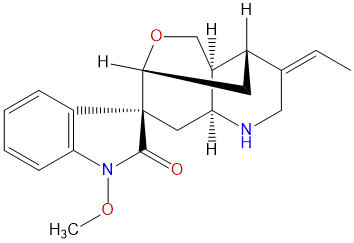
| Catalog No | Package | Original Price | Price | Inventory | Quantity | Operating |
|---|---|---|---|---|---|---|
| BP4260-5mg | 5mg | $420.00 | Sign in |
|


Product name: Rankinidine
Synonym name: Demethoxyhumantenirine; N-Demethylhumantenine
Catalogue No.: BP4260
Cas No.: 106466-66-4
Formula: C20H24N2O3
Mol Weight: 340.423
Botanical Source: Gelsemium elegans
Type of Compound: Alkaloids
Purity: 95%~99%
Analysis Method: HPLC-DAD or/and HPLC-ELSD
Identification Method: Mass, NMR
Packing: Brown vial or HDPE plastic bottle
Storage: Store in a well closed container, protected from air and light. Put into refrigerate or freeze for long term storage.
Whenever possible, you should prepare and use solutions on the same day. However, if you need to make up stock solutions in advance, we recommend that you store the solution as aliquots in tightly sealed vials at -20℃. Generally, these will be useable for up to two weeks.
The product could be supplied from milligrams to grams
Inquire for bulk scale.
For Reference Standard and R&D, Not for Human Use Directly.
Storage conditions:Short-term storage at 2~8℃, long-term storage at -20 ~ -80℃
50.8000
1.9978
1.1201
2.3521
2.7486
20.5728
High
54.7699
6.2962
No
Yes
No
No
Yes
No
1.2
No
No
Yes
Yes
Natural products, as an important source of drug discovery, play an irreplaceable role in the development of anti-tumor drugs. In recent years, the research on active ingredients based on traditional medicinal plants has been continuously deepened, and many natural compounds with potential clinical application value have been discovered and developed one after another. 4-demethylated cranberry alkaloid (Rankinidine) is a hydroxyindole alkaloid isolated from the methanol extract of Gelsemium rankinii, a plant belonging to the Polygonatum genus. It has attracted much attention due to its unique chemical structure and multi-target pharmacological activity. As a malignant tumor with high incidence rate and mortality worldwide, liver cancer urgently needs new effective and low toxic therapeutic drugs. Previous studies have shown that 4-demethylated sophocarpine B has significant regulatory effects on liver cancer-related signaling pathways, particularly exhibiting strong inhibitory activity against key targets such as BCL2, STAT3, and TOP1, demonstrating excellent anti-tumor potential. This article will provide a systematic review of the chemical structure, sources, pharmacological activity, mechanism of action, and pharmacological evaluation of 4-demethylated sophocarpine B, and explore its application prospects in the treatment of liver cancer.
4-Demethylated Houttuynia cordata alkaloids belong to the class of indole alkaloids, with a molecular formula of C20H26N2O3 and a molecular weight of 340.4230. Its structural features include a typical indole ring system and hydroxyl substituents, and demethylation modification makes it different from berberine in molecular conformation and polarity. The LogP value is 1.9978, indicating that the compound has moderate lipid solubility, which is beneficial for cell membrane penetration and in vivo distribution. The topological polar surface area (TPSA) is 50.8 Å ², belonging to a moderately polar molecule, with good water solubility (2.3521 mg/mL) and lipid solubility balance, which helps to improve its bioavailability. The high penetration ability of the blood-brain barrier suggests its potential role in central nervous system diseases. The negative result of hERG channel inhibition experiment indicates a low risk of cardiac toxicity. The Ames mutagenicity test value is 1.2, indicating a low risk of genetic toxicity. Overall, 4-demethylated sophocarpine B has good physicochemical properties and safety foundation, laying a solid foundation for its further drug development.
4-Demethylated Houttuynia cordata alkaloids are mainly derived from Gelsemium rankinii, a plant of the Polygonatum genus, which is widely distributed in parts of Asia and the Americas. It has been used in traditional folk medicine and has multiple pharmacological effects such as pain relief, anti-inflammatory, and anti-tumor. After the whole plant or rhizome of Gelsemium rankinii is extracted with methanol (MeOH), high-purity 4-demethylated sophocarpine ethyl can be obtained through multi-step chromatographic separation techniques such as silica gel column chromatography, reverse phase high-performance liquid chromatography, etc. In the extraction process, parameters such as solvent polarity, extraction time, and temperature have a significant impact on the yield and purity of the product. In recent years, the application of green and efficient technologies such as ultrasound assisted extraction and microwave-assisted extraction has further optimized the extraction process of this compound, improving extraction efficiency and environmental friendliness. In addition, structural identification mainly relies on modern analytical methods such as nuclear magnetic resonance (NMR), mass spectrometry (MS), and infrared spectroscopy (IR) to ensure the accuracy of the compound's structure.
4-demethylated sophocarpine B exhibits significant anti proliferative and pro apoptotic activity in various tumor cell lines, particularly exhibiting strong cytotoxicity in liver cancer cells. In vitro cell experiments have shown that the compound can inhibit the proliferation, migration, and invasion ability of liver cancer cells, induce cell cycle arrest and apoptosis. Animal model studies further confirm its inhibitory effect on liver cancer tumor growth in vivo, with low toxicity and side effects, demonstrating good safety. Mechanism studies have shown that 4-demethylated sophocarpine B achieves its anti-tumor effect by regulating multiple signaling pathways, including inhibiting abnormal activation of STAT3, reducing anti apoptotic expression of BCL2, inhibiting TOP1 mediated DNA repair process, and promoting cancer cell apoptosis. In addition, its regulation of signaling molecules such as MAPK1, PIK3CA, EGFR, etc. helps to inhibit the proliferation and metastasis of tumor cells. Overall, 4-demethylated sophocarpine B has multi-target and multi mechanism anti-tumor potential.
The anti liver cancer effect of 4-demethylated sophocarpine involves multiple key molecular targets. Firstly, BCL2 family proteins serve as key regulatory factors for cell apoptosis, and their downregulation promotes tumor cell apoptosis. 4-demethylated berberine significantly inhibits the expression of BCL2 and disrupts the anti apoptotic barrier of tumor cells. Secondly, the STAT3 signaling pathway plays a central role in the occurrence and development of liver cancer. This compound inhibits the phosphorylation of STAT3, blocks its transcriptional activity, suppresses tumor cell proliferation, and immune escape. TOP1, as a DNA topoisomerase, participates in DNA replication and repair. 4-demethylated matrine B inhibits TOP1 activity, induces DNA damage, and promotes cell apoptosis. The regulation of MAPK1 and PIK3CA signaling pathways further inhibits the proliferation and migration of tumor cells. The inhibitory effect of TERT helps to limit the unlimited proliferation ability of tumor cells. The decrease in MMP9 expression inhibits tumor invasion and metastasis. The regulation of EGFR and PTGS2 involves changes in the tumor microenvironment and inhibition of inflammatory responses. As a tumor suppressor gene, TP53's functional recovery contributes to the apoptosis and growth inhibition of tumor cells. In summary, 4-demethylated sophocarpine B achieved comprehensive inhibition of liver cancer cells through multi-target synergistic effects.
The development of medicinal properties is a crucial step in the development of natural product drugs. 4-demethylated sophocarpine B exhibits good drug compatibility in terms of physicochemical properties. LogP is about 2, indicating that it has moderate lipid solubility, which is beneficial for oral absorption and cell membrane penetration. The moderate TPSA value indicates good bioavailability and cell permeability. Moderate water solubility is beneficial for formulation development. The high penetration ability of the blood-brain barrier suggests its potential pharmacological activity related to the central nervous system, but potential central toxicity risks also need to be considered. The hERG channel inhibition experiment results were negative, reducing the risk of cardiac toxicity. The Ames test results show that its genetic toxicity risk is low and its safety is good. Pharmacokinetic studies have shown that the compound has good stability and suitable half-life in vivo, and can maintain effective blood drug concentration. The metabolic pathway mainly involves the liver enzyme system, and the safety of metabolites needs further evaluation. Overall, 4-demethylated berberine B has a good pharmacological basis and is suitable for further preclinical development.
Liver cancer, as one of the most important malignant tumors worldwide, currently has treatment options including surgical resection, radiotherapy, chemotherapy, and targeted therapy, but the efficacy is limited and the side effects are significant. 4-demethylated matrine B provides a new approach for the treatment of liver cancer due to its multi-target and multi mechanism anti-tumor effects. Its excellent pharmacokinetic properties and safety lay the foundation for clinical application. Future research should further clarify its mechanism of action, optimize dosage forms and administration regimens, conduct systematic toxicological and pharmacological evaluations, and promote its entry into clinical trials. In addition, combining modern molecular targeting technology and nano drug delivery systems to enhance their targeting and efficacy, and reduce side effects, is also an important direction for future research. The potential application of 4-demethylated berberine B in tumors and diseases other than liver cancer is also worth exploring, especially its blood-brain barrier penetration ability suggests its potential value in neurological diseases.
4-demethylated sophocarpine B, as a hydroxyindole alkaloid derived from Gelsemium rankinii, has shown broad prospects for drug development due to its unique chemical structure and multi-target anti liver cancer activity. Its excellent physicochemical properties, drug properties, and safety provide strong support for its clinical translation. In the future, through in-depth pharmacological mechanism research, optimization of drug formulations, and systematic preclinical evaluation, it is expected to be developed into a new natural drug for the treatment of liver cancer, benefiting a large number of patients. Meanwhile, the research on this compound will also promote the development of natural product pharmacology, facilitate the rational utilization of natural product resources, and facilitate the discovery of innovative drugs.
