


Product name: Koumine
Synonym name:
Catalogue No.: BP0832
Cas No.: 1358-76-5
Formula: C20H22N2O
Mol Weight: 306.409
Botanical Source: Gelsemium elegans
Physical Description:
Type of Compound: Alkaloids
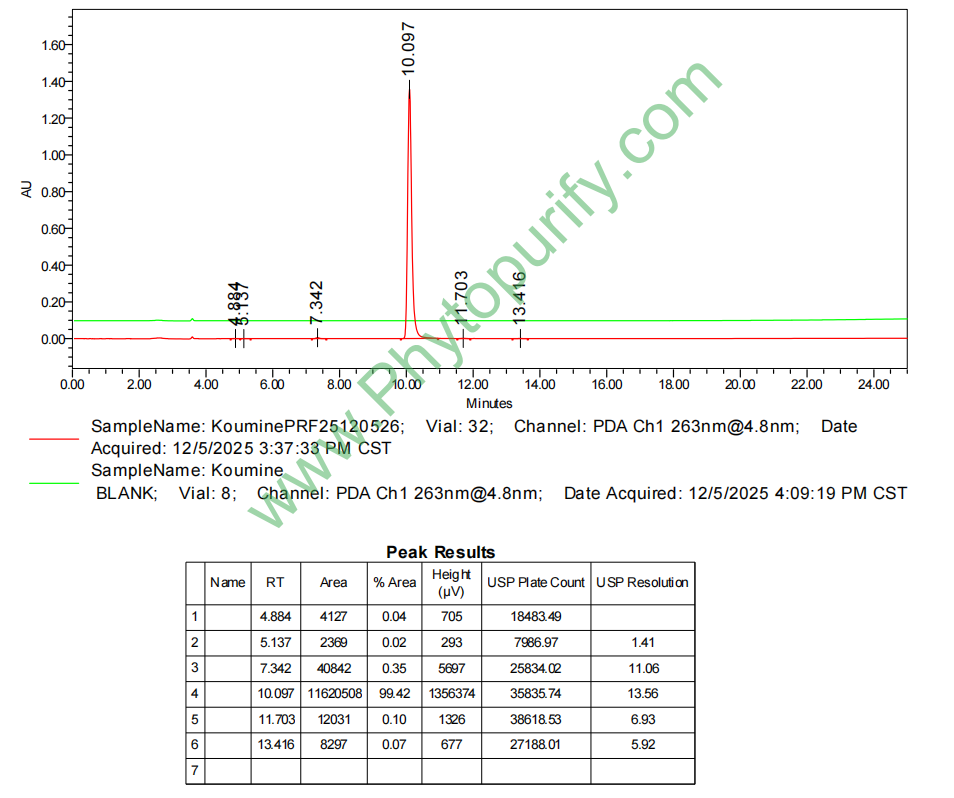
Purity: 95%~99%
Analysis Method: HPLC-DAD or/and HPLC-ELSD
Identification Method: Mass, NMR
Packing: Brown vial or HDPE plastic bottle
Storage: Store in a well closed container, protected from air and light. Put into refrigerate or freeze for long term storage.
Whenever possible, you should prepare and use solutions on the same day. However, if you need to make up stock solutions in advance, we recommend that you store the solution as aliquots in tightly sealed vials at -20℃. Generally, these will be useable for up to two weeks.
The product could be supplied from milligrams to grams
Inquire for bulk scale.
Description:
Koumine shows potent anti-tumor, anxiolytic, antistress, antipsoriatic, and analgesic activities, it also protects against the development of arthritis in Rheumatoid arthritis (RA) animal models.Koumine can induce apoptosis of LoVo cells in a time-dependent manner and inhibit the DNA synthesis in LoVo cells, thereby blocking the cell cycle from G1 to S phase.
References:
Cell Biochem Biophys. 2015 Jan 6.
Apoptotic Effect of Koumine on Human Breast Cancer Cells and the Mechanism Involved.
Koumine is an alkaloid separated from traditional Chinese herb Gelsemium elegans.
METHODS AND RESULTS:
In this study, anticancer activity and underlying mechanisms were investigated with an extract using human breast cancer cells. The survival rate was reduced in a concentration- and time-dependent manner as assessed by MTT assay. After incubation for 48 h, typical apoptotic morphological changes were observed by Hoechst 33258 dye assay. Flow cytometry result revealed that the treatment obviously induced G2/M arrest and apoptosis in MCF-7 cells. Furthermore, Western blotting demonstrated the down-regulation of protein expression of Bcl-2, whereas Bax and caspase-3 expressions were up-regulated.
CONCLUSIONS:
Therefore, we propose that Koumine has the potential to be a future breast cancer chemotherapeutic agent.
Di Yi Jun Yi Da Xue Xue Bao. 2005 May;25(5):562-4.
Effect of koumine on proliferation of murine CD4+ T cells purified by magnetic-activated cell sorting in vitro.
To assess the separation efficiency of magnetic-activated cell sorting in the purification of CD4+ T cells from murine spleen, and observe the effects of Koumine on the proliferation of the separated cells.
METHODS AND RESULTS:
CD4+ T cells were isolated from murine spleen by magnetic-activated cell sorting (MiniMACS). Fluorescence-activated cell sortering was employed to determine the purity of CD4+ T cells before and after the separation procedure followed by evaluation of the cell viability using trypan blue staining. Concanavalin A- (ConA, 5 microg/ml) or phytahematoagglutinin (PHA,1 mg/ml)-induced murine T cells were treated with different concentrations of Koumine (10-320 microg/ml), and their proliferation was determined by MTT colorimetry, and enzyme-linked immunosorbent assay was used to measure IL-2 level in the cell culture supernatant. The purity of CD4+ T cells reached (90.3+/-5.8)% after the purification with a cell viability of (94.9+/-3.6)%. Koumine (20-320 microg/ml) dose-dependently inhibited ConA- or PHA-induced proliferation of murine lymphocytes as compared with the controls (P<0.05). Koumine (20, 100, and 200 microg/ml) significantly decreased the level of IL-2 in comparison with the control group (P<0.05).
CONCLUSIONS:
CD4+ T cells of high purity can be obtained from murine spleen using MiniMACS without impairing the viability of the cells. Koumine significantly inhibits the proliferation of murine CD4+ T cells due to its immunosuppressive effect and inhibition of IL-2 secretion.
Pharmacol Biochem Behav. 2012 May;101(3):504-14.
Effects of koumine, an alkaloid of Gelsemium elegans Benth., on inflammatory and neuropathic pain models and possible mechanism with allopregnanolone.
Crude alkaloidal extraction from Gelsemium elegans Benth. produces analgesic property. However, its clinical utility has been obstructed by its narrow therapeutic index.
METHODS AND RESULTS:
Here, we investigated the potential of Koumine, a monomer of Gelsemium alkaloids, to reduce both inflammatory and neuropathic pain. Interestingly, allopregnanolone, a neurosteroid, appeared to mediate the reduction of neuropathic pain. The potential anti-inflammatory pain effects of Koumine were evaluated by acetic acid-, formalin- and complete Freund's adjuvant (CFA) -induced nociceptive behaviors in mice. Chronic constriction injury (CCI) and L5 spinal nerve ligation (L5 SNL), inducing thermal hyperalgesia and mechanical allodynia in rats, were used to test whether repeated treatment of Koumine ameliorated neuropathic pain. Finally, we explored if Koumine altered the level of neurosteroids in rat spinal cord of CCI neuropathy using liquid chromatography-tandem mass spectrometry. Koumine dose-dependently reduced the acetic acid-induced writhes and formalin-induced licking/biting time of Phase II in mice. Repeated administrations of Kouminealso dose-dependently reversed the CFA-, CCI- and L5 SNL-induced thermal hyperalgesia, as well as, CCI- and L5 SNL-induced mechanical allodynia in rats. The level of allopregnanolone, but not pregnenolone, in the L5-6 spinal cord was elevated by repeated treatment of Koumine in CCI-induced neuropathic rats.
CONCLUSIONS:
These results demonstrate that Koumine has a significant analgesic effect in rodent behavioral models of inflammatory and neuropathic pain, and that the reduction in neuropathic pain may be associated with the upregulation of allopregnanolone in the spinal cord.
HPLC of Koumine
Storage conditions:Short-term storage at 2~8℃, long-term storage at -20 ~ -80℃
Koumine (CAS number: 1358-76-5) is a traditional Chinese medicinal herb derived from the plant(Gelsemium elegans)Natural alkaloids isolated from the middle. Due to its significant biological activity, especially its potential pharmacological effects in anti-tumor, analgesic, anti anxiety, and immune regulation fields, Gelsemium elegans has attracted widespread attention in recent years. Gelsemium elegans not only regulates the expression of apoptosis related proteins and promotes cell apoptosis in tumor cells, but also exhibits therapeutic potential for neurological and inflammatory diseases. This article provides a systematic review of the chemical structure and physicochemical properties, plant sources and extraction methods, pharmacological activity and mechanism of action, pharmacological evaluation, and clinical application prospects of Gelsemium elegans. The aim is to provide reference for the in-depth research and drug development of this natural product.
Gelsemium belongs to indole alkaloids, with a molecular formula of C20H26N2O and a molecular weight of 306.4090. Its structural core is a complex polycyclic indole skeleton with high spatial configuration complexity. The LogP value of Gelsemium elegans is 2.4179, indicating its moderate lipid solubility, which is beneficial for membrane penetration and in vivo distribution. Its topological polar surface area (TPSA) is 24.83 Å ², indicating a low molecular polarity that facilitates the penetration of the blood-brain barrier, consistent with its role in the central nervous system. The low water solubility of Gelsemium elegans (0.1684 mg/mL) suggests its limited solubility in vivo and may require formulation optimization to improve bioavailability.
In addition, Gelsemium elegans has high blood-brain barrier permeability and can effectively enter the central nervous system to exert pharmacological effects. However, its hERG channel inhibitory activity suggests caution in assessing cardiac safety. The Ames test results show that it has a certain genotoxicity risk (value 1.5), and further toxicological studies are needed to clarify its safety.
The main source of Gelsemium is Gelsemium(Gelsemium elegans)This is a toxic plant distributed in southern China and Southeast Asia, traditionally used in traditional Chinese medicine to treat pain, rheumatic diseases, and neurological disorders. As one of the main alkaloid components in Gelsemium, the content of Gelsemium is relatively high.
The commonly used extraction methods include organic solvent extraction combined with column chromatography separation technology. Generally, methanol or ethanol is used to extract the dried rhizomes of Gelsemium elegans, followed by enrichment of alkaloids through acid-base regulation. Purification of the crude extract was carried out using methods such as silica gel column chromatography and reverse phase high-performance liquid chromatography (RP-HPLC), resulting in the production of high-purity Gelsemium elegans seeds. In recent years, the application of ultrasound assisted extraction and microwave-assisted extraction technologies has improved extraction efficiency and purity, providing sufficient material basis for subsequent pharmacological research.
Gelsemium elegans exhibits significant cytotoxic effects in various tumor cell lines. The main mechanism is to induce apoptosis of tumor cells, specifically by increasing the ratio of pro apoptotic protein Bax to anti apoptotic protein Bcl-2, and promoting the activation of mitochondrial pathways. In addition, Gelsemium elegans can upregulate the expression of caspase-3, trigger the cascade reaction of cell apoptosis, and effectively inhibit the proliferation of tumor cells. A number of in vitro and in vivo experiments have confirmed that gelsemin has a good inhibitory effect on breast cancer, liver cancer and lung cancer cells.
Gelsemium has shown great potential in analgesic research. Its targets involve multiple pain related receptors and channels, including TRPV1, TRPA1, CNR1 (cannabinoid receptor 1), OPRM1 (μ - opioid receptor), OPRD1 (δ - opioid receptor), OPRK1 (κ - opioid receptor), PTGS1/2 (cyclooxygenase 1/2), and SLC6A4 (serotonin transporter protein). Gelsemium elegans exhibits strong analgesic effects by regulating the activity of these targets, reducing inflammatory and neuropathic pain.
The research on Gelsemium elegans in the field of neurological and psychiatric disorders shows that it has anti anxiety and anti stress effects. Animal model experiments have shown that Gelsemium elegans can regulate neurotransmitter levels in the central nervous system, improve anxiety behavior, and alleviate stress responses. This may be related to its good blood-brain barrier permeability and regulation of neural targets such as dopamine D2 receptor (DRD2).
Gelsemium elegans exhibits activity in inhibiting inflammatory response and regulating immune function in psoriasis models. It reduces skin inflammation symptoms by regulating the release of inflammatory mediators. In addition, in animal models of rheumatoid arthritis, gelsemin can effectively prevent the development of arthritis, indicating its potential application value in autoimmune diseases.
The pharmacological effects of Gelsemium elegans involve multiple signaling pathways and molecular targets. Its anti-tumor mechanism mainly involves regulating the expression of Bcl-2 family proteins, promoting the activation of mitochondrial dependent apoptosis pathway, enhancing caspase-3 activity, and inducing programmed cell death in tumor cells. In addition, Gelsemium elegans may also exert its effects by inhibiting tumor cell proliferation signaling pathways such as PI3K/Akt and MAPK, and related research is still ongoing.
In terms of analgesic mechanism, Gelsemium elegans regulates pain signal transduction through multi-target synergistic effects. Its inhibition of TRPV1 and TRPA1 channels reduces calcium influx and neural excitability, alleviating pain sensation. Activation of the opioid receptor family (OPRM1, OPRD1, OPRK1) enhances endogenous analgesic effects. Gelsemium also regulates PTGS1/2, inhibits prostaglandin synthesis, and reduces inflammatory pain. In addition, regulating CNR1 and SLC6A4 can also help improve neural regulation and emotional states.
The anti anxiety and anti stress effects may be related to the regulation of neurotransmitters in the central nervous system by Gelsemium elegans, especially the regulation of dopamine D2 receptor (DRD2), which affects dopaminergic neurotransmission and improves emotional and stress responses.
The molecular weight of Gelsemium elegans is moderate, with moderate lipid solubility and low TPSA, indicating its good membrane permeability and blood-brain barrier penetration ability, which provides a basis for its application in central nervous system diseases. Its low water solubility suggests that oral bioavailability may be limited and needs to be improved through formulation technology.
Gelsemium elegans exhibits hERG channel inhibitory activity, indicating a potential risk of cardiac toxicity. Therefore, it is important to focus on cardiac safety assessment during drug development. The Ames test results suggest a possible genotoxicity risk, which needs to be further confirmed through in vivo toxicology studies.
At present, there is limited research on the pharmacokinetics of Gelsemium elegans. Preliminary data indicate that it is widely distributed in the body, especially at high concentrations in brain tissue. The metabolic pathway may involve the liver cytochrome P450 enzyme system, and the metabolites and their activities require further research.
Gelsemium elegans has shown broad clinical application prospects due to its multi-target and multi pathway pharmacological activities. Its anti-tumor activity provides a new natural drug candidate molecule for cancer treatment, especially with unique advantages in regulating tumor cell apoptosis. The analgesic and anti anxiety effects make it potentially valuable in the management of neurological disorders and chronic pain. The immunomodulatory effects of anti psoriasis and rheumatoid arthritis have expanded their potential applications in the field of autoimmune diseases.
However, the clinical translation of Gelsemium elegans still faces many challenges, including poor water solubility, potential cardiac toxicity, and genotoxicity risks. Future research needs to focus on optimizing its drug formulation, clarifying its pharmacokinetic and toxicological characteristics, and conducting systematic preclinical safety evaluations. Meanwhile, in-depth analysis of its molecular mechanism of action and target network will help guide the determination of clinical indications and precise medication.
In addition, as a complex natural product, the synthesis and derivative design of Gelsemium elegans are also important directions for future research. Improving activity and safety through structural modification, and developing novel derivatives with better pharmacokinetic properties, will promote their clinical application.
As an important alkaloid component in Gelsemium elegans, Gelsemium elegans has become a hot topic in natural product pharmacology research due to its diverse pharmacological activities and good blood-brain barrier penetration. It has shown significant potential in anti-tumor, analgesic, anti anxiety, and immune regulation, demonstrating broad clinical application prospects. Despite certain safety risks and challenges in drug development, with the continuous advancement of extraction and separation techniques, drug design, and pharmacological mechanism research, Gelsemium elegans is expected to become an important candidate molecule for the development of new natural medicines. In the future, interdisciplinary collaboration will assist in the transformation of Gelsemium elegans from laboratory to clinical use, benefiting patients.
