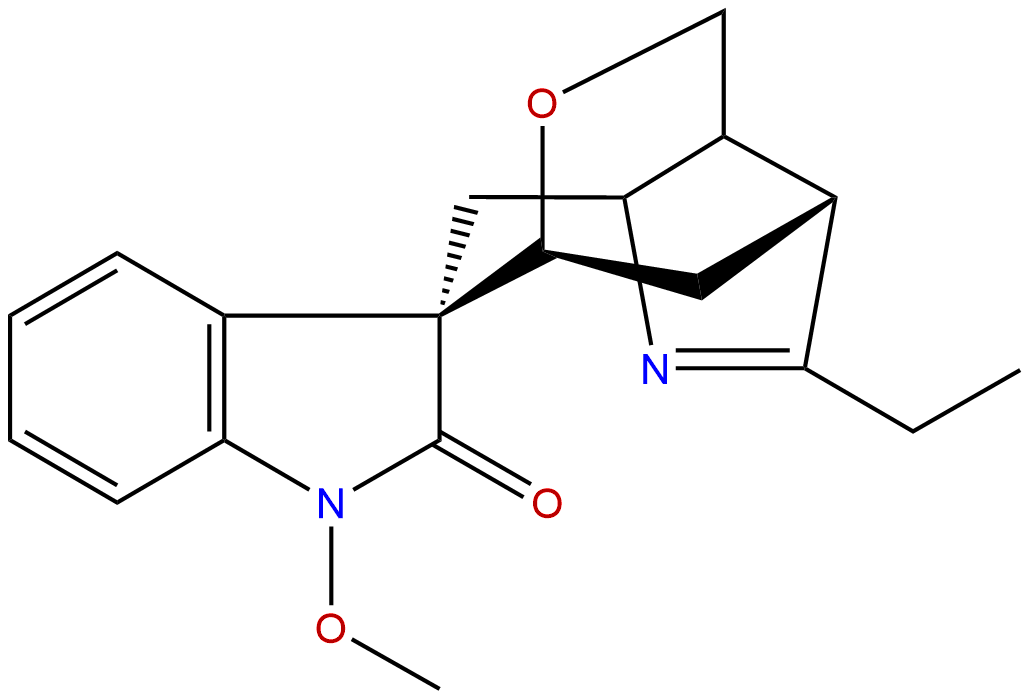


Product name: Gelsenicine
Synonym name: Humantenmine
Catalogue No.: BP3429
Cas No.: 82354-38-9
Formula: C19H22N2O3
Mol Weight: 326.396
Botanical Source:
Physical Description: Cryst.
Type of Compound: Alkaloids
Purity: 95%~99%
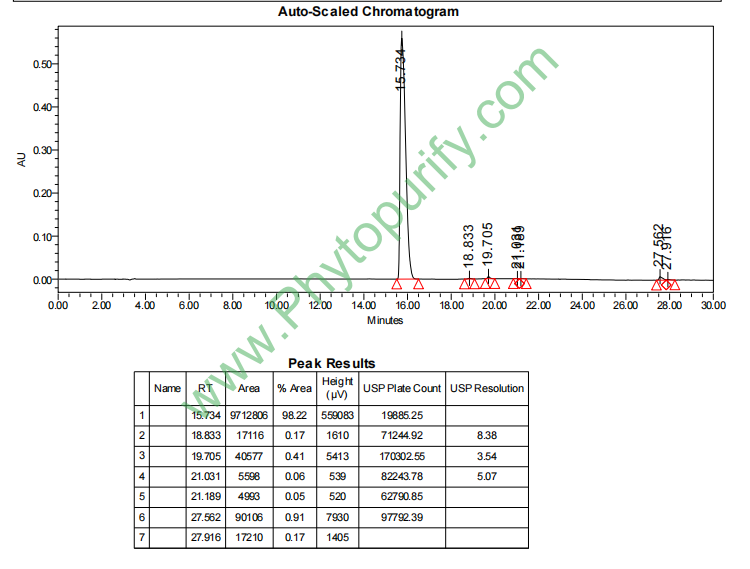
Analysis Method: HPLC-DAD or/and HPLC-ELSD
Identification Method: Mass, NMR
Packing: Brown vial or HDPE plastic bottle
The product could be supplied from milligrams to grams. Inquire for bulk scale.
We provide solution to improve the water-solubility of compounds, thereby facilitating the variety of activity tests and clinic uses.
For Reference Standard and R&D, Not for Human Use Directly.
HPLC of Gelsenicine
Storage conditions:Short-term storage at 2~8℃, long-term storage at -20 ~ -80℃
51.1300
2.2735
2.2668
.1622
5.6688
23.9008
High
75.2747
6.2791
No
Yes
Yes
No
Yes
No
1.5
Yes
Yes
Yes
Yes
Gelsenicine, also known as Humanteng alkaloid A, is a traditional poisonous plant derived from Gelsemium elegans(Gelsemium elegans)Indole alkaloids isolated from the middle. Its CAS number is 82354-38-9, molecular formula is C19H22N2O3, and molecular weight is approximately 326.40 g/mol. As one of the complex and biologically active alkaloids in Gelsemium elegans, Huwanvine alkaloid A has long been shrouded in mystery due to the highly toxic properties of its parent plant. Gelsemium elegans is known as the "intestinal cutting grass" in folk culture. The entire plant is poisonous, and ingestion can cause serious poisoning or even death. However, modern pharmacological research is gradually revealing that the chemical components contained in this highly toxic plant, especially alkaloids like matrine A, may have strong therapeutic potential, especially in the field of anti-tumor, with precise dosage and targeted effects. In recent years, with the deepening development of natural product chemistry and molecular pharmacology, researchers have begun to systematically analyze the chemical structure, target of action, and molecular mechanism of matrine A, aiming to transform it from a "toxin" into a potential "drug". This article will provide a comprehensive professional interpretation of this controversial and promising natural compound from its chemical nature, sources, pharmacological mechanisms, drug evaluation, and research prospects.
Hu Man Teng alkaloid A belongs to the monoterpene indole alkaloid family, with a complex structure and multiple chiral centers. From the provided SMILES string (CCC1=NC2C [C @ @] 3 (C (=O) N (OC) c4ccccc43) [C @ @ H] 3C [C @ @ H] 1C2CO3), it can be inferred that its core skeleton contains an indole or hydrogenated indole ring system, fused with multiple cyclic structures (such as cyclohexane, oxygen-containing heterocycles, etc.), as well as functional groups such as methoxycarbonyl. This complex polycyclic fused structure is the material basis for its unique biological activity.
From the perspective of pharmacological parameters, its molecular weight (MW) is 326.40, which meets the requirement of "molecular weight less than 500" in Lipinski's five rules. The calculated topological polar surface area (TPSA) is 51.13 Å ², which is moderate and usually indicates good membrane permeability. The lipid water partition coefficient (LogP) is 2.27, and the LogD (usually 7.4 at a specific pH) is 2.27, indicating that the compound has moderate lipophilicity, neither too hydrophilic (difficult to excrete) nor too lipophilic (not easy to accumulate in adipose tissue), which is beneficial for its distribution in the body. Its theoretical water solubility value is relatively low (0.1622, usually measured in mg/mL or mol/L, not specified here, but the small value indicates limited solubility), which is consistent with its LogP value. This is a common challenge faced by many natural alkaloids and may require optimization in formulation studies.
The only known plant source of Humangteng alkaloid A is Gelsemium elegans(Gelsemium elegans)It belongs to the Gelsemiaceae family. Gelsemium is mainly distributed in southern China, Southeast Asia, and India, and is an evergreen woody vine plant. In traditional Chinese medicine and folk applications, the use of Gelsemium elegans is extremely cautious due to its severe toxicity. Although there is a record in ancient books of "using poison to attack poison", which is used to treat rheumatism, rheumatism, bruises, scabies, etc., it has a very narrow treatment window (the effective dose is very close to the toxic dose), and the risk of use is extremely high, so it has not become a mainstream traditional Chinese medicine. More often than not, it is seen as a toxic plant that requires strict control. This strong toxicity is mainly attributed to the various alkaloids it contains, including sophocarpine A, B, C, D, etc., among which huperzine A is one of them. These alkaloids can strongly inhibit the activity of neurons in the central nervous system, especially in the brainstem and spinal cord, leading to muscle relaxation, respiratory depression, and ultimately death. It is this powerful ability to interfere with life activities that prompts scientists to think: can this toxicity be "controlled" and directed towards specific killing of abnormal cells (such as tumor cells)?
Modern pharmacological research has focused on the biological activity of matrine A in Houttuynia cordata antitumor field The target information provided by the database provides important clues for us to understand its potential mechanism of action. These targets are not direct receptors, but key signaling molecules and apoptosis related proteins within cells, suggesting that matrine A may exert anti-tumor effects by affecting the cell cycle and apoptosis pathways.
Hypothesis of mechanism of action Based on these target information, the potential network of action of Huwanteng alkaloid A can be outlined. It may activate the tumor suppressor protein p53 through some initial signal that has not been fully elucidated, such as causing DNA damage or oxidative stress. Activated p53 upregulates the expression of its downstream target gene p21 (CDKN1A), causing cell cycle arrest; On the other hand, p53 can transcribe and activate the pro apoptotic protein BAX, and may inhibit the expression of anti apoptotic proteins. The activation of BAX leads to mitochondrial dysfunction, the release of apoptotic factors, and the activation of executor proteases such as Caspase-3 (CASP3), ultimately resulting in cell apoptosis. Meanwhile, Hu Man Teng alkaloid A may inhibit the expression of the oncogene MYC through independent or p53 dependent pathways, thereby weakening the proliferation driving signals of tumor cells. This multi-target and multi pathway mode of action may result in strong inhibitory and cytotoxic effects of Huwanvine alkaloid A on tumor cells. Of course, this is just a reasonable hypothesis based on bioinformatics target prediction. The specific mechanism of action, the upstream and downstream relationships between each target, and the initial target of action still require extensive in vitro and in vivo experimental verification.
Based on the provided pharmacological parameters, we can conduct a preliminary evaluation of the potential of Huwanvine alkaloid A as a candidate drug.
Lipinski's Rule of Five This is an empirical rule for evaluating the oral absorption potential of compounds. The situation of Hu Man Teng alkaloid A is as follows: 1) Molecular weight 326.40<500; 2) Calculate LogP value 2.27<5; 3) Hydrogen bond donors (inferred from structure, may be 0 or 1, such as NH? Requires precise calculation) may be less than 5; 4) The number of hydrogen bond acceptors (N, O atoms) is approximately 5 (with a molecular formula containing 3 O and 2 N atoms), which may be close to but not exceed 10. Overall, it basically conforms to Lipinski's rules, indicating that it has good oral absorption potential.
Absorption and distribution:
- Caco-2 permeability 23.90 (unit not provided, usually on the order of 10 ⁻⁶ cm/s), this value is relatively high, indicating good permeability in intestinal models and supporting its potential for good oral bioavailability.
- Blood-brain barrier (BBB) penetrability Annotated as' high '. This is consistent with the characteristics of many bioactive alkaloids and explains the central neurotoxicity of the alkaloids in Gelsemium elegans. This is a potential advantage for drugs aimed at treating central nervous system tumors, such as gliomas; However, for the treatment of peripheral tumors, high BBB penetration may lead to unnecessary central nervous system side effects, which is a risk that requires caution.
- Plasma protein binding rate (PPB)75.27%, belonging to the moderate to high level. High protein binding can affect the free concentration, distribution volume, and clearance rate of drugs, which may complicate the pharmacokinetic relationship.
Metabolism and toxicity:
- Ames test The value of 1.5 (usually the mutagenicity ratio, if>2, it is considered positive) is close to but not clearly above the threshold, indicating that its mutagenicity risk needs further experimental confirmation.
- chromosome aberration Marked as' yes', this is a clear warning signal of genetic toxicity and a serious issue that needs to be focused on in drug development.
- HERG inhibition Marked as' no ', this is a positive signal, indicating a low likelihood of causing QT interval prolongation in the heart (a serious risk of arrhythmia).
- Skin sensitization (Skid_Sens) and respiratory sensitization (Resp_Sens)All are marked as "Yes", indicating that the compound may have allergenic potential.
- Serum biochemical indicators Elevated levels of serum alkaline phosphatase (Ser_LK), gamma glutamyltransferase (Ser_GGT), aspartate aminotransferase (Ser_ST), and alanine aminotransferase (Ser_LT) are all marked as "yes". These are commonly used biomarkers for liver cell injury, strongly suggesting that matrine A has Potential hepatotoxicity This is one of the biggest obstacles on its path to becoming a drug.
- Maximum Recommended Treatment Dose (MRTD)Annotated as' no ', it may mean that the safe dose cannot be determined based on existing data, or it has been determined that the treatment window is too narrow.
comprehensive evaluation Hu Man Teng alkaloid A exhibits good pharmacological properties in terms of molecular size, lipid solubility, and membrane permeability, and has the physical and chemical basis to become an oral medication. However, its serious security issue It is the key to restricting its direct development into medicine. The clear risk of chromosomal aberrations, potential hepatotoxicity, sensitization, and central side effects associated with high BBB penetration pose significant challenges. These toxicities are likely homologous to their strong biological activity (anti-tumor mechanism), that is, their pathway of killing tumor cells may also damage normal cells, especially proliferating cells (such as liver cells, bone marrow cells) and the nervous system.
At present, research on the alkaloid A of Houttuynia cordata is still ongoing Preclinical stage Moreover, compared to its homologous compounds such as Gelsemine A, there are limited publicly available in-depth research reports. Current research mainly focuses on chemical separation and identification, preliminary cytotoxicity screening, and database based bioinformatics target prediction (as cited in this article). Its strong toxicity characteristics make researchers very cautious about its direct development as an anti-cancer drug.
Future research directions may focus on the following aspects:
1. Deep analysis of mechanism The primary task is to use molecular biology and cell biology techniques to accurately validate the predicted targets (TP53, CASP3, MYC, BAX, CDKN1A) in tumor cell models, elucidate the specific signaling pathway network that induces apoptosis and cycle arrest, and search for their initial molecular targets.
2. Structural modification and optimization This is the core strategy to reduce its toxicity and improve selectivity. Pharmaceutical chemists can use it as a mother nucleus for systematic structural modifications, such as introducing or altering certain functional groups, with the aim of reducing its BBB penetration and minimizing neurotoxicity; Modifying pharmacophores that may cause liver toxicity and genetic toxicity; Attempt to improve its selectivity index towards tumor cells and normal cells. The study of structure-activity relationships will guide the synthesis of a series of derivatives or analogues.
3. Innovation in dosage form and administration strategy By utilizing modern drug delivery technologies such as nanoparticles, liposomes, antibody conjugated drugs (ADCs), etc., targeted delivery of huperzine A to tumor tissues is achieved, reducing its distribution in normal tissues (especially the liver and central nervous system), thereby improving efficacy while reducing systemic toxicity.
4. Exploration of combination therapy Study the synergistic effect of the combination application of Huwanteng alkaloid A and existing clinical anticancer drugs, to see if they can produce synergistic effects, reduce their respective dosages, and thus bypass the problem of high single drug toxicity.
Application Prospects The road to directly becoming a marketed drug is very difficult, mainly due to its inherent toxicity spectrum. However, as a Excellent lead compounds The value is enormous. Its unique complex chemical structure and demonstrated multi-target anti-tumor activity provide a valuable starting point for medicinal chemists. Through rational structural modification, it is entirely possible to obtain a new generation of candidate drugs with lower toxicity, higher selectivity, and better drug properties. In addition, continuous research on its mechanism of action can also help reveal the deep biological principles behind the impact of highly toxic substances such as alkaloids from Gelsemium elegans on cell life and death decisions, and may discover new anti-cancer targets or pathways.
In short, Hu Man Teng alkaloid A is a typical "double-edged sword", originating from highly toxic plants, carrying strong cell killing ability and severe safety warnings. The task of modern drug research is to use scientific "carving" to tame its toxicity and guide its sharp edge to accurately target cancer cells. This path is full of challenges, but it is also the charm and significance of developing innovative drugs for natural products.
