


Product name: Garcinone C
Synonym name:
Catalogue No.: BP0622
Cas No.: 76996-27-5
Formula: C23H26O7
Mol Weight: 414.454
Botanical Source: Garcinia mangostana L.
Physical Description:
Type of Compound: Xanthones
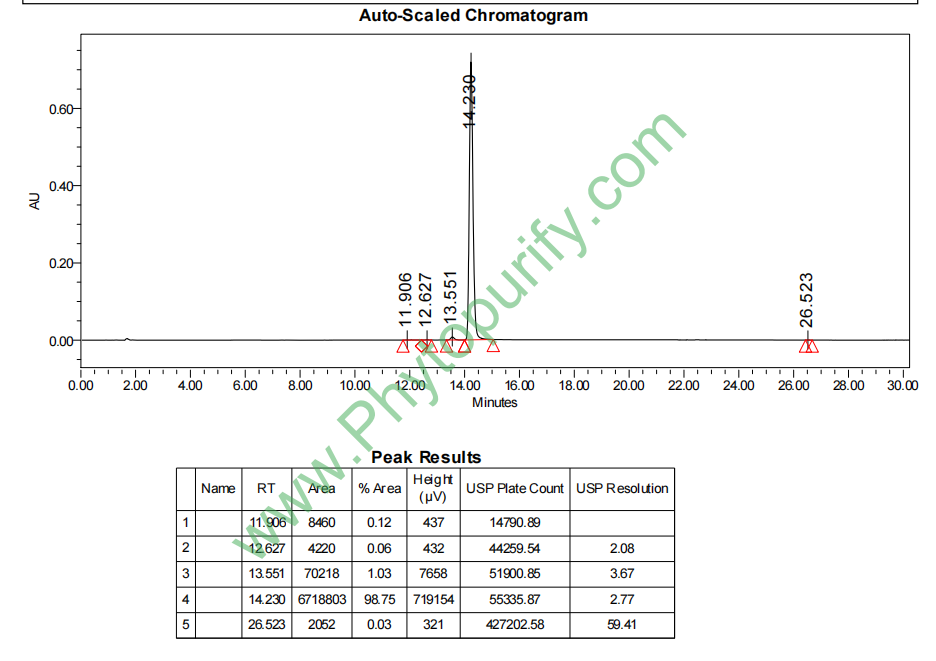
Purity: 95%~99%
Analysis Method: HPLC-DAD or/and HPLC-ELSD
Identification Method: Mass, NMR
Packing: Brown vial or HDPE plastic bottle
Storage: Store in a well closed container, protected from air and light. Put into refrigerate or freeze for long term storage.
Whenever possible, you should prepare and use solutions on the same day. However, if you need to make up stock solutions in advance, we recommend that you store the solution as aliquots in tightly sealed vials at -20℃. Generally, these will be useable for up to two weeks.
The product could be supplied from milligrams to grams
Inquire for bulk scale.
Chengdu Biopurify Phytochemicals Ltd. is a leading company in the research, development, manufacture and marketing of High Quality Phytochemicals and Extracts(especially Active Ingredients from Traditional Chinese Medicine,TCM), Natural Active Pharmaceutical Ingredients worldwide.
The main services:
A. Supply active ingredients and reference standards of TCM, from mgs to kgs scale
B. Custom extraction and purification, target Herb Active Ingredients
C. Custom synthesis and semi-synthesis for Natural Active Ingredients
D. CR(contract research), CM(contract manufacture) and PD(process development) services from lab scale, pilot scale to commercial scale(GMP is also available)
E. TCM compounds library for drug screen,more than 3000 compounds available, many of them are rare and unique.
HPLC of Garcinone C
Storage conditions:Short-term storage at 2~8℃, long-term storage at -20 ~ -80℃
131.3600
3.5878
3.4337
.0564
1.8032
2.8133
Low
88.8385
3.2399
No
No
No
No
Yes
Yes
0.6
Yes
No
Yes
No
Natural products have always been an important source of innovative drug discovery, among which mountain ketone compounds have attracted much attention due to their extensive and significant biological activities. Garcinone C (CAS number: 76996-27-5), as a unique pharmacological derivative of mountain ketone, is mainly derived from the traditional medicinal plant Lingnan bamboo(Garcinia oblongifolia). Early research has revealed that it has traditional application values such as anti-inflammatory, astringent, and promoting granulation. In recent years, with the deepening of tumor research, Garcinone C has shown great potential in the field of anti-tumor, especially in inhibiting malignant tumors such as nasopharyngeal carcinoma. Research has shown that its mechanism of action is related to regulating the Hedgehog signaling pathway, inducing cell cycle arrest and apoptosis, and involves multiple key molecular targets. In addition, its oral activity provides favorable conditions for the development of its medicinal properties. This article aims to systematically review the chemical structure, plant origin, pharmacological activity, molecular mechanism of action, pharmacological evaluation, and clinical application prospects of Garcinone C, in order to provide comprehensive scientific references for the in-depth research and drug development of this natural product.
Garcinone C is a multi methoxy substituted ketone compound. Its basic parent nucleus is a ketone, also known as 9H-hexane-9-one structure, and its chemical name is 1,3,6,7-tetrahydroxy-2,4,5,8-tetramethoxy-hexane-9-one. Its molecular formula is C19H18O10 and its molecular weight is 414.4540 g/mol.
The chemical structure of this compound is characterized by its highly substituted mode: hydroxyl groups (- OH) are present at positions 1, 3, 6, and 7 of the xanthenone skeleton, while methoxy groups (- OCH3) are present at positions 2, 4, 5, and 8. The arrangement of multiple hydroxyl and methoxy groups not only determines their polarity, but is also closely related to their biological activity. Hydroxyl groups provide hydrogen bond donor ability, while methoxy groups contribute hydrophobicity and steric hindrance, jointly affecting their interactions with biomolecules.
From the analysis of physical and chemical properties, the lipid water partition coefficient (LogP) of Garcinone C is 3.5878, indicating its moderate to high lipophilicity, which is beneficial for its penetration of cell membranes. Its topological polar surface area (TPSA) is 131.3600 Å ², reflecting the presence of multiple polar groups (hydroxyl and carbonyl oxygen) in the molecule. The water solubility data is 0.0564 mg/mL, which belongs to the category of slightly soluble to poorly soluble. This suggests that solubilization strategies may need to be considered in formulation development. Based on its molecular weight, LogP, and TPSA, this compound basically conforms to the Rule of Five, indicating that it has good oral absorption potential. The phenolic hydroxyl groups in its structure also endow it with the potential for antioxidation and chelation with metal ions.
Garcinone C is mainly derived from the Clusiaceae family and the genus Clusiaceae(Garcinia)Plant Ridge Nanshan Bamboo(Garcinia oblongifolia Champ. ex Benth.), This plant is widely distributed in southern China, and its fruit, bark, and leaves are commonly used in folk medicine to treat inflammation, diarrhea, and skin damage.
The extraction and separation of Garcinone C from plant materials typically follow the classic process of natural product chemistry. Firstly, crush the dried bamboo fruits or bark of Lingnan Mountain and extract them using organic solvents. Common extraction solvents include methanol, ethanol, or acetone, as they can effectively dissolve polar to moderately polar ketone components. After vacuum concentration, the crude extract is subjected to preliminary fractionation using liquid-liquid extraction (such as extraction with petroleum ether, ethyl acetate, and n-butanol in sequence), and Garcinone C is usually enriched in the ethyl acetate fraction.
Further purification relies on various chromatographic techniques. Silica gel column chromatography is commonly used for preliminary separation, with different ratios of chloroform methanol or petroleum ether ethyl acetate gradient elution. Subsequently, high-purity Garcinone C monomer compounds were obtained by combining reverse phase silica gel (such as C18) column chromatography, preparative thin layer chromatography (PTLC), or high performance liquid chromatography (HPLC) for fine purification. Structural identification is accomplished through spectroscopic techniques such as nuclear magnetic resonance (NMR, including 1H-NMR and 13C-NMR), mass spectrometry (MS), infrared spectroscopy (IR), and ultraviolet spectroscopy (UV). Modern technology has also explored green technologies such as ultrasound assisted extraction and microwave-assisted extraction to improve extraction efficiency.
The pharmacological activity research of Garcinone C mainly focuses on the field of anti-tumor, and has also shown certain potential in other aspects.
1. Antitumor activity
Garcinone C exhibits significant cytotoxicity against various tumor cell lines, with the most prominent inhibitory effect on nasopharyngeal carcinoma (NPC) cell lines such as CNE1, CNE2, HK1, HONE1. Research has confirmed that Garcinone C can inhibit the viability of these cells in a time-dependent and dose-dependent manner, with a half maximal inhibitory concentration (IC50) value at the micromolar level, demonstrating strong anti proliferative effects. In addition to nasopharyngeal carcinoma, it also has a certain growth inhibition effect on liver cancer, breast cancer, colon cancer and other cell lines, indicating that its anti-tumor spectrum is relatively broad.
2. Anti inflammatory activity
As one of the traditional medicinal ingredients of Lingnan bamboo, the anti-inflammatory effect of Garcinone C has been experimentally verified. In the lipopolysaccharide (LPS) - induced macrophage inflammation model, Garcinone C can effectively inhibit the production of nitric oxide (NO), prostaglandin E2 (PGE2), and pro-inflammatory cytokines such as TNF - α and IL-6. Its anti-inflammatory mechanism may be related to the inhibition of the activation of nuclear factor kappa B (NF - κ B) and mitogen activated protein kinase (MAPK) signaling pathways.
3. Other activities
Preliminary research suggests that Garcinone C may have certain antioxidant activity, which is related to its phenolic hydroxyl structure. In addition, its "astringency" characteristic may be related to its ability to bind with proteins, while the traditional description of "promoting granulation" may point to its potential impact on certain tissue repair processes, but the specific mechanism still needs to be further studied.
The anti-tumor effect of Garcinone C involves a complex regulatory network of multiple pathways and targets, and its core mechanisms mainly include inducing cell cycle arrest, promoting cell apoptosis, and inhibiting tumor invasion and metastasis.
1. Inhibit Hedgehog signaling pathway
The Hedgehog (Hh) pathway plays a crucial role in embryonic development and the occurrence and development of various cancers, including nasopharyngeal carcinoma. Garcinone C has been proven to be an effective inhibitor of this pathway. It may down regulate downstream target genes (such as Bcl-2, Cyclin D1, etc.) by interfering with the activity or expression of the key transcription factor Gli1 in the Hh pathway, ultimately leading to inhibition of cell proliferation and increased susceptibility to apoptosis.
2. Inducing DNA damage response and cell cycle arrest
Garcinone C can stimulate the expression of ATR (ataxia telangiectasia and Rad3 related proteins) in a time-dependent and dose-dependent manner. ATR is a core kinase in the DNA damage response (DDR) pathway, and its activation typically indicates that cells have experienced DNA replication pressure or damage. Meanwhile, Garcinone C upregulates the phosphorylation level of 4E-BP1 (eukaryotic translation initiation factor 4E binding protein 1). 4E-BP1 is a downstream effector molecule of the mTOR pathway, whose activation can inhibit cap dependent translation, thereby globally reducing protein synthesis and inhibiting cell growth. These events work together to block the cell cycle at the G1/S or G2/M checkpoint, preventing cells from entering mitosis.
3. Regulating apoptosis related proteins
Garcinone C can downregulate the expression of anti apoptotic proteins MCL1 and BCL2, and may also affect the activation of STAT3 (signal transduction and transcription activator 3). STAT3 is an important oncogenic transcription factor, whose sustained activation promotes cell survival, proliferation, and immune escape. Inhibiting STAT3 signaling helps to restore the apoptotic program of cells.
4. Inhibit invasion and metastasis related factors
Garcinone C has inhibitory effects on matrix metalloproteinase 2 (MMP2) and hypoxia inducible factor 1 alpha (HIF1A). MMP2 can degrade extracellular matrix, promote tumor invasion and metastasis; HIF1A is activated in the hypoxic microenvironment of tumors, regulating processes such as angiogenesis and metabolic reprogramming. Inhibiting these two targets helps to curb the invasion and metastasis ability of tumors.
5. Impact on other potential targets
Garcinone C may also interfere with DNA replication and transcription by inhibiting the activity of topoisomerases I (TOP1) and II α (TOP2A). Its potential effects on estrogen receptor α (ESR1) and aromatase (CYP19A1) suggest that it may have application value in hormone dependent cancer (such as breast cancer). In addition, regulation of the MAPK1 (ERK2) pathway is also involved in its growth inhibitory effect.
In summary, Garcinone C forms a multi-target anti-tumor network by interweaving multiple key nodes such as the Hh pathway, DDR pathway, apoptosis pathway, STAT3 signaling, and invasion and metastasis related factors.
Based on its chemical structure and preliminary biological data, conduct a preliminary pharmacological evaluation of Garcinone C.
1. Physical and chemical properties and ADMET properties
As mentioned earlier, the molecular weight (414.45) and LogP (3.59) of Garcinone C are within an acceptable range, with slightly higher TPSA (131.36 Å ²), but still within the range of many oral medications. Its micro solubility is the main challenge in formulation development, which may require improving dissolution through techniques such as salt formation, solid dispersion formation, or the use of nano formulations. The blood-brain barrier permeability is predicted to be 'low', which may reduce unnecessary neurotoxicity for the treatment of tumors outside the central nervous system. Importantly, preliminary safety predictions indicate a 'no' risk of hERG inhibition, suggesting a lower risk of causing cardiac QT interval prolongation. The Ames test value is 0.6 (usually considered to have a mutagenic risk of>1.0), indicating a low genetic toxicity risk, but further experimental confirmation is needed.
2. Pharmacokinetic prediction and challenges
Garcinone C has oral activity, which provides convenience for its administration route. However, mountain ketone compounds often face challenges with low oral bioavailability, which may include first pass metabolism (the phenolic hydroxyl group in their structure is a potential site for glucuronidation and sulfation combined metabolism), limited intestinal permeability, and solubility issues. There is currently a lack of systematic pharmacokinetic research data on its metabolic pathways, main metabolites, distribution characteristics, and excretion patterns in the body. In the future, in-depth preclinical pharmacokinetic studies are needed to clarify its absolute bioavailability, half-life, tissue distribution, and potential drug drug interactions (especially with the CYP450 enzyme system).
3. Toxicological considerations
Although Ames test predictions are good, comprehensive preclinical toxicology evaluation is essential, including acute toxicity, repeated dose toxicity (28 days or longer), reproductive toxicity, and organ specific toxicity (such as liver toxicity, as some ketone compounds have been reported to cause liver damage) studies.
Garcinone C, as a natural lead compound with multi-target anti-tumor activity, has broad clinical application prospects, but also faces many challenges.
1. As a lead compound for anti-tumor drugs
Its most direct application prospect is the development of new anti-tumor drugs, especially for malignant tumors such as nasopharyngeal carcinoma and liver cancer that are highly prevalent in Asia and prone to developing resistance to existing therapies. Its unique mechanism of action, especially the inhibition of the Hedgehog pathway, provides a new candidate molecule for the treatment of tumors with abnormal activation of this pathway. It can explore its potential as a monotherapy or in combination with existing chemotherapy drugs (such as cisplatin) and targeted drugs to enhance efficacy and overcome drug resistance.
2. As a chemopreventive or adjuvant therapy agent
Given its anti-inflammatory and antioxidant activity, Garcinone C may be developed for chemoprevention of cancer or to alleviate the inflammatory side effects caused by radiotherapy and chemotherapy.
3. Challenges faced and future research directions
- structural optimization By modifying the structure of Garcinone C (such as modifying hydroxyl and methoxy groups), the aim is to improve its water solubility, metabolic stability, target selectivity, and efficacy, while reducing potential toxicity.
- Formulation development Develop advanced drug delivery systems suitable for their physicochemical properties, such as nanoparticles, liposomes, phospholipid complexes, etc., to improve their oral bioavailability and tumor targeting.
- Deepening mechanism It is necessary to use techniques such as gene knockout/knock in, proteomics, metabolomics, etc. to more accurately elucidate its direct targets and upstream and downstream signaling networks.
- Preclinical translational studies Establish more reliable animal models (such as human tumor xenograft models) for systematic pharmacological, pharmacokinetic, and toxicological evaluations, providing solid data for clinical trial applications.
- Explore new indications Based on its multi-target characteristics, its potential applications in other proliferative or inflammatory diseases such as fibrosis and autoimmune diseases can be explored.
Garcinone C is a bioactive mountain ketone compound isolated from the traditional medicinal plant Lingnan bamboo. In recent years, significant progress has been made in its research in the field of anti-tumor, revealing its broad-spectrum anti-tumor effects through multiple mechanisms such as inhibiting the Hedgehog signaling pathway, activating DNA damage response and translation inhibition mediated by ATR/4E-BP1, regulating apoptosis and survival related proteins (such as MCL1, BCL2, STAT3), and inhibiting invasion transfer factors (such as MMP2, HIF1A). It has oral activity and preliminary pharmacological predictions indicate its potential for development. However, its poor water solubility and lack of systematic pharmacokinetic data are bottlenecks for clinical application. Future research should focus on optimizing the structure through medicinal chemistry methods, improving its bioavailability using modern formulation techniques, and conducting systematic preclinical evaluations. Garcinone C, as an excellent natural lead molecule, not only provides valuable clues for the development of novel multi-target anti-tumor drugs, but also fully demonstrates the enormous potential of exploring the value of modern drugs from traditional medicinal plants. With the continuous deepening of research, Garcinone C is expected to realize its translational medical value in tumor treatment and even other disease fields.
