


Synonym name:
Catalogue No.: BP1366
Cas No.: 2189-80-2
Formula: C32H52O2
Mol Weight: 468.766
Botanical Source: Alnus spp. and Lithocarpus spp. and others
Purity: 95%~99%
Analysis Method: HPLC-DAD or/and HPLC-ELSD
Identification Method: Mass, NMR
Packing: Brown vial or HDPE plastic bottle
Can be supplied from milligrams to grams.
For Reference Standard and R&D, Not for Human Use Directly.
Inquire for bulk scale.
HPLC of Taraxerol acetate
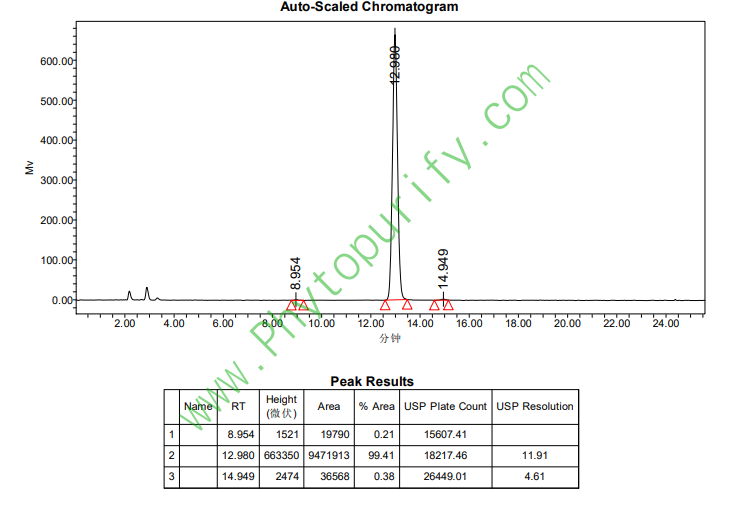
Storage conditions:Short-term storage at 2~8℃, long-term storage at -20 ~ -80℃
26.3000
9.1987
9.1998
.0002
9.7068
3.2924
High
91.7842
4.8064
No
No
No
No
No
No
0.0
No
No
No
No
Natural products, as an important treasure trove for drug discovery, play an irreplaceable role in the history of human disease prevention and treatment. Among them, triterpenoids have attracted much attention due to their widespread distribution in the plant kingdom and diverse biological activities. Taraxerol acetate, as an acetylated derivative of lupine type pentacyclic triterpenes, has gradually emerged from numerous natural triterpenes in recent years and become an emerging hotspot in pharmacological research. Its CAS number is 2189-80-2, originally discovered for its presence in traditional medicinal plants. Early research mainly focused on its anti-inflammatory properties, confirming that it is a non selective cyclooxygenase (COX) inhibitor with IC50 values of 116.3 μ M and 94.7 μ M for COX-1 and COX-2, respectively. This characteristic suggests its potential application value in inflammation related diseases. More importantly, subsequent studies have revealed its significant anti-cancer activity and ability to induce tumor cell apoptosis, demonstrating its broad prospects in the field of tumor prevention and treatment. In addition, in-depth exploration of its liver protective effect has revealed that it can regulate multiple key targets, including NRF2, MMP9, TGFB1, etc., indicating its multi-target and multi pathway characteristics. Although its pharmacological parameters, such as extremely high LogP values, pose development challenges, its clear biological activity and relatively abundant natural sources make it a highly valuable lead compound for research. This article aims to systematically review the chemical properties, plant sources, pharmacological activities, mechanisms of action, and medicinal properties of acetyl dandelion terpenoids, in order to provide comprehensive academic references for the in-depth research and future development of this compound.
The chemical name of acetylated dandelion terpenol is (3 β) - D-Friedoleanan-3-yl acetate, with a molecular formula of C32H52O2 and a molecular weight of 468.7660. Its core structure is the lupine type pentacyclic triterpenoid skeleton, which is composed of five fused rings (usually four hexagonal rings and one pentagonal ring) and has a high degree of stereochemical complexity. Acetylation on the C-3 hydroxyl group to form acetate is a key structural feature that distinguishes it from the parent compound Taraxerol. This modification not only affects its lipid solubility and membrane permeability, but also often has a significant impact on its biological activity and target of action.
From the analysis of physical and chemical properties, acetylated dandelion terpenoids exhibit typical characteristics of lipophilic triterpenoids. Its calculated lipid water partition coefficient (LogP) is as high as 9.1987, indicating its strong lipophilicity. Consistent with this, its water solubility is extremely low, about 0.0002 mg/mL, which determines the challenges it will face in terms of distribution in organisms, formulation development, and administration routes. Its topological polar surface area (TPSA) is relatively small, only 26.3 Å ², further confirming its low molecular polarity and easy penetration of lipid bilayers. Based on these properties, the predictive model shows that it has a high blood-brain barrier permeability, which provides the possibility for its application in central nervous system related diseases such as neuroinflammation and brain tumors. In early safety evaluations, data showed no hERG potassium channel inhibitory activity (hERG inhibition: No), indicating a low potential risk of cardiac toxicity; At the same time, the Ames test result was 0.0, indicating that there was no mutagenicity under the test conditions used, providing preliminary support for its safety. In summary, acetyl dandelion terpenol is a highly lipophilic, low polarity, and specific safety window lupine type triterpenoid derivative.
Acetyldandelion terpenoids are relatively widely distributed in nature and mainly exist in different parts of various traditional medicinal plants. Its most common source is the Taraxacum genus in the Asteraceae family, such as the medicinal dandelion Taraxacum officinale, which is also the origin of its name. In addition, it has also been found in plants of multiple families such as Euphorbiaceae, Leguminosae, Euonymus, etc., such as Croton oblongifolius, Pongamia pinnata, Cleistanthus collinus, and various Combretum plants. It often coexists with other triterpenoids and sterols such as dandelion terpenoids in plant bodies, and is mainly enriched in bark, leaves, root bark, and the milk or resin of certain plants.
Extracting acetyl dandelion terpenoids from plant materials usually follows the conventional process of natural product chemistry. Firstly, organic solvents are used for crude extraction. Due to its high lipid solubility, chloroform, dichloromethane, ethyl acetate, or different proportions of methanol chloroform mixed solvents are often used to obtain total extracts from dried and crushed plant materials through cold impregnation, hot reflux, or Soxhlet extraction methods. Subsequently, preliminary separation was performed using silica gel column chromatography, and the total extract was segmented based on polarity differences using gradient elution systems such as petroleum ether ethyl acetate or cyclohexane ethyl acetate. Acetyldandelion terpenoids typically appear in moderately polar elution fractions. In order to further purify, it is often necessary to combine repeated silica gel column chromatography, gel (LH-20) column chromatography and high performance liquid chromatography (HPLC, usually using reverse C18 column, methanol water or acetonitrile water as mobile phase) and other technologies. The separation process can be monitored by thin layer chromatography (TLC) and colored using a chromogenic agent such as vanillin sulfuric acid ethanol solution. The structural identification comprehensively utilizes modern spectroscopic methods such as nuclear magnetic resonance (NMR, including 1H NMR, 13C NMR, 2D NMR), mass spectrometry (MS), infrared spectroscopy (IR), and X-ray single crystal diffraction to ultimately confirm its planar and three-dimensional structure. In recent years, green extraction techniques such as supercritical fluid extraction have also been explored for efficient extraction of such triterpenes.
Numerous in vitro and in vivo pharmacological studies have confirmed that acetylated dandelion terpenoids have multiple biological activities, among which anti-cancer and liver protective effects are the most prominent.
1. Anti inflammatory activity:
As a dual inhibitor of COX-1 and COX-2, acetyl dandelion terpenoids exert anti-inflammatory effects by blocking the conversion of arachidonic acid to prostaglandins (PGs). In various cellular inflammatory models, such as lipopolysaccharide induced macrophages, it can effectively inhibit the production of nitric oxide (NO), prostaglandin E2 (PGE2), and pro-inflammatory cytokines (such as TNF - α, IL-6). Animal experiments have also shown that it has anti-inflammatory effects in acute inflammation models such as carrageenan induced paw edema in rats.
2. Anti cancer and apoptosis inducing activity:
This is one of the most highly anticipated activities of acetyl dandelion terpenoids. Research has shown that it exhibits growth inhibition and cytotoxicity against various human cancer cell lines, and can induce cell apoptosis. For example, in liver cancer, breast cancer, colon cancer, lung cancer and other cell lines, acetyl dandelion terpene alcohol treatment can lead to a dose-dependent decline in cell viability. The induced apoptosis process is accompanied by typical morphological changes (such as cell shrinkage and nuclear fragmentation) and biochemical markers, including decreased mitochondrial membrane potential, cytochrome c release, activation of caspase-3 and caspase-9, and cleavage of poly (ADP ribose polymerase) (PARP). In addition, it can also block the cell cycle, often blocking cells in the G0/G1 or G2/M phase, thereby inhibiting cell proliferation.
3. Liver protective activity:
In a chemical liver injury model, acetyl dandelion terpenoids exhibit significant hepatoprotective effects. For example, in acute liver injury mouse or rat models induced by acetaminophen (APAP), carbon tetrachloride (CCl4), or D-galactosamine, pre - or simultaneous administration of acetyl dandelion terpenoids can effectively reduce serum levels of alanine aminotransferase (ALT), aspartate aminotransferase (AST), and alkaline phosphatase (ALP), and alleviate liver tissue pathological damage (such as necrosis, inflammatory infiltration, and steatosis). Its liver protective effect is closely related to antioxidant, anti-inflammatory, and anti fibrotic mechanisms.
4. Other activities:
In addition, the study also reported the potential antibacterial, anti ulcer, and anti hyperglycemic activities of acetylated dandelion terpenoids. Although the research in these areas is relatively preliminary, it broadens its potential application scope.
The pharmacological effects of acetylated dandelion terpenoids, especially their anti-cancer and hepatoprotective activities, are achieved by regulating complex intracellular signaling networks and multiple molecular targets, reflecting the multi-target nature of natural products.
The mechanism of action in liver protection:
The core of its liver protective effect lies in its strong antioxidant stress and anti-inflammatory, anti fibrotic abilities.
* Activate the NRF2/ARE antioxidant pathway: Acetyldandelion terpenol is an effective activator of NRF2 (nuclear factor E2 related factor 2). It can promote the dissociation and translocation of NRF2 from the cytoplasmic chaperone protein Keap1 to the nucleus, where it binds to the antioxidant response element (ARE), thereby initiating the transcriptional expression of a series of downstream phase II detoxifying enzymes and antioxidant proteins. This includes quinone oxidoreductase 1 (NQO1), heme oxygenase-1 (HMOX1), glutathione peroxidase 1 (GPX1), etc. At the same time, it can also upregulate the activity of endogenous antioxidant enzymes such as superoxide dismutase (SOD1, SOD2) and catalase (CAT), jointly clearing excess reactive oxygen species (ROS) and maintaining the redox balance of liver cells.
* Inhibition of TGF - β 1/Smad pro fibrotic pathway: The activation of hepatic stellate cells (HSCs) is the central link in liver fibrosis. Acetyldandelion terpenoids can inhibit the expression of transforming growth factor - β 1 (TGFB1) and its downstream Smad signaling, thereby suppressing the activation and proliferation of HSCs and reducing excessive deposition of extracellular matrix (especially collagen). At the same time, it can downregulate the expression of alpha smooth muscle actin (ACTA2, a marker of activated HSC) and reverse the myofibroblast phenotype of HSC.
* Regulating MMP9/TIMP balance: The balance of matrix metalloproteinase 9 (MMP9) and its tissue inhibitors (TIMPs) is crucial for the degradation and deposition of extracellular matrix. Acetyl dandelion terpenoids can promote abnormal deposition of extracellular matrix degradation by regulating this balance, which helps alleviate fibrosis.
The mechanism of action in anti-cancer:
Its anti-cancer effect is mainly achieved by inducing cell apoptosis through the mitochondrial pathway and blocking the cell cycle.
* Inducing endogenous apoptosis pathway: Acetyldandelion terpenoids can induce mitochondrial dysfunction, leading to membrane potential collapse, release of apoptosis related proteins (such as cytochrome c) into the cytoplasm, form apoptotic bodies with Apaf-1, and sequentially activate caspase-9 and caspase-3, ultimately executing the cell apoptosis program. This process often involves the regulation of Bcl-2 family proteins, such as upregulation of pro apoptotic protein Bax and downregulation of anti apoptotic protein Bcl-2.
* Regulating cell cycle checkpoint proteins: It can inhibit cell cycle progression at specific checkpoints (such as G1/S or G2/M) by upregulating cyclin dependent kinase inhibitors (such as p21, p27) and/or downregulating cyclins (such as cyclin D1, cyclin B1) and cyclin dependent kinases (CDKs).
* Inhibiting inflammation and invasion related pathways: By inhibiting the activation of the COX-2/PGE2 pathway and NF - κ B, it not only reduces inflammation in the tumor microenvironment, but also downregulates the expression of genes related to cell proliferation, survival, invasion, and metastasis (such as MMP9). Inhibition of MMP9 helps to reduce the invasion and metastasis ability of tumor cells.
Although acetyl dandelion terpenoids have clear pharmacological activities, their pharmacological parameters suggest significant challenges in developing them into modern drugs, and their pharmacokinetic studies are still in the preliminary stage.
Drug Evaluation:
According to the provided parameters, its biggest challenge lies in its extremely high lipophilicity (LogP=9.1987) and extremely low water solubility (0.0002 mg/mL). This may lead to the following issues: 1)Poor oral absorption Although high lipid solubility facilitates passive diffusion through the intestinal membrane, low water solubility limits its dissolution in gastrointestinal fluids, becoming the rate limiting step in absorption and potentially leading to low bioavailability and high variability. 2)Difficulty in formulation Conventional dosage forms are difficult to effectively dissolve and release, and advanced drug delivery technologies such as nanocrystals, liposomes, micelles, solid dispersions, or cyclodextrin inclusion complexes are needed to improve their solubility and stability. 3)Distribution and Metabolism A high LogP value indicates that it is prone to accumulate in adipose tissue, has a large distribution volume in the body, and may have a longer elimination half-life. Its high blood-brain barrier permeability is a double-edged sword, which is beneficial for treating brain diseases but may also increase the risk of central nervous system side effects. Fortunately, it showed no hERG inhibition or Ames mutagenicity negative results, providing a preliminary safety starting point for subsequent development.
Pharmacokinetic studies:
At present, there are few reports on the pharmacokinetic studies of the acetyl dandelion terpenoid system, and the information is limited. Based on its physicochemical properties and the common characteristics of triterpenoids, it can be inferred that after oral administration, it may be absorbed through passive diffusion in the small intestine, but its absolute bioavailability may not be high due to the first pass effect (which may occur in the intestine and liver through II combined reactions such as glucuronidation and sulfation). After absorption, it will be widely distributed in various tissues, especially lipid rich organs such as fat and liver. Metabolism mainly relies on the oxidative reactions of the liver cytochrome P450 enzyme system (CYP450) and subsequent binding reactions. Its prototype and metabolites may mainly be excreted through bile into feces, with some being excreted through the kidneys and urine. To obtain accurate pharmacokinetic parameters (such as Cmax, Tmax, AUC, t1/2), it is necessary to rely on sensitive and specific analytical methods (such as LC-MS/MS) for in-depth in vitro and in vivo studies in the future.
Acetyldandelion terpenoids, as a natural triterpenoid compound with multi-target activity, have shown potential application prospects in various disease fields, but their clinical application also faces many challenges.
Potential application directions:
1. Adjuvant therapy for liver disease Based on its clear antioxidant, anti-inflammatory, and anti fibrotic effects, acetylated dandelion terpenoids are expected to be developed as therapeutic or adjuvant drugs for chemical liver injury, alcoholic/non-alcoholic steatohepatitis (NASH), and early liver fibrosis. Its multi-target mechanism of action is particularly suitable for intervening in complex pathological diseases such as NASH.
2. Chemotherapy prevention and adjuvant therapy for cancer Its anti-inflammatory and apoptosis inducing properties make it a potential chemopreventive agent for preventing inflammation related cancers (such as liver cancer and colon cancer) in high-risk populations. It can also be used in combination with existing chemotherapy drugs to enhance efficacy or reduce drug resistance. The value of high BBB permeability in the treatment of central nervous system tumors such as gliomas is worth exploring.
3. Inflammatory related diseases As a COX inhibitor, it can be used to develop local anti-inflammatory drugs (such as topical preparations for treating skin inflammation and arthritis), which may have better safety than systemic administration.
Challenges and Future Prospects:
1. Optimization of drug properties The primary task is to address its water solubility and bioavailability issues. Future research should focus on Formulation innovation By utilizing modern delivery systems such as nanotechnology, stable, efficient, and targeted acetyl dandelion terpenoid preparations can be constructed.
2. In depth mechanism research It is necessary to use techniques such as gene knockout/knockdown, proteomics, metabolomics, etc. to more accurately elucidate its direct target (such as whether it directly interacts with Keap1 or other proteins) and the detailed regulatory mechanisms of upstream and downstream signaling networks.
3. System preclinical evaluation It is necessary to complete comprehensive preclinical pharmacodynamics (in animal models closer to human diseases), pharmacokinetics (ADME), and safety evaluation (acute toxicity, long-term toxicity, reproductive toxicity, etc.) in accordance with new drug development standards, and clarify its treatment window and potential risks.
4. Research on structural modification and analogues Using it as the mother nucleus, conduct reasonable Structural modification The aim is to improve its water solubility, enhance activity, and reduce potential toxicity, which is an effective strategy for obtaining better candidate drugs. It is also crucial to synthesize or search for its natural analogues for structure-activity relationship studies.
5. Explore combination therapy Studying its synergistic effect with existing standard treatment drugs (such as sorafenib for liver cancer or metformin for NASH) may lead to a faster identification of its clinical application entry point.
Acetyldandelion terpenol, as a plant derived lupine triterpenoid compound, has become a promising research object in the field of natural product pharmacology due to its unique chemical structure and diverse pharmacological activities. From non selective COX inhibition to significant anti-cancer and liver protective effects, its biological activity spectrum is constantly expanding. The study of its mechanism of action reveals that it exerts its effects through multiple targets and pathways, such as activating the NRF2 antioxidant pathway, inhibiting TGF - β 1 fibrosis signaling, regulating apoptosis and cycle related proteins, which is in line with the current therapeutic concept of intervening in complex disease systems. However, its extreme lipophilicity and low water solubility constitute the main bottlenecks in its conversion to drugs. Future research needs to deepen the elucidation of its molecular mechanism and vigorously utilize the methods of medicinal chemistry and pharmacy to optimize drug properties. Through structural modification, innovative formulations, and rational combination therapy strategies, it is expected to overcome existing deficiencies and fully unleash its therapeutic potential. In summary, acetyl dandelion terpenoids not only provide new candidate molecules for liver diseases, cancer, and inflammatory diseases, but also provide important scientific clues and research paradigms for drug discovery and development based on natural triterpenoid frameworks.
