


Product name: Taraxerol
Synonym name: Skimmiol; Alnulin
Catalogue No.: BP1365
Cas No.: 127-22-0
Formula: C30H50O
Mol Weight: 426.729
Botanical Source: Taraxacum officinale (dandelion), Alnus spp., Skimmia japonica, Rhododendron spp., Euphorbia spp. and other plants. Rather widely distributed. Also the lichen Pertusaria ophthalmiza (poss. not a genuine lichen constit.)
Physical Description: Powder
Type of Compound: Triterpenoids
Purity: 95%~99%
Analysis Method: HPLC-DAD or/and HPLC-ELSD
Identification Method: Mass, NMR
Packing: Brown vial or HDPE plastic bottle
Storage: Store in a well closed container, protected from air and light. Put into refrigerate or freeze for long term storage.
Whenever possible, you should prepare and use solutions on the same day. However, if you need to make up stock solutions in advance, we recommend that you store the solution as aliquots in tightly sealed vials at -20℃. Generally, these will be useable for up to two weeks.
The product could be supplied from milligrams to grams, up to kilograms
Inquire for bulk scale.
Descriptions:
Taraxerol, a triterpenoid compound, has potent anti-inflammatory effects,it downregulates the expression of proinflammatory mediators in macrophages by interfering with the activation of TAK1 and Akt, thus preventing NF-κB activation. [1]
Taraxerol can produce triterpenoid anti-cancer compound in Agrobacterium-transformed root cultures of butterfly pea (Clitoria ternatea L.).[2]
Taraxerol can be used as a lipid biomarker for mangrove input to the SE Atlantic, the proxy-environment relations for taraxerol and Rhizophora pollen down-core show that increased taraxerol and Rhizophora pollen abundances occur during transgressions and periods with a humid climate, these environmental changes modify the coastal erosion and sedimentation patterns, enhancing the extent of the mangrove ecosystem and/or the transport of mangrove organic matter offshore.[3]
Taraxerol has inhibitory effects on AGS cell growth through inducing G2/M arrest and promotion of cell apoptosis, taraxeryl acetate has less effect on cell cycle arrest and apoptosis of AGS cells than taraxerol.[4]
References:
[1] Yao X, Li G, Bai Q, et al. Int Immunopharmacol, 2013, 15(2):316–24.
[2] Swain S S, Rout K K, Chand P K. Appl Biochem Biotech, 2012, 168(3):487-503.
[3] Versteegh G J M, Schefu? E, Dupont L, et al. Geochim Cosmochim Ac, 2004, 68(3):411-22.
[4] Tan B, Shi H L, Ji G, et al. Journal of Chinese Integrative Medicine, 2011, 32(6):1278-84.
[5] Kumar V, Mukherjee K, Kumar S, et al. Phytochem Anal, 2008, 19(19):244-50.
HPLC of Taraxerol
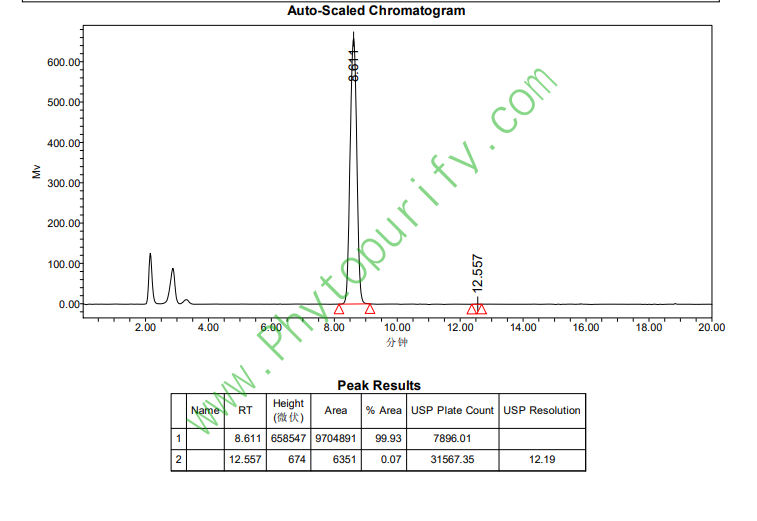
Storage conditions:Short-term storage at 2~8℃, long-term storage at -20 ~ -80℃
20.2300
8.6065
8.6065
.0001
9.6486
7.7975
High
92.6106
4.8000
No
No
No
No
No
No
0.0
No
No
No
No
Natural products, as an important treasure trove for drug discovery, play an irreplaceable role in the history of human disease prevention and treatment. Among them, triterpenoids have always been a hot topic in medicinal chemistry and pharmacology research due to their extensive and significant biological activities. Taraxerol (CAS number: 127-22-0), a pentacyclic triterpenoid compound widely present in various medicinal plants, has attracted much attention in recent years due to its outstanding pharmacological activities in anti-inflammatory, anticancer, and liver protection. Its name comes from its earliest isolation from Taraxacum plants, but subsequent research has found that it is also distributed in various traditional medicinal plants such as lychee leaves, loquat leaves, and water chestnuts. Modern pharmacological studies have shown that the core mechanism of action of dandelion terpenoids is closely related to the regulation of key inflammatory signaling pathways such as nuclear factor kappa B (NF - κ B), and can effectively induce tumor cell apoptosis. Especially in oxidative stress and inflammation related disease models such as alcoholic liver injury, dandelion terpenoids have shown the potential to exert protective effects by regulating the expression of tumor necrosis factor alpha (TNF - α), interleukin (IL-6, IL-1 β), inducible nitric oxide synthase (NOS2), and a series of oxidoreductases such as SOD, CAT, NQO1, CYP2E1. This article aims to systematically review the chemical properties, plant sources, pharmacological activities, molecular mechanisms of action, pharmacological parameters, and clinical application prospects of dandelion terpenoids, in order to provide comprehensive scientific references for the deep development and transformation research of this natural product.
The chemical name of dandelion terpenol is (3 β) - D-Friedolean-14-en-3-ol, with a molecular formula of C30H50O and a molecular weight of 426.7290. Its basic skeleton is a pentacyclic triterpene of Oleanane type, but there is a double bond between positions C-13 and C-14, belonging to the D-friedooleanane structural type. Its C-3 position is replaced by a β - configured hydroxyl group, which is one of the key functional groups for its biological activity.
From the analysis of physical and chemical properties, dandelion terpenoids exhibit typical characteristics of triterpenoids. Its lipid water partition coefficient (LogP) is as high as 8.6065, indicating that the compound has extremely strong lipophilicity. Consistent with this, its water solubility is extremely low, about 0.0001 mg/mL, which poses the primary challenge for its formulation development. Its topological polar surface area (TPSA) is relatively small, only 20.23 Å ², further confirming its low molecular polarity. Based on these properties, computer models predict that dandelion terpenoids have a high blood-brain barrier permeability, indicating their potential application value in central nervous system related diseases. In early safety screening, the compound did not show significant hERG potassium channel inhibitory activity (low risk of arrhythmia) and Ames test mutagenicity (result 0.0), providing preliminary evidence for its relatively safe pharmacological properties.
Dandelion terpenoids are widely distributed in nature and mainly exist in the roots, stems, leaves, bark, and resin of various dicotyledonous plants.
1. Main plant sources:
* Dandelion genus Taraxacum officinale, also known as medicinal dandelion, is the earliest source of its isolation and naming.
* Unprotected Child Health The leaves and seeds of Litchi chinensis are important resources rich in dandelion terpenoids.
* Rosaceae Like the leaves of Eriobotrya japonica.
* Solanaceae family Like the roots and fruits of Solanum torvum.
* Other It has also been reported in various medicinal plants such as Euphorbiaceae, Fabaceae, and Euonymus.
A large number of pharmacological experiments in vitro and in vivo have confirmed that dandelion terpenoids have various biological activities, among which anti-inflammatory, anticancer, and liver protective effects are the most prominent.
anti-inflammatory activity Dandelion terpenoids have shown significant anti-inflammatory effects in various acute and chronic inflammation models. In acute inflammation models induced by carrageenan or acetic acid in mice, it can effectively reduce paw swelling and increase vascular permeability. Its anti-inflammatory effect is not limited to the periphery. In the lipopolysaccharide (LPS) - induced microglial activation model, it can inhibit the release of inflammatory mediators, suggesting its potential intervention effect on neuroinflammation.
anticancer activity Taraxacum terpenoid alcohol can inhibit the growth and induce apoptosis of many human cancer cell lines, including breast cancer (such as MCF-7, MDA-MB-231), colon cancer (such as HCT-116, HT-29), lung cancer (such as A549), liver cancer (such as HepG2), etc. Its anti-cancer mechanisms are diverse, including inducing apoptosis, blocking the cell cycle (often blocking cells in G0/G1 or G2/M phases), inhibiting cell migration and invasion (anti metastatic potential), and inducing autophagy.
Liver protective effect This is an active field of dandelion terpenoids that has received much attention in recent years, especially in the study of alcoholic liver injury models. Research has shown that pretreatment with dandelion terpenoids can significantly improve liver pathological damage caused by alcohol exposure, such as steatosis and inflammatory infiltration, and reduce serum transaminase (ALT, AST) levels. Its hepatoprotective effect is closely related to reducing oxidative stress and inhibiting inflammatory response.
Other activities In addition, the study also reported that taraxelian terpene alcohol has potential activities such as antibacterial, anti diabetes, anti osteoporosis, and cardiovascular protection, showing its multi target effect.
The pharmacological effects of dandelion terpenoids, especially anti-inflammatory and liver protective effects, involve the regulation of complex signaling networks and multiple molecular targets.
Core signaling pathway: inhibition of NF - κ B pathway NF - κ B is a key transcription factor that regulates inflammation, cell survival, and proliferation. Dandelion terpenoids have been proven to effectively inhibit NF - κ B activation induced by stimuli such as LPS and TNF - α. Its mechanism includes inhibiting the phosphorylation and degradation of I κ B α, preventing the nuclear translocation of p65 subunit, thereby downregulating the expression of a series of pro-inflammatory cytokines and enzymes, such as TNF-α、IL-6、IL-1βand Inducible nitric oxide synthase (NOS2)This is the core mechanism of its anti-inflammatory and induction of apoptosis in certain cancer cells.
Multi target regulation in alcoholic liver injury The core pathological processes of alcoholic liver injury are oxidative stress and inflammation. Dandelion terpenoids exhibit multi-target protective effects during this process:
Mechanism of inducing cell apoptosis In cancer cells, the pathways through which dandelion terpenoids induce apoptosis include mitochondrial pathway (mitochondrial membrane potential decrease, cytochrome c release), death receptor pathway (such as regulating Fas/FasL), and endoplasmic reticulum stress pathway. Its upstream signals typically involve the regulation of survival and stress signaling pathways such as PI3K/Akt and MAPK (such as JNK, p38).
Although the pharmacological activity of dandelion terpenoids is clear, there are significant challenges in their drug liking, mainly due to their extreme physicochemical properties.
Drug Challenge:
Formulation strategy and structural optimization:
Dandelion terpenoids, as a lead compound, have broad clinical application prospects, but the road ahead is long.
Potential therapeutic areas:
Future research directions and challenges:
Dandelion terpenoids, as a naturally occurring pentacyclic triterpenoid compound, have shown remarkable potential in anti-inflammatory, anticancer, and liver protection fields due to their multiple pharmacological mechanisms, including inhibition of the NF - κ B pathway, regulation of oxidative stress and inflammation balance, and induction of tumor cell apoptosis. Its multidimensional regulation of key targets such as TNF - α, NOS2, CYP2E1, SOD, NQO1, etc. in the alcoholic liver injury model highlights the advantages of its multi-target effect. However, its extreme lipophilicity and low water solubility constitute the main bottlenecks in its conversion to drugs. Future research should focus on overcoming drug defects through advanced formulation techniques, prodrug strategies, or rational structural modifications, supplemented by systematic and in-depth mechanistic and pharmacokinetic studies. With the gradual resolution of these scientific issues, dandelion terpenoids are expected to develop from a promising natural lead compound into innovative drug candidates for the treatment of inflammation related diseases and liver diseases, contributing their unique value to human health.
