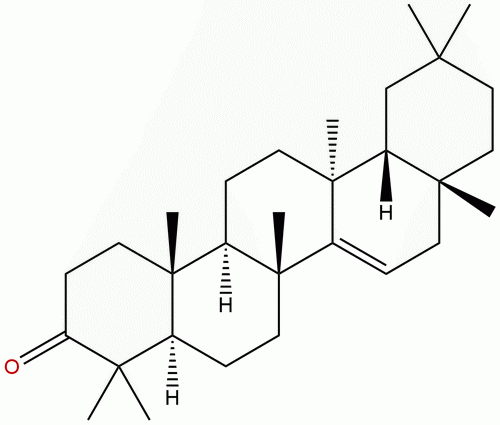


Product name: Taraxerone
Synonym name: Taraxerone
Catalogue No.: SBP00567
Cas No.: 514-07-8
Formula: C30H48O
Mol Weight: 424.713
Botanical Source:
Physical Description:
Type of Compound: Triterpenoids
Purity: 95%~99%
Analysis Method: HPLC-DAD or/and HPLC-ELSD
Identification Method: Mass, NMR
Packing: Brown vial or HDPE plastic bottle
The product could be supplied from milligrams to grams
Inquire for bulk scale.
For Reference Standard and R&D, Not for Human Use Directly.
Storage conditions:Short-term storage at 2~8℃, long-term storage at -20 ~ -80℃
17.0700
8.4315
8.4315
.0001
10.8642
11.5992
High
90.1714
4.7670
No
Yes
No
No
No
No
0.0
No
No
Yes
No
Taraxerone, a naturally occurring triterpenoid compound, is gradually emerging from numerous plant secondary metabolites and becoming a potential star molecule in natural product pharmacology research. Its CAS number is 514-07-8, molecular formula is C30H48O, and molecular weight is 424.71 g/mol. Although its name "Dandelion Terpenone" directly points to its classic source - the Asteraceae plant dandelion(Taraxacum officinale)However, research has shown that it also exists in various other plants, such as the drooping pot grass mentioned in the data. This compound initially attracted the interest of researchers, possibly due to its allelopathic and antifungal effects as part of the plant's own defense system. However, as research deepens, its more remarkable pharmacological activities are gradually revealed.
Existing studies have shown that dandelion terpenes exhibit various biological activities. It can significantly enhance the activity of alcohol dehydrogenase (ADH) and aldehyde dehydrogenase (ALDH), with EC50 values of approximately 512.42 μ M and 500.16 μ M, respectively. This characteristic suggests its potential value in regulating alcohol metabolism and protecting the liver. More importantly, it can effectively prevent the decrease in catalase, superoxide dismutase activity, and reduced glutathione concentration caused by ethanol intake in a concentration dependent manner, revealing its strong antioxidant and cell protective abilities. From a chemical classification perspective, dandelion terpenes belong to the scalaran sessterpenoid class and play the role of plant metabolites in nature. The current research focus has shifted from its basic biological activity to more specific molecular mechanisms, especially its interactions with multiple key inflammatory targets, which have shown broad prospects in the field of anti-inflammatory drug development. This article will start from its chemical essence, systematically sort out its plant origin, pharmacological mechanism, medicinal evaluation, and look forward to its future research directions.
The chemical structure of dandelion terpenes is the material basis for their biological activity. The SMILES string (CC1 (C) CC [C @] 2 (C) CC=C3 [C @] 4 (C) CC [C @ H] 5C (C) (C) C (=O) CC [C @] 5 (C) [C @ H] 4CC [C @ @] 3 (C) [C @ @ H] 2C1) accurately describes its atomic connectivity sequence and stereochemical configuration. According to the molecular formula C30H48O, it is a triterpenoid skeleton molecule containing 30 carbon atoms and a ketone carbonyl group (C=O). This highly modified, polycyclic terpenoid skeleton structure endows molecules with specific three-dimensional shapes and rigidity, which is crucial for their specific recognition and binding with biomolecules such as enzymes and receptors.
Its physicochemical properties provide key information for us to understand its behavior in living organisms:
- Molecular weight (MW):424.71 g/mol, Slightly higher than the ideal molecular weight for oral medications (<500 Da), but still within an acceptable range.
- Lipid water partition coefficient (LogP/LogD)Up to 8.43. This is a very significant feature, indicating that dandelion terpenes have extremely strong lipophilicity. Such a high LogP value means that its solubility in water is extremely low (only 0.0001 mg/mL), but it can easily dissolve and penetrate into lipid bilayers such as cell membranes. This explains it Caco-2 permeability (11.60 cm/s x 10 ^ -6) and Effective permeability (Peff, 10.86 cm/s x 10 ^ -4) The extremely high numerical value indicates its excellent potential for oral absorption and intestinal permeation.
- Topological Polarity Surface Area (TPSA)Only 17.07 Å ². TPSA is related to the hydrogen bonding ability of molecules, and the low TPSA value further supports its high lipid solubility and good membrane penetration.
- Blood-brain barrier permeability (BBB)Predicted as' high '. Combining its high LogP and low TPSA, dandelion terpenoids are likely to successfully cross the blood-brain barrier, providing a chemical basis for their application in the study of central nervous system related inflammatory diseases such as neurodegenerative diseases.
- Plasma protein binding rate (PPB)As high as 90.17%, it indicates that most molecules will bind to plasma proteins (mainly albumin) after entering the bloodstream. This will affect its free drug concentration, distribution volume, and onset time of efficacy, which are important factors to consider in pharmacokinetic design.
In summary, dandelion terpenes are a typical lipophilic, small molecule triterpenoid compound with excellent membrane permeability and potential brain distribution ability. However, their extremely low water solubility and high protein binding rate are challenges that need to be overcome in formulation development and pharmacokinetic optimization.
The most well-known plant source of dandelion terpenes is dandelion(Taraxacum officinale). Dandelion is widely distributed worldwide and has a long history of application in traditional Chinese medicine, European herbal medicine, and many folk medical systems. In traditional Chinese medicine theory, dandelion (whole plant) is cold in nature, bitter and sweet in taste, and belongs to the liver and stomach meridians. It has the effects of clearing heat and detoxifying, reducing swelling and dispersing nodules, diuresis and promoting diuresis. Commonly used for treating conditions such as carbuncles, toxins, breast abscesses, scrofula, redness and swelling of the eyes, sore throat, lung abscesses, intestinal abscesses, damp heat jaundice, and heat induced pain. In these traditional application descriptions, keywords such as "clearing heat," "detoxifying," and "reducing swelling" are highly consistent with modern medical concepts such as "anti-inflammatory," "antioxidant," and "anti infective.
Modern plant chemistry research has confirmed that dandelion is a rich treasure trove of bioactive ingredients, containing various components such as terpenes (such as dandelion terpenes, dandelion sterols), flavonoids, phenolic acids, polysaccharides, and more. Dandelion terpenes, as one of the triterpenoid components, are likely to be one of the material bases for dandelion to exert its traditional medicinal effects. Traditionally, dandelion water decoction or fresh products are used for pounding, and the fat soluble dandelion terpenes may exert their effects through small amounts of co decoction or transdermal absorption pathways. It is worth noting that data shows that dandelion terpenes are also derived from Sedum scoparia(Sedum sarmentosum)Separated from traditional Chinese medicine, Chupencao is commonly used in the treatment of damp heat jaundice, urinary obstruction, etc. It also has the effect of protecting the liver and promoting bile flow, which cross confirms the possible hepatoprotective activity of such compounds from the perspective of different medicinal plants.
Traditional applications provide valuable clues and directions for modern research. The experience of using dandelion for "reducing swelling and dispersing nodules" directly leads to modern exploration of its anti-inflammatory mechanism; The experience used for "damp heat jaundice" corresponds to modern pharmacological discoveries that enhance alcohol metabolism enzymes and protect liver cells from oxidative damage. Therefore, the study of dandelion terpenes is a typical case that connects traditional wisdom with modern science and elucidates the scientific connotation of traditional Chinese medicine.
The pharmacological activity research of dandelion terpenes has progressed from early observation of phenomena to molecular targets and signaling pathways. Its core activity can be summarized as anti-oxidative stress and anti-inflammatory There are two major aspects, and they are closely related.
1. Antioxidant and liver protection mechanisms:
As mentioned earlier, dandelion terpenes can counteract ethanol induced oxidative damage in a concentration dependent manner. Ethanol is metabolized in the body to produce a large amount of reactive oxygen species (ROS), consuming antioxidant substances such as glutathione (GSH), and inhibiting the activity of antioxidant enzymes such as catalase (CAT) and superoxide dismutase (SOD), leading to oxidative stress and damage to liver cells. Dandelion terpenoids can prevent the decrease of CAT, SOD activity, and GSH levels, indicating that they may maintain cellular redox balance by directly clearing ROS and upregulating the expression or activity of endogenous antioxidant defense systems. At the same time, it can enhance the activity of ADH and ALDH, accelerate the clearance of ethanol and its toxic metabolite acetaldehyde, and reduce the production of oxidative stress substances from the source. This multi-target antioxidant effect forms the basis of its liver protective effect.
2. Anti inflammatory effects and core molecular targets:
This is currently the most concerned area in the research of dandelion terpenes. The database information clearly identifies five key targets of its action: TNF (tumor necrosis factor - α), PTGS2 (prostaglandin endoperoxide synthase 2, COX-2), NFKB1 (nuclear factor kappa B p105 subunit), IL6 (interleukin-6), and IL1B (interleukin-1 β). These five targets are the core nodes in the classical inflammatory signaling pathway network.
Core regulation of NF - κ B pathway NF - κ B is the "master switch" that regulates inflammatory responses. In the resting state, NF - κ B (usually composed of p50/p65 dimers) binds to its inhibitory protein I κ B and exists in the cytoplasm. When stimulated by inflammatory factors such as TNF - α, IL-1 β, or other stimuli, I κ B is phosphorylated and degraded, and NF - κ B is activated and transferred into the nucleus, initiating the transcription of numerous inflammation related genes downstream, including TNF - α itself, IL-6, IL-1 β, and PTGS2 (COX-2)Dandelion terpenes act on NFKB1 (encoding p105, which can be processed into p50), possibly by inhibiting the activity of I κ B kinase (IKK) or stabilizing I κ B protein, preventing the activation and nuclear translocation of NF - κ B, and thus at the transcriptional level Simultaneously inhibit TNF - α, IL-6, IL-1 β, and COX-2 The expression.
Inhibition of key inflammatory factors:
Dandelion terpenes can simultaneously act on multiple key links in this inflammatory network, exhibiting the characteristics of "multi-target and pathway regulation". It does not block only one signal like a single target inhibitor, but may systematically regulate the production of pro-inflammatory factors and mediators by inhibiting upstream NF - κ B, thereby more effectively suppressing the cascade amplification reaction of inflammation. This mechanism of action makes it unique in the treatment of complex, multifactorial chronic inflammatory diseases (such as atherosclerosis, metabolic inflammation, neuritis, etc.).
Related disease associations Based on the above mechanism, the anti-inflammatory activity of dandelion terpenes has broad potential for disease applications. In addition to obvious inflammatory diseases such as rheumatoid arthritis, osteoarthritis and dermatitis, it may also have beneficial effects on alcoholic/nonalcoholic fatty liver disease (anti inflammation and liver protection), atherosclerosis (inhibition of vascular inflammation), diabetes and its complications (improvement of insulin resistance and metabolic inflammation), and even Alzheimer's disease (inhibition of neuroinflammation) by inhibiting NF - κ B and inflammatory factors.
Based on the provided pharmacological parameters, we can conduct a preliminary evaluation of the development prospects of dandelion terpenoids as potential drugs. Evaluation usually refers to empirical rules such as Lipinski's Rule of Five (Ro5).
1. Compliance analysis of Lipinski's Five Rules:
- Rule 1: Molecular weight MW<500 Da The MW of dandelion terpenes is 424.71, which is consistent.
- Rule 2: Lipid water partition coefficient LogP<5 Dandelion terpenes have a LogP as high as 8.43,seriously non-compliant This is its most prominent pharmaceutical defect.
- Rule 3: Number of hydrogen bond donors (HBD)<5 From its molecular formula C30H48O and structure, it only contains ketone carbonyl groups and does not contain typical hydrogen bond donors such as hydroxyl groups. Its HBD is about 0, which is consistent.
- Rule 4: The number of hydrogen bond acceptors (HBA) is less than 10 Only one ketone carbonyl oxygen acts as a hydrogen bond acceptor, with an HBA of approximately 1, which is consistent.
Overall, dandelion terpenes violated one of the five rules (high LogP). Ro5 is not an absolute standard, and many marketed drugs also violate 1-2 rules, but high LogP is often associated with extremely low water solubility, high metabolic rate, potential tissue accumulation, and toxicity risks.
2. Detailed interpretation of specific parameters:
- Solubility and permeability The extremely low water solubility (0.0001 mg/mL) is the primary obstacle to its formulation development. Any oral or injectable form must address its dissolution issue, which may require the use of advanced formulation technologies such as solubilizers, cyclodextrin inclusion, nanocrystals, liposomes, etc. On the other hand, its extremely high Caco-2 permeability and predicted high BBB permeability are its advantages, meaning that once absorbed, its bioavailability and tissue distribution (including into the brain) may be good.
- Metabolism and toxicity:
- Ames test The result is 0.0 (usually negative), indicating no direct toxicity of gene point mutations.
- chromosome aberration: None, indicating no significant genotoxicity at the chromosome level.
- HERG inhibition No, indicating a low likelihood of causing QT interval prolongation in the heart (a serious risk of arrhythmia).
- Skin sensitization (Skid_Sens)Yes. This is a signal that requires caution, indicating that the compound may have the potential to trigger skin allergic reactions, and special attention should be paid when developing topical preparations or clinical use.
- Serum biomarkers Ser_SET (Aspartate Aminotransferase) is "Yes", indicating that an increase in AST may be observed under test conditions, which may be a sign of liver cell damage. Combined with its liver protective activity, this result may seem contradictory, but it may suggest a biphasic effect at high concentrations or under specific conditions (low concentration protection, high concentration may produce burden or toxicity), which requires detailed dose-response relationship studies to clarify.
- Other toxicities Phototoxicity, respiratory sensitization, and elevated serum ALT/ALK/GGT are all negative, which is a positive aspect.
3. Comprehensive evaluation conclusion:
Dandelion terpenes are a compound with Clear and attractive multi-target anti-inflammatory mechanism The lead compound. Its medicinal properties exhibit typical characteristics Advantages and challenges coexist The situation:
- Advantage Clear molecular targets and pathways, good membrane permeability and BBB penetration potential, and low initial genetic toxicity risk.
- major challenge:Extremely poor water solubility(Originating from excessively high LogP)Potential skin sensitization and possible liver enzyme effects High plasma protein binding rate (>90%) may also affect drug efficacy.
Therefore, it is difficult to directly develop dandelion terpenes into traditional oral or injectable drugs. A more realistic development path may be: 1) as a lead compound Structural modification While retaining its core pharmacophore, introducing polar groups to reduce LogP, improve water solubility, and optimize toxicity spectrum; 2) Utilize its high permeability advantage to develop Topical preparations(such as gel or patch for treating dermatitis and arthritis), but its skin sensitization should be strictly evaluated; 3) As One of the effective ingredients in natural herbal medicine formulas Plays a role in the overall compatibility by assisting with solubilization or synergistic enhancement through other ingredients.
At present, research on dandelion terpenoids is still in the preclinical stage, mainly focusing on activity screening, mechanism exploration, and preliminary pharmacological evaluation. The existing research has firmly established the molecular basis for its anti-inflammatory effect by regulating the NF - κ B pathway, inhibiting key factors such as TNF - α, IL-6, IL-1 β, COX-2, etc., and revealed its potential in antioxidant and hepatoprotective aspects. These findings provide a solid theoretical basis for its subsequent development.
However, to achieve the leap from "active compounds" to "candidate drugs", there is still a lot of research work that urgently needs to be carried out:
Future research directions:
1. In depth mechanism research More precise clarification is needed on its interaction mode with specific proteins in the NF - κ B pathway (such as IKK, I κ B, p65) (whether it directly binds or indirectly regulates). The use of techniques such as molecular docking and surface plasmon resonance (SPR) to identify its direct target will greatly enhance the depth of research.
2. Comprehensive pharmacokinetic studies Systematically study the absorption, distribution, metabolism, and excretion (ADME) characteristics after oral/injection in animal models (mice, rats). Clarify its bioavailability, major metabolic organs and metabolites, tissue distribution characteristics (especially whether it can be enriched at the site of inflammation), and elimination half-life.
3. Pharmacodynamic and safety evaluation of the system Validate its in vivo anti-inflammatory efficacy in animal models closer to human diseases, such as collagen induced arthritis mice, DSS induced colitis mice, non-alcoholic fatty liver disease models, etc. At the same time, conduct standardized preclinical safety evaluations for acute toxicity, subchronic toxicity, reproductive toxicity, etc., and clarify their treatment window.
4. Structure based optimization of medicinal chemistry Conduct systematic structural modification and structure-activity relationship research to address its poor water solubility and potential toxicity issues. The goal is to obtain derivatives with comparable or superior activity, but significantly improved physicochemical properties and safety profiles.
5. Exploration of New Delivery Systems Even without structural modification, modern formulation technologies such as nanoemulsions, solid dispersions, polymer micelles, etc. can be explored to improve their solubility and oral bioavailability, or to develop delivery systems targeting inflammatory sites.
Application prospect outlook:
Despite facing challenges, the application prospects of dandelion terpenes are still worth looking forward to. In the short term, it serves as Natural anti-inflammatory functional factors or raw materials for health products The research may lead to faster applications, such as developing health products with liver protection, hangover relief, or chronic inflammation relief. In the medium to long term, through the in-depth study of medicinal chemistry and formulation, it is expected to be developed into a treatment for specific inflammatory diseases Innovative drugs Especially for complex diseases that require multi-target regulation. In addition, in the process of modernizing traditional Chinese medicine, in-depth research on dandelion terpenes can provide key scientific basis for elucidating the pharmacological substance basis and quality control standards of traditional herbs such as dandelion, and promote the international development of traditional Chinese medicine.
In short, dandelion terpenes are a valuable chemical template bestowed upon us by nature. It is like a multi toothed key that can simultaneously act on multiple key lock holes of an inflammation lock. The future research is to polish this natural key more accurately, safely, and effectively, ultimately opening the door to a new type of anti-inflammatory therapy.
Batch can search by a CAS number,one per line
