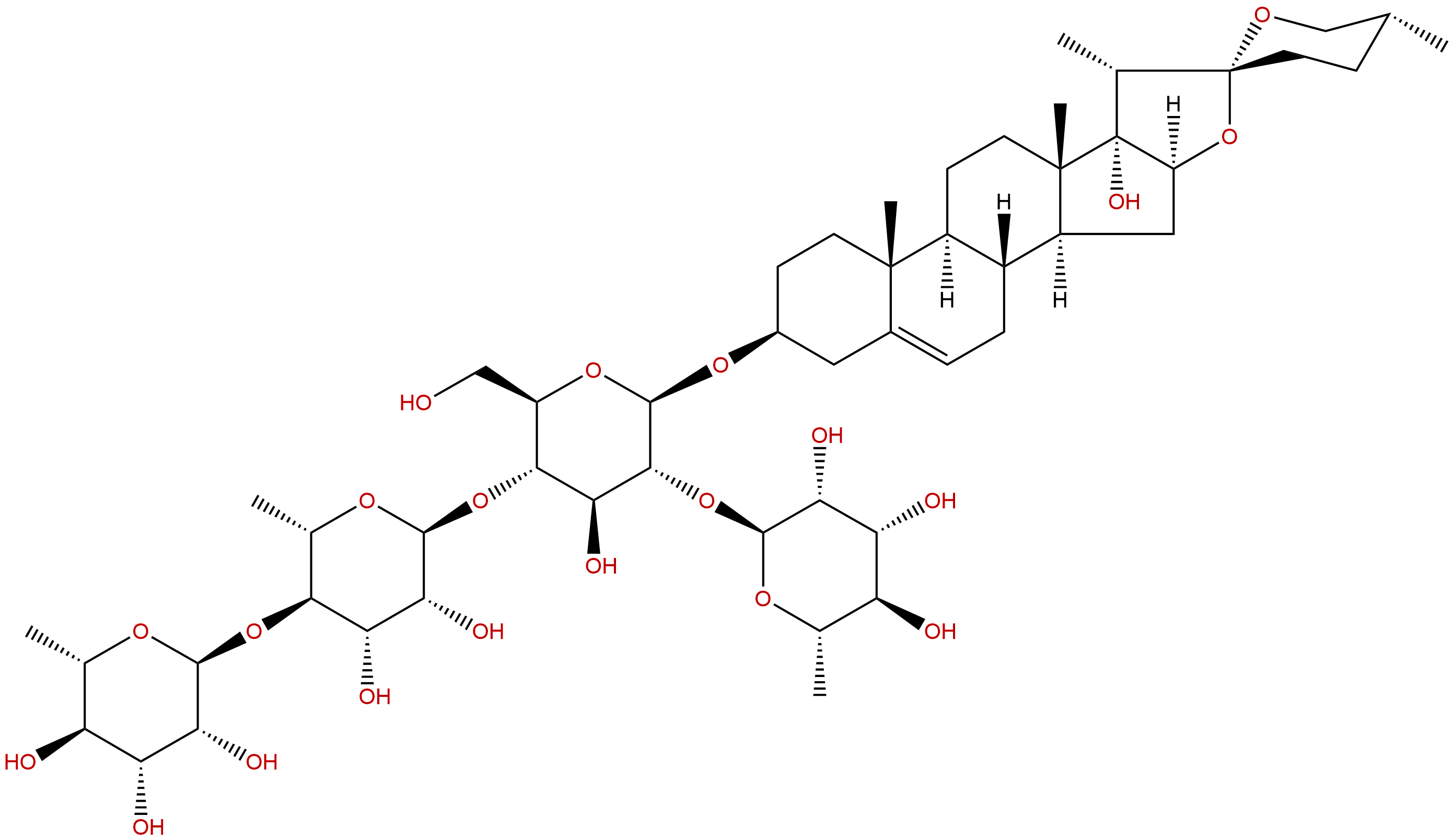


Product name: Polyphyllin VII
Synonym name:
Catalogue No.: BP3324
Cas No.: 68124-04-9
Formula: C51H82O21
Mol Weight: 1031.2
Botanical Source:
Physical Description: Powder
Type of Compound: Steroids
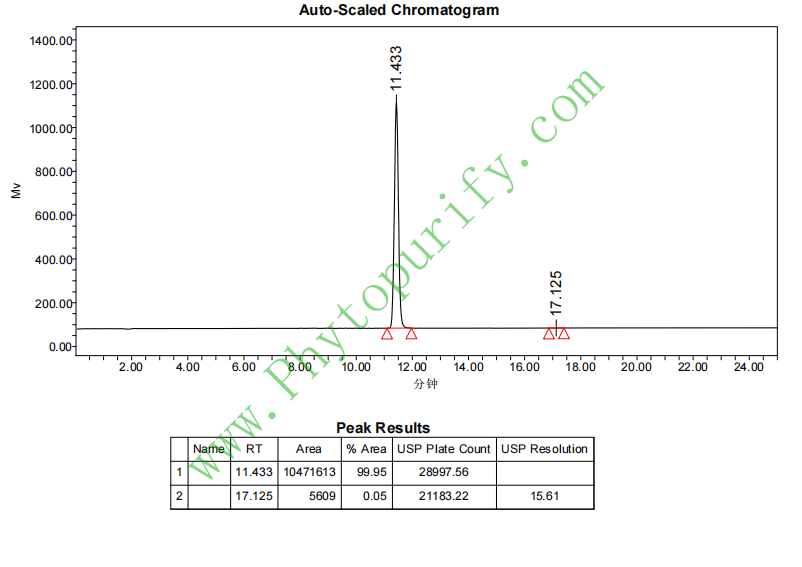
Purity: 95%~99%
Analysis Method: HPLC-DAD or/and HPLC-ELSD
Identification Method: Mass, NMR
Packing: Brown vial or HDPE plastic bottle
The product could be supplied from milligrams to grams. Inquire for bulk scale.
We provide solution to improve the water-solubility of compounds, thereby facilitating the variety of activity tests and clinic uses.
For Reference Standard and R&D, Not for Human Use Directly.
HPLC of Polyphyllin VII
Storage conditions:Short-term storage at 2~8℃, long-term storage at -20 ~ -80℃
314.8300
1.8534
1.8535
.1320
.5389
.5629
Low
67.4357
7.2418
No
No
No
No
No
No
0.0
Yes
No
Yes
Yes
Polyphyllin VII, also known as Polyphyllin G, is a natural steroid saponin isolated from the traditional medicinal plant Paris polyphylla. Its CAS number is 68124-04-9, the molecular formula is C51H82O21, and the molecular weight is as high as 1031.2000 g/mol. It belongs to the complex structure of macromolecular compounds. As one of the characteristic active ingredients of plants in the genus Polygonatum, Polygonatum sibiricum saponin VII has shown promising results in various human cancer cell lines in recent years Strong anti-cancer activity And it has attracted much attention. In addition, the study also found that it has significant anti parasitic activity against parasites such as roundworms, indicating its broad spectrum of biological activity. What is even more remarkable is that, based on its known target information, Zhonglou saponin VII has shown potential application value in the field of antiviral, especially for key proteases and replicases targeting certain viruses (such as NS3, NS5B, RdRp, etc.). This article will provide a systematic and professional interpretation of this natural compound with multiple biological activities, including its chemical structure, plant origin, pharmacological mechanism, medicinal evaluation, and research prospects.
The chemical structure of Zhonglou saponin VII belongs to the spirostanol type steroid saponin, and its complex structure is accurately described by SMILES strings and molecular formulas. The molecular formula C51H82O21 indicates that it is a giant molecule containing 51 carbon atoms, 82 hydrogen atoms, and 21 oxygen atoms, with a molecular weight exceeding 1000 Da. Its structural core is a steroid mother nucleus (spirostane), which is connected to multiple sugar groups (such as glucose, xylose, etc.) through glycosidic bonds. The composition and connection mode of these sugar groups are important foundations for its high polarity and biological activity.
Analyzing its physicochemical properties from the parameters of drug properties:
- Molecular weight (MW):1031.1960 g/mol, Far beyond the scope of conventional small molecule drugs (usually<500 Da).
- Topological Polarity Surface Area (TPSA)Up to 314.8300 Å ², which is closely related to the presence of multiple hydroxyl groups and sugar ring structures in its molecule, indicating high molecular polarity and possible good water solubility.
- Lipid water partition coefficient (LogP/LogD)Approximately 1.85. The LogP value reflects the distribution equilibrium of compounds in the octanol and water phases, ranging from 1 to 3, indicating that saponins VII have a certain degree of lipophilicity, but not a high degree of lipophilicity. Combined with its high TPSA, the molecule exhibits an overall appearance amphiphilic features.
- Water solubility The calculated value is 0.1320 mg/mL, which belongs to the range of slightly soluble or poorly soluble. This may seem contradictory to its high TPSA, but in fact, its high molecular weight and complex spatial structure may limit its ability to freely diffuse and solvate in water.
- Membrane permeability The permeability (Peff) of Caco-2 cells is about 0.5389, which is a low value, indicating its weak ability to cross the intestinal epithelial cell membrane through passive diffusion. This is consistent with the characteristics of large molecules and highly polar compounds.
In summary, Zhonglou saponin VII is a typical large molecule, highly polar steroid saponin, and its physicochemical properties determine that its absorption, distribution, metabolism, and excretion (ADME) processes in organisms will face challenges.
Zhonglou Saponin VII is mainly derived from plants in the Melanthiaceae genus of the Liliaceae family Paris Polyphylla Chonglou, also known as Seven Leaf One Branch Flower or Flea Rest, is a perennial herbaceous plant widely distributed in Asia such as China, Nepal, and Bhutan. Its dried rhizome is a famous traditional Chinese medicinal herb with a long history of medicinal use. It was first recorded in the "Shennong Bencao Jing" and is listed as a inferior product. It has the effects of clearing heat and detoxifying, reducing swelling and pain, and cooling the liver and calming the nerves.
In traditional Chinese medicine clinical practice, heavy buildings are commonly used for the treatment of:
- Swelling, swelling, and sore throat Taking its heat clearing and detoxifying effects, it is often combined with honeysuckle, Forsythia suspensa, and other herbs.
- Poisonous snake bites, falls and injuries For external and internal use, to reduce swelling and relieve pain.
- Trembling wind convulsions Utilize its calming and calming effect.
- In recent years, it has been more widely used in anti-tumor compound formulations。
Modern plant chemistry research has confirmed that the main active ingredients of Polygonatum sibiricum are steroidal saponins, including various homologs such as Polygonatum sibiricum saponins I, II, VI, VII, etc. These saponins are considered to be the material basis for the traditional medicinal effects of Chonglou, especially its anti-inflammatory and anti-tumor effects. As one of them, Zhonglou Saponin VII inherits the medicinal heritage from plant sources and has become a focus of modern medicinal chemistry research due to its unique activity.
The pharmacological activity research of Zhonglou saponin VII mainly focuses on anti-tumor and antiviral aspects, and its mechanism of action involves the regulation of multiple key biological targets.
The existing description clearly indicates that saponins VII from Polygonatum sibiricum exhibit strong anti-cancer activity in various human cancer cell lines. Its anti-tumor mechanism is complex and multifaceted, which may include:
1. Inducing cell apoptosis Steroid saponins can activate the Caspase cascade through the mitochondrial pathway or death receptor pathway, leading to programmed cell death in cancer cells.
2. Block cell cycle Block cancer cells in the G2/M or S phase and inhibit their proliferation.
3. Inhibit cell invasion and metastasis By downregulating the expression of matrix metalloproteinases (MMPs), epithelial mesenchymal transition (EMT) is affected, thereby inhibiting the migration and invasion ability of cancer cells.
4. Induce autophagy In some cases, cancer cells may self digest by activating autophagic flow.
5. Inhibit angiogenesis Inhibiting the formation of tumor neovascularization by affecting signaling pathways such as vascular endothelial growth factor (VEGF).
Its broad anti-cancer spectrum suggests that its target may be located upstream or at a common node in the cell proliferation and death signaling pathway.
The target information provided by the database provides important clues for revealing its antiviral potential. Zhonglou saponin VII has been predicted or validated to potentially act on the following key viral targets:
- NS3 (non structural protein 3) and NS5B (RNA dependent RNA polymerase)These two are the core components of the hepatitis C virus (HCV) replication complex. NS3 has serine protease and helicase activity, and NS5B is a key enzyme for viral RNA replication. Inhibiting their function can directly block the replication of HCV.
- RdRp (RNA dependent RNA polymerase)This is an enzyme necessary for the replication of many RNA viruses, such as coronaviruses, influenza viruses, and hepatitis C viruses. Targeting RdRp is an important strategy for the development of broad-spectrum antiviral drugs.
- ACE2 (angiotensin-converting enzyme 2) and TMPRSS2 (transmembrane serine protease 2)These two are key host factors for coronaviruses such as SARS-CoV-2 to invade host cells. The viral Spike protein first binds to ACE2 and is then activated by TMPRSS2 cleavage, completing membrane fusion and cell entry. Regulating or inhibiting these two host targets can block the early steps of virus invasion.
Explanation of the mechanism of action:
Zhonglou saponin VII may competitively inhibit its enzymatic activity by binding to the active centers of viral proteases or polymerases through its steroidal saponin structure. For the host targets ACE2 and TMPRSS2, it may affect the recognition and processing of viral Spike proteins by interfering with their expression or spatial conformation. This characteristic of simultaneously targeting the virus's own enzymes and host factors gives it the potential to become Multi targeted antiviral drugs The potential may help to cope with virus mutations and reduce the risk of drug resistance. Its related diseases are labeled as "antiviral" based on the interaction of these potential targets.
The study also showed that it has significant anti parasitic activity against Dactyloglus intermedius (EC50=1.2 mg/L), with an acute toxicity LC50 of 2.9 mg/L, indicating a certain degree of selective toxicity, which may have application value in the field of aquatic parasite control.
Based on the provided pharmacological parameters and in combination with classic standards such as the "Rule of Five" (Ro5), evaluate the pharmacological potential of saponins VII from Polygonatum sibiricum:
Lipinski's Five Rules Compliance Analysis:
1. Molecular weight<500 Da:not conform to(1031 > 500)。
2. Lipid water partition coefficient LogP<5:Comply with(1.85 < 5)。
3. Hydrogen bond donor number (HBD)<5:not conform to(There are many molecules such as - OH, and HBD is much greater than 5).
4. Number of hydrogen bond acceptors (HBA)<10:not conform to(21 O atoms, HBA is much larger than 10).
Zhonglou Saponin VII seriously violates three of Lipinski's rules (MW, HBD, HBA), which clearly classifies it as'Lead like compounds' rather than' drug like molecules'Ro5 is mainly based on the statistics of small molecule drugs with good oral absorption, and has limited applicability to large molecule natural products such as saponins, peptides, and macrolides.
Detailed interpretation of specific parameters:
- absorb High TPSA (314.83) and low Caco-2 permeability (0.5629) indicate its Oral bioavailability is likely to be extremely low Large molecules and strong polarity make it difficult for them to passively diffuse through intestinal epithelial cells.
- distribution The plasma protein binding rate (PPB) is 67.44%, which belongs to moderate binding and can affect its free drug concentration. The blood-brain barrier (BBB) penetration is "low", which means it is difficult for it to enter the central nervous system, which is disadvantageous for treating brain tumors or viral infections, but may also reduce the risk of central neurotoxicity.
- Metabolism and toxicity:
-Ames test (0.0) and chromosome aberration (none) results are negative, preliminary indication No genetic toxicity。
-HERG inhibition (no) indicates a low risk of potential cardiac toxicity (causing QT interval prolongation).
-Not showing skin sensitization, respiratory sensitization, or phototoxicity.
-However, serum biochemical indicators suggest that it may have a certain impact on the liver (Ser_LT/AST is "yes"), which may cause an increase in liver enzymes, suggesting Potential hepatotoxicity This needs to be closely monitored in subsequent development.
- Feasibility of synthesis The synthetic accessibility index is 7.24 (usually the higher the value, the more difficult it is to synthesize), and its structure is complex, making total synthesis extremely challenging. Currently, it mainly relies on extraction and isolation from plants.
Summary of Medicinal Properties:
Zhonglou Saponin VII as a Outstanding activity but poor medicinal properties Natural product lead compounds. Its powerful multi-target pharmacological activity is its greatest advantage. However, the large molecular weight, excessive hydrogen bonding, poor oral absorption, potential hepatotoxicity, and complex synthetic pathways are the main obstacles to its conversion to drugs. Future development strategies may include: ① Development Injection type(such as intravenous administration), bypassing absorption issues; ② Carry out Structural modification and simplification Reduce molecular weight, optimize LogP and polarity, and improve ADME properties while retaining pharmacophores; ③ Utilize New drug delivery system(such as nanoparticles, liposomes, prodrug technology) to improve their solubility, stability, and targeting.
Research status:
At present, research on the saponin VII of Polygonatum sibiricum is still ongoing Preclinical stage Mainly focused on:
1. In vitro activity screening Validate its activity in more types of cancer cell lines and viral models (such as HCV, SARS-CoV-2 pseudovirus system), and explore its synergistic effect with existing drugs.
2. Deep exploration of the mechanism of action Using techniques such as molecular docking, surface plasmon resonance (SPR), and gene knockout/knockdown, verify its direct interaction with predicted targets (NS3, NS5B, ACE2, etc.) and elucidate downstream signaling pathways.
3. Pharmacodynamic evaluation in vivo Evaluate its therapeutic efficacy and preliminary safety in animal tumor models or viral infection models.
4. Structure Activity Relationship (SAR) Study Modify its steroid core and sugar chain to search for derivatives with better activity, lower toxicity, and better drug properties.
Application Prospects:
1. Development of anti-tumor drugs As a novel multi-target anti-tumor candidate, it may provide new treatment options, especially for refractory and drug-resistant tumors. The combination of chemotherapy, radiotherapy, or immunotherapy is a direction worth exploring.
2. Development of antiviral drugs Given its potential to act on both viral and host targets simultaneously, it has unique value in the development of broad-spectrum or antiviral drugs targeting specific viruses such as HCV and coronavirus. In the current context of frequent outbreaks of infectious diseases, the research on such multi-target natural products is of great significance.
3. Aquaculture industry As a plant-based antiparasitic agent, it has potential advantages such as environmental friendliness and resistance to parasitic diseases in fish.
4. Model of modernization of traditional Chinese medicine The in-depth study of saponins VII from Chonglou is a key link in elucidating the scientific connotation of "clearing heat, detoxifying, reducing swelling, and relieving pain" in Chonglou medicinal materials, which helps to promote the improvement of quality standards, clarification of active ingredients, and modernization of formulations for this traditional Chinese medicine.
Challenges and Future Directions:
Future research needs to focus on addressing the bottleneck of drug development. The key directions include: utilizing synthetic biology methods for heterologous synthesis in microorganisms to address plant source limitations; Design and synthesize a series of simplified analogues, conduct systematic structure-activity relationship research and optimize drug properties; Conduct in-depth toxicology and pharmacokinetic studies to clarify their safety window. Only by overcoming these challenges can Zhonglou Saponin VII truly move from a brilliant natural star molecule to clinical applications, benefiting human health.
Disclaimers This article is based on the provided compound data and aims to promote scientific popularization and academic exploration. The pharmacological activities and mechanisms involved are mostly derived from preclinical studies and have not been validated through human clinical trials, and cannot be used as any medical advice or medication basis. The drug development process is lengthy and full of uncertainty.
