


Product name: Punicalagin
Synonym name:
Catalogue No.: BP1181
Cas No.: 65995-63-3
Formula: C48H28O30
Mol Weight: 1084.72
Botanical Source: Punica granatumL.
Physical Description:
Type of Compound: Polyphenols
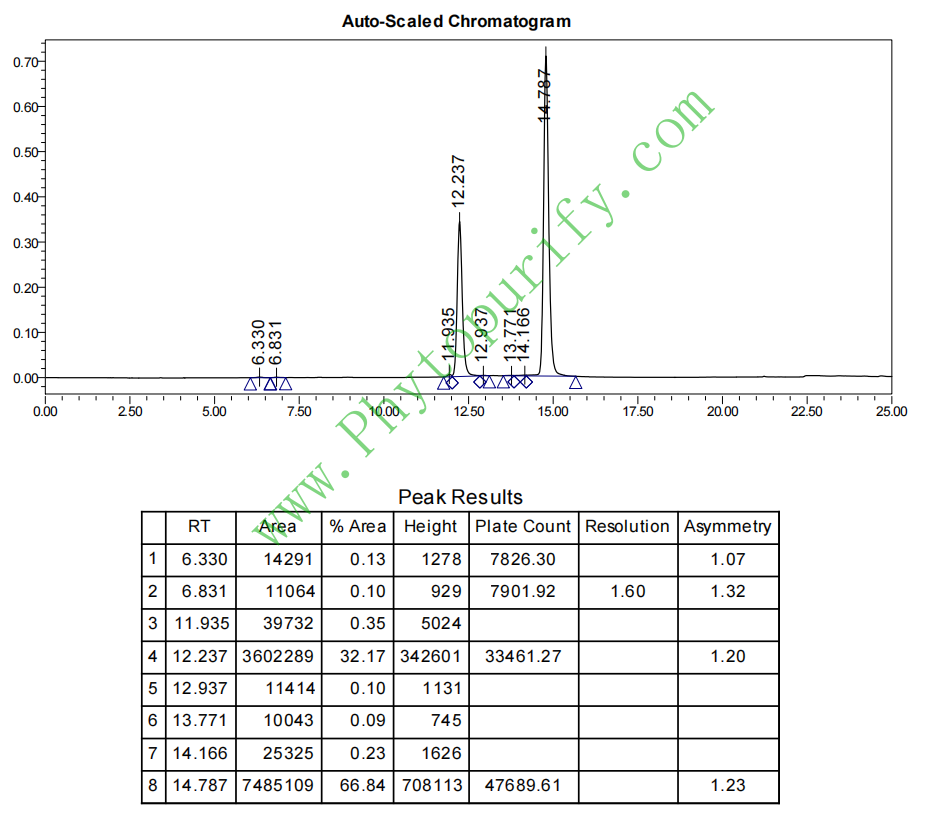
Purity: 95%~99%
Analysis Method: HPLC-DAD or/and HPLC-ELSD
Identification Method: Mass, NMR
Packing: Brown vial or HDPE plastic bottle
Storage: Store in a well closed container, protected from air and light. Put into refrigerate or freeze for long term storage.
Whenever possible, you should prepare and use solutions on the same day. However, if you need to make up stock solutions in advance, we recommend that you store the solution as aliquots in tightly sealed vials at -20℃. Generally, these will be useable for up to two weeks.
The product could be supplied from milligrams to grams
Inquire for bulk scale.
Description:
Punicalagin has antifungal , antiviral, anti-atherosclerotic, hepatoprotective , anti-obesity., antiproliferative, anti-apoptotic, anti-inflammatory, and antioxidant effects. It can suppress the phosphorylation of MAPK including p38, c-JNK, and ERK, it also has potently inhibiting the activity of fatty acid synthase with half-inhibitory concentration values (IC 50 ) of 4.50μM.
References:
Ann Clin Microbiol Antimicrob. 2014 Sep 5;13(1):32.
Antifungal activity of pomegranate peel extract and isolated compound punicalagin against dermatophytes.
Dermatophyte species infect the epidermis and appendages, often with serious social and health-economic consequences. The hydroalcoholic extract of pomegranate fruit peel showed activity against the dermatophyte fungi Trichophyton mentagrophytes, T. rubrum, Microsporum canis and M. gypseum.
METHODS AND RESULTS:
Hydroalcoholic extract was prepared with pomegranate peels. This crude extract was fractionated and submitted to liquid-liquid partition, resulting in an active fraction which was fractionated in a Sephadex LH-20 column, followed by a Lobar column. The structure of the active compound was established with the use of spectroscopic methods. The crude extract of pomegranate fruit peel showed activity against the dermatophytes Trichophyton mentagrophytes, T. rubrum, Microsporum canis, and M. gypseum, with MICs values of 125 μg/ml and 250 μg/ml, respectively for each genus. Punicalagin was isolated and identified by spectroscopic analysis. The crude extract and Punicalagin showed activity against the conidial and hyphal stages of the fungi. The cytotoxicity assay showed selectivity for fungal cells than for mammalian cells.
CONCLUSIONS:
These results indicated that the crude extract and Punicalagin had a greater antifungal activity against T. rubrum, indicating that the pomegranate is a good target for study to obtain a new antidermatophyte medicine.
Appl Environ Microbiol. 2014 Oct;80(19):6204-11.
Punicalagin inhibits Salmonella virulence factors and has anti-quorum-sensing potential.
Punicalagin, an essential component of pomegranate rind, has been demonstrated to possess antimicrobial activity against several food-borne pathogens, but its activity on the virulence of pathogens and its anti-quorum-sensing (anti-QS) potential have been rarely reported. This study investigated the efficacy of subinhibitory concentrations of Punicalagin on Salmonella virulence factors and QS systems.
METHODS AND RESULTS:
A broth microdilution method was used to determine the MICs of Punicalagin for 10 Salmonella strains. Motility assay and quantitative reverse transcription (RT)-PCR were performed to evaluate the effects of Punicalagin on the virulence attributes and QS-related genes of Salmonella. The MICs of Punicalagin for several Salmonella strains ranged from 250 to 1,000 μg/ml. Motility assays showed that Punicalagin, at 1/16× MIC and 1/32× MIC, significantly decreased bacterial swimming and swarming motility, which corresponded to downregulation of the motility-related genes (fliA, fliY, fljB, flhC, and fimD) in RT-PCR assays. RT-PCR also revealed that Punicalagin downregulated the expression of most of the selected genes involved in Salmonella virulence. Moreover, a QS inhibition assay indicated that Punicalagin dose dependently inhibited the production of violacein by Chromobacterium violaceum and repressed the expression of QS-related genes (sdiA and srgE) in Salmonella. In addition, Punicalagin significantly reduced Salmonella invasion of colonic cells (P<0.01) with no impact on adhesion.
CONCLUSIONS:
These findings suggest that Punicalagin has the potential to be developed as an alternative or supplemental agent for prevention of Salmonella infection.
Phytother Res. 2001 May;15(3):206-12.
Antioxidant and hepatoprotective effects of punicalagin and punicalin on acetaminophen-induced liver damage in rats.
Punicalagin and punicalin were isolated from the leaves of Terminalia catappa L., a Combretaceous plant distributed throughout tropical and subtropical beaches, which is used for the treatment of dermatitis and hepatitis. Our previous studies showed that both of these compounds exert antioxidative activity.
METHODS AND RESULTS:
In this study, the antihepatotoxic activity of Punicalagin and punicalin on acetaminophen-induced toxicity in the rat liver was evaluated. After evaluating the changes of several biochemical functions in serum, the levels of aspartate aminotransferase (AST) and alanine aminotransferase (ALT) were increased by acetaminophen administration and reduced by Punicalagin and punicalin. Histological changes around the hepatic central vein and oxidative damage induced by acetaminophen were also recovered by both compounds. The data show that both Punicalagin and punicalin exert antihepatotoxic activity, but treatment with larger doses enhanced liver damage.
CONCLUSIONS:
These results suggest that even if Punicalagin and punicalin have antioxidant activity at small doses, treatment with larger doses will possibly induce some cell toxicities.
Biochem Biophys Res Commun. 2008 Jul 11;371(4):799-803.
Immune-suppressive activity of punicalagin via inhibition of NFAT activation.[Pubmed: 18466764]
Since T cell activation is central to the development of autoimmune diseases, we screened a natural product library comprising 1400 samples of medicinal herbal extracts, to identify compounds that suppress T cell activity.
METHODS AND RESULTS:
Punicalagin (PCG) isolated from the fruit of Punica granatum was identified as a potent immune suppressant, based on its inhibitory action on the activation of the nuclear factor of activated T cells (NFAT). PCG downregulated the mRNA and soluble protein expression of interleukin-2 from anti-CD3/anti-CD28-stimulated murine splenic CD4+ T cells and suppressed mixed leukocytes reaction (MLR) without exhibiting cytotoxicity to the cells. In vivo, the PCG treatment inhibited phorbol 12-myristate 13-acetate (PMA)-induced chronic ear edema in mice and decreased CD3+ T cell infiltration of the inflamed tissue.
CONCLUSIONS:
These results suggest that PCG could be a potential candidate for the therapeutics of various immune pathologies.
Phytomedicine. 2012 Dec 15;20(1):67-70.
Antiviral activity of punicalagin toward human enterovirus 71 in vitro and in vivo.
Human enterovirus 71 is one of the major causative agents of hand, foot and mouth disease in children and has caused mortalities in large-scale outbreaks in the Asia-Pacific region in recent years. No vaccine or antiviral therapy is available currently in the clinic.
METHODS AND RESULTS:
In this work, we investigated the antiviral effect of Punicalagin on enterovirus 71 both in vitro and in vivo. The results showed that Punicalagin reduced the viral cytopathic effect on rhabdomyosarcoma cells with an IC₅₀) value of 15 μg/ml. Moreover, Punicalagin treatment of mice challenged with a lethal dose of enterovirus 71 resulted in a reduction of mortality and relieved clinical symptoms by inhibiting viral replication.
CONCLUSIONS:
Our work suggested that Punicalagin have the potential for further development as antiviral agents against enterovirus 71.
HPLC of Punicalagin
Storage conditions:Short-term storage at 2~8℃, long-term storage at -20 ~ -80℃
518.7600
2.0239
2.0244
.0004
.9786
.7791
Low
84.2067
7.4223
Yes
No
No
No
Yes
Yes
0.6
Yes
No
Yes
No
Natural products, as an important treasure trove for drug discovery, play an irreplaceable role in the long history of human fight against diseases. Among them, polyphenolic compounds have attracted much attention due to their extensive biological activity and low toxicity. Punicalagin (CAS number: 65995-63-3) is a highly active tannin polyphenol isolated from plants such as pomegranate (Punica granatum L.) and Terminalia catappa L. in recent years. Its unique chemical structure endows it with excellent multiple pharmacological activities such as antioxidant, anti-inflammatory, antiviral, and anti-tumor. Especially in the context of the global novel coronavirus pneumonia (COVID-19) epidemic, pomegranate glycoside was identified as a reversible and non competitive inhibitor of the main protease (3CLpro) of SARS CoV-2, showing the potential to inhibit virus replication, making it a hot spot molecule in pharmacological research rapidly. In addition, its research on anti hepatitis B virus (HBV), metabolic diseases, and cancer prevention and treatment is becoming increasingly in-depth. This article aims to systematically review the chemical properties, plant sources, pharmacological activities, mechanisms of action, pharmacological evaluation, and clinical application prospects of pomegranate glycoside, in order to provide comprehensive scientific references for the deep development and transformation of this natural product.
Anthocyanin is a large polyphenolic compound with a molecular weight of up to 1084.7220 Da, belonging to the category of ellagic tannins in terms of chemical structure. Its core structure is composed of two hexahydroxybiphenyldicarboxylic acid (HHDP) units connected to a glucose molecule through ester bonds. The HHDP unit can further hydrolyze to generate tannic acid, which is an important structural basis for many of its biological activities. This complex polyphenol structure gives it multiple phenolic hydroxyl groups, which are the molecular basis for its strong antioxidant capacity.
From the analysis of physical and chemical properties, the theoretical lipid water partition coefficient (LogP) of aristolochic acid is about 2.02, indicating that it has a certain degree of lipophilicity, but not high lipid solubility. Its topological polar surface area (TPSA) is as high as 518.76 Å ², mainly attributed to the large number of polar hydroxyl and ester bonded oxygen atoms in the molecule. The extremely high TPSA value contrasts sharply with the extremely low water solubility (about 0.0004 mg/mL), which is a typical characteristic of large polyphenol molecules and presents the primary challenge for their formulation development. The molecule is difficult to penetrate the blood-brain barrier (BBB permeability is low), indicating that its application in central nervous system diseases may be limited, but it may also reduce the risk of related central side effects. Preliminary in vitro safety assessment shows that it has no significant hERG potassium channel inhibitory activity (low risk of arrhythmia), and the Ames test result is 0.6, indicating a low risk of mutagenicity, providing preliminary positive data for its safety.
Anthocyanin is mainly found in the peel, juice, flowers, and leaves of pomegranate, with the peel being the most abundant and much higher in content than the flesh. In addition, this component has also been isolated from the leaves of the Euphorbia lanceolata plant in the Junziaceae family. Pomegranate, as a traditional medicinal and edible plant, is significantly affected by factors such as variety, place of origin, harvest season, and storage conditions in terms of the content of arbutin in different parts.
There are various methods for extracting naringin, aiming to efficiently obtain and maintain its biological activity. Traditional methods include solvent extraction, commonly using methanol, ethanol, acetone water system, or ethyl acetate for extraction. Among them, aqueous ethanol is commonly used due to its safety, low cost, and high efficiency. Modern extraction techniques have significantly improved extraction efficiency and selectivity, such as:
1. Ultrasonic assisted extraction Using cavitation effect to destroy plant cell walls, accelerate solvent penetration and component dissolution, shorten extraction time, and improve yield.
2. Microwave assisted extraction By selectively heating the internal water of plants with microwave energy, high pressure is generated to promote cell rupture and rapidly release target components, which has the advantages of high efficiency and energy saving.
3. Supercritical fluid extraction Supercritical CO ₂ is usually used to change its solubility by adjusting temperature and pressure. This method has no solvent residue, mild conditions, but high equipment costs, and often requires the addition of entrainers (such as ethanol) to improve the extraction rate of polar polyphenols.
The crude extract after extraction usually needs to go through further separation and purification steps, such as macroporous adsorption resin chromatography (such as AB-8 and D101 resins), silica gel column chromatography, Sephadex gel column chromatography and high performance liquid chromatography (HPLC) preparation, to obtain high-purity pomegranate glycoside monomer.
Numerous in vitro and in vivo studies have confirmed that naringin has broad and significant pharmacological activities.
Antiviral activity:
Antioxidant damage This is one of the most essential biological activities of astragaloside. The abundant phenolic hydroxyl groups in its molecule can directly scavenge free radicals (such as DPPH, ABTS ⁺, superoxide anions, hydroxyl radicals), and effectively chelate metal ions (such as Fe ² ⁺, Cu ² ⁺), blocking the Fenton reaction and reducing the generation of reactive oxygen species (ROS) from the source. In a variety of oxidative stress models (such as chemically induced liver injury, atherosclerosis, and neurodegenerative disease models), pomegranate glycoside can significantly enhance tissue antioxidant capacity and reduce the level of lipid peroxidation products (such as MDA).
anti-inflammatory effect Pomegranate glycoside exerts anti-inflammatory effects through multiple pathways. It can inhibit the production of pro-inflammatory mediators such as nitric oxide (NO) and prostaglandin E2 (PGE2), and downregulate the expression of inducible nitric oxide synthase (iNOS) and cyclooxygenase-2 (COX-2). At the same time, it can also inhibit the release of key pro-inflammatory cytokines such as tumor necrosis factor - α (TNF - α), interleukin-1 β (IL-1 β), IL-6, as well as the overactivation of inflammatory signaling pathways such as nuclear factor kappa B (NF - κ B).
Anti-cancer effect: Androglucin has growth inhibition and apoptosis promoting activity on many cancer cell lines (such as breast cancer, prostate cancer, colon cancer, lung cancer, liver cancer, etc.). Its anti-cancer mechanism is complex, including inducing cell cycle arrest (often in G1/S or G2/M phase), activating mitochondrial and death receptor pathways to induce apoptosis, inhibiting cell invasion and migration (by downregulating MMPs, inhibiting epithelial mesenchymal transition EMT), anti angiogenesis (inhibiting VEGF expression), and regulating autophagy.
Other activities: The study also suggests that pomegranate glycoside has potential benefits such as protecting cardiovascular system (reducing blood fat and atherosclerosis), improving metabolic syndrome (improving insulin resistance and lowering blood sugar), neuroprotection (combating A β toxicity and alleviating Parkinson's disease symptoms), and protecting gastrointestinal tract (resisting ulcerative colitis).
The multiple pharmacological activities of Angelica sinensis stem from its interactions with multiple cellular signaling pathways and molecular targets, and its antioxidant activity is the core starting point for many downstream effects.
In Antioxidant damage In terms of aspect, the core mechanism of artemisinin is activation Keap1-Nrf2/ARE signaling pathway In the basal state, the transcription factor Nrf2 (encoded by the NFE2L2 gene) binds to its inhibitory protein Keap1 in the cytoplasm and is degraded by ubiquitination. The active group of astragaloside can undergo covalent modification with cysteine residues on Keap1, or interfere with Keap1-Nrf2 interaction by generating electrophilic substances, thereby stabilizing Nrf2 and promoting its translocation to the nucleus. In the nucleus, Nrf2 binds to antioxidant response elements (ARE), initiating the transcriptional expression of a series of phase II detoxifying enzymes and antioxidant proteins, including:
* Heme oxygenase-1 (HMOX1)Catalyze the degradation of hemoglobin to produce biliverdin and carbon monoxide, which have antioxidant and anti-inflammatory effects.
* Superoxide dismutase (SOD1, SOD2)Catalytic conversion of superoxide anions into hydrogen peroxide.
* Catalase (CAT)Decompose hydrogen peroxide into water and oxygen.
* Glutathione peroxidase 1 (GPX1)Using glutathione to reduce hydrogen peroxide and lipid peroxides.
Through the upregulation of this core pathway, naringin systematically enhances the endogenous antioxidant defense system of cells.
In Anti inflammatory and anti-cancer In its function, pomegranate glycoside is often found to have an effect on NF - κ B, MAPK (such as p38, JNK, ERK), and PI3K/Akt Inhibition of key signaling pathways. By inhibiting the activity of I κ B kinase (IKK), the phosphorylation and degradation of I κ B are prevented, thereby inhibiting the nuclear translocation of NF - κ B p65 subunit and the transcription of downstream pro-inflammatory/pro survival genes. In addition, it can regulate apoptosis related proteins (such as upregulation of Bax, downregulation of Bcl-2, activation of caspase cascade) and cell cycle regulatory proteins (such as p21, p27, cyclins, CDKs).
In antiviral In terms of aspect, its direct target is Viral proteases (such as SARS-CoV-2 3CLpro)By utilizing molecular docking and hydrogen bonding interactions to occupy the active pocket or conformational site of the enzyme, its function is inhibited.
Despite the excellent pharmacological activity of pomegranate glycoside, its medicinal properties face significant challenges, mainly due to its unique physicochemical properties.
To improve its medicinal properties, researchers are exploring various strategies:
1. Structural modification Esterification, methylation or preparation of prodrugs for phenolic hydroxyl groups to improve their stability and membrane permeability.
2. New drug delivery system:
* Nano drug delivery system Liposomes, nanoparticles, micelles, solid lipid nanoparticles, etc. can improve their solubility, protect them from premature degradation, enhance cellular uptake, and potentially achieve targeted delivery.
* Phospholipid complex Forming a complex with phospholipids significantly improves lipid solubility and absorption.
* Cyclodextrin inclusion complex Utilizing the cavity encapsulation of cyclodextrin to increase water solubility and stability.
3. Optimization of administration route Develop local drug delivery (such as skin, eye), injectable drug delivery (to address solubility issues), or colon targeted delivery systems to bypass gastric acid disruption and upper gastrointestinal metabolism.
The clinical application prospects of astragaloside are broad, but the transformation path needs to be gradual.
Direct therapeutic application:
As a lead compound for drug development Based on its structure, reasonable chemical modifications and optimizations are carried out with the aim of obtaining new derivatives with stronger activity, more stable metabolism, and higher bioavailability, and developing them into innovative drugs.
Application in functional foods and cosmetics Currently, some pomegranate extracts (rich in naringin) have been used in antioxidant, anti-aging health foods and high-end skincare products. With the advancement of purification and stabilization technologies, the application value of high-purity naringin will be further enhanced.
Future research priorities should include:
* Thoroughly elucidate the material basis of internal action Clarify the contribution and synergistic relationship between the prototype of pomegranate glycoside and its metabolites (tannic acid, urolithin) in the overall pharmacological effect.
* Strengthen preclinical and clinical research Conduct standardized pharmacological and long-term toxicological studies, and advance to Phase I/II clinical trials to obtain human safety, efficacy, and pharmacokinetic data.
* Breakthrough the bottleneck of formulation Accelerating the development of efficient, stable, and controllable new delivery systems is the key to promoting their clinical application.
* Explore combination therapy strategies Systematically study its synergistic effects with existing drugs to provide a basis for clinical planning.
As a natural polyphenol derived from plants such as pomegranate, astragaloside has become a star molecule in natural product pharmacology research due to its unique tannin structure and rich pharmacological activity. From its powerful antioxidant and anti-inflammatory core effects, to its remarkable antiviral (especially anti-SARS-CoV-2) and anticancer activities, its multi-target action characteristics demonstrate the unique advantages of natural products in complex disease intervention. Although its inherent physical and chemical properties, such as low solubility and low oral bioavailability, pose significant challenges to its drug development, they also drive the innovative development of new drug delivery technologies and structural modification strategies. With the in-depth analysis of its mechanism of action, especially the core regulatory role of the Keap1-Nrf2 pathway, as well as continuous breakthroughs in pharmaceutical and clinical translational research, astragaloside and its derivatives are expected to achieve a leap from "laboratory to clinical" in the fields of antiviral, antioxidant related disease prevention and treatment, and tumor adjuvant therapy, providing important scientific basis and candidate resources for the development of safe and effective natural medicines. Future research needs to continue to focus on deepening understanding of mechanisms, overcoming delivery challenges, and verifying clinical value, in order to fully unleash the modern medical potential of this ancient plant gift.
