


Product name: Punicalin
Synonym name: 4,6-Gallagylglucose
Catalogue No.: BP1182
Cas No.: 65995-64-4
Formula: C34H22O22
Mol Weight: 782.528
Botanical Source: Punica granatumL.
Physical Description:
Type of Compound: Polyphenols
Purity: 95%~99%
Analysis Method: HPLC-DAD or/and HPLC-ELSD
Identification Method: Mass, NMR
Packing: Brown vial or HDPE plastic bottle
Storage: Store in a well closed container, protected from air and light. Put into refrigerate or freeze for long term storage.
Whenever possible, you should prepare and use solutions on the same day. However, if you need to make up stock solutions in advance, we recommend that you store the solution as aliquots in tightly sealed vials at -20℃. Generally, these will be useable for up to two weeks.
The product could be supplied from milligrams to grams
Inquire for bulk scale.
Description:
Punicalin exerts anti-inflammatory, antioxidative, and anti-hepatotoxic activities, it shows inhibitory activity on HIV-1 reverse transcriptase in a dose-dependent manner, with an IC50 of 0.11 microg/ml (0.14 microM).
References:
Am J Chin Med. 1999;27(3-4):371-6.
Effects of punicalagin and punicalin on carrageenan-induced inflammation in rats.
Punicalagin and Punicalin were isolated from the leaves of Terminalia catappa L.
METHODS AND RESULTS:
In this study, we evaluated the anti-inflammatory activity of punicalagin and Punicalin carrageenan-induced hind paw edema in rats. After evaluation of the anti-inflammatory effects, the edema rates were increased by carrageenan administration and reduced by drug treatment. After 4 hr of carrageenan administration, the best effect group was the punicalagin (10 mg/kg) treated group (inhibition rate was 58.15%), and the second was the punicalagin (5 mg/kg)-treated group (inhibition rate was 39.15%). However, even if the anti-inflammatory activity of punicalagin was the same as Punicalin at the 5 mg/kg dose, the inhibition effect from larger doses of punicalagin was increased, but there was a decrease with a larger dose of Punicalin.
CONCLUSIONS:
The data showed that both punicalagin and Punicalin exert anti-inflammatory activity, but treatment with larger doses of Punicalin may induce some cell damages.
J Pharm Pharmacol. 1998 Jul;50(7):789-94.
Antioxidant and hepatoprotective activity of punicalagin and punicalin on carbon tetrachloride-induced liver damage in rats.
Punicalagin and Punicalin, isolated from the leaves of Terminalia catappa L., are used to treat dermatitis and hepatitis. Both compounds have strong antioxidative activity. The antihepatotoxic activity of punicalagin and Punicalin on carbon tetrachloride (CCl4)-induced toxicity in the rat liver was evaluated.
METHODS AND RESULTS:
Levels of serum glutamate-oxalate-transaminase and glutamate-pyruvate-trans-aminase were increased by administration of CCl4 and reduced by drug treatment. Histological changes around the liver central vein and oxidation damage induced by CCl4 also benefited from drug treatment. The results show that both punicalagin and Punicalin have anti-hepatotoxic activity but that the larger dose of Punicalin induced liver damage.
CONCLUSIONS:
Thus even if tannins have strong antioxidant activity at very small doses, treatment with a larger dose will induce cell damage.
HPLC of Punicalin
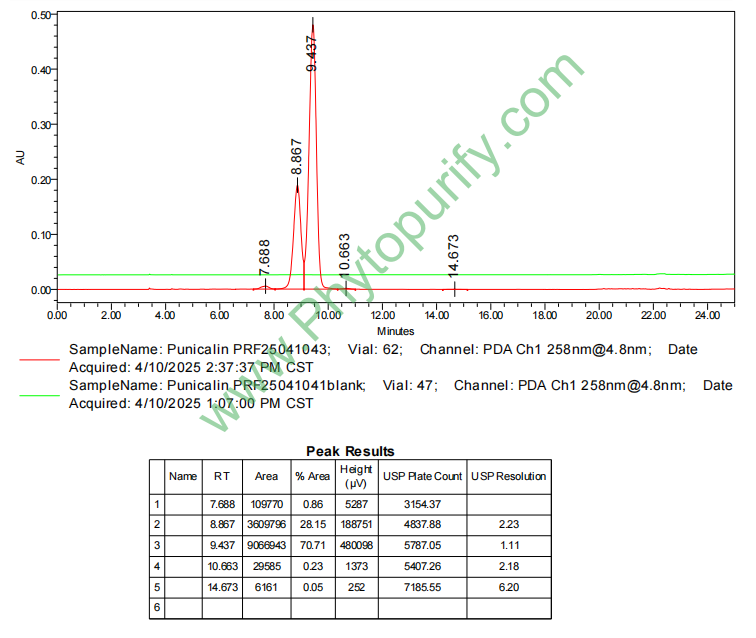
Storage conditions:Short-term storage at 2~8℃, long-term storage at -20 ~ -80℃
385.2400
1.0074
-.4996
.0034
.5349
.7915
Low
80.3680
6.8878
Yes
No
No
No
Yes
Yes
0.6
Yes
No
Yes
No
Natural products, as an important treasure trove for drug discovery, have always played a crucial role in the long history of human fight against diseases. Among them, tannic compounds derived from traditional medicinal plants have become a hot topic in modern pharmacological research due to their complex and diverse structures and wide biological activities. Punicalin (CAS number: 65995-64-4) is one of the shining stars. Anshi durian forest is made from pomegranates(Punica granatum L. A major tanning tannin compound isolated from leaves, fruit peels, and other parts. Early research focused on its contribution as an antioxidant and anti-inflammatory component in pomegranate extract. However, with the deepening of research, Anshilin has demonstrated remarkable multi-target pharmacological activity beyond traditional understanding. Existing evidence suggests that it not only has significant potential against hepatitis B virus (HBV) and SARS-CoV-2 virus, but also induces a special inflammatory programmed cell death called pyroptosis and inhibits carbonic anhydrase activity. Of particular importance is its ability to exhibit multiple pathways and targets in the field of anti-tumor therapy, involving multiple levels such as regulating apoptosis, inhibiting metastasis, and interfering with signal transduction. This article aims to provide a systematic review of the chemical characteristics, plant sources, pharmacological activities, molecular mechanisms of action, pharmacological evaluation, and clinical application prospects of pomegranate forests in order to provide comprehensive scientific references for the in-depth development and transformation research of this natural product.
Anshilin is a typical tannin derivative of tannic acid, whose chemical structure is composed of a central glucose group and two tannic acid units connected by C-C bonds, forming a highly conjugated complex polyphenol system. Its molecular formula is C34H22O22 and its molecular weight is 782.5280. The abundant phenolic hydroxyl groups in the structure give it a strong electron supply ability, which is the structural basis for its excellent antioxidant activity. Meanwhile, these polar groups also contribute to their larger topological polar surface area (TPSA, 385.2400 Å ²), indicating that the molecule has strong hydrogen bonding ability.
In terms of physical and chemical properties, the lipid water partition coefficient (LogP) of An Shi Liu Lin is about 1.0074, indicating that it has a certain degree of lipophilicity, but overall it still leans towards amphiphilic properties. Its water solubility is relatively low, about 0.0034 mg/mL, which is closely related to its high molecular weight and polyphenol structure, and is also a common challenge faced by most polyphenolic natural products in formulation development. Pharmacokinetic predictions indicate that the ability of Anserin to penetrate the blood-brain barrier is relatively low, and it is mainly distributed in the peripheral system. In the preliminary safety screening, the hERG channel inhibition risk was negative, indicating a low potential risk of arrhythmia. The Ames test result (0.6) preliminarily indicates a low risk of mutagenicity, but further in vitro and in vivo genetic toxicity studies are needed to confirm. These physicochemical and pharmacological parameters provide key data support for subsequent structural modifications and formulation optimization.
The main source of the Anshi durian forest is the pomegranate plant in the pomegranate family, which belongs to the pomegranate genus(Punica granatum L.)。 Unlike the widely recognized pomegranate seeds and juice, the content of pomegranate pomegranates in the peel, diaphragm, and especially leaves is relatively high. This provides the possibility of developing high value-added products by comprehensively utilizing pomegranate processing by-products (such as skins).
Solvent extraction is commonly used to extract durian from plant materials. Due to its polyphenolic properties, solvent systems with moderate polarity have higher efficiency. The common extraction process includes: soaking or ultrasound assisted extraction of dried and crushed pomegranate peels or leaves using methanol, ethanol, or acetone water mixed solutions. The crude extract is then subjected to a series of separation and purification steps, such as macroporous resin adsorption (commonly AB-8, D101, etc.), and enriched using its hydrogen bonding and hydrophobic interactions with the resin. Further purification relies on preparative high-performance liquid chromatography (HPLC), using a reverse phase C18 column and gradient elution with methanol water or acetonitrile water (often containing small amounts of formic acid or acetic acid to improve peak shape) as the mobile phase. In recent years, some green extraction techniques such as supercritical CO2 extraction (requiring entrainers) and microwave-assisted extraction have also been explored to improve extraction efficiency and selectivity. The optimization of extraction process needs to comprehensively consider the yield, purity, economic and environmental benefits of the target product.
Anshi durian exhibits a wide range of pharmacological activities, and its research has expanded from its initial antioxidant and anti-inflammatory properties to major disease fields such as antiviral and anti-tumor effects.
1. Antiviral activity:
Anshi durian has broad-spectrum antiviral potential. Research has shown that it can effectively inhibit the replication of hepatitis B virus (HBV) and reduce the expression of viral antigens. What is more striking is that in the study of novel coronavirus (SARS CoV-2), acerbin was confirmed to be able to block the binding of virus spike protein (S-glycoprotein) to the host cell surface angiotensin converting enzyme 2 (ACE2) receptor, which may prevent the virus from invading cells, which provides a basis for its potential as a leading compound against COVID-19.
2. Anti inflammatory and antioxidant activity:
As a polyphenolic compound, Anshilin is a powerful free radical scavenger and metal chelating agent that can effectively alleviate oxidative stress damage. Its anti-inflammatory effect involves inhibiting the expression of pro-inflammatory mediators such as TNF - α, IL-6, COX-2, iNOS. It is worth noting that under specific conditions, anliulin can induce apoptosis of immune cells. Cellular pyroptosis is a programmed cell death that relies on the formation of membrane pores by Gasdermin family proteins, accompanied by the release of large amounts of pro-inflammatory factors such as IL-1 β and IL-18. The pyroptosis induced by Anshilin may be a double-edged sword: moderate activation can help clear pathogenic or tumor cells, but excessive activation may lead to severe tissue inflammation and damage, and its regulatory mechanism and physiological and pathological significance need to be further elucidated.
3. Antitumor activity:
This is currently one of the most promising research directions for the Anshi durian forest. A large number of in vitro studies have shown that Anshigualin has significantly inhibited proliferation and promoted apoptosis in a variety of human cancer cell lines, including breast cancer, prostate cancer, liver cancer, colon cancer, etc. Its anti-tumor effect is not achieved through a single pathway, but through the synergistic effect of multiple targets. In addition, the study also suggests that resveratrol can inhibit the migration and invasion of tumor cells, suggesting its potential for anti metastasis.
4. Carbonic Anhydrase Inhibition Activity:
Anshilin has been identified as an inhibitor of carbonic anhydrase (CA). Carbonic anhydrase participates in various physiological processes such as pH regulation and ion transport in the body. Its isoenzymes CA IX and CA XII are often overexpressed in tumor cells and are closely related to the formation, proliferation, and metastasis of the acidic microenvironment of tumors. Inhibiting these isoenzymes has become one of the anti-cancer strategies. The CA inhibitory activity of Anshilin may be associated with its anti-tumor effect.
The various pharmacological activities of Anshilin, especially its core anti-tumor effect, stem from its precise intervention in multiple key signaling pathways and molecular targets within cells.
1. Regulating cell apoptosis and survival pathways:
Anshilin can significantly downregulate the expression of anti apoptotic proteins Bcl-2 and Mcl-1, and may also affect pro apoptotic proteins, thereby disrupting mitochondrial membrane potential, triggering cytochrome C release, activating Caspase cascade reaction, and ultimately leading to endogenous apoptosis. This is an important mechanism for its direct killing of tumor cells.
2. Inhibit signal transduction and transcriptional activation:
Signal transducer and activator of transcription factor 3 (STAT3) is an important oncogenic transcription factor. Anshilin can inhibit the phosphorylation (activation) of STAT3, prevent its nuclear translocation and transcription of downstream target genes (such as Bcl-2, Mcl-1, Cyclin D1, etc.), thereby simultaneously inhibiting tumor cell proliferation, survival, and angiogenesis.
3. Interference with cell cycle and DNA metabolism:
The study suggests that the An Shiliu Lin may act on topoisomerase I (TOP1) and topoisomerase II α (TOP2A), interfering with DNA replication and transcription processes, leading to DNA damage and cell cycle arrest. This provides another explanation for its cytotoxic effects.
4. Inhibit tumor invasion and metastasis:
Anshilin can reduce the expression and activity of matrix metalloproteinase-2 (MMP-2). MMP-2 is a key enzyme that degrades extracellular matrix and promotes tumor invasion and metastasis. By inhibiting MMP-2, An Shilin can weaken the migration and infiltration ability of tumor cells. At the same time, it can also inhibit the stability and activity of hypoxia inducible factor-1 alpha (HIF-1 alpha), which is a core regulatory factor for tumors to adapt to the hypoxic microenvironment, promote angiogenesis and metastasis.
5. Affects hormone related pathways:
For hormone dependent tumors (such as breast cancer), Anshigualin has shown interference with estrogen receptor α (ESR1) signaling pathway and can inhibit the activity of aromatase (CYP19A1). Aromatase is a key enzyme in estrogen synthesis, and its inhibition can reduce estrogen levels in the body, thereby inhibiting the growth of estrogen dependent tumors.
6. Regulating kinase activity:
There are studies involving the extracellular signal regulated kinase (MAPK1/ERK2) pathway. Anshilin may affect cell proliferation, differentiation, and stress response by regulating MAPK/ERK signaling.
In summary, Anshilin works through a complex "multi-target network" to synergistically inhibit tumor growth, survival, invasion, and angiogenesis, which may help overcome the problem of resistance to single target drugs to some extent.
Despite exhibiting excellent biological activity in vitro, the drug like properties of Anshi durian face challenges, mainly due to its inherent properties as a natural polyphenol.
1. Absorption, distribution, metabolism, and excretion (ADME):
* Absorption: The larger molecular weight (>500) and higher polar surface area may limit its passive transmembrane diffusion, resulting in lower expected oral bioavailability. Its stability in the gastrointestinal tract, whether it is metabolized and broken down by gut microbiota, and whether there is an active transport mechanism are key factors affecting its oral absorption.
* Distribution: The prediction shows that its blood-brain barrier permeability is low, mainly distributed in the blood and systemic tissues. Its binding rate with plasma proteins (such as albumin) may be high, which can affect its free drug concentration and efficacy.
* Metabolism: As a polyphenol, An Shi Liu Lin is likely a substrate for various phase I and phase II metabolic enzymes, such as cytochrome P450 enzymes, UDP glucuronosyltransferase, and sulfotransferase. It may be rapidly metabolized into tannic acid or other smaller phenolic compounds in the body, which may still be active but undergo fundamental changes in pharmacokinetic behavior.
* Excretion: It is expected that its prototype or metabolites will mainly be excreted through the kidneys and/or bile.
2. Dosage form and administration strategy:
In order to improve its bioavailability, innovative formulation strategies are needed. Possible solutions include: preparation of phospholipid complexes, cyclodextrin inclusion complexes, nanoparticles (such as liposomes, polymer nanoparticles), microemulsion or self microemulsion systems, etc. These delivery systems can enhance their solubility, protect them from premature metabolism, promote intestinal lymphatic absorption, or achieve targeted delivery.
3. Security:
The preliminary negative hERG inhibition and low-risk Ames test values are positive signals. However, comprehensive preclinical safety evaluations (including acute toxicity, chronic toxicity, reproductive toxicity, etc.) have not yet been systematically conducted. Its activity in inducing cell pyroptosis also needs to be carefully evaluated, and its therapeutic window needs to be clarified to avoid triggering uncontrolled systemic inflammation.
At present, there is still a lack of research data on the pharmacokinetics of the Anserin system, which is a key gap that must be filled in order to move towards drug development.
The multi-target anti-tumor and antiviral properties of Anshilin have outlined a broad blueprint for its clinical application, but it faces both opportunities and challenges on the road.
1. As an anti-tumor lead compound:
Its multi-channel anti-tumor mechanism is the biggest advantage. Future research and development directions may include:
* Combination therapy: Combined with existing chemotherapy drugs (such as topoisomerase inhibitors, paclitaxel, etc.) or targeted drugs, it may produce synergistic effects, reduce individual doses and toxic side effects, and overcome drug resistance.
* Structural modification: Using it as the parent nucleus for chemical structure optimization, aiming to improve activity, selectivity, and drug properties. For example, improving solubility, metabolic stability, and targeting by modifying phenolic hydroxyl groups or introducing specific functional groups.
* New delivery system: Developing tumor targeted nanomedicine, such as utilizing EPR effect or coupling targeted ligands (such as folate, RGD peptide), to enhance drug accumulation at the tumor site and achieve precise treatment.
2. As an antiviral agent:
The preliminary findings in anti HBV and anti SARS-CoV-2 are worth further exploration. It can be used in combination with existing antiviral drugs or developed into preventive nasal sprays, lozenges and other local drug forms to block respiratory tract virus infection.
3. Application in inflammation related diseases:
Its anti-inflammatory and antioxidant properties can be used to treat chronic inflammatory diseases such as metabolic syndrome, arthritis, neurodegenerative diseases, etc. But it is necessary to precisely regulate its activity of inducing pyroptosis to avoid exacerbating inflammation.
4. Challenges and Future Research Focus:
* Systematic pharmacokinetic studies: Urgent research is needed on ADME in animals to clarify its absolute bioavailability, major metabolic pathways, distribution of major organs, and elimination half-life.
* In depth study of the mechanism of action: Chemical biology methods such as affinity fishing, molecular docking, and kinetic simulations need to be used to confirm the protein targets that directly interact with each other, and to elucidate the network relationships between their multiple targets.
* Pharmacodynamic validation in vivo: It is necessary to validate its efficacy and safety in more and more clinically relevant animal models, such as human tumor xenograft models and transgenic mouse models.
* Resources and Sustainability: Ensure stable, economical, and environmentally friendly access to sufficient amounts of safe pomegranate forests from pomegranate by-products, or develop fully synthetic/semi synthetic routes to meet future development needs.
Anshi durian, a tannin derived from ancient pomegranate trees, has transformed from a common plant polyphenol into a natural lead compound with significant development potential due to its unique chemical structure and multi-target pharmacological activity. Its outstanding performance in the fields of anti-tumor, antiviral, anti-inflammatory, etc., especially through regulating multiple key targets such as MCL1, STAT3, MMP2, TOP1, etc., reveals the systemic regulatory advantages of natural products in the treatment of complex diseases. However, its inherent pharmaceutical defects, such as low solubility and potentially complex metabolic fate, are the main obstacles between laboratory research and clinical applications. Future research should focus on thoroughly elucidating its systemic pharmacokinetic behavior, accurately analyzing its direct target network, and utilizing modern pharmaceutical chemistry and formulation techniques to rationalize and deliver it. Through interdisciplinary collaboration, Anshilin is expected to transform from a gift from nature into an innovative drug serving human health, continuing the immortal legend of natural products in modern medicine.
