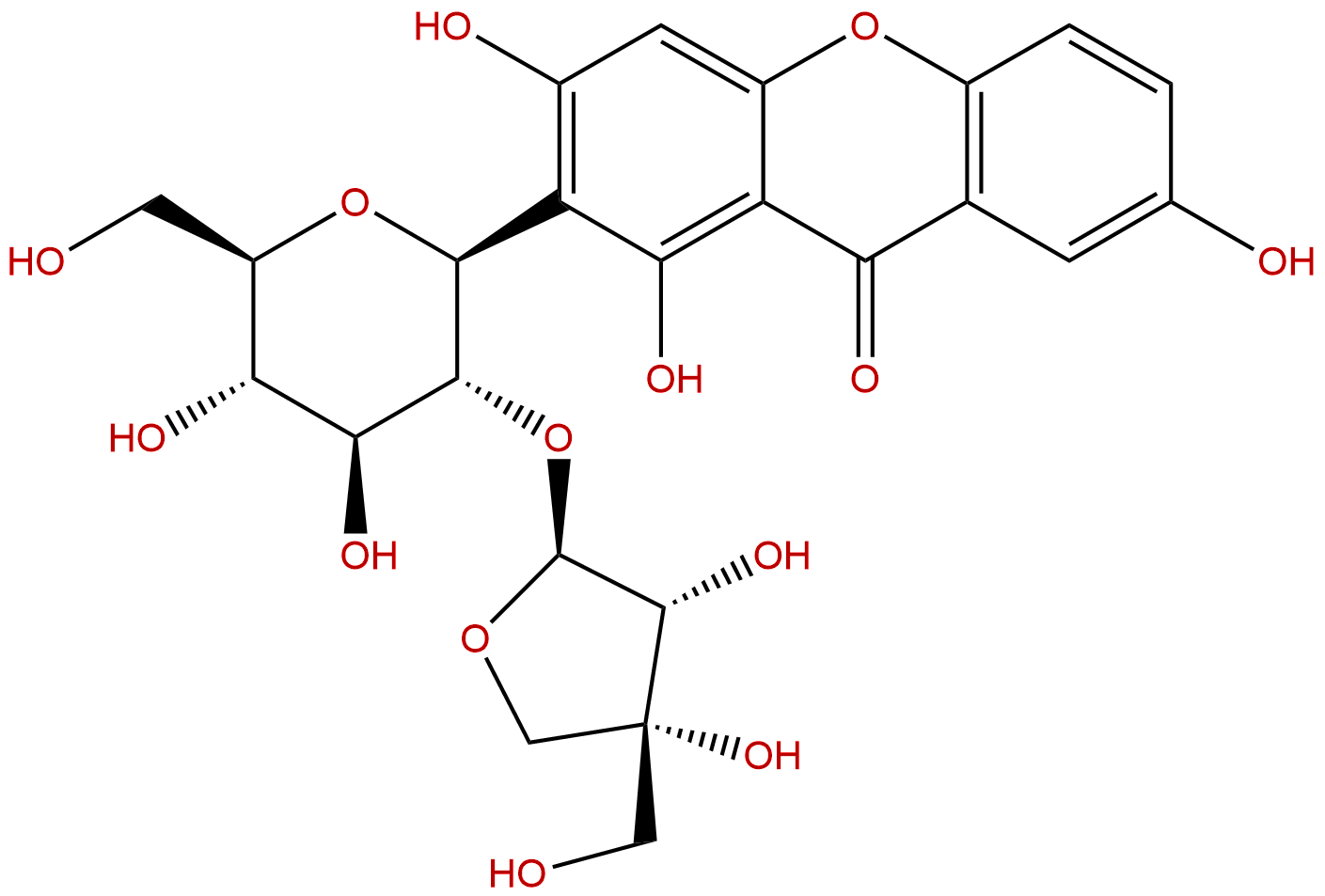


Product name: sibiricaxanthone B
Synonym name:
Catalogue No.: BP3366
Cas No.: 241125-81-5
Formula: C24H26O14
Mol Weight: 538.458
Botanical Source:
Physical Description: Powder
Type of Compound: Xanthones
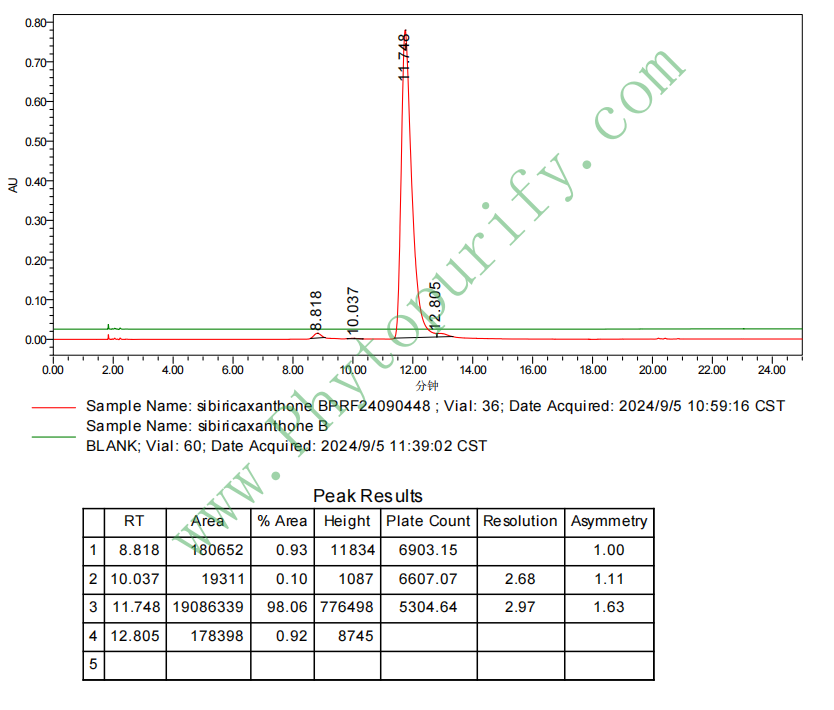
Purity: 95%~99%
Analysis Method: HPLC-DAD or/and HPLC-ELSD
Identification Method: Mass, NMR
Packing: Brown vial or HDPE plastic bottle
The product could be supplied from milligrams to grams. Inquire for bulk scale.
We provide solution to improve the water-solubility of compounds, thereby facilitating the variety of activity tests and clinic uses.
For Reference Standard and R&D, Not for Human Use Directly.
Description:
Sibiricaxanthone B is a natural product from Polygala tenuifolia.
References:
J Sep Sci. 2017 May;40(10):2131-2140.
Ultra-fast liquid chromatography with tandem mass spectrometry determination of eight bioactive components of Kai-Xin-San in rat plasma and its application to a comparative pharmacokinetic study in normal and Alzheimer's disease rats.
A method of ultra-fast liquid chromatography with tandem mass spectrometry was developed and validated for the simultaneous quantitation of eight bioactive components, including polygalaxanthone III, Sibiricaxanthone B, tenuifolin, sibiricose A5, sibiricose A6, tenuifoliside A, ginsenoside Re and ginsenoside Rb1 in rat plasma after oral administration of Kai-Xin-San.
METHODS AND RESULTS:
The plasma samples were extracted by liquid-liquid extraction using digoxin as an internal standard. Chromatographic separation was performed on a Venusil MP C18 column (100 mm × 2.1 mm, 3 μm) with methanol and 0.05% acetic acid in water as mobile phase. The tandem mass spectrometric detection was performed in the multiple reaction monitoring with turbo ion spray source in the negative ionization. Validation parameters were within acceptable ranges. The established method has been successfully applied to compare the pharmacokinetic profiles of the analytes between normal and Alzheimer's disease rats.
CONCLUSIONS:
The results indicated that there were significant differences in pharmacokinetic parameters of some components between two groups, which may be due to the mechanisms of Alzheimer's disease and pharmacological effects of the analytes. The pharmacokinetic research in the pathological state might provide more useful information to guide the clinical usage of herbal medicine.
HPLC of sibiricaxanthone B
Storage conditions:Short-term storage at 2~8℃, long-term storage at -20 ~ -80℃
239.9700
-.7703
-.8284
1.1069
.5462
.1620
Low
71.8577
4.7790
Yes
No
No
No
Yes
No
1.5
Yes
No
Yes
No
Depression is a highly prevalent mental disorder worldwide, with complex pathological mechanisms involving imbalances in monoamine neurotransmitters, impaired neural plasticity, dysfunction of the hypothalamic pituitary adrenal (HPA) axis, and inflammatory responses. Although traditional antidepressants, represented by selective serotonin reuptake inhibitors (SSRIs), are widely used in clinical practice, they generally suffer from delayed onset, limited efficacy, and significant side effects. Therefore, searching for novel antidepressant lead compounds with novel structures, diverse mechanisms of action, and higher safety from natural products has always been an important direction in the field of drug development. Polygala tenuifolia Willd., as a traditional Chinese medicine for intelligence and calming the mind, has been extensively studied for its antidepressant activity. Sibiricanthone B, isolated from Polygala tenuifolia, is a type of anthraquinone compound that has attracted much attention due to its unique chemical structure and potential antidepressant activity. This article aims to systematically review the chemical properties, plant sources, pharmacological activities, mechanisms of action, and medicinal properties of Siberian mountain ketone B, in order to provide comprehensive scientific references for the in-depth research and development of this compound.
The chemical name of Siberian Yuanzhi Mountain Ketone B is 1,3,5,6-tetrahydroxy-2,8-bis (3-methylbut-2-en-1-yl) -9H-oxaanthrone 9-one, and its CAS number is 241125-81-5. Structurally, it belongs to the class of anthraquinone compounds, with its parent nucleus being a tricyclic aromatic system, i.e. an anthraquinone skeleton. The significant feature of this compound is that it is connected to two isopentenyl side chains at positions C-2 and C-8, respectively, and there are four hydroxyl substituents at positions C-1, C-3, C-5, and C-6. This highly oxidized structure and the introduction of isopentenyl groups give it a unique electronic distribution and spatial conformation, which is often closely related to specific biological activities.
Its molecular weight is 538.4580 g/mol. The calculated lipid water partition coefficient (LogP) is -0.7703, indicating that the compound has high hydrophilicity. The topologically polar surface area (TPSA) is as high as 239.97 Å ², mainly attributed to the presence of multiple hydroxyl and carbonyl groups in the molecule, which are potential hydrogen bond donors and acceptors. The theoretically calculated water solubility value is 1.1069 mg/mL, further confirming its excellent hydrophilic properties. However, high TPSA and hydrophilicity often affect the ability of compounds to penetrate lipid bilayers. Preliminary computer simulation predictions indicate that Siberian tanshinone B has a low ability to penetrate the blood-brain barrier (BBB), which poses a potential challenge for the development of central nervous system (CNS) drugs. In the preliminary safety screening, the compound did not show significant hERG potassium channel inhibition risk (predicted as "no"), indicating a low potential risk of arrhythmia. The predicted value of the Ames test is 1.5, indicating that its mutagenic risk is in a gray area that requires careful evaluation and further experimental validation is needed.
Siberian Polygala tenuifolia B mainly comes from the dried roots of plants in the Polygala family, especially the traditional Chinese medicine Polygala tenuifolia Willd. Yuanzhi, as a traditional Chinese medicine, has the effects of calming the mind, improving intelligence, dispelling phlegm, and opening the orifices. It is commonly used to treat insomnia, forgetfulness, and palpitations. Its antidepressant and neuroprotective activities have been widely studied in modern pharmacology. Oxyanthrone compounds are another important class of active ingredients in Yuanzhi, in addition to saponins and oligosaccharides.
The extraction and separation of Siberian mountain ketone B from plant materials usually use multi-step chromatographic techniques. The conventional process is as follows: Firstly, the dried roots of Yuanzhi are crushed and heated with high concentration ethanol (such as 70% -95%) for reflux or ultrasound assisted extraction to fully extract polar and medium polar components including anthraquinone. Combine the extracts and concentrate under reduced pressure to obtain a crude extract. Subsequently, the crude extract was suspended in water and subjected to gradient extraction using organic solvents such as petroleum ether, ethyl acetate, and n-butanol. Siberian Yuanzhi Mountain Ketone B is mainly enriched in the highly polar ethyl acetate and n-butanol fractions due to its polyhydroxy structure. After the active site is obtained, a variety of modern chromatographic separation technologies are comprehensively used for purification, such as silica gel column chromatography, reverse phase C18 column chromatography (ODS), Sephadex gel column chromatography (LH-20) and high performance liquid chromatography (HPLC). By using spectroscopic techniques such as nuclear magnetic resonance (NMR, including 1H-NMR and 13C-NMR), mass spectrometry (MS), and ultraviolet spectroscopy (UV), and comparing with literature data, its chemical structure can ultimately be identified. At present, there are few reports on the total synthesis of this compound, and its source mainly relies on plant extraction, which to some extent limits its large-scale supply and structural modification research.
A large number of in vitro and in vivo pharmacological studies have confirmed that Siberian tanshinone B has significant antidepressant like activity and is one of the important material bases for its plant derived plant, tanshinone B, to exert antidepressant effects.
In the classic animal behavior despair model, Siberian mountain ketone B showed good performance. In the forced swimming test (FST) and tail suspension test (TST) in mice, administration of this compound significantly shortened the immobility time of mice, and this effect was dose-dependent within a certain dose range. Its antidepressant activity is comparable or slightly superior to some classic antidepressants such as fluoxetine, but the onset time may vary. In addition, in the chronic unpredictable mild stress (CUMS) induced depression model rats, long-term administration of Siberian tanshinone B not only improved behavioral despair (increased FST immobility time) and pleasure loss (decreased sucrose preference) in the model animals, but also reversed a series of depression like behaviors such as slow weight gain and reduced exploratory activity caused by stress. These results strongly demonstrate its potential in alleviating various core symptoms of depression.
In addition to its core antidepressant behavioral effects, research has also found that Siberian resveratrol B has multiple neuroprotective and regulatory activities. In PC12 cells or primary cortical neuron injury models induced by corticosterone or glutamate, this compound can significantly improve cell survival rate, reduce lactate dehydrogenase (LDH) leakage, and inhibit cell apoptosis. Its neuroprotective effect is closely related to reducing oxidative stress (such as lowering reactive oxygen species (ROS) levels and increasing superoxide dismutase (SOD) activity) and inhibiting inflammatory responses (such as downregulating the expression of pro-inflammatory factors TNF - α and IL-1 β). These activity cues suggest that the antidepressant effect of Siberian resveratrol B may not only stem from rapid regulation of neurotransmitters, but also involve long-term improvement of the neuronal survival environment.
The antidepressant mechanism of Siberian Yuanzhishanketone B exhibits multi-target and multi pathway characteristics, which is consistent with its complex chemical structure and also conforms to the modern concept of multi-target treatment of complex diseases with natural products.
Regulating the monoamine neurotransmitter system This is one of the possible ways for it to exert rapid antidepressant effects. Research has shown that Siberian mountain ketone B exhibits certain inhibitory activity on monoamine oxidase A and B (MAO-A and MAO-B). MAO is a key enzyme that degrades serotonin (5-HT), norepinephrine (NE), and dopamine (DA). Inhibiting its activity can increase the concentration of monoamine neurotransmitters in synaptic cleft. In addition, molecular docking simulations suggest that it may bind to the serotonin transporter (SLC6A4/SERT), potentially inhibiting the reuptake of 5-HT, similar to the effect of SSRIs. Meanwhile, it is also predicted to have a high affinity for the 5-HT1A receptor (HTR1A), whose activation is associated with antidepressant and anti anxiety effects. The potential inhibitory effect on catechol-O-methyltransferase (COMT) may also contribute to maintaining levels of dopamine and norepinephrine in the prefrontal cortex.
Promoting Neuronutrition and Neuroplasticity This is the core mechanism for achieving long-term antidepressant and neuroprotection. Siberian Yuanzhi Mountain Ketone B can significantly upregulate the expression of brain-derived neurotrophic factor (BDNF) in brain regions such as the hippocampus. BDNF activates its high affinity receptor TrkB, thereby initiating multiple downstream signaling pathways. Among them, the compound has been proven to inhibit the activity of glycogen synthase kinase-3 β (GSK3 β). GSK3 β is a key negative regulator of the Wnt/β - catenin and PI3K/Akt pathways, and its overactivity is associated with neurodegeneration and depression. Inhibiting GSK3 β can promote β - catenin stability and cell survival. At the same time, BDNF/TrkB signaling can also activate cAMP response element binding protein (CREB1). CREB1, as a transcription factor, can further promote the transcription of BDNF itself and other genes related to synaptic plasticity and neuronal survival (such as Bcl-2), forming a positive feedback loop. This multi-level regulation of the BDNF/GSK3 β/CREB signaling axis is the basis for the reversal of structural plasticity damage such as hippocampal neuronal atrophy and reduced dendritic spine density in the CUMS model by Siberian resveratrol B.
Regulating the balance of neural excitability Studies have found through molecular docking that Siberian tanshinone B may bind to the alpha 1 subunit (GABRA1) of gamma aminobutyric acid type A receptor (GABAA). GABA is the main inhibitory neurotransmitter in the central nervous system, and regulating the function of GABAA receptors may affect the excitation/inhibition balance of neural networks. This is similar to some mechanisms of certain fast acting antidepressants (such as ketamine), which may be involved in their rapid improvement of mood.
In summary, Siberian Yuanzhi Mountain Ketone B forms a three-dimensional antidepressant network through synergistic effects on multiple levels such as monoamine neurotransmitter regulation, neural nutrition enhancement, and neural excitability balance.
Despite the enormous potential demonstrated in pharmacological activity of Siberian mountain ketone B, its pharmacological development still faces some challenges and requires systematic pharmacokinetic (PK) and pharmacodynamic (PD) evaluations.
According to its physical and chemical properties analysis, the compound has strong hydrophilicity (LogP is negative, TPSA is high), which may lead to poor oral bioavailability. High polarity molecules have poor passive diffusion and absorption in the gastrointestinal tract, and may become substrates for efflux transporters such as P-glycoprotein, which are pumped into the ileal lumen. Computer simulation predicts low blood-brain barrier permeability, which is one of the most critical obstacles in the development of central nervous system drugs. Although there may be blood-brain barrier dysfunction in depression, relying on it is not a reliable medication strategy. Therefore, in the future, it may be necessary to improve its absorption and brain targeted delivery through prodrug strategies (such as esterifying hydroxyl groups to enhance lipid solubility) or the development of novel drug delivery systems (such as nanoliposomes, polymer micelles).
At present, there are insufficient reports on the pharmacokinetic studies of the Siberian Far Eastern Mountain Ketone B system. Based on research on similar oxanthrone compounds, it is speculated that they may undergo extensive II phase metabolic binding reactions in vivo, such as glucuronidation and sulfation, due to the presence of multiple phenolic hydroxyl groups in the molecule, which are ideal sites for binding reactions. This may result in low exposure and short half-life of its prototype drug in the bloodstream. The activity of its metabolites and the specific subtypes of metabolic enzymes (such as UGT and SULT) require further research. In terms of safety, preliminary computer predictions did not indicate hERG risk, but the Ames test prediction value (1.5) requires experimental validation to exclude genetic toxicity. In addition, its multi-target nature may also bring off target effects and unforeseeable side effects, which need to be closely monitored in long-term toxicology research.
Siberian Yuanzhi Mountain Ketone B, as a structurally novel natural anthraquinone, provides new ideas and candidate molecules for the development of a new generation of antidepressant drugs through its multi-target antidepressant mechanism. The clinical application prospects and future research directions are mainly reflected in the following aspects:
As a novel multi-target antidepressant lead compound In response to the limitations of existing single target antidepressants, the simultaneous regulation of the monoaminergic system and BDNF neurotrophic pathway by Siberian resveratrol B may bring therapeutic advantages such as faster onset, higher efficacy, and improved cognitive function. It is particularly suitable for patients with refractory depression who have poor response to traditional SSRIs/SNRIs.
Structural optimization and derivative development Reasonable structural modification is the core research direction for addressing its drug weakness, especially in terms of oral absorption and BBB penetration. For example, selective alkylation of its phenolic hydroxyl group or preparation of ester prodrugs to balance LogP and TPSA and improve membrane permeability; Or by introducing specific functional groups to avoid becoming substrates for efflux proteins. Through structure-activity relationship (SAR) studies, it is expected to significantly improve its pharmacokinetic properties while retaining or even enhancing its core pharmacological activity.
Combination therapy and complementary replacement therapy In traditional Chinese medicine formulas or plant extracts, Siberian yuanzhishan ketone B may have a synergistic effect with other active ingredients such as yuanzhi saponins and oligosaccharides, exerting a comprehensive therapeutic effect of "multi-component multi-target". Exploring its combination with low-dose traditional antidepressants may help reduce the dosage and side effects of the latter, and improve the treatment index.
Expand the field of treatment Given its clear neuroprotective, anti-inflammatory, and antioxidant activities, research on Siberian resveratrol B should not be limited to depression. Its therapeutic potential in neurodegenerative and traumatic diseases such as Alzheimer's disease, Parkinson's disease, and cerebral ischemia-reperfusion injury is worth exploring. In addition, the inhibition of GSK3 β also suggests that it may be used in diabetes, cancer and other diseases.
In depth mechanism research and biomarker exploration Modern technologies such as gene knockout, optogenetics, and chemogenetics are needed to more accurately validate their key targets (such as GSK3 β, SERT, 5-HT1A) in cell and animal models. Meanwhile, searching for biomarkers of therapeutic response, such as peripheral blood BDNF levels and inflammatory cytokine profiles, can help achieve precise classification and personalized medication for depression.
Siberian Yuanzhi Mountain Ketone B is a natural product of the anthraquinone class with significant antidepressant potential isolated from the traditional Chinese medicine Yuanzhi. Its unique isopentenyl substituted polyhydroxyanthraquinone structure endows it with multi-target and multi pathway functional characteristics. It not only regulates monoamine neurotransmission by potentially inhibiting targets such as MAO and SERT, but also effectively promotes neuroplasticity and neuronal survival by upregulating BDNF, inhibiting GSK3 β, activating CREB and other core mechanisms, fundamentally combating the neurobiological changes of depression. Although it faces challenges in terms of oral bioavailability and blood-brain barrier penetration, these are precisely the areas that modern medicinal chemistry and pharmacy can focus on addressing. Through systematic structural optimization, delivery system innovation, and in-depth preclinical research, Siberian Yuanzhishanketone B is expected to develop from an excellent natural lead compound into a new generation of candidate drugs for the treatment of depression and related neurological and psychiatric disorders, fully demonstrating the enormous potential of exploring modern therapeutic value from traditional medical treasure trove. Future research should focus on improving its pharmacokinetic properties, accurately elucidating its mechanism of action, and expanding its therapeutic field to accelerate its translation into clinical applications.
