Introduction/Overview
Natural products, as an important source of drug discovery, play an irreplaceable role in the long history of human fight against diseases. Fungi, especially medicinal fungi, have attracted much attention due to their unique secondary metabolites and significant biological activity. Ganoderma lucidum(Ganoderma lucidum)As a traditional and precious Chinese medicinal herb, it is known as the "fairy grass" and "auspicious grass" and has a medicinal history of thousands of years in China and East Asia. Modern pharmacological research has confirmed that Ganoderma lucidum is rich in various active ingredients such as polysaccharides, triterpenoids, sterols, nucleosides, etc., and has multiple pharmacological effects such as immune regulation, anti-tumor, antioxidant, anti-inflammatory, liver protection, and blood glucose lowering. Among them, triterpenoids from Ganoderma lucidum are considered as one of the core material foundations for its anti-tumor activity.
Ganoderma triterpenoids have complex and diverse structures, and can be divided into several subtypes based on their different skeletons and functional groups, such as ganoderic acids, ganoderils, ganoderic aldehydes, and ganoderic acids. Ganoderma acid F (GA-F) is one of the representative highly oxidized lanostane triterpenoids. Since its isolation and identification from Ganoderma lucidum fruiting bodies, GA-F has attracted widespread attention from scholars at home and abroad due to its unique chemical structure and potential biological activity, especially anti-tumor activity. Research has shown that GA-F can inhibit the proliferation, induce apoptosis, suppress invasion and metastasis of various tumor cells through multiple targets and pathways, and exhibits the potential to interact with multiple anti-tumor targets such as MCL1, BCL2, STAT3, MMP2, TOP1, HIF1A, TOP2A, MAPK1, ESR1, CYP19A1, etc. This article aims to provide a systematic review of the chemical structure, physicochemical properties, plant origin, pharmacological activity, mechanism of action, medicinal properties, and clinical application prospects of Ganoderma lucidum acid F, in order to provide reference for the in-depth research and development of this natural product.
Chemical structure and physicochemical properties
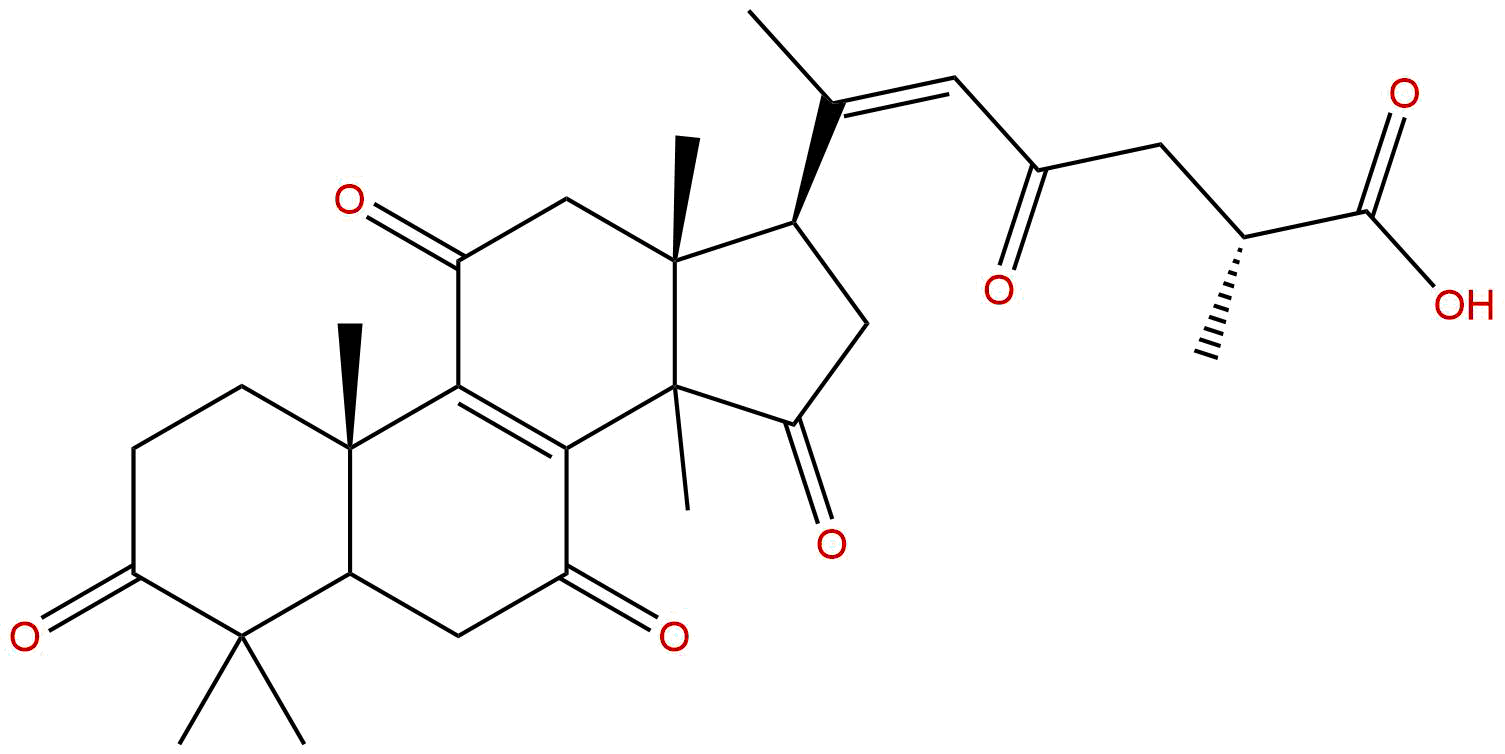
Lingzhi acid F belongs to highly oxidized lanostane triterpenoids. Its chemical structure has typical triterpenoid skeleton characteristics, consisting of six isoprene units and containing four carbon rings (A, B, C, D rings). Similar to many other ganoderic acid compounds, the structural complexity of GA-F is reflected in the presence of multiple chiral centers, hydroxyl, carbonyl, and carboxyl functional groups on its molecular skeleton. Specifically, GA-F molecules typically contain a carbonyl group located at the C-3 position, one or more hydroxyl groups (such as C-7, C-15), and a carboxyl group located at the C-26 position, which gives them a certain degree of polarity and acidity. In addition, its side chain often contains double bonds and additional hydroxyl or carbonyl modifications. The molecular formula of GA-F is C ∝₀ H ∝₈ O ₇, with a molecular weight of 510.6270 g/mol. Its precise stereochemical structure has been confirmed by modern spectroscopic techniques such as nuclear magnetic resonance (NMR) and mass spectrometry (MS).
From the perspective of physicochemical properties, the lipid water partition coefficient (LogP) of GA-F is 2.9348, indicating its lipophilicity, which is consistent with the hydrophobicity of its triterpenoid skeleton. Its polar surface area (TPSA) is 122.65 Å ², which is relatively high and usually indicates that the molecule has good polarity, possibly due to the large number of hydrogen bond acceptors and donors. The water solubility of GA-F is extremely poor, only 0.0095 mg/mL, which greatly limits its solubility and bioavailability in aqueous systems. This characteristic is a common challenge faced by many natural triterpenoids, and it is also a key issue that needs to be addressed in the development of drug formulations in the future. According to computer prediction models (such as ADMET prediction), GA-F has a lower ability to cross the blood-brain barrier (BBB), indicating its limited potential in the treatment of central nervous system diseases, but it may also mean that it is less likely to cause toxic side effects in the central nervous system. In addition, the predictive model showed a low inhibitory risk of GA-F on hERG potassium ion channels (associated with cardiac toxicity) ("No"), and the Ames test result was 0.0, indicating a low potential genetic toxicity risk. These preliminary pharmacological evaluation results provide positive signals for its potential as a candidate drug molecule.
Plant sources and extraction methods
Lingzhi acid F mainly comes from the porous fungal family Ganoderma lucidum(Ganoderma lucidum)The fruiting body, mycelium, or spore powder. Lingzhi has a wide range of production areas, including China, Japan, South Korea, and Southeast Asia. There may be significant differences in the content and composition of triterpenoids in Ganoderma lucidum from different regions, varieties (such as Ganoderma lucidum and Ganoderma lucidum), and growth stages. Usually, mature Ganoderma lucidum fruiting bodies have a higher content of triterpenoids, and GA-F, as one of the trace components, its content is influenced by various factors, including strain, culture conditions, harvesting time, etc.
The method of extracting GA-F usually follows the classic process of natural product chemistry, which mainly includes the following steps:
- Raw material pretreatment Crush the dried Ganoderma lucidum fruiting body to a certain fineness (such as 40-60 mesh) to increase the solvent contact area and improve extraction efficiency.
- Solvent extraction Due to the lipophilicity of GA-F, organic solvents with moderate polarity are usually selected for extraction. The most commonly used solvents are ethanol (such as 95% ethanol) or methanol. To improve the extraction rate, methods such as cold soaking, percolation, reflux, or ultrasound assisted extraction can be used. Among them, ultrasound assisted extraction is widely used due to its high efficiency and time-saving characteristics. The extraction process is usually repeated 2-3 times, and the extraction solutions are combined.
- Concentration and preliminary separation Concentrate the extract under reduced pressure to obtain a paste. Subsequently, the extract was dispersed in water and subjected to liquid-liquid extraction using organic solvents of different polarities, such as petroleum ether, ethyl acetate, and n-butanol. Medium polarity triterpenoid acid compounds such as GA-F are mainly enriched in the ethyl acetate extraction layer.
- Chromatographic separation and purification This is a crucial step in obtaining high-purity GA-F. Common chromatographic techniques include:
- Silica gel column chromatography Perform gradient elution using chloroform methanol or petroleum ether ethyl acetate systems with different ratios to achieve preliminary separation.
- Reverse phase silica gel column chromatography (such as ODS)Use methanol water or acetonitrile water system for elution to finely separate the target compound.
- Preparative High Performance Liquid Chromatography (HPLC)This is currently the most effective method to obtain high-purity monomeric compounds. By optimizing the mobile phase (such as acetonitrile water formic acid) and chromatographic column (such as C18 column), baseline separation of GA-F from other structurally similar compounds can be achieved, resulting in GA-F purity greater than 95%.
- Structural Identification Through spectroscopic methods such as ultraviolet spectroscopy (UV), infrared spectroscopy (IR), mass spectrometry (MS), and one-dimensional and two-dimensional nuclear magnetic resonance (1D/2D NMR) techniques, the isolated compound was structurally analyzed and ultimately confirmed to be ganoderic acid F.
Pharmacological activity research
The pharmacological activity research of Ganoderma lucidum acid F mainly focuses on the field of anti-tumor, and there are also a few reports on its anti-inflammatory, antioxidant and other activities.
Antitumor activity
Numerous in vitro and in vivo studies have shown that GA-F exhibits significant inhibitory effects on the proliferation of various types of tumor cells.
- Inhibit cell proliferation: GA-F can inhibit the growth of many cancer cell lines in a dose and time-dependent manner, including liver cancer (such as HepG2, Huh7), lung cancer (such as A549), breast cancer (such as MCF-7, MDA-MB-231), prostate cancer (such as PC-3), colon cancer (such as HCT-116), and leukemia cells. Its half maximal inhibitory concentration (IC ₅₀) value is usually in the micromolar range, indicating strong cytotoxicity. It is worth noting that GA-F has relatively low toxicity to certain normal cells and exhibits a certain degree of selectivity.
- Inducing cell apoptosis GA-F induced apoptosis of tumor cells is one of the core mechanisms by which it exerts anti-tumor effects. Research has found that tumor cells treated with GA-F exhibit typical apoptotic morphological features, such as cell shrinkage, chromatin condensation, nuclear fragmentation, and the formation of apoptotic bodies. Flow cytometry analysis further confirmed that GA-F can increase cell apoptosis rate and cause cell cycle arrest, commonly in G1 or G2/M phase.
- Inhibit cell invasion and metastasis The invasion and metastasis of tumors are the main causes of patient death. Studies have shown that GA-F can effectively inhibit the migration and invasion of highly metastatic tumor cells (such as MDA-MB-231 breast cancer cells). This effect is closely related to its regulation of the expression and activity of matrix metalloproteinases (MMPs).
Other pharmacological activities
In addition to anti-tumor activity, preliminary studies also suggest that GA-F may have other biological activities. For example, it has been reported that GA-F can inhibit the production of nitric oxide (NO) and prostaglandin E2 (PGE2) in macrophages induced by lipopolysaccharide (LPS), exhibiting certain anti-inflammatory activity. In addition, its antioxidant activity has also been validated in some chemical models. However, compared to anti-tumor activity, research in these fields is not yet in-depth and needs further exploration.
Mechanism of action and molecular targets
The anti-tumor effect of GA-F is not achieved through a single pathway, but involves a complex network regulation of multiple signaling pathways and molecular targets. Based on existing research, its mechanism of action can be summarized as follows:
Regulating apoptosis related proteins
GA-F can induce tumor cell apoptosis through two pathways: endogenous (mitochondrial) and exogenous (death receptor).
- Endogenous pathway GA-F can downregulate the expression of anti apoptotic proteins Bcl-2 family members (such as BCL2, MCL1), while upregulating the expression of pro apoptotic proteins (such as Bax, Bak), leading to a decrease in mitochondrial membrane potential (Δ PSI m), promoting the release of cytochrome c from mitochondria to cytoplasm, thereby activating Caspase-9 and downstream Caspase-3/7, ultimately triggering an apoptotic cascade reaction. This is highly consistent with the target list of GA-F, which includes MCL1 and BCL2.
- Exogenous pathway GA-F may also upregulate the expression of death receptors (such as Fas and DR5), activate Caspase-8, and subsequently cleave and activate Caspase-3, executing the apoptotic program.
Inhibition of STAT3 signaling pathway
Signal transducer and activator of transcription factor 3 (STAT3) is a key oncogenic transcription factor that is continuously activated in various tumors, promoting cell proliferation, survival, angiogenesis, and immune escape. GA-F has been shown to inhibit the phosphorylation (activation) of STAT3, thereby blocking its nuclear translocation and transcription of downstream target genes (such as Cyclin D1, Survivor, VEGF, Bcl xL). STAT3 in the target list is the core node of this pathway.
Inhibition of invasion and metastasis related pathways
The ability of GA-F to inhibit tumor cell invasion and metastasis is related to its regulation of matrix metalloproteinases (MMPs). MMP2 is a key enzyme that degrades extracellular matrix (ECM) and plays an important role in tumor invasion. Research has shown that GA-F can significantly reduce the mRNA and protein expression levels of MMP2 and inhibit its enzyme activity. In addition, GA-F may also downregulate the expression of MMP2 by inhibiting the MAPK signaling pathway (such as ERK1/2, MAPK1), thereby blocking the migration and invasion of tumor cells.
Affects DNA topoisomerase and hypoxia signaling
- Inhibition of Topoisomerase DNA topoisomerase (TOP) is an important target for anti-tumor drugs. TOP1 and TOP2A are responsible for regulating DNA topology during DNA replication and transcription processes. GA-F is predicted as a potential inhibitor for TOP1 and TOP2A. By inhibiting the activity of these enzymes, GA-F may cause DNA damage, thereby inhibiting tumor cell proliferation and inducing apoptosis.
- Regulating hypoxia inducible factors HIF1A is a key transcription factor for cells to adapt to low oxygen environments (hypoxia), which is highly expressed in solid tumors and promotes angiogenesis, glycolysis, and metastasis. GA-F may weaken the survival and adaptability of tumor cells under hypoxic conditions by inhibiting the expression or stability of HIF1A.
Affects hormone signaling pathways
For hormone dependent tumors (such as breast cancer), GA-F may play a role by influencing estrogen signaling pathway. The ESR1 (estrogen receptor alpha) and CYP19A1 (aromatase) in its target list are key nodes. GA-F may act as an estrogen receptor antagonist, or reduce the estrogen level in vivo by inhibiting the activity of aromatase, thus inhibiting the growth of breast cancer cells.
In summary, GA-F forms a synergistic anti-tumor network with multiple targets and pathways by simultaneously acting on multiple molecular targets closely related to tumor occurrence, development, metastasis, and drug resistance, such as MCL1, BCL2, STAT3, MMP2, TOP1, HIF1A, TOP2A, MAPK1, ESR1, and CYP19A1. This multi-target mode of action is an important reason for its strong anti-tumor activity and potential difficulty in developing drug resistance.
Evaluation of drug properties and pharmacokinetics
Although GA-F exhibits remarkable pharmacological activity, its successful development as a clinical drug depends on its pharmacological properties, especially its pharmacokinetic (ADME) characteristics.
Drugability assessment
Based on computer-aided drug design (CADD) and early experimental data, a preliminary evaluation of the pharmacological properties of GA-F was conducted
- drug-likeness The molecular weight of GA-F (510.63) is slightly higher than the classical "Lipinski Five Rules" (MW<500), but its LogP (2.93) meets the requirements, and the number of hydrogen bond donors and acceptors is also within an acceptable range. Its TPSA value (122.65 Å ²) is relatively high, indicating a possible oral absorption disorder.
- Water solubility The extremely low water solubility (0.0095 mg/mL) is the biggest challenge faced by GA-F drug development. This directly leads to extremely low oral bioavailability, making it difficult to achieve effective therapeutic concentrations in the body.
- safety Preliminary predictions indicate that GA-F has no risk of hERG inhibition (low cardiac toxicity), and the Ames test is negative (low genetic toxicity), providing a positive signal for its safety. However, a comprehensive toxicological evaluation (such as acute toxicity, long-term toxicity, reproductive toxicity, etc.) still needs to be systematically evaluated through animal experiments.
pharmacokinetics
At present, there is very limited publicly available research data on the pharmacokinetics of GA-F in vivo. Based on its physical and chemical properties, it can be inferred that:
- absorb Due to its poor water solubility, GA-F may have poor oral absorption and low bioavailability. This may be one of the main reasons why there is relatively little research on its in vivo properties.
- distribution Due to its lipophilicity, GA-F may tend to distribute to tissues and organs rich in fat. Its low BBB permeability indicates limited distribution in the central nervous system.
- Metabolism As a triterpenoid compound, GA-F is likely to undergo extensive phase I (such as oxidation and reduction) and phase II (such as glucuronidation and sulfation) metabolic reactions in the liver, producing various metabolites.
- excretion Metabolites and small amounts of prototype drugs may be mainly excreted through bile and urine.
Clinical application prospects and prospects
Although GA-F has shown great potential in preclinical studies, there are still many challenges and opportunities from laboratory to clinical applications.
challenges faced
- Solubility and bioavailability issues This is the primary bottleneck faced by GA-F development. The extremely low water solubility limits its administration route (difficult to make into oral formulations) and in vivo efficacy. Future research should focus on developing novel drug delivery systems, such as:
- nano-formulation Such as liposomes, polymer nanoparticles, solid lipid nanoparticles, nanosuspensions, etc., can significantly improve the solubility and bioavailability of GA-F.
- Phospholipid complex Forming complexes with phospholipids can improve their lipid solubility and transmembrane ability.
- Cyclodextrin inclusion complex Using the hydrophobic cavity of cyclodextrin to encapsulate GA-F, improving its water solubility and stability.
- Deep analysis of the mechanism of action Although multiple targets of GA-F have been identified, the interaction network, primary secondary relationships, and specificity among these targets in different tumor types still need further clarification. Systems biology and network pharmacology methods will help to gain a more comprehensive understanding of their mechanisms of action.
- In vivo efficacy and safety verification Currently, most research is focused on the in vitro cellular level, and there is a relative lack of pharmacological and toxicological data on in vivo animal models. Systematic and standardized in vivo studies are needed, including xenograft tumor models, in situ tumor models, and comprehensive toxicological evaluations, to confirm their in vivo efficacy and safety.
- Source and cost issues GA-F has a low content in Ganoderma lucidum, and the cost of obtaining high-purity products through natural extraction and separation is high. Developing efficient chemical or biological synthesis methods (such as using synthetic biology techniques to modify yeast or mold) is a long-term solution to their source problem.
Clinical application prospects
- Candidate anti-tumor drugs Given its multi-target and multi pathway anti-tumor mechanism, GA-F is expected to be developed as a novel anti-tumor drug, especially targeting tumor types that are resistant to existing chemotherapy drugs or prone to recurrence. The combination strategy with conventional chemotherapy drugs (such as cisplatin, paclitaxel) or targeted drugs (such as STAT3 inhibitors) is worth exploring, as it may produce synergistic effects and reduce toxic side effects.
- neoadjuvant therapy As a natural product, GA-F may have lower toxic side effects. Therefore, it may be used as an adjuvant therapy for cancer patients to improve quality of life, enhance immune function, and alleviate the toxic side effects of radiotherapy and chemotherapy.
- lead compound The unique chemical framework and clear target of GA-F make it an ideal lead compound. Through medicinal chemical methods such as structural modification and structure-activity relationship studies, a series of GA-F derivatives can be designed and synthesized in order to obtain candidate drugs with stronger activity, higher selectivity, and better pharmacokinetic properties.
Conclusion
As an important triterpenoid active ingredient in Ganoderma lucidum, ganoderic acid F has shown significant research value and development potential in the field of natural product pharmacology due to its unique chemical structure and multi-target anti-tumor mechanism. It systematically inhibits tumor cell proliferation, induces apoptosis, and blocks invasion and metastasis by regulating a series of key molecules such as MCL1, BCL2, STAT3, MMP2, TOP1, HIF1A, TOP2A, MAPK1, ESR1, CYP19A1, etc. However, its extremely low water solubility and resulting low bioavailability are the main obstacles restricting its clinical translation. Future research should focus on: (1) utilizing advanced drug delivery technologies to address issues of solubility and bioavailability; (2) Deeply elucidate its in vivo functional network using omics and systems biology methods; (3) Conduct systematic in vivo pharmacological and toxicological evaluations; (4) Explore its combination application strategy with existing anti-tumor drugs; (5) Develop efficient and low-cost synthetic or biosynthetic methods. Despite the numerous challenges ahead, with its unique chemical framework and clear pharmacological activity, ganoderic acid F and its derivatives are expected to play an important role in the future development of anti-tumor drugs and contribute to human health.