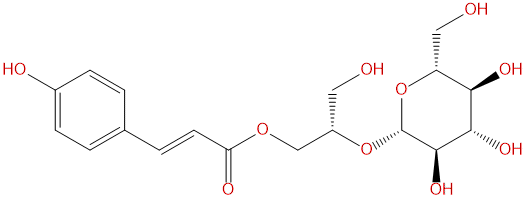


Product name: Regaloside D
Synonym name:
Catalogue No.: BP4401
Cas No.: 120601-66-3
Formula: C18H24O10
Mol Weight: 400.38
Botanical Source:
Type of Compound:
Purity: 95%~99%
Analysis Method: HPLC-DAD or/and HPLC-ELSD
Identification Method: Mass, NMR
Packing: Brown vial or HDPE plastic bottle
Storage: Store in a well closed container, protected from air and light. Put into refrigerate or freeze for long term storage.
Whenever possible, you should prepare and use solutions on the same day. However, if you need to make up stock solutions in advance, we recommend that you store the solution as aliquots in tightly sealed vials at -20℃. Generally, these will be useable for up to two weeks.
The product could be supplied from milligrams to grams
Inquire for bulk scale.
For Reference Standard and R&D, Not for Human Use Directly.
Storage conditions:Short-term storage at 2~8℃, long-term storage at -20 ~ -80℃
Natural products, as important resources for drug development, have long held a central position in new drug discovery due to their structural diversity and wide range of biological activities. Phenylpropanoid compounds, as a major class of plant secondary metabolites, have become a hot research topic in the fields of anti-tumor, anti-inflammatory, antioxidant, etc. due to their unique chemical structure and diverse biological activities. Regaloside D is a phenylpropanoid compound isolated from Lilium longiflorum, a plant in the lily genus. In recent years, it has gradually attracted attention in the fields of pharmacology and natural medicinal chemistry due to its significant anti-tumor activity and multi-target regulatory effects.
This review aims to systematically summarize the chemical structure and physicochemical properties, plant sources, and extraction methods of Wangyuxin D, with a focus on its pharmacological activity and mechanism of action, exploring its pharmacological parameters and pharmacokinetic characteristics, and looking forward to its clinical application potential, providing theoretical basis and reference for subsequent research and development.
Wangyuzhi D is a typical phenylpropanoid compound with a molecular formula of C21H28O9 and a molecular weight of 400.38. Its structural characteristics include the combination of phenylpropane skeleton and glycoside part, which endows it with good water solubility and biological activity. According to chemical analysis, Wang Baihe glycoside D contains multiple hydroxyl and ether bonds, and the presence of the glycosidic part in its structure significantly increases its polarity, resulting in a LogP value of -0.6886, indicating strong hydrophilicity.
In terms of physical and chemical properties, the topological polar surface area (TPSA) of Wangyuxin D is 166.14 Å ², indicating that its molecule has a large polar surface area, which may affect its cell membrane permeability and bioavailability. The water solubility is 11.13 mg/mL, indicating good water solubility, which is beneficial for absorption and distribution in the body. Its blood-brain barrier permeability is relatively low, indicating that its role in the central nervous system is limited and may reduce the risk of neurotoxicity. The hERG channel inhibition experiment result was negative, indicating that the potential adverse effects of baicalin D on cardiac electrophysiology are relatively small. The Ames test result is 0.3, indicating low mutagenicity and good safety.
Wangyuxin D mainly comes from the Lilium longiflorum plant, which is widely distributed in East Asia and has important medicinal and ornamental value. L. The bulbs and petals of longiflorum are rich in various phenylpropanoids and steroidal saponins, which are the main natural sources of baicalin D.
The extraction process usually uses alcohols (such as methanol and ethanol) as solvents, and obtains crude extracts through reflux extraction or ultrasound assisted extraction. Subsequently, liquid-liquid partitioning, column chromatography (silica gel, C18 reverse phase column, etc.), and high-performance liquid chromatography (HPLC) techniques were used for separation and purification. During the purification process, the compound structure was identified using methods such as mass spectrometry (MS) and nuclear magnetic resonance (NMR). In recent years, the application of supercritical fluid extraction and molecular imprinting technology has provided new ideas for improving extraction efficiency and purity.
Lilioside D shows significant anti-tumor activity, covering a variety of tumor cell lines, including breast cancer, lung cancer, liver cancer and colorectal cancer. In vitro cell experiments have shown that Wangyuxin D can inhibit tumor cell proliferation, induce cell apoptosis, and suppress tumor cell migration and invasion ability. Its half maximal inhibitory concentration (IC_50) is at a low micromolar level in multiple cell lines, demonstrating strong cytotoxicity.
In vivo experiments, the anti-tumor effect of Wangyuzhi D was validated through a mouse tumor model, significantly prolonging the survival of experimental animals, inhibiting tumor volume growth, and showing no significant toxic side effects, indicating its good safety.
In addition to anti-tumor effects, Wangyuxin D also exhibits certain anti-inflammatory and antioxidant activities. It reduces inflammation and cell damage by regulating inflammatory mediators and oxidative stress-related signaling pathways, providing a foundation for its potential application in inflammation related diseases.
The anti-tumor mechanism of Wangyuxin D involves multiple signaling pathways and key molecular targets, exhibiting the characteristics of multi-target and multi pathway synergistic regulation.
MCL1 and BCL2 As anti apoptotic proteins, MCL1 and BCL2 play important roles in tumor cell survival. Wangyuzhi D promotes tumor cell apoptosis and reverses the anti apoptotic ability of tumor cells by downregulating the expression of these two proteins.
STAT3 Signal transducer and activator of transcription factor 3 (STAT3) plays a key regulatory role in the occurrence and development of tumors. Wangyuzhi D can inhibit the phosphorylation activation of STAT3, block its nuclear translocation, and thereby inhibit tumor cell proliferation and immune escape.
MMP2 Matrix metalloproteinase-2 (MMP2) mediates matrix degradation and metastasis of tumor cells. Wangyuzhi D inhibits the expression and activity of MMP2, reducing the invasive ability of tumor cells.
TOP1 and TOP2A Topoisomerase I and II α are key enzymes involved in DNA replication and transcription. Wangyuzhi D inhibits the activity of these two enzymes, blocks DNA metabolism in tumor cells, and induces cell cycle arrest and apoptosis.
HIF1A Hypoxia inducible factor 1 alpha (HIF1A) promotes angiogenesis and metabolic reprogramming in the hypoxic microenvironment of tumors. Wangyuzhi D inhibits the expression of HIF1A and blocks the tumor's ability to adapt to hypoxia.
MAPK1 Mitogen activated protein kinase 1 (MAPK1) is involved in cell proliferation and differentiation signaling. Wangyuzhi D regulates the MAPK1 signaling pathway and inhibits tumor cell growth.
ESR1 and CYP19A1 Estrogen receptor alpha (ESR1) and aromatase (CYP19A1) play important roles in hormone dependent tumors. Lilioside D affects hormone signals and inhibits the progression of hormone dependent tumors such as breast cancer by regulating these two targets.
In summary, Wang Baihe glycoside D exerts its anti-tumor effect through multi-target and multi pathway synergistic effects, demonstrating its potential as a candidate molecule for multifunctional anticancer drugs.
The pharmacological evaluation of Wang Baihe glycoside D shows that it has certain potential for drug development. Although its molecular weight of 400.38 is slightly higher than the ideal range recommended by Lipinski's rule (<500), it is still within an acceptable range. A negative LogP value (-0.6886) indicates strong hydrophilicity, which is beneficial for in vivo dissolution and distribution, but may limit passive diffusion and absorption of the cell membrane.
The TPSA value of 166.14 is relatively high, indicating its high polarity, which may affect oral bioavailability and cell membrane permeability. The low permeability of the blood-brain barrier reduces the risk of central nervous system toxicity and side effects. HERG channel inhibition negative and Ames test low mutagenicity indicate good safety.
At present, there is limited research on the pharmacokinetics of Wangyuxin D. Preliminary data indicate that its metabolism is stable in vivo, mainly through the liver enzyme system, and its excretion pathway is mainly through the kidneys. Further systematic pharmacokinetic (PK) and toxicological studies are needed in the future to clarify its in vivo absorption, distribution, metabolism, and excretion (ADME) characteristics, guide clinical dose design, and safety evaluation.
Wang Baihe Glycoside D, as a natural product of phenylpropanoid with clear source and unique structure, has shown broad clinical application prospects due to its multi-target anti-tumor activity. Its mechanism of action involves multiple key links such as tumor cell proliferation, apoptosis, invasion, and regulation of the tumor microenvironment, making it suitable for development as a new anti-tumor drug or adjuvant therapy.
Future research should focus on the following aspects:
Improvement of pharmacokinetics and toxicology Systematically evaluate the in vivo behavior and safety of Wang Baihe Glycoside D, and optimize the dosing regimen.
Structural modification and drug design Based on the core structure of Wangyuxin D, chemical modification is carried out to improve its oral bioavailability and targeting, and reduce potential side effects.
Combination therapy research Explore the synergistic effect of Wangyuzhi D with existing chemotherapy drugs or targeted drugs to enhance efficacy and reduce drug resistance.
Preclinical and clinical trials Conduct animal models and human clinical trials to verify its efficacy and safety, and promote its translation into clinical drugs.
Development of indications for multiple diseases Consider its anti-inflammatory and antioxidant activities, and expand its potential applications in inflammatory and metabolic diseases.
Wangyuzhi D, as a natural phenylpropanoid compound with significant anti-tumor activity, has shown important potential as a new anti-cancer drug due to its multi-target regulatory ability and good safety. Although the research on its pharmacokinetics and clinical applications is still in its early stages, with the in-depth analysis of molecular mechanisms and the advancement of drug development technology, Wangyuxin D is expected to occupy an important position in the future development of anti-tumor drugs. The pharmacological research and clinical validation of the system will be the key to promoting its translational application, and we look forward to seeing new breakthroughs in the field of tumor treatment with Wangyuxin D.
