


Synonym name: 4'-Dihydroxy-2-methoxychalcone
Catalogue No.: BP0521
Cas No.: 34221-41-5
Formula: C16H14O4
Mol Weight: 270.284
Botanical Source: tissue culture of Glycyrrhiza echinata, from Glycyrrhiza inflata and Bauhinia manca
Purity: 95%~99%
Analysis Method: HPLC-DAD or/and HPLC-ELSD
Identification Method: Mass, NMR
Packing: Brown vial or HDPE plastic bottle
Can be supplied from milligrams to grams.
For Reference Standard and R&D, Not for Human Use Directly.
Inquire for bulk scale.
Description:
Echinatin has significant antioxidant and anti-inflammary activities, it shows strong scavenging activity toward the ABTS + radical, it also inhibits the production of nitric oxide (NO), interleukin-6 (IL-6) and prostaglandin E2 (PGE2) in LPS-induced macrophage cells. Echinatin disturbs the mitochondrial energy transfer reactions and membrane permeability, at a low concentration cause deterioration of respiratory control and oxidative phosphorylation of isolated rat liver mitochondria, inhibits DNP-ATPase activity while stimulating range latent ATPase activity.
References:
J Toxicol Sci. 1982 Nov;7(4):245-54.
The effects of echinatin and its related compounds on the mitochondrial energy transfer reaction.
METHODS AND RESULTS:
To investigate the mechanism by which various biological action of licorice root are brought about, the effects of Echinatin as a small constituent of Glycyrrhiza echinata and several related compounds on mitochondrial energy transfer reactions were examined. The results obtained were as follows: 1) Echinatin, 4'-hydroxychalcone, chalcone and 3,4'-dihydroxychalcone at a low concentration cause deterioration of respiratory control and oxidative phosphorylation of isolated rat liver mitochondria. 2) Chalcone and 4'-hydroxychalcone stimulate both latent and DNP-ATPase activity of mitochondria. Echinatin inhibits DNP-ATPase activity while stimulating range latent ATPase activity in the low concentration. 3) Chalcone and 4'-hydroxychalcone induce a rapid potassium release from mitochondrial vesicles, while Echinatin and 3,4'-dihydroxychalcone have lesser effect than the former two substances.
CONCLUSIONS:
From these results, it can be concluded that Echinatin and several related compounds disturb the mitochondrial energy transfer reactions and membrane permeability.
Food Chem. 2013 Nov 15;141(2):1063-71.
Antioxidant and anti-inflammatory activities of six flavonoids separated from licorice.
Licorice, the roots and rhizomes of several Glycyrrhiza species (Leguminosae), is an important natural sweetening agent and a widely used herbal medicine.
METHODS AND RESULTS:
In this work, six flavonoids, 5-(1,1-dimethylallyl)-3,4,4'-trihydroxy-2-methoxychalcone (1), licochalcone B (2), licochalcone A (3), Echinatin (4), glycycoumarin (5) and glyurallin B (6), were isolated from the extracts of licorice (Glycyrrhiza inflata and Glycyrrhiza uralensis). Their structures were elucidated using various spectroscopic methods. To our knowledge, compound 1 was isolated from natural plants for the first time. All the isolates were tested by antioxidant and anti-inflammatory assays. Compounds 2, 4 and 5 showed strong scavenging activity toward the ABTS(+) radical, and compounds 1, 2, 3, 5 and 6 exhibited potent inhibition of lipid peroxidation in rat liver microsomes compared with the reference controls. Compounds 1-4 dose-dependently inhibited LPS induced reactive oxygen species (ROS) production in RAW 264.7 cells. Furthermore, compounds 1-5 were demonstrated to inhibit the production of nitric oxide (NO), interleukin-6 (IL-6) and prostaglandin E2 (PGE2) in LPS-induced macrophage cells. Moreover, the contents of the six compounds, in different Glycyrrhiza species, were quantified by HPLC-MS.
Chinese Journal of New Drugs, 2013, 22(21):2547-52.
Determination of antioxidant activity in licorice vitro metabolites by DPPH spiking coupled with HPLC-Q-TOF MS/MS
To investigate the antioxidant activity of liver microsomal metabolites from six flavonoids in licorice by 1, 1-diphenyl-2-picrylhydrazyl (DPPH) spiking coupled with HPLC-Q-TOF MS/MS.
METHODS AND RESULTS:
The six flavonoids were incubated with rat liver microsomes and the resultant metabolites were identified by HPLC-Q-TOF MS/MS. The antioxidant activity of the metabolites was calculated by comparing the peak area changes before and after incubation with DPPH. The peak area of the metabolites significantly decreased or even disappeared after incubation with DPPH. Besides the metabolites Lico A-M1 and Lico A-M2 of licochalcone A, more than 90% of other metabolites of flavonoids were oxidized.
CONCLUSIONS:
Liver microsomal metabolites of Echinatin, licochalcone B, licochalcone A, 5-(1, 1-dimethylally)-3, 4, 4'-trihydroxy-2-methoxychalcone, glycycourmarin and glyurallin B still have significant antioxidant activities.
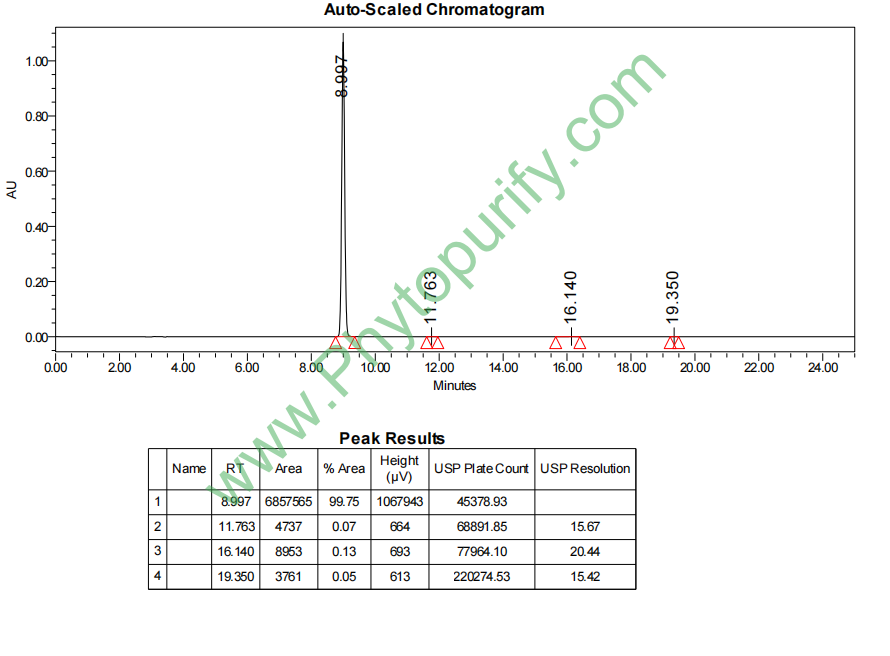
HPLC of Echinatin
Storage conditions:Short-term storage at 2~8℃, long-term storage at -20 ~ -80℃
Echinatin, CAS number 34221-41-5, is a natural chalcone compound isolated from the traditional Chinese medicine Glycyrrhiza spp. Licorice, as a commonly used medicinal herb in traditional Chinese medicine, has attracted much attention due to its various bioactive components, among which chalcone compounds have become a research hotspot due to their unique structure and significant pharmacological activity. Licorice licorice chalcone has various pharmacological effects such as liver protection, anti-inflammatory, and anti-tumor, especially in the regulation of tumor related signaling pathways, showing potential therapeutic value.
In recent years, with the deepening development of natural product pharmacology, the pharmacological mechanism, molecular targets, and pharmacokinetic characteristics of licorice chalcone have gradually been revealed. Its rapid absorption and elimination in the body, wide tissue distribution, and relatively low bioavailability provide important pharmacokinetic references for its clinical application. This article aims to systematically review the chemical structure, plant origin, pharmacological activity, mechanism of action, pharmacological evaluation, and future clinical application prospects of licorice chalcone, in order to provide theoretical basis and reference for related research and drug development.
Licorice licorice chalcone belongs to chalcone natural products, with a molecular formula of C16H014O4 and a molecular weight of 270.2840. Its structural feature is a typical 1,3-diketone phenylpropanone skeleton, with two aromatic rings connected by α, β - unsaturated ketones, endowing it with unique chemical activity. In terms of physical and chemical properties, the LogP value of licorice chalcone is 2.8440, indicating its moderate lipid solubility, which is beneficial for cell membrane penetration and in vivo distribution. The polar surface area (TPSA) is 66.7600, indicating that it has moderate polarity and is conducive to binding with biomolecules. Low water solubility (0.0938 mg/mL) may limit its oral absorption efficiency.
In addition, licorice chalcone showed high blood-brain barrier penetration ability, indicating its potential application value in central nervous system diseases. The negative result of hERG channel inhibition experiment indicates a low risk of cardiac toxicity. The Ames test score is 0.6, indicating a low risk of genotoxicity and meeting drug safety requirements.
Licorice chalcone mainly comes from plants of the licorice genus, especially the roots of licorice (Glycyrrhiza uralensis Fisch.). Licorice, as a traditional Chinese medicine, contains abundant chalcone compounds in its roots and stems. The extraction of chalcones from licorice is usually carried out by solvent extraction, with ethanol or methanol commonly used as extraction solvents to ensure the effective dissolution of chalcone components.
The extraction process generally includes the following steps: first, dry and crush the root of licorice, extract it by reflux with 70% -95% ethanol, and then obtain the crude extract by vacuum concentration. The crude extract was separated by silica gel column chromatography and purified using solvent systems of different polarities (such as petroleum ether ethyl acetate gradient elution). Finally, the purity and content of licorice chalcone were confirmed by high performance liquid chromatography (HPLC). In addition, in recent years, ultrasound assisted extraction and microwave-assisted extraction technologies have been introduced to improve extraction efficiency and purity.
Licorice chalcone has shown significant hepatoprotective effects in multiple experiments. It reduces liver damage by inhibiting the inflammatory response and oxidative stress of liver cells. Animal model studies have shown that licorice chalcone can reduce serum transaminase levels, alleviate liver tissue pathological damage, and significantly inhibit the process of liver fibrosis. Its mechanism of action may be related to regulating liver inflammatory factors and antioxidant enzyme activity.
Licorice chalcone has significant anti-inflammatory activity and can inhibit the release of various inflammatory mediators, such as tumor necrosis factor alpha (TNF - α), interleukin-6 (IL-6), and nitric oxide (NO). In vitro cell experiments have shown that licorice chalcone exerts anti-inflammatory effects by inhibiting the nuclear factor kappa B (NF - κ B) signaling pathway, reducing the expression of inflammation related genes.
The research on licorice chalcone in the field of anti-tumor is increasingly in-depth, involving multiple tumor cell lines. It exhibits broad-spectrum anti-cancer potential by regulating tumor cell apoptosis, inhibiting proliferation and migration. Specifically manifested as inducing tumor cell apoptosis, blocking cell cycle progression, and inhibiting the activity of tumor related enzymes.
The anti-tumor activity of licorice chalcone is closely related to its multi-target regulation. Research has shown that its main targets include:
The multiple regulation of these molecular targets enables licorice chalcone to exhibit broad anti-cancer activity in various types of tumors.
The pharmacological parameters of licorice chalcone show that it has good potential for drug development. The molecular weight is moderate (270.2840), with a LogP value of 2.8440, which conforms to Lipinski's rule, indicating a good possibility of oral absorption. The TPSA is 66.7600, indicating that its polarity is moderate and helpful for cell membrane penetration.
Pharmacokinetic studies have shown that licorice chalcone can be rapidly absorbed in rats, with a rapid peak in plasma concentration. However, its absolute bioavailability is only about 6.81%, indicating that its oral absorption is limited and may be related to low water solubility (0.0938 mg/mL) and first pass effects. It is widely distributed in the body, especially able to penetrate the blood-brain barrier, and has potential central nervous system functions.
In terms of safety, the hERG channel inhibition experiment was negative, reducing the risk of cardiac toxicity. The Ames test results showed that its genotoxicity was low and met the drug safety requirements.
As a natural chalcone compound with multiple pharmacological activities, licorice chalcone has shown broad clinical application prospects. Its significant hepatoprotective, anti-inflammatory, and anti-tumor effects make it potentially valuable in the treatment of liver diseases, inflammatory diseases, and tumors. Especially in the field of tumor therapy, licorice chalcone is expected to become a candidate molecule for novel anticancer drugs by regulating the survival and metastasis of tumor cells through multi-target mechanisms.
However, its low bioavailability and poor water solubility currently limit further clinical application. Future research should focus on optimizing its drug formulations, such as nanocarriers, solid dispersions, and other novel drug delivery systems, to enhance its in vivo utilization and therapeutic efficacy. At the same time, in-depth analysis of its mechanism of action and toxicological characteristics, and systematic preclinical and clinical research will lay a solid foundation for its clinical translation.
In addition, given its excellent blood-brain barrier penetration ability, the potential application of licorice chalcone in neurological diseases also deserves further exploration.
As an important chalcone active ingredient in licorice, licorice chalcone has become an important object of natural product pharmacology research due to its unique chemical structure and diverse pharmacological activities. It exhibits significant biological effects in liver protection, anti-inflammatory, and anti-tumor aspects, and achieves comprehensive regulation of diseases through multi-target mechanisms. Despite facing challenges such as bioavailability and water solubility, licorice chalcone still demonstrates good pharmacological and safety properties, providing a solid foundation for its future drug development and clinical applications. With the continuous progress of formulation technology and molecular mechanism research, licorice chalcone is expected to play a greater role in the field of natural product medicine and become an effective drug candidate for treating various diseases.
