


Synonym name:
Catalogue No.: BP1491
Cas No.: 112516-05-9
Formula: C37H48O21
Mol Weight: 828.77
Botanical Source: Cistanche tubulosa, a parasitic plant growing on roots of Salvadora calotropis
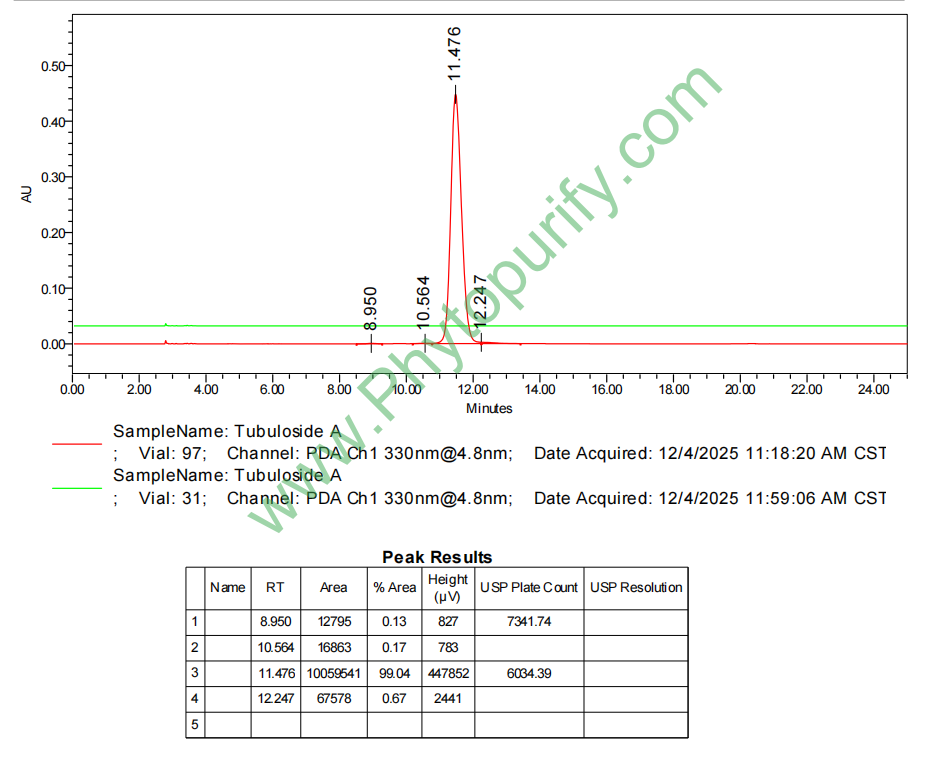
Purity: 95%~99%
Analysis Method: HPLC-DAD or/and HPLC-ELSD
Identification Method: Mass, NMR
Packing: Brown vial or HDPE plastic bottle
Can be supplied from milligrams to grams. Inquire for bulk scale.
For Reference Standard and R&D, Not for Human Use Directly.
Description:
Tubuloside A has anti-inflammatory, antioxidative and hepatoprotective activities. Tubuloside A shows stronger free radical scavenging activities than alpha-tocopherol on 1,1-diphenyl-2-picrylhydrazyl (DPPH) radical and xanthine/xanthine oxidase (XOD) generated superoxide anion radical (O2-.).
References;
Plant Biotechnology 12(1), 46-54, 1995-04-01
Studies on the Tissue Culture of Cistanche Plants: I. Callus Induction and Shoot Differentiation from the Seed of Cistanche tubulosa Wight
Cistanche tubulosa Wight. is an important herbal medicine including such phenylethanoide glycosides as echinacoside (E), Tubuloside A (TA), acteoside (A) and 2′-acetylacteoside (2′AA), and is a holoparasitic plant distributed in a wide range from the North African to Chinese in and and semi arid regions.
METHODS AND RESULTS:
In this plant, seed germination occured without a host plant by the addition of gibberellic acid to the medium and the removal of the seed coat. Callus were induced on 1/2MS medium containing 2.5mg/l indol-3-acetic acid and 0.5mg/l kinetin, and with chilling treatment (at 4°C for 3 months) of the seeds. With this condition, a shoot differentiated from the callus in 6 weeks, but a parasitic root did not form. The shape of the vascular bundle of the shoot and that of the mother plant was slightly different.The largest value for phenylethanoide glycosides contained in the shoot was 10 fold that of the mother plant.
Eur J Pharmacol. 2000 Jul 14;400(1):137-44.
Inhibition of nitric oxide by phenylethanoids in activated macrophages.
Nitric oxide (NO) is one of the pro-inflammatory molecules. Some phenylethanoids have been previously shown to possess anti-inflammatory effects.
METHODS AND RESULTS:
Seven phenylethanoids from the stems of Cistanche deserticola, viz. isoacteoside, tubuloside B, acteoside, 2'-O-acetylacteoside, echinacoside, cistanoside A and Tubuloside A, were tested for their effect on NO radical generation by activated murine macrophages. At the concentration of 100-200 microM, all the phenylethanoids reduced (6.3-62.3%) nitrite accumulation in lipopolysaccharide (0.1 microgram/ml)-stimulated J774.1 cells. At 200 microM, they inhibited by 32.2-72.4% nitrite accumulation induced by lipopolysaccharide (0.1 microgram/ml)/interferon-gamma (100 U/ml) in mouse peritoneal exudate macrophages. However, these compounds did not affect the expression of inducible nitric oxide (iNOS) mRNA, the iNOS protein level, or the iNOS activity in lipopolysaccharide-stimulated J774.1 cells. Instead, they showed a clear scavenging effect (6.9-43.9%) at the low concentrations of 2-10 microM of about 12 microM nitrite generated from an NO donor, 1-propanamine-3-hydroxy-2-nitroso-1-propylhydrazino (PAPA NONOate).
CONCLUSIONS:
These results indicate that the phenylethanoids have NO radical-scavenging activity, which possibly contributes to their anti-inflammatory effects.
HPLC of Tubuloside A
Storage conditions:Short-term storage at 2~8℃, long-term storage at -20 ~ -80℃
330.5100
-.3557
-.3658
8.3256
.4379
.0535
Low
65.6696
5.4627
Yes
No
No
No
No
No
0.0
Yes
No
Yes
Yes
Natural products have always been an important source of innovative drug discovery, among which phenylethanoid glycosides have attracted much attention due to their extensive and significant biological activities. Tubuloside A, as a member of the phenylethanoid glycoside family, has entered the research field with its unique antioxidant and hepatoprotective activities since its structure was elucidated. With the development of modern molecular pharmacology technology, its pharmacological activity spectrum continues to expand, especially in the field of anti-tumor effects, showing multi-target and multi pathway characteristics, transforming it from a natural ingredient with traditional medicinal potential to an attractive lead compound in modern tumor pharmacology research. This article aims to systematically review the chemical properties, plant sources, pharmacological activities, mechanisms of action, medicinal properties, and clinical application prospects of Guanhua glycoside A, in order to provide comprehensive academic references for the in-depth research and development of this compound.
The chemical name of Guanhua Glycoside A is relatively complex, and its CAS registration number is 112516-05-9. Structurally, it is a typical phenylethanoid glycoside with a molecular formula of C ∝₄ H ₄₄ O ₂ and a molecular weight of 828.7700. Its core structure is composed of caffeoyl groups, hydroxyphenylethanol glycosides, and multiple glycosides (usually including glucose, rhamnose, etc.) connected by glycosidic bonds. This multi hydroxyl, multi aromatic ring structure endows it with unique physicochemical properties.
According to the provided pharmacological parameters, the logarithmic (LogP) value of the lipid water partition coefficient of Guanhua glycoside A is -0.3557, indicating that the compound has hydrophilicity and tends to be distributed in the aqueous phase. Its topological polar surface area (TPSA) is as high as 330.51 Å ², which is closely related to the presence of a large number of hydroxyl and glycosyl structures in its molecules. High TPSA is one of the main factors limiting its membrane permeability. The water solubility value is 8.3256 (usually referring to LogS or related solubility indicators), further confirming its good water solubility. These properties collectively determine the basic characteristics of its pharmacokinetic behavior: it is easy to dissolve in body fluids, but its ability to cross biological membranes (such as intestinal absorption, blood-brain barrier) may be poor. The blood-brain barrier penetration assessment is' low ', consistent with its high TPSA and hydrophilicity. In terms of early safety indicators, the hERG inhibition test was negative, indicating a low potential risk of cardiac toxicity; The Ames test result was 0.0, indicating that no mutagenicity was observed under the conditions of this experiment, providing preliminary favorable evidence for its safety.
Guanhua glycoside A mainly comes from various medicinal plants, especially concentrated in plant families such as Orobanchaceae and Scrophulariaceae. Initially, it originated from traditional medicinal plants cistanche tubulosa It was isolated and identified from the dried fleshy stem of Cistanche tubulosa, which is also the origin of its name "Guanhua Glycoside A. The plant of Cistanche genus is known as the "desert ginseng" in traditional Chinese medicine, commonly used for tonifying kidney yang, nourishing essence and blood, moistening intestines and promoting bowel movements. In addition, in some plants of the same genus such as Cistanche deserticola and other plants containing phenylethanoid glycosides, guanosine A or its analogues may also be detected.
The extraction and separation method follows the conventional process of natural product chemistry. Firstly, methanol, ethanol, or ethanol water mixed solvents are usually used to heat reflux or ultrasound assisted extraction of dried plant materials to fully extract the highly polar phenylethanolic glycosides. Subsequently, preliminary enrichment and decolorization were carried out using macroporous adsorption resin (such as D101, AB-8) column chromatography, followed by water washing to remove impurities such as polysaccharides and inorganic salts. Then, gradient elution was performed using ethanol solutions of different concentrations to collect the fraction rich in phenylethanolic glycosides. Further purification requires the use of modern chromatographic techniques such as silica gel column chromatography, reverse phase silica gel column chromatography (such as ODS-C18), and high performance liquid chromatography (HPLC). By using techniques such as nuclear magnetic resonance (NMR) and mass spectrometry (MS) for structural identification, high-purity Guanhua glycoside A monomer was ultimately obtained. Optimizing the extraction process, such as using microwave-assisted extraction or supercritical fluid extraction, aims to improve yield, shorten time, and reduce solvent consumption.
The pharmacological activity research of Guanhua glycoside A has expanded from its initial antioxidant and hepatoprotective effects to multiple fields such as anti-tumor, neuroprotective, and anti-inflammatory effects, showing a multi effect characteristic.
Antioxidant and hepatoprotective activity This is the earliest known activity of Guanhua glycoside A. The phenolic hydroxyl group in its molecule is an effective hydrogen donor that can scavenge free radicals (such as DPPH free radicals and superoxide anions), inhibit lipid peroxidation, and protect cells from oxidative stress damage. In animal models of acute liver injury induced by carbon tetrachloride and acetaminophen, guanosine A can significantly reduce serum transaminase (ALT, AST) levels and alleviate liver tissue pathological damage. Its mechanism is closely related to enhancing the activity of endogenous antioxidant systems in the liver, such as superoxide dismutase (SOD) and glutathione (GSH).
Antitumor activity This is currently the most active field of research on guanosine A. A large number of in vitro studies have shown that angiocyanin A can inhibit proliferation and induce apoptosis in a variety of human tumor cell lines, including liver cancer, breast cancer, colon cancer, lung cancer, etc. Its anti-tumor effect is not achieved through a single cytotoxicity, but involves inducing cell cycle arrest (such as G1 phase or G2/M phase), triggering cell apoptosis through mitochondrial and death receptor pathways, inhibiting tumor cell invasion and migration, and other multiple processes.
Other activities The study also suggests that guanosine A may have neuroprotective effects and has the potential to alleviate beta amyloid toxicity in Alzheimer's disease cell models; Its anti-inflammatory activity has also been preliminarily confirmed, which can inhibit the release of inflammatory factors induced by lipopolysaccharide (LPS).
The anti-tumor mechanism of Guanhua glycoside A is complex, involving the regulation of multiple key signaling pathways and molecular targets, reflecting the characteristic of multi-target action of natural products. Based on the provided target information, its functional network can be summarized as follows:
Regulating apoptosis related proteins (BCL2, MCL1)BCL2 and MCL1 are important anti apoptotic proteins. Guanhua glycoside A can downregulate the expression of these proteins, thereby relieving their inhibition of pro apoptotic proteins such as BAX and BAK, promoting increased mitochondrial outer membrane permeability, cytochrome C release, and activating the caspase cascade reaction, ultimately leading to cell apoptosis.
Inhibition of Signal Transduction and Transcription Activation Factor 3 (STAT3)STAT3 is a key oncogenic transcription factor in the occurrence and development of tumors. Continuously activated STAT3 promotes cell proliferation, survival, angiogenesis, and immune escape. Guanhua glycoside A can inhibit the phosphorylation (activation) of STAT3, suppress its nuclear translocation and the transcription of downstream target genes (such as Cyclin D1, Survivor, VEGF), thereby inhibiting tumor growth.
Affects cell cycle and DNA metabolism (TOP1, TOP2A)Topoisomerase I and II (TOP1/2A) are key enzymes that regulate DNA topology and are targets of many chemotherapy drugs. Guanhua glycoside A may interfere with the function of these enzymes, leading to DNA replication and transcription disorders, causing DNA damage, activating cell cycle checkpoints, and causing cell cycle arrest.
Inhibition of invasion and metastasis related factors (MMP2, HIF1A)Overexpression of matrix metalloproteinase 2 (MMP2) is closely related to tumor invasion and metastasis. Guanhua glycoside A can downregulate the expression or activity of MMP2. At the same time, it can also inhibit the stability and activation of hypoxia inducible factor 1 alpha (HIF1A), which is a core regulatory factor for tumors to adapt to the hypoxic microenvironment and promote angiogenesis. By targeting MMP2 and HIF1A, guanosine A may exert anti-tumor invasion and metastasis effects.
Regulating kinase and hormone related pathways (MAPK1, ESR1, CYP19A1)Mitogen activated protein kinase 1 (MAPK1, ERK2) is an important component of the MAPK/ERK pathway, involved in cell proliferation signaling. The inhibition of Guanhua glycoside A may help block pro proliferative signals. Estrogen receptor alpha (ESR1) and aromatase (CYP19A1) are important targets for the treatment of hormone dependent breast cancer. Guanhua glycoside A may exert inhibitory effects on hormone sensitive tumors by regulating the estrogen signaling pathway.
In summary, Guanhua glycoside A forms a network that inhibits tumor growth, promotes apoptosis, and prevents metastasis by synergistically acting on multiple targets and pathways mentioned above. This may be its potential advantage of being effective and less prone to developing drug resistance.
Although Guanhua glycoside A exhibits excellent pharmacological activity in vitro, its drug affinity faces challenges mainly due to its physicochemical properties.
Absorption, distribution, metabolism, excretion (ADME):
Preliminary evaluation of safety The early data provided (hERG inhibition negative, Ames test negative) is a positive signal, but a comprehensive preclinical safety evaluation is still needed, including a complete set of tests for acute toxicity, long-term toxicity, reproductive toxicity, genetic toxicity, etc.
Considerations for formulation development To overcome the bottleneck of drug development, future research needs to focus on novel drug delivery systems. For example, encapsulating it in liposomes, polymer nanoparticles, or solid dispersions can improve its membrane permeability, stability, and targeting, thereby improving oral absorption or achieving tumor targeted delivery after intravenous administration.
Guanhua glycoside A, as a multi-target anti-tumor natural lead compound, has broad clinical application prospects, but the road ahead is long and requires interdisciplinary collaboration.
As a development of anti-tumor drugs:
Application in the field of liver disease Its clear antioxidant and hepatoprotective activities make it have the potential to be developed as a hepatoprotective drug in the prevention and treatment of drug-induced liver injury, alcoholic liver disease, non-alcoholic fatty liver disease, etc. It can be explored as an adjuvant therapy drug.
Challenges and Future Directions:
Guanhua glycoside A is a naturally occurring phenylethanoid glycoside with unique structure and diverse biological activities. The evolution of research value from traditional hepatoprotective antioxidants to modern anti-tumor multi-target lead compounds reflects the depth and breadth of natural product pharmacology research. Although its inherent physicochemical properties pose challenges to drug development, this is precisely the field where modern medicinal chemistry and pharmacy can play a role. By delving into its complex molecular network and utilizing advanced drug design, modification, and delivery technologies, guanosine A is expected to move from the laboratory to clinical practice, or provide new strategies and weapons for the treatment of diseases such as tumors. Continuous and in-depth research on it will not only contribute to the development of new drugs, but also further enrich our scientific understanding of the biological activity of phenylethanoid glycosides.
