


Product name: Indirubin
Synonym name: Couroupitine B; 479-41-4
Catalogue No.: BP0764
Cas No.: 906748-38-7
Formula: C16H10N2O2
Mol Weight: 262.268
Botanical Source: Alkaloid from Indigofera spp. as minor indigo. the molluscs Hexaplex trunculus and Murex brandaris (as component of Tyrian purple). Couroupita guianensis, root of Isatis indigotica, Isatis tinctoria, Polygonum tinctoriu
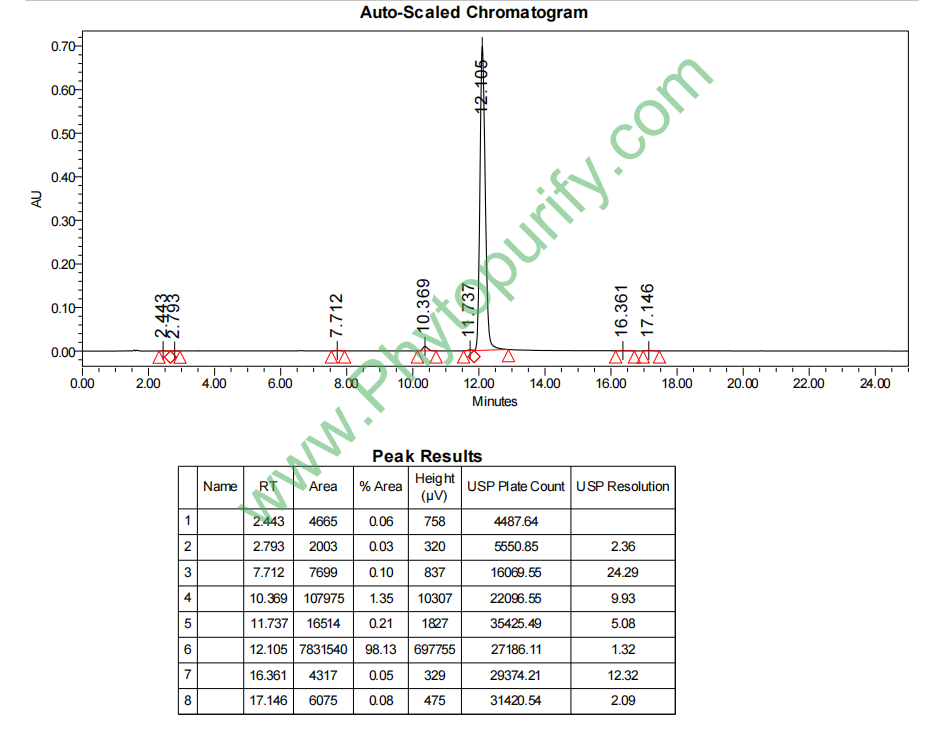
Purity: 95%~99%
Analysis Method: HPLC-DAD or/and HPLC-ELSD
Identification Method: Mass, NMR
Packing: Brown vial or HDPE plastic bottle
Can be supplied from milligrams to grams.
For Reference Standard and R&D, Not for Human Use Directly.
Inquire for bulk scale.
HPLC of Indirubin
Storage conditions:Short-term storage at 2~8℃, long-term storage at -20 ~ -80℃
58.2000
2.8389
2.8388
.0070
3.1139
10.4118
High
92.4640
2.2791
Yes
No
Yes
No
Yes
Yes
1.2
Yes
Yes
Yes
Yes
Indirubin, also known as Couroupitine B, is a type of indole alkaloid with a unique structure, first isolated from the traditional Chinese medicine Indigo naturalis. As an important active ingredient used in traditional Chinese medicine to treat leukemia and inflammatory diseases, indirubin has received widespread attention in recent years due to its significant anti-cancer activity, especially its potential therapeutic effect in chronic myeloid leukemia (CML). Numerous studies have shown that indigo carmine not only exhibits excellent biological activity in inhibiting cell proliferation and inducing apoptosis, but also exerts its anti leukemia effect by regulating related signaling pathways through multiple targets. This article aims to provide a systematic review of the chemical structure and physicochemical properties, plant sources and extraction methods, pharmacological activity, mechanism of action, drug evaluation, and clinical application prospects of indigo carmine. It is expected to provide theoretical basis and research direction for its subsequent drug development and clinical translation.
The chemical structure of indigo carmine is a bis indole skeleton, with a molecular formula of C16H10N2O2 and a molecular weight of 262.2680. Its structure contains two indole rings connected by carbon carbon bonds, forming a stable conjugated system. The LogP value of indigo carmine is 2.8389, indicating moderate lipid solubility and facilitating membrane penetration. Its polar surface area (TPSA) is 58.20 Å ², indicating that the molecule has certain polar groups that facilitate binding with biomolecules. Low water solubility (0.0070 mg/mL) suggests limited solubility in aqueous phase, which may affect in vivo absorption and bioavailability. The high permeability of the blood-brain barrier indicates that indigo carmine has potential central nervous system activity or risk of side effects. The hERG channel inhibition test result is negative, indicating a low risk of cardiac toxicity. The Ames test result is 1.2, indicating a low risk of genetic toxicity.
Indirubin has good chemical stability, but it may undergo structural isomerization under light and alkaline conditions, forming the equivalent isomer of indigo. Its structural features provide a solid foundation for subsequent drug design and structural modification.
Indirubin mainly exists in indigo plants (such as Indigofera tinctoria and Isatis tinctoria) and their fermented products. In traditional Chinese medicine, indigo natural products are fermented by microorganisms to produce indigo carmine, which is one of the isomers of indigo. There are differences in color and biological activity between the two.
The common methods for extracting indigo carmine include:
Solvent extraction method Using organic solvents such as methanol, ethanol, or ethyl acetate to extract indigo plants or fermented products, followed by liquid-liquid distribution and column chromatography purification to obtain indigo carmine.
Acid-base extraction method Utilizing the difference in solubility of indigo carmine under different pH conditions for acid-base adjustment extraction, combined with recrystallization technology to improve purity.
Chromatographic separation technology Including silica gel column chromatography, reverse phase high performance liquid chromatography (RP-HPLC), etc., used for further purification and quantitative analysis of indigo carmine.
In recent years, supercritical CO2 extraction and membrane separation technologies have also been attempted to be applied to the extraction of indigo carmine to improve extraction efficiency and environmental friendliness. The extraction process of indigo carmine is continuously optimized, laying the foundation for its industrial production and drug development.
The pharmacological activity of indigo carmine mainly focuses on anti-tumor effects, especially its inhibitory effect on leukemia cells. Numerous in vitro and in vivo studies have confirmed that indigo carmine has significant inhibitory effects on proliferation and induces apoptosis in chronic myeloid leukemia (CML) cell lines.
Anti leukemia activity
Indirubin can effectively inhibit the proliferation of CML cells, induce cell cycle arrest, and promote cell apoptosis. Its function is not limited to a single target, but is achieved through coordinated regulation of multiple targets and signaling pathways. Research has shown that indigo carmine has a better inhibitory effect on leukemia cells than traditional chemotherapy drugs, and its cytotoxicity is relatively low.
Anti inflammatory and immune regulatory effects
Indirubin has the ability to regulate immune response and anti-inflammatory activity, inhibit the expression of inflammatory factors, and alleviate chronic inflammation, which has an auxiliary effect on the treatment of leukemia and its complications.
Other anti-tumor effects
In addition to leukemia, indirubin also exhibits certain inhibitory effects on various solid tumor cells, such as lung cancer, liver cancer, etc., demonstrating its potential broad-spectrum anticancer activity.
Neuroprotection and other pharmacological effects
Due to its high blood-brain barrier permeability, some studies have explored its application in neurodegenerative diseases, showing certain neuroprotective effects, but the relevant mechanisms still need further clarification.
The anti leukemia mechanism of indirubin is complex, involving multiple signaling pathways and key molecular targets. The current research mainly focuses on the following aspects:
AMPK (PRKAA1) activation
Indirubin can activate the cellular energy sensing enzyme AMPK, regulate cellular metabolic status, induce autophagy and apoptosis, and inhibit the growth and proliferation of tumor cells.
Regulation of anti apoptotic proteins MCL1 and BCL2
Indirubin disrupts the anti apoptotic ability of leukemia cells and promotes programmed cell death by downregulating the expression of MCL1 and BCL2.
NOTCH1 signaling pathway inhibition
NOTCH1 plays an important role in the proliferation and differentiation of leukemia cells. Indirubin can inhibit the NOTCH1 signal and block abnormal proliferation of leukemia cells.
STAT3 signaling pathway blockade
STAT3 is a key transcription factor for the survival and immune escape of various tumor cells. Indirubin can inhibit the phosphorylation and activation of STAT3, reducing the survival rate of tumor cells.
TOP1 (Topoisomerase I) inhibition
Indirubin has TOP1 inhibitory activity, interfering with DNA replication and transcription processes, causing DNA damage and death in tumor cells.
SIRT1 regulation
By regulating the deacetylase SIRT1, indirubin affects cellular metabolism, stress response, and apoptosis processes.
Other targets
Indirubin also acts on molecules such as MAPT (microtubule associated protein Tau), IDH1 (isocitrate dehydrogenase 1), and NFE2L2 (nuclear factor E2 related factor 2), regulating cytoskeletal stability, metabolic reprogramming, and antioxidant response, exerting a comprehensive anti-tumor effect.
In summary, indirubin regulates the survival, proliferation, and apoptosis of leukemia cells through multi-target and multi pathway synergistic effects, demonstrating its unique advantages as a potential anti leukemia drug.
The pharmacological evaluation of indirubin shows that it has certain potential for drug development:
Molecular weight and lipid solubility
The molecular weight of 262.27 conforms to Lipinski's rule, with a moderate LogP value of 2.84, which is beneficial for cell membrane penetration and oral absorption.
Polarized surface area (TPSA)
A TPSA value of 58.2 Å ² facilitates binding to target proteins while supporting good membrane permeability.
Water solubility
Low water solubility (0.0070 mg/mL) may limit its bioavailability, and drug formulation technology is needed to improve solubility.
Blood-brain barrier permeability
The high blood-brain barrier permeability suggests that indigo carmine can act on the central nervous system, but potential central nervous system side effects should also be monitored.
Cardiac toxicity risk
HERG channel inhibition is negative, reducing the risk of arrhythmia.
Genotoxicity
The Ames test result is 1.2, indicating a low risk of genetic toxicity.
In terms of pharmacokinetics, indirubin is absorbed quickly after oral administration, but its bioavailability is limited due to poor water solubility. Widely distributed in the body, especially with high concentrations in the liver and blood system. Metabolism mainly occurs through the liver enzyme system, generating various metabolic products. The main excretion pathways are bile and urine. The half-life of indigo carmine is moderate, supporting the design of daily dosing regimens.
To overcome poor water solubility and improve bioavailability, researchers have attempted to use strategies such as nanocarriers, liposome encapsulation, and structural modification, and have made certain progress.
Indirubin, as an active ingredient in traditional Chinese medicine, has shown broad application prospects in the field of leukemia treatment. Its multi-target mechanism of action and low toxicity make it a potential novel therapeutic drug for chronic myeloid leukemia and other types of leukemia.
At present, indirubin and its derivatives have entered the preclinical research stage, and some clinical trials are underway to evaluate their safety, efficacy, and dosing regimen. Future research priorities include:
Optimization of drug formulations
Improve the water solubility and bioavailability of indigo carmine, and develop oral or injectable formulations.
Combination therapy strategy
Combined use with existing chemotherapy drugs or targeted drugs to enhance efficacy and reduce the occurrence of drug resistance.
Precision Medicine Applications
Based on the molecular characteristics of the target, screen the patient population suitable for indirubin treatment and achieve personalized treatment.
Toxicology and safety assessment
Conduct in-depth research on the safety and potential side effects of long-term medication to ensure the safety and reliability of clinical applications.
Expand indications
Explore the potential application of indigo carmine in other malignant tumors and inflammatory diseases.
In summary, indirubin, as a natural product with a unique structure and multi-target mechanism of action, has the potential to become a novel anti leukemia drug, and its future clinical translation and drug development are worth looking forward to.
Indirubin, as a classic indole alkaloid, has become a hot topic in natural product pharmacology research due to its unique chemical structure and multi-target anti leukemia activity. Its significant effect in the treatment of chronic myeloid leukemia, combined with good drug properties, provides valuable lead compounds for the development of new drugs. Despite challenges such as poor water solubility and limited bioavailability, modern pharmaceutical formulation technology and structural optimization strategies provide solutions for the clinical application of indigo carmine. In the future, with the deepening of mechanism research and the advancement of clinical trials, indirubin is expected to become an important therapeutic drug in the field of anti leukemia, promoting the development of natural product drugs to new heights.
