| Catalog No | Package | Original Price | Price | Inventory | Quantity | Operating |
|---|---|---|---|---|---|---|
| BP4010-2mg | 2mg | $420.00 | Sign in |
|


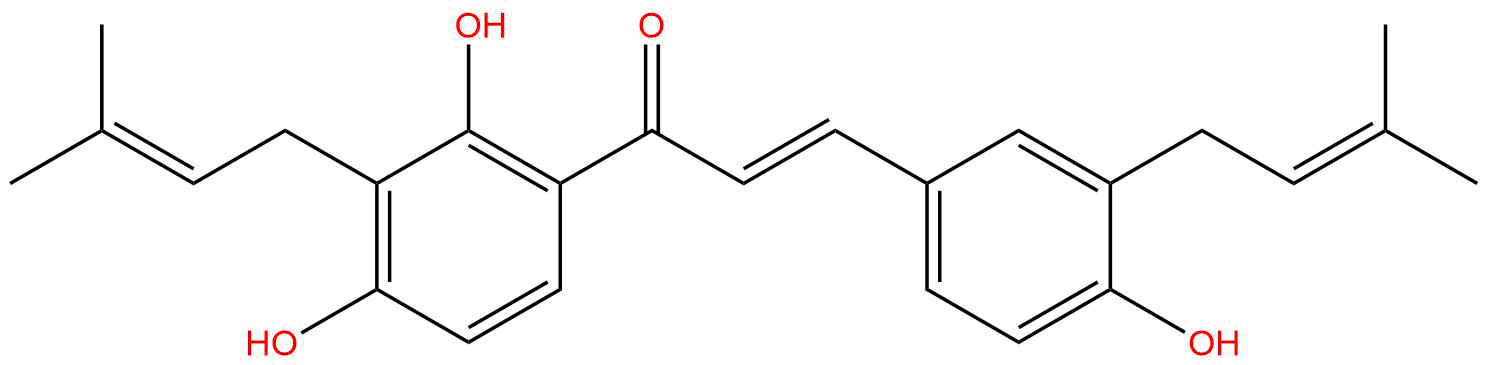
Product name: Kanzonol C
Synonym name: 2',4',4-Trihydroxy-3'-prenylchalcone
Catalogue No.: BP4010
Cas No.: 151135-82-9
Formula: C25H28O4
Mol Weight: 392.495
Botanical Source: Radix Glycyrrhizae
Physical Description:
Type of Compound: Chalcones
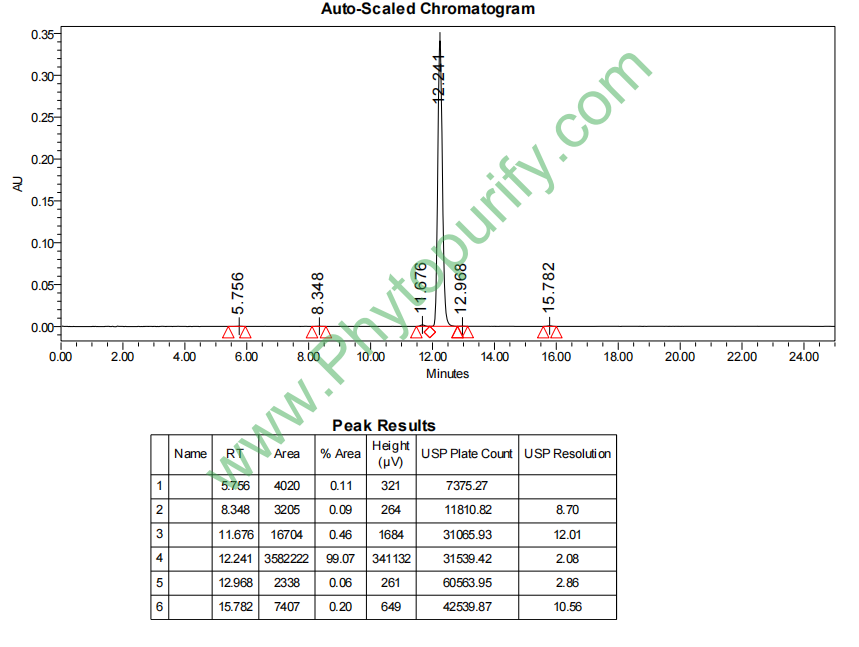
Purity: 95%~99%
Analysis Method: HPLC-DAD or/and HPLC-ELSD
Identification Method: Mass, NMR
Packing: Brown vial or HDPE plastic bottle
Storage: Store in a well closed container, protected from air and light. Put into refrigerate or freeze for long term storage.
Whenever possible, you should prepare and use solutions on the same day. However, if you need to make up stock solutions in advance, we recommend that you store the solution as aliquots in tightly sealed vials at -20℃. Generally, these will be useable for up to two weeks.
The product could be supplied from milligrams to grams
Inquire for bulk scale.
For Reference Standard and R&D, Not for Human Use Directly.
HPLC of Kanzonol C
Storage conditions:Short-term storage at 2~8℃, long-term storage at -20 ~ -80℃
77.7600
5.8469
5.8060
.0371
5.5492
5.3366
Low
93.1438
2.8278
Yes
No
Yes
No
Yes
Yes
0.0
No
Yes
Yes
Yes
Natural products, as an important source of drug discovery, play an irreplaceable role in the long history of human struggle against diseases. The deepening of research in plant chemistry and pharmacology has revealed numerous secondary metabolites with complex structures and significant biological activities. Among them, flavonoids and their derivatives have always been a research hotspot due to their extensive pharmacological activities, such as antioxidant, anti-inflammatory, anti-tumor, antibacterial, etc. Chalcone, as a subclass of flavonoids, is characterized by its unique structure where two aromatic rings are connected by an α, β - unsaturated carbonyl chain (1,3-diphenyl-2-propen-1-one), endowing them with diverse biological functions.
Kanzonol C (CAS number: 151135-82-9) is a species from the genus Glycyrrhiza(Glycyrrhiza)Natural chalcone compounds isolated from plants. Licorice, as one of the most widely used herbs in traditional medicine, is known as the "old man of the country". It has the effects of tonifying the spleen and qi, clearing heat and detoxifying, dispelling phlegm and cough, relieving urgency and pain, and harmonizing various medicines. Modern pharmacological research has confirmed that licorice and its active ingredients have various effects such as anti-inflammatory, antiviral, hepatoprotective, anti ulcer, and immune regulation. As one of the many active ingredients in licorice, Kanzonol C has not been studied as deeply as mainstream ingredients such as glycyrrhetinic acid and glycyrrhizin. However, in recent years, with the gradual revelation of its pharmacological activity and mechanism of action, Kanzonol C has shown unique potential in the fields of anti-inflammatory and related disease treatment, attracting attention from the academic community. This article aims to provide a systematic review of the chemical structure, plant origin, pharmacological activity, mechanism of action, medicinal properties, and clinical application prospects of Kanzonol C, in order to provide reference for the in-depth research and development of this natural product.
Kanzonol C belongs to chalcone compounds in terms of chemical structure. The basic skeleton of chalcone is composed of A and B rings connected by a three carbon chain (- CO-CH=CH -). The specific structural features of Kanzonol C are the presence of specific hydroxyl and prenyl substituents on its A and B rings. The presence of these substituents, especially isopentenyl, not only increases the lipophilicity of the molecule, but is also often considered closely related to the biological activity of the compound, such as enhancing its ability to penetrate biofilms or interact with specific protein targets.
From the perspective of physical and chemical properties, the molecular weight of Kanzonol C is 392.4950 Da, belonging to the category of small molecule compounds. Its lipophilic water partition coefficient (LogP) is 5.8469, indicating that the compound has high lipophilicity, which is consistent with its structural characteristics of containing multiple aromatic rings and isopentenyl side chains in its molecule. A higher LogP value usually indicates that the compound is easily able to penetrate the cell membrane, but it may also lead to poor water solubility. Its topological polar surface area (TPSA) is 77.7600 Å ², which is at a moderate level and suggests that it may have some potential for oral absorption. However, molecules with TPSA greater than 140 Å ² are generally considered to have poor oral absorption. The water solubility of Kanzonol C is 0.0371 mg/mL, making it a poorly soluble compound. This may be one of the key challenges that need to be overcome in its subsequent formulation development and in vivo pharmacokinetic studies. In addition, preliminary pharmacological evaluations have shown that Kanzonol C has a low ability to penetrate the blood-brain barrier (BBB), which means its potential in the treatment of central nervous system diseases may be limited, but it may also reduce the associated risk of neurotoxicity. The prediction result of hERG inhibition is' no ', indicating a low risk of causing QT interval prolongation and arrhythmia in the heart. The Ames test result is 0.0, indicating that it did not show significant mutagenicity in the bacterial recovery mutation test, and the preliminary safety is good. These physicochemical properties and early pharmacological parameters provide important foundational data for further optimization of Kanzonol C as a lead compound.
Kanzonol C mainly comes from the Fabaceae family of licorice(Glycyrrhiza)Plants. There are about 30 species of licorice plants worldwide, mainly distributed in temperate and subtropical regions of Eurasia, America, and Australia. In China, the main medicinal licorice includes Ural licorice(Glycyrrhiza uralensis Fisch.)、 Swelling fruit licorice(Glycyrrhiza inflata Bat. and licorice with light fruit(Glycyrrhiza glabra L.)。 Kanzonol C was initially isolated and identified from the roots and rhizomes of licorice. In addition, it may also exist in other licorice varieties such as swollen fruit licorice.
The chemical composition of licorice is extremely complex, and over 400 compounds have been isolated and identified, mainly including triterpenoid saponins (such as glycyrrhizic acid and glycyrrhetinic acid), flavonoids (such as glycyrrhizin, isoliquiritigenin, and licorice chalcone A), coumarins, polysaccharides, etc. The content of Kanzonol C in licorice is usually low and belongs to trace active ingredients.
The extraction of Kanzonol C usually follows the classic process of natural product chemistry, which mainly includes the following steps:
The pharmacological activity research of Kanzonol C is currently in its early stages, but existing studies have revealed its potential in anti-inflammatory, antioxidant, and other aspects, with anti-inflammatory activity being the most prominent.
1. Anti inflammatory activity
Inflammation is a defensive response of the body to harmful stimuli, but excessive or persistent inflammation is the core pathological process of many diseases (such as rheumatoid arthritis, inflammatory bowel disease, atherosclerosis, neurodegenerative diseases, etc.). The anti-inflammatory activity of Kanzonol C has been validated in multiple in vitro and in vivo models.
2. Antioxidant activity
Oxidative stress is closely related to inflammation, and excessive reactive oxygen species (ROS) can activate inflammatory signaling pathways. The phenolic hydroxyl group in the molecular structure of Kanzonol C endows it with potential antioxidant capacity. Research has shown that Kanzonol C exhibits certain free radical scavenging activity in in vitro chemical systems, such as DPPH radical scavenging experiments and ABTS radical scavenging experiments, and can inhibit lipid peroxidation. This antioxidant activity may partially explain the mechanism of its anti-inflammatory effect.
3. Other potential activities
Given the extensive biological activity of chalcone compounds, Kanzonol C may also have other pharmacological effects, such as anti-tumor and antibacterial effects, but there are few related research reports and further exploration is needed.
The anti-inflammatory mechanism of Kanzonol C is the result of the synergistic effect of multiple targets and pathways. According to existing research, its main molecular targets and signaling pathways include:
1. Inhibit the NF - κ B signaling pathway
Nuclear factor kappa B (NF - κ B) is the core transcription factor in inflammatory response. In the resting state, NF - κ B (usually a p50/p65 heterodimer encoded by the RELA gene) binds to its inhibitory protein I κ B and exists in an inactive form in the cytoplasm. When cells are stimulated by inflammation such as LPS and TNF - α, I κ B kinase (IKK, encoded by genes such as IKBKB) is activated, which phosphorylates I κ B and leads to its ubiquitination degradation. The released NF - κ B immediately enters the nucleus, initiating the transcription of downstream pro-inflammatory genes such as TNF - α, IL-6, NOS2, and PTGS2. Research has shown that Kanzonol C can inhibit the activity of IKK, thereby blocking the phosphorylation and degradation of I κ B, ultimately inhibiting the nuclear translocation and transcriptional activity of NF - κ B. This is one of the core mechanisms by which Kanzonol C exerts anti-inflammatory effects.
2. Regulating the STAT3 signaling pathway
Signal transducer and activator of transcription factor 3 (STAT3) also plays a critical role in inflammation and immune responses. After binding to cytokines such as IL-6 and their receptors, JAK kinase can be activated to phosphorylate STAT3, causing it to form dimers and merge into the nucleus, regulating the expression of target genes. The excessive activation of STAT3 is closely related to chronic inflammation and tumorigenesis. Kanzonol C has been shown to inhibit IL-6-induced STAT3 phosphorylation, thereby blocking the STAT3 signaling pathway and reducing the production of downstream inflammatory factors.
3. Inhibit inflammasome activation
Inflammatory bodies are multi protein complexes within the cytoplasm, and their assembly and activation are key steps in initiating inflammatory responses, particularly the maturation and secretion of IL-1 β and IL-18. The cysteine containing aspartic acid protease 1 (CASP1, also known as caspase-1) is an effector protein for inflammasome activation. Activated caspase-1 cleaves pro-IL-1 β and pro-IL-18, producing mature inflammatory factors. Kanzonol C may exert anti-inflammatory effects by inhibiting the assembly of NLRP3 inflammasomes or directly suppressing the activity of caspase-1, thereby reducing the secretion of IL-1 β.
4. Regulating transient receptor potential (TRP) channels
TRPV1 and TRPA1 are two important transient receptor potential ion channels, mainly expressed in sensory neurons, involved in the perception and transmission of pain, itching, and neurogenic inflammation. They can be activated by various inflammatory mediators (such as prostaglandins, bradykinin) and physical stimuli (such as heat and acid). The regulatory effect of Kanzonol C on TRPV1 and TRPA1 may be related to its potential to alleviate inflammation related pain. The specific mechanism may be to act as an antagonist to block the activation of these channels, or indirectly regulate their function through other signaling pathways.
5. Affects arachidonic acid metabolism
PTGS1 (COX-1) and PTGS2 (COX-2) are key enzymes involved in the metabolism of arachidonic acid into prostaglandins. COX-1 is a constitutive expression that maintains physiological functions; COX-2 is an inducible expression that is produced in large quantities under inflammatory stimulation. The inhibitory effect of Kanzonol C on PTGS1 and PTGS2, especially its selective inhibition of PTGS2, is the direct reason for its reduction in the synthesis of inflammatory substances such as PGE2.
In summary, Kanzonol C forms a multi-level anti-inflammatory network by inhibiting key transcription factors such as NF - κ B and STAT3, blocking inflammasome activation, regulating TRP channel activity, and inhibiting arachidonic acid metabolism enzyme system, effectively inhibiting the production and release of various inflammatory mediators such as TNF - α, IL-6, NO, PGE2, etc.
The successful development of natural products into clinical drugs must undergo rigorous pharmacological evaluation, among which pharmacokinetic (ADME) properties are one of the key factors determining whether candidate compounds can ultimately be marketed.
1. Analysis of pharmacological parameters
Based on the aforementioned physicochemical parameters, the pharmacological properties of Kanzonol C exhibit a combination of opportunities and challenges.
2. Pharmacokinetic characteristics (prediction and preliminary study)
At present, there are few detailed experimental data reports on the pharmacokinetics of Kanzonol C in vivo, but reasonable predictions can be made based on its physicochemical properties:
3. Strategies for improving drug properties
Given the solubility and bioavailability issues faced by Kanzonol C, the following strategies can be considered for future development:
Kanzonol C, as a natural product with a unique chalcone skeleton, has a clear anti-inflammatory activity and multi-target mechanism of action, which opens up broad application prospects for its treatment of various inflammation related diseases.
1. Treatment of inflammatory diseases
This is the most direct application direction of Kanzonol C. Given its inhibitory effects on various key inflammatory mediators such as TNF - α, IL-6, NO, PGE2, as well as its regulation of core signaling pathways such as NF - κ B and STAT3, Kanzonol C is expected to be developed for the treatment of:
* Chronic inflammatory diseases Such as rheumatoid arthritis, osteoarthritis, inflammatory bowel disease (Crohn's disease, ulcerative colitis), etc.
* acute inflammation Such as acute pancreatitis, acute lung injury, sepsis, etc.
* Metabolic inflammation Such as obesity related adipose tissue inflammation, non-alcoholic steatohepatitis (NASH), etc. Atherosclerosis is also a chronic inflammatory process in essence, and Kanzonol C may play an anti atherosclerotic role through its anti-inflammatory effect.
2. Pain management
By regulating TRPV1 and TRPA1 channels, Kanzonol C may have analgesic effects, particularly suitable for inflammatory pain (such as arthritis pain, toothache, postoperative pain) and neuropathic pain. Compared with traditional nonsteroidal anti-inflammatory drugs (NSAIDs), it may have different mechanisms of action and side effect profiles, providing new options for pain treatment.
3. Adjuvant therapy for autoimmune diseases
The pathogenesis of many autoimmune diseases, such as systemic lupus erythematosus and psoriasis, is closely related to abnormal immune inflammatory responses. The regulatory effect of Kanzonol C on the function of immune cells, such as macrophages, makes it a potential adjuvant therapy for these diseases.
4. Future research directions
Despite its promising prospects, research on Kanzonol C is still in a very early stage and there is still a long way to go before it can be clinically applied. Future research should focus on the following areas:
Kanzonol C is a natural chalcone compound isolated from the traditional medicinal plant licorice. It exhibits multi pathway and multi-level anti-inflammatory activity by acting on multiple inflammation related molecular targets such as NF - κ B, STAT3, CASP1, TRPV1, TRPA1, PTGS1, NOS2, etc. The preliminary pharmacological evaluation of the compound shows that it has the advantages of moderate molecular weight, no hERG inhibition and mutagenic risk, but also faces challenges such as poor water solubility and possibly low oral bioavailability.
Although research on Kanzonol C is currently insufficient, its unique chemical structure and significant anti-inflammatory potential make it a lead compound worthy of further investigation and development. In the future, by combining modern medicinal chemistry, pharmacology, pharmacy, pharmacokinetics and other interdisciplinary methods, Kanzonol C will undergo systematic structural optimization and drug modification, and is expected to be developed into a new candidate drug for the treatment of inflammatory diseases. This not only helps to explore the modern scientific value of licorice, a traditional Chinese medicine, but also provides a useful example for discovering innovative drugs from natural products. The in-depth study of Kanzonol C will be a promising addition to the arsenal of weapons against inflammation related diseases.
