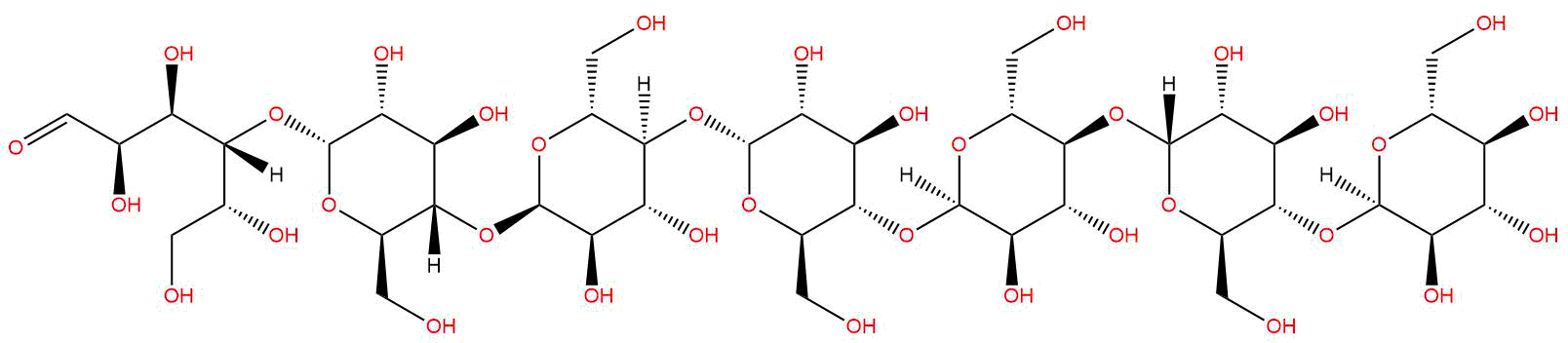


Product name: Maltoheptaose
Synonym name: Amyloheptaose
Catalogue No.: BP4531
Cas No.: 34620-78-5
Formula: C42H72O36
Mol Weight: 1153
Botanical Source: Hordeum vulgare L.
Type of Compound: Oligose
Purity: 95%~99%
Analysis Method: HPLC-DAD or/and HPLC-ELSD
Identification Method: Mass, NMR
Packing: Brown vial or HDPE plastic bottle
Storage: Store in a well closed container, protected from air and light. Put into refrigerate or freeze for long term storage.
Whenever possible, you should prepare and use solutions on the same day. However, if you need to make up stock solutions in advance, we recommend that you store the solution as aliquots in tightly sealed vials at -20℃. Generally, these will be useable for up to two weeks.
The product could be supplied from milligrams to grams
Inquire for bulk scale.
For Reference Standard and R&D, Not for Human Use Directly.
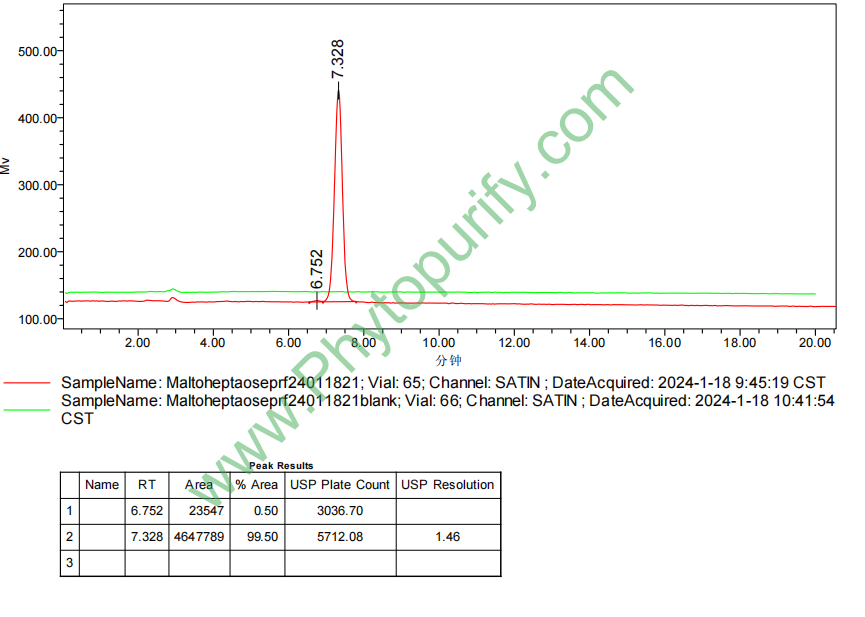
HPLC of Maltoheptaose
Storage conditions:Short-term storage at 2~8℃, long-term storage at -20 ~ -80℃
593.1200
-4.8096
-4.8096
90.3995
.4346
.1032
Low
14.9300
6.5779
Yes
No
No
No
No
No
0.0
Yes
Yes
Yes
Yes
Malt oligosaccharides, as products of incomplete starch hydrolysis, are a linear oligosaccharide family composed of glucose units connected by alpha-1,4 glycosidic bonds. Among them, maltoheptaose (CAS number: 34620-78-5), composed of seven glucose units, occupies a special position in the field of functional oligosaccharides due to its unique degree of polymerization. Traditionally, maltooligosaccharides have been mainly used as sweeteners, stabilizers, and thickeners in the food industry. However, with the rapid development of modern nutrition and microbiology, the research perspective has shifted from simple carbohydrate metabolism to its deep regulatory effects on host health, especially its precise impact on gut microbiota.
The gut microbiota, known as the "second genome" of humans, is closely related to the occurrence and development of various chronic diseases, such as inflammatory bowel disease, metabolic syndrome, autoimmune diseases, and even neurological and psychiatric disorders. Therefore, the search for functional components that can safely and effectively regulate gut microbiota has become a research hotspot. Malt seven sugar, as a non digestible or difficult to digest oligosaccharide (depending on individual differences in intestinal enzyme spectrum), can reach the colon in whole or in part and be selectively utilized by specific beneficial microorganisms (such as Bifidobacterium, Lactobacillus, etc.), thereby exerting prebiotic effects. In recent years, research has further revealed that the biological effects of maltose heptaose go far beyond promoting probiotic growth. It can also directly or indirectly affect intestinal barrier function, immune response, and energy metabolism by regulating key signaling pathways in host cells. Its potential targets involve important molecules such as AMPK, TLR4, NF - κ B.
This article aims to systematically review the chemical characteristics, sources, and pharmacological activities of maltose heptaose, with a focus on its core function of "regulating gut microbiota". It deeply analyzes its multi-target mechanism of action, and finally evaluates and prospects its pharmacological properties and clinical application prospects, in order to provide scientific basis for the deep development and utilization of this natural product.
Maltose heptaose is a typical linear homologous oligosaccharide, whose chemical structure is composed of seven D-glucopyranose units connected in sequence by alpha-1,4-glycoside bonds. Its molecular formula is C42H72O36, with a molecular weight of 1153.0020 Da. This linear α -1,4-linkage makes it a miniature model of amylose, which also determines its specific physicochemical properties and enzymatic sensitivity.
In terms of physical and chemical properties, maltose seven sugar exhibits highly hydrophilic characteristics. Its calculated lipid water partition coefficient (LogP) is -4.8096, indicating that it is almost completely lipophilic. The topologically polar surface area (TPSA) is as high as 593.1200 Å ², further confirming that its molecular surface is rich in hydroxyl groups and has strong hydration ability. Experimental data shows that it has excellent water solubility, reaching 90.3995 mg/mL, and can be easily prepared into high concentration aqueous solutions. These properties determine that maltose heptaose is mainly distributed in hydrophilic environments in organisms, such as the contents of the intestinal lumen, making it difficult to penetrate the lipid bilayer of cells, which is consistent with its extremely low blood-brain barrier permeability prediction.
In terms of stability, maltose heptaose is relatively stable to changes in heat and pH, but under strong acid conditions or in the presence of specific amylase enzymes (such as alpha amylase and glucose amylase), its glycosidic bonds can be hydrolyzed to produce smaller oligosaccharides such as maltose six and maltose five, as well as glucose. Its sweetness is lower than sucrose, its taste is mild, and its viscosity is between oligosaccharides and polysaccharides.
Malt seven sugar is not widely present directly in natural plants, but mainly derived from the enzymatic or acid controlled degradation of starch. Starch, as a natural high molecular weight polysaccharide composed of linear starch (α -1,4-linked) and branched starch (α -1,4-and α -1,6 linked), is the most abundant source of raw materials for the production of maltose. Common starch raw materials include corn, potatoes, cassava, wheat, and rice.
1. Extraction and preparation methods:
At present, industrial production of maltulose mainly relies on enzymatic engineering technology to achieve precise and efficient preparation.
* Enzymatic hydrolysis This is the most important method. Use amylase enzymes with different specificities for combination treatment. Firstly, the starch slurry undergoes liquefaction by medium temperature alpha amylase to generate a mixture of dextrins and oligosaccharides containing different chain lengths. Subsequently, by utilizing key enzymes such as maltooligosaccharides with specific product preferences (such as maltooligosaccharides from Pseudomonas aeruginosa) or screened cyclodextrin glucosyltransferase (CGTase) variants, the liquefied products can be transformed to significantly increase the proportion of maltooligosaccharides in the mixture. In addition, pullulanase can be used to hydrolyze branched structures and increase the yield of linear oligosaccharides.
* Chromatographic separation method The mixed oligosaccharide products obtained by enzymatic hydrolysis need to be purified through efficient separation techniques. Preparative high-performance liquid chromatography (HPLC) and simulated moving bed chromatography (SMB) are key technologies for obtaining high-purity maltose. Especially SMB technology, due to its advantages of continuity, high efficiency, and low solvent consumption, has become the preferred choice for industrial scale separation of malt oligosaccharide homologs.
* Synthetic biology methods The emerging synthetic biology strategy aims to genetically engineer microorganisms to directly synthesize and accumulate specific chain length maltooligosaccharides, such as maltooligosaccharides, using a simple carbon source. This method is still in the research stage, but represents the future direction of green manufacturing development.
The core pharmacological activity of maltose heptaose focuses on Regulation of gut microbiota And the systemic health benefits it brings. As a prebiotic like substance, it exhibits various biological activities, including:
1. Selective promotion of beneficial bacterial proliferation: Malt seven sugar is difficult to be completely hydrolyzed by enzymes secreted by the human digestive tract, and most of it can reach the colon. Probiotics such as Bifidobacterium and Lactobacillus in the intestine can secrete extracellular enzymes (such as alpha glucosidase) to decompose and utilize them as a preferred carbon source, thereby stimulating their own growth and metabolism. This selective proliferation helps optimize the microbial community structure, increase the proportion of beneficial bacteria in the intestine, and inhibit the colonization of potential pathogenic bacteria.
2. Enhance intestinal barrier function: Research has shown that the metabolites of maltose heptaose, especially short chain fatty acids (SCFAs) such as acetic acid, propionic acid, and butyric acid, can provide energy to colon epithelial cells, especially crypt stem cells, promoting their proliferation and differentiation. SCFAs (especially butyric acid) can directly upregulate the expression of tight junction proteins (such as Occludin, ZO-1) and mucins (such as MUC2). MUC2 is the main component of the intestinal mucus layer, and its enhanced expression (through targets such as PPAR γ) helps to strengthen chemical barriers, effectively isolate intestinal contents from epithelial cells, and prevent pathogen invasion and toxin translocation.
3. Regulating intestinal immunity and anti-inflammatory: Malt seven sugar can regulate intestinal immune homeostasis directly or indirectly (through microbial metabolites). It may be recognized by pattern recognition receptors on the surface of intestinal epithelial cells or immune cells (such as TLR2, TLR4, NOD2), but the ultimate effect of these interactions often manifests as anti-inflammatory. For example, the SCFAs induced by it have strong anti-inflammatory properties, which can inhibit histone deacetylase (HDAC), promote regulatory T cell (Treg) differentiation, and inhibit excessive activation of nuclear factor kappa B (NF - κ B), thereby downregulating the expression of pro-inflammatory cytokines (such as TNF - α, IL-6) and upregulating the level of anti-inflammatory cytokine IL-10.
4. Improve metabolic indicators: By regulating the microbiota, maltose may indirectly affect the host's energy metabolism and glucose and lipid homeostasis. The proliferation of beneficial bacteria and the production of SCFAs can activate the AMPK pathway, which is the "master switch" of cellular energy metabolism, promoting fatty acid oxidation and improving insulin sensitivity. In addition, SCFAs can stimulate intestinal endocrine cells to secrete glucagon like peptide-1 (GLP-1) and peptide YY (PYY), increase satiety, and regulate blood sugar.
The mechanism by which maltose seven sugar regulates gut microbiota and exerts subsequent physiological effects is a complex network involving dialogue between microorganisms and hosts. Its core molecular targets and signaling pathways are as follows:
1. Microbial level: Maltose seven sugar, as a substrate, is fermented by specific probiotics to produce metabolic end products such as SCFAs and gases. This process not only changes the composition and abundance of the microbial community, but more importantly, produces bioactive signaling molecules SCFAs.
2. Host cell level: SCFAs (especially butyric acid and propionic acid) are key messengers mediating most of the downstream effects of maltulose.
* AMPK pathway activation: SCFAs can be absorbed by intestinal epithelial cells, leading to an increase in the intracellular AMP/ATP ratio and activation of AMPK. Activated AMPK promotes energy generation, inhibits inflammation, and may regulate intestinal barrier related genes by affecting downstream transcription factors.
* G protein coupled receptors (GPCRs) signaling: SCFAs are endogenous ligands for free fatty acid receptors FFAR2 (GPR43) and FFAR3 (GPR41). Activating these receptors can trigger a series of intracellular events, including promoting GLP-1/PSY secretion, regulating immune cell function, and more.
* Histone deacetylase (HDAC) inhibition: Butyric acid is an effective HDAC inhibitor. Inhibition of HDAC activity can increase histone acetylation levels, relax chromatin structure, and promote transcriptional expression of beneficial genes such as MUC2, DEFB1, IL-10, etc.
* Regulation of Pattern Recognition Receptors (PRRs): Maltose heptaose itself or its products interacting with the microbiota may interact with receptors such as TLR2, TLR4, NOD2 in a low-intensity, non pathogenic manner. This interaction usually does not trigger a strong pro-inflammatory response, but may instead induce a "training immunity" or tolerance state, by negatively regulating the activity of the adaptor protein MYD88 and transcription factor NF - κ B (encoded by NFKB1), balancing the intestinal immune response and preventing excessive inflammation.
* Activation of nuclear receptor PPAR γ: SCFAs, Especially butyric acid can activate peroxisome proliferator activated receptor gamma (PPAR gamma). The activation of PPAR γ has strong anti-inflammatory and differentiation promoting effects in colonic epithelial cells. It can directly inhibit the transcriptional activity of NF - κ B and promote epithelial cell maturation and barrier function improvement.
In summary, maltulose forms a multi-target and multi-level regulatory network through the "substrate microbiota metabolite host target" axis. Its core lies in activating AMPK, inhibiting HDAC, stimulating FFARs/PPAR γ, and regulating TLR/NF - κ B signaling through SCFAs, ultimately achieving a comprehensive effect of maintaining intestinal barrier, inhibiting inflammation, and improving metabolism.
From the perspective of drug development, maltose seven sugar has distinct medicinal characteristics, with both advantages and challenges.
1. Analysis of pharmacological parameters:
* Excellent security foundation: Malt seven sugar is essentially a carbohydrate derived from food starch, which has a long history of consumption by the human body and is expected to have high safety. The calculated toxicology prediction shows that the Ames test result is negative (0.0), indicating no mutagenic risk; There is no inhibitory effect on hERG potassium channels, indicating that it has no potential cardiac toxicity. These are the solid foundations for its use as functional food or pharmaceutical excipients.
* The physicochemical properties determine its biopharmaceutical behavior: The extremely high hydrophilicity (low LogP, high TPSA) and molecular weight (>1000 Da) determine the extremely low oral bioavailability of maltose heptaose. It is not easily absorbed by gastrointestinal epithelial cells into the systemic circulation, which explains its predicted extremely low blood-brain barrier permeability. This characteristic is important for its function as Localized intestinal targeted drugs On the contrary, it is not a disadvantage, but an advantage - drugs can be maximally enriched in the site of action (colon), reducing systemic exposure and potential side effects.
* Stability and formulation: Its chemical properties are stable and easy to make into oral solid preparations (such as powders, tablets) or liquid preparations. Attention should be paid to moisture prevention during the preparation process.
2. Pharmacokinetic characteristics:
The oral pharmacokinetic behavior of maltose heptaose is relatively simple and unique:
* Absorption: After oral administration, only a very small portion is slowly hydrolyzed into smaller sugar units by salivary amylase or pancreatic alpha amylase in the upper gastrointestinal tract (oral cavity, stomach, small intestine) and absorbed. The vast majority reach the terminal ileum and colon in prototype form.
* Distribution: The prototype drug is mainly distributed in the gastrointestinal tract, especially in the colon contents. SCFAs produced by microbial fermentation can be rapidly absorbed by the colonic mucosa and enter the portal vein circulation.
* Metabolism: Its main metabolism occurs in the colon and is completed by the gut microbiota, with metabolic end products including SCFAs, carbon dioxide, and hydrogen. SCFAs undergo partial first pass metabolism in the liver.
* Excretion: A small amount of prototype that has not been fermented may be excreted with feces. The gases produced by metabolism are excreted through respiration or anus, and the carbon skeleton of SCFAs can ultimately participate in host energy metabolism or be excreted through the kidneys.
Therefore, the focus of pharmacokinetic research on maltose heptaose is not on monitoring blood drug concentration, but on evaluating its dose to the colon, microbial fermentation efficiency, and the kinetic characteristics of SCFAs produced.
Based on its unique pharmacological mechanism and good safety, maltose seven sugar has shown broad application prospects in multiple fields:
1. Adjuvant treatment for gastrointestinal diseases:
* Inflammatory bowel disease (IBD): As an adjuvant therapy for ulcerative colitis and Crohn's disease, its anti-inflammatory, barrier enhancing, and microbiota regulating functions may help induce or maintain remission, reducing the dosage and side effects of traditional immunosuppressants.
* Irritable bowel syndrome (IBS): By regulating the balance of microbiota and producing SCFAs for different subtypes (such as constipation and diarrhea), it is possible to improve intestinal motility, alleviate abdominal pain and bloating symptoms.
* Antibiotic associated diarrhea and Clostridium difficile infection: After antibiotic treatment, it can help quickly restore the damaged gut microbiota and inhibit the overgrowth of pathogenic bacteria.
2. Management of metabolic diseases:
As a dietary supplement, it is used for the auxiliary management of obesity, type 2 diabetes and non-alcoholic fatty liver disease. By improving insulin sensitivity, increasing satiety, and regulating liver lipid metabolism, it plays a positive role.
3. Gut nutrition support and barrier protection:
Used for enteral nutrition support in postoperative surgery, critically ill patients, or patients undergoing radiotherapy and chemotherapy, protecting the intestinal barrier, preventing bacterial and endotoxin translocation, and reducing the risk of systemic infections.
4. Outlook and Challenges:
* Precise prebiotics: Future research needs to more accurately define the types of strains that maltose can promote, as well as the differences in effects among different individuals (different baseline microbial populations), in order to achieve personalized applications.
* Structural optimization and derivative development: By chemically modifying maltose heptaose (such as esterification and etherification), its enzymatic properties, targeting ability, and even new activities may be altered, expanding its application range.
* Deep analysis of the mechanism of action: More in vitro and in vivo research is needed, especially using sterile animals and gene knockout models, to accurately elucidate the direct causal relationship between maltose and each key target (such as TLR4, NOD2, PPAR γ).
* Clinical evidence upgrade: Currently, most research is focused on the preclinical stage. It is urgent to design rigorous, large sample randomized controlled clinical trials to confirm their efficacy and optimal dosage regimen in specific diseases.
* Regulations and Classification: Clarifying its regulatory path as a "food ingredient," "health food," or "drug" will affect its development strategy and market positioning.
Malt seven sugar, a natural oligosaccharide composed of seven glucose units connected together, is gradually evolving from its traditional role as a food ingredient to a "gut microbiome regulator" with clear biological activity and multi-target mechanisms of action. Its value lies not only in providing nutrition for beneficial bacteria, but also in building a bridge between microbial activity and host physiological functions through the metabolic products SCFAs of the microbiota. It precisely regulates core signaling pathways such as AMPK, PPAR γ, NF - κ B, and plays a pivotal role in intestinal barrier integrity, immune homeostasis, and energy metabolism balance. Despite its "deficiencies" in absorption and systemic distribution, this precisely contributes to its advantage as a locally targeted therapeutic agent. With the continuous deepening of understanding of the interaction mechanism between the microbiota and the host, as well as advances in biomanufacturing and purification technologies, maltose and its derivatives are expected to open up new horizons in the fields of functional foods, specialty foods, and adjuvant therapy drugs for digestive system diseases, providing a safe and effective natural solution for the prevention and treatment of chronic diseases related to gut microbiota imbalance. Future research should strive to promote its transition from laboratory to clinical use, from mechanism exploration to precise application, and fully unleash the health potential of this natural molecule.
