Introduction/Overview
Liver cancer is one of the malignant tumors with the highest incidence rate and mortality worldwide. Its occurrence and development involve a complex regulatory network of multiple genes and multiple signal pathways. Despite continuous advancements in surgery, radiotherapy, chemotherapy, and targeted therapy, the overall prognosis of liver cancer patients is still not ideal, and issues such as drug resistance and toxic side effects urgently need to be addressed. Therefore, exploring highly efficient and low toxicity anti liver cancer lead compounds from natural products has always been an important direction for drug development. Triterpenes, as a large class of naturally occurring compounds with diverse structures and broad biological activities, have shown great potential in the field of anti-tumor therapy. Among them, it comes from the traditional precious medicinal fungus Ganoderma lucidum(Ganoderma lucidum)The triterpenoid components have attracted much attention due to their significant anti-tumor activity.
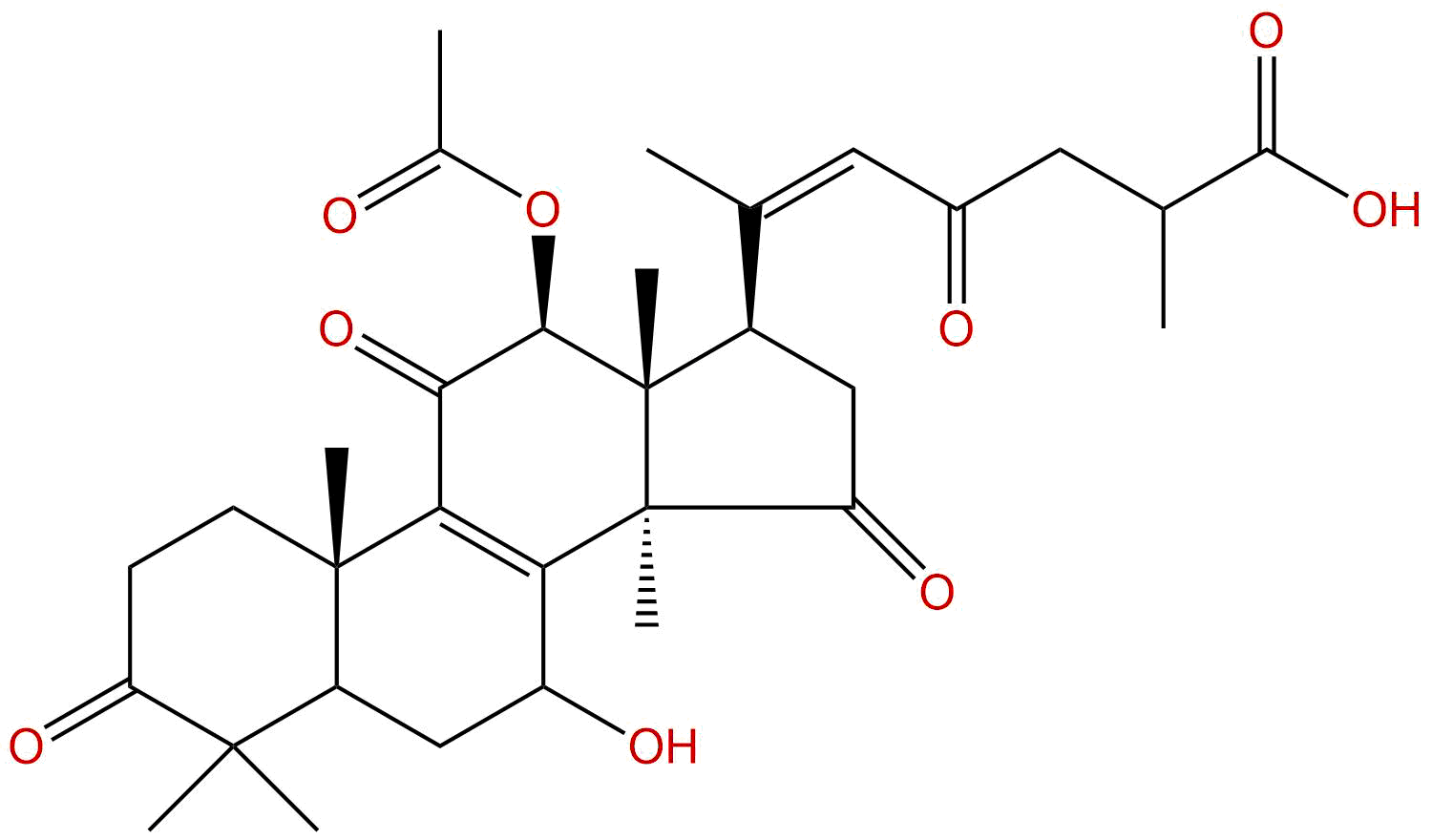
7 β - Hydroxyganoderic acid F (CAS: 1245946-62-6), also known as 12 β - acetoxy-7 β - hydroxy-3,11,15,23-tetraoxo-5 α - lanostane-8,20-diene-26-acid, is a lanostane type triterpenoid acid with a unique oxidation mode isolated from Ganoderma lucidum. In recent years, studies have found that this compound exhibits significant inhibitory activity against liver cancer cells in vitro and in vivo models. Its effects involve inducing apoptosis, inhibiting proliferation, blocking the cell cycle, resisting invasion and metastasis, and exerting its effects by regulating multiple key signaling pathways and molecular targets. This article aims to provide a systematic review of the chemical structure, sources, pharmacological activities, mechanism of action, and pharmacological characteristics of 7 β - hydroxy ganoderic acid F, in order to provide comprehensive scientific basis for the in-depth research and development of this compound as a candidate drug for liver cancer.
Chemical structure and physicochemical properties
7 β - Hydroxyganoderic acid F belongs to highly oxidized lanostane triterpenoids. Its basic skeleton is 5 α - lanostane-8,20-diene, with the following key structural features:
1. Rich oxidation sites Four ketone carbonyl groups (3,11,15,23-tetraoxo) are formed at positions C-3, C-11, C-15, and C-23, with a β - configured hydroxyl group (7 β - hydroxy) at position C-7, a β - configured acetoxy group (12 β - acetoxy) at position C-12, and a carboxyl group (- oic acid) at position C-26. The structure of this multi carbonyl and multi oxygen-containing functional group is an important basis for its high polarity and potential biological activity.
2. Unsaturated double bond There are two double bonds at positions C-8 (9) and C-20 (22), forming a typical 8,20-diene system that increases the rigidity of the molecule and affects its electron distribution.
3. Chiral center There are multiple chiral carbon atoms in the molecule, and their absolute configurations have been confirmed through spectroscopic analysis (such as NMR, CD) and X-ray single crystal diffraction, which is crucial for their specific recognition with biomolecules.
According to its pharmacological parameters, the molecular weight of this compound is 570.6790, which belongs to the category of medium molecular weight compounds. Its calculated lipid water partition coefficient (LogP) is 2.4690, indicating that it has a certain degree of lipophilicity, but not highly hydrophobic. The topologically polar surface area (TPSA) is as high as 152.1100 Å ², which is mainly attributed to the presence of multiple polar groups such as carbonyl, hydroxyl, and carboxyl groups in the molecule, indicating that it may have more hydrogen bond donor and acceptor sites. The water solubility parameter is 0.0282, indicating its low solubility in water, which may be a potential limiting factor for its oral bioavailability. In addition, the prediction shows that its ability to cross the blood-brain barrier is relatively low, indicating a lower risk of central nervous system related side effects; There is no significant inhibition of hERG potassium channels, indicating a lower potential risk of arrhythmia; The Ames test predicted a value of 0.0, indicating that it may not have direct genetic toxicity. These preliminary pharmacological parameters provide direction for its subsequent chemical modification and formulation development.
Plant sources and extraction methods
7 β - Hydroxyganoderic acid F is mainly derived from the porous fungal family Ganoderma lucidum(Ganoderma lucidum The fruiting body, mycelium, or spore powder of (Leyss. ex Fr.) Karst. Ganoderma lucidum, as a "fairy grass" with thousands of years of application history, has a complex chemical composition. Triterpenes are considered one of its most important active ingredient groups, and highly oxidized lanostane triterpenoids such as ganoderic acids and ganoderic acid derivatives are its characteristic components.
The extraction and separation of this compound usually follow the conventional process of natural product chemistry, but optimization is needed for its structural characteristics:
1. Extract Organic solvents are usually used to extract dried and crushed Ganoderma lucidum materials. Common methods include: ① Alcohol extraction method: using methanol or ethanol for reflux extraction or ultrasound assisted extraction, which has a high extraction efficiency for polar triterpenoid acids. ② Combination solvent extraction: Sometimes chloroform methanol mixed solvents are used to balance components of different polarities.
2. Enrichment and Separation After the crude extract is concentrated under reduced pressure, the acidic characteristics of triterpenoids are often utilized for preliminary enrichment using the alkali soluble acid precipitation method. Further separation and purification mainly rely on various chromatographic techniques: ① Normal phase silica gel column chromatography: using different ratios of petroleum ether ethyl acetate or chloroform methanol gradient elution for preliminary grouping. ② Reverse phase chromatography (such as ODS, C18): For polar triterpenoid acids containing carboxyl groups and multiple hydroxyl groups, reverse phase chromatography (commonly used in methanol water or acetonitrile water systems) is the key purification step. ③ High performance liquid chromatography (HPLC): preparative HPLC is the ultimate method for obtaining high-purity 7 β - hydroxy ganoderic acid F, often using a reverse phase C18 column and acetonitrile water (with a small amount of formic acid or acetic acid to adjust pH) as the mobile phase for isocratic or gradient elution.
3. appraisal The molecular formula of the isolated monomer compound was determined by high-resolution mass spectrometry (HR-ESI-MS), and its planar structure and relative configuration were analyzed using one-dimensional and two-dimensional nuclear magnetic resonance spectra (1H NMR, 13C NMR, HSQC, HMBC, COSY, NOESY, etc.). Its absolute configuration was determined by circular dichroism (CD) or single crystal X-ray diffraction.
At present, the content of this compound in Ganoderma lucidum is relatively low and belongs to trace components, which poses a challenge for its large-scale acquisition and subsequent research. Therefore, exploring the optimization of production strains and increasing yields through fungal fermentation engineering technology, or conducting total synthesis and semi synthesis research, is an important strategy to solve its source problem.
Pharmacological activity research
Numerous in vitro and in vivo pharmacological studies have shown that 7 β - hydroxyganoderic acid F has broad and significant inhibitory activity against liver cancer cells.
1. In vitro anti liver cancer activity
This compound exhibits strong cytotoxicity against various human liver cancer cell lines, such as HepG2, Huh7, SMMC-7721, Hep3B, etc. Its half maximal inhibitory concentration (IC50 value) is usually at the micromolar (μ M) or even sub micromolar level, and its activity is superior to some traditional chemotherapy drugs (such as 5-fluorouracil). Moreover, its toxicity to normal liver cells (such as LO2) is relatively low, demonstrating a certain degree of selectivity.
- Inhibit cell proliferation and colony formation It can dose - and time-dependent inhibit the proliferation activity of liver cancer cells and significantly reduce the ability to form cell colonies (clones), indicating its ability to inhibit the long-term proliferation potential of tumor cells.
- Inducing cell apoptosis Through Annexin V/PI double staining, Hoechst/PI staining, and TUNEL detection, it was confirmed that the compound can effectively induce apoptosis in liver cancer cells. Under the microscope, typical apoptotic forms such as cell shrinkage, chromatin condensation, and nuclear fragmentation can be observed.
- Block cell cycle Flow cytometry analysis showed that 7 β - hydroxyganoderic acid F can block liver cancer cells at specific cell cycle phases, commonly G0/G1 or G2/M, thereby preventing cells from entering the DNA synthesis or mitotic phase and inhibiting their proliferation.
- Inhibit migration, invasion, and metastasis Through scratch healing experiments and Transwell chamber (Matrigel coated) experiments, it has been confirmed that this compound can significantly inhibit the migration and invasion ability of liver cancer cells. The mechanism is closely related to the downregulation of extracellular matrix degradation related proteins (such as MMP9) expression.
2. In vivo anti liver cancer activity
In nude mouse liver cancer transplantation models (such as HepG2 or Huh7 cell subcutaneous transplantation tumors), intraperitoneal injection or gavage of 7 β - hydroxyganoderic acid F can significantly inhibit tumor growth, manifested as a significant reduction in tumor volume and weight. Pathological examination showed that there were large areas of necrosis and an increase in apoptotic cells in the tumor tissue of the treatment group, while the expression of proliferation markers (such as Ki-67) decreased. At the same time, at the effective dose, there was no significant decrease in body weight in mice, and no significant pathological damage was observed in major organs (heart, liver, spleen, lungs, kidneys), indicating that their toxicity in vivo may be low and the treatment window may be wide.
In addition, preliminary studies suggest that the compound may have auxiliary anti-tumor activities such as anti-inflammatory and antioxidant effects, which can help improve the tumor microenvironment and enhance its direct anti-tumor effect.
Mechanism of action and molecular targets
The anti liver cancer effect of 7 β - hydroxy ganoderic acid F involves synergistic regulation of multiple targets and pathways, and its mechanism of action is complex and refined. According to existing research, its core mechanism of action and key molecular targets can be summarized as follows:
1. Inducing mitochondrial pathway apoptosis
This compound can downregulate the expression of anti apoptotic protein BCL2, and may also affect the activation or translocation of pro apoptotic proteins (such as BAX), leading to a decrease in mitochondrial membrane potential, release of cytochrome C from mitochondria to cytoplasm, and activation of caspase-9 and caspase-3 cascade reactions, ultimately triggering cell apoptosis. This is one of the core pathways through which it exerts cytotoxic effects.
2. Inhibit the STAT3 signaling pathway
Signal transducer and activator of transcription factor 3 (STAT3) is a key oncogenic protein that is continuously activated during the occurrence and development of liver cancer. 7 β - Hydroxyganoderic acid F can inhibit the phosphorylation (activation) of STAT3, prevent its nuclear translocation and binding to DNA, thereby downregulating the transcription of a series of downstream targets related to cell proliferation (such as Cyclin D1), survival (such as Survivor, MCL-1), angiogenesis (such as VEGF), and immune escape.
3. Interference with MAPK/ERK signaling pathway
This compound can regulate the phosphorylation levels of members of the mitogen activated protein kinase (MAPK) family, particularly the extracellular signal regulated kinase (MAPK1/ERK). By inhibiting the excessive activation of ERK, it can affect cell proliferation, differentiation, and survival signals.
4. Inhibit the PI3K/Akt signaling pathway
Mutations or activations of phosphatidylinositol 3-kinase catalytic subunit alpha (PIK3CA) are common in liver cancer. 7 β - Hydroxyganoderic acid F may directly or indirectly inhibit the activity of PI3K, thereby reducing the phosphorylation level of its downstream key effector molecule Akt. Inhibiting the PI3K/Akt pathway can promote apoptosis, inhibit proliferation, and enhance sensitivity to chemotherapy.
5. Inhibit telomerase activity
The reactivation of telomerase reverse transcriptase (TERT) is a crucial step in cellular immortalization (carcinogenesis). Research has shown that this compound may cause telomere shortening, leading to cellular aging or apoptosis by inhibiting the expression or activity of TERT.
6. Inhibit DNA Topoisomerase I
As a key enzyme for DNA replication and transcription, topoisomerase I (TOP1) is a target for various anticancer drugs. 7 β - Hydroxyganoderic acid F may stabilize the cleavage complex formed between TOP1 and DNA through a mechanism similar to a "topoisomerase toxin", leading to the accumulation of DNA single strand breaks, triggering DNA damage reactions and cell death.
7. Affects other key targets
- Matrix metalloproteinase 9 (MMP9)By downregulating the expression of MMP9 and inhibiting the degradation of extracellular matrix, the invasion and metastasis ability of liver cancer cells can be weakened.
- Epidermal growth factor receptor (EGFR)May interfere with the activation of EGFR or its downstream signaling, inhibiting proliferation signals driven by growth factors.
- Cyclooxygenase-2 (PTGS2/COX-2)Inhibiting the expression of COX-2 can help reduce tumor associated inflammatory responses and the production of prostaglandin growth factors.
- P53 (TP53) pathway In liver cancer cells carrying wild-type p53, this compound may promote p53 dependent cell cycle arrest and apoptosis by stabilizing p53 protein or enhancing its transcriptional activity.
In summary, 7 β - hydroxy ganoderic acid F forms a multidimensional and networked anti liver cancer mechanism by simultaneously acting on multiple key targets located at different signaling nodes and biological processes, such as BCL2, STAT3, MAPK1, PIK3CA, TERT, TOP1, MMP9, EGFR, PTGS2, and TP53. This may be an important reason for its high efficiency and low susceptibility to drug resistance.
Evaluation of drug properties and pharmacokinetics
Although 7 β - hydroxy ganoderic acid F exhibits excellent pharmacological activity, its successful development as a drug depends on its drugability and pharmacokinetic (PK) properties.
1. Preliminary evaluation of drug properties
Based on computational chemistry and preliminary experimental data:
- Solubility and permeability Its low water solubility (0.0282) and moderate LogP value (2.4690) may belong to Class II (low solubility, high permeability) or Class IV (low solubility, low permeability) compounds in the Biopharmaceutical Classification System (BCS). This may lead to poor oral absorption and low bioavailability.
- Metabolic stability The molecule contains multiple ketone, hydroxyl, and acetoxy groups, which may act as binding sites for phase I metabolic enzymes (such as cytochrome P450) and phase II metabolic enzymes (such as glucuronosyltransferase and sulfatase), suggesting that they may metabolize rapidly in vivo.
- Protein binding rate The presence of high TPSA and carboxyl groups suggests a possible strong binding with plasma proteins (such as albumin), which can affect their free drug concentration and tissue distribution.
- Security Warning Currently, it is predicted that there will be no hERG inhibition or Ames mutagenicity, but comprehensive preclinical safety evaluations (such as genetic toxicity, reproductive toxicity, and long-term toxicity) still need to be conducted.
2. Pharmacokinetic challenges and strategies
At present, there are few reports on the pharmacokinetic studies of the 7 β - hydroxy ganoderic acid F system. Based on its structure, the following challenges can be foreseen:
- Oral absorption Low water solubility and potential intestinal first pass effects may limit its oral absorption.
- distribution A higher plasma protein binding rate and lower BBB penetration affect its tissue distribution, but may also reduce central neurotoxicity.
- Metabolism and excretion May be widely metabolized by the liver, and the proportion of prototype drugs excreted by the kidneys may be relatively low.
To improve its medicinal properties, the following strategies can be adopted:
- Prodrug design Esterification, amidation, and other modifications are carried out on the carboxyl group at C-26 or the hydroxyl groups at C-7 and C-12 to prepare prodrugs for improving lipid solubility, membrane permeability, or targeting specific tissues, which can be hydrolyzed and released in vivo.
- Formulation optimization Develop nano formulations (such as liposomes, polymer micelles, solid lipid nanoparticles), self microemulsion delivery systems, or cyclodextrin inclusion complexes to improve their solubility, stability, and bioavailability.
- Simplification and Modification of Structure Simplify the molecule while retaining the pharmacophore, and synthesize analogs with similar activity but better LogP and TPSA, and more stable metabolism.
Clinical application prospects and prospects
7 β - Hydroxyganoderic acid F, as a natural triterpenoid compound with clear multi-target anti liver cancer activity, has broad clinical application prospects, but the road ahead is long.
1. Potential application directions
- Single drug therapy for liver cancer As a novel multi-target candidate drug for liver cancer, it is particularly suitable for patients who are resistant or not suitable for existing targeted drugs such as sorafenib and lenvatinib.
- Combination therapy sensitizer Combined with conventional chemotherapy drugs (such as cisplatin, doxorubicin) or other targeted drugs, it may enhance efficacy, reduce individual doses, and reverse drug resistance through synergistic effects.
- Liver cancer prevention and adjuvant therapy Given its multi-target regulatory properties and potential low toxicity, it may be used for chemoprevention in high-risk populations of liver cancer (such as patients with cirrhosis) or as postoperative adjuvant therapy to clear residual lesions and prevent recurrence.
2. Future research prospects
To achieve the transformation from "active compounds" to "candidate drugs", future research should focus on:
- In depth mechanism research Using chemical biology methods such as affinity fishing, molecular docking, gene knockout/knock in to identify its direct target and draw a more accurate signal network map.
- Systematic pharmacokinetic study Comprehensively evaluate its ADME (absorption, distribution, metabolism, excretion) characteristics in multiple animal models and clarify its pharmacokinetic pharmacodynamic (PK-PD) relationship.
- Comprehensive preclinical safety evaluation Complete systematic toxicology studies in accordance with Good Laboratory Practice (GLP) requirements for non clinical drug research.
- Formulation development and optimization Actively explore advanced drug delivery systems suitable for its physical and chemical properties to solve delivery challenges.
- Structural optimization and structure-activity relationship Conduct structural modification of the system, study its structure-activity relationship, and search for derivatives with stronger activity and better drug properties.
Conclusion
7 β - Hydroxyganoderic acid F is a lanostane type triterpenoid acid with a unique chemical structure and significant anti liver cancer activity contained in Ganoderma lucidum. It exhibits multidimensional and networked pharmacological effects in inhibiting liver cancer cell proliferation, inducing apoptosis, blocking the cell cycle, and resisting invasion and metastasis by synergistically acting on multiple key targets such as BCL2, STAT3, PI3K/Akt, MAPK/ERK, TERT, TOP1, etc. Although it faces challenges in terms of solubility, permeability, and other aspects of drug development, it is expected to overcome these bottlenecks through rational intervention using modern medicinal chemistry and pharmacology methods. As one of the bridges connecting the wisdom of traditional Chinese medicine and modern precision medicine, the continuous in-depth research on 7 β - hydroxy ganoderic acid F not only helps to clarify the scientific connotation of ganoderic acid's anti-tumor effect, but also may provide a new multi-target candidate drug for liver cancer treatment, which has important scientific significance and clinical translational value. Future research should focus on deepening mechanism understanding, optimizing compound properties, advancing preclinical evaluation, and ultimately promoting its clinical application for the benefit of patients.