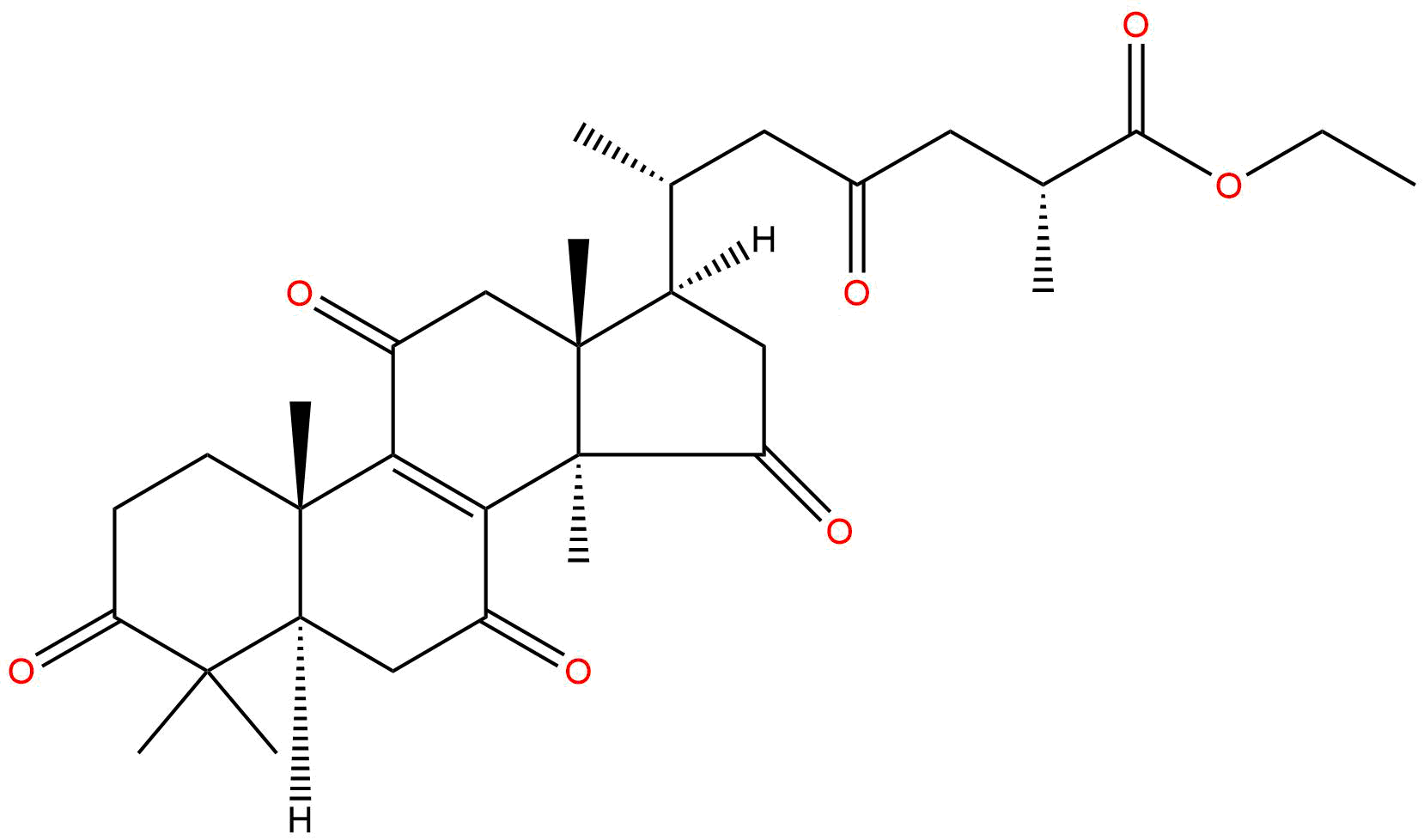


Product name: Ethyl ganoderate E
Synonym name:
Catalogue No.: BP2251
Cas No.:
Formula: C32H44O7
Mol Weight: 540.697
Botanical Source: Ganoderma
Type of Compound: Triterpenoids
Purity: 95%~99%
Analysis Method: HPLC-DAD or/and HPLC-ELSD
Identification Method: Mass, NMR
Packing: Brown vial or HDPE plastic bottle
Storage: Store in a well closed container, protected from air and light. Put into refrigerate or freeze for long term storage.
Whenever possible, you should prepare and use solutions on the same day. However, if you need to make up stock solutions in advance, we recommend that you store the solution as aliquots in tightly sealed vials at -20℃. Generally, these will be useable for up to two weeks.
The product could be supplied from milligrams to grams
Inquire for bulk scale.
For Reference Standard and R&D, Not for Human Use Directly.
Storage conditions:Short-term storage at 2~8℃, long-term storage at -20 ~ -80℃
110.5000
4.2000
3.8000
No
.9500
No
Negative
Ethyl ganoderite E is a traditional medicinal fungus derived from Ganoderma lucidum(Ganoderma lucidum)Natural triterpenoid compounds isolated from the middle. As one of the important members of the ganoderic acid family, it inherits the rich biological activity potential contained in the "Oriental Fairy Grass" of Ganoderma lucidum. Although its specific molecular formula, molecular weight, CAS number and other basic chemical information are not yet complete in public databases (product numbers are often labeled as internal research numbers such as BP2251), this has not hindered researchers' enthusiasm for exploring it. In the field of natural product chemistry and pharmacology research, ganoderic acid ethyl ester is regarded as a candidate molecule with great research value, based on the profound application history of ganoderic acid, which has been revered as a superior product in the traditional Chinese medicine system for thousands of years, promoting health and longevity. Modern research aims to strip away the traditional experience and use scientific language to analyze its specific chemical entities, targets, and molecular mechanisms, in order to evaluate its potential for development into modern drugs. This article will provide a systematic professional review and popular science interpretation of ganoderic acid ethyl ester from multiple dimensions, including its chemical essence, source, pharmacological activity, medicinal properties, and future prospects.
Ganoderma lucidum ethyl ester belongs to the highly oxidized lanostane triterpenoid class, which is a characteristic active ingredient category in Ganoderma lucidum. From the name, it can be inferred that the compound is an ethylated derivative of ganoderic acid E.Lingzhi acid It is a large class of compounds with a common tetracyclic triterpenoid parent nucleus and functional groups such as hydroxyl, carboxyl, carbonyl, etc. connected at different positions.“E” Usually refers to a specific isomer or substitution pattern in the ganoderic acid series, and Ethyl ester This indicates that the carboxyl group (- COOH) in its structure has formed an ester bond (- COOCH ₂ CH3) with ethanol.
Although there is currently a lack of precise molecular formula and molecular weight, based on the structural characteristics of similar compounds, we can make reasonable inferences. Typical ganoderic acid compounds have a molecular weight between 500-600 Da. Its core structure consists of a steroid like rigid skeleton composed of multiple cyclohexane rings, connected by multiple oxygen-containing functional groups, which leads to its High polarity and theoretical topological polarity surface area (TPSA)It may affect its transmembrane absorption. Esterification modification is usually carried out to improve the properties of the parent compound (ganoderic acid E)fat-soluble The introduction of ethyl ester will mask a polar carboxyl group, thereby Reduce the overall polarity of molecules and increase their lipid water partition coefficient (LogP value)In theory, this helps compounds better penetrate the lipid bilayer of cells and improve their oral bioavailability. However, ester bonds are easily hydrolyzed by esterases in the body and converted back into acidic forms, which is often utilized in the design of drug precursors (prodrugs). Its physicochemical properties, such as solubility (possibly slightly soluble in water, soluble in organic solvents such as methanol and DMSO), stability (sensitivity to light, heat, pH), etc., are closely related to its unique chemical structure and serve as the basis for subsequent formulation research and activity evaluation.
The only known plant source of ethyl ganoderic acid E is Lingzhi, scientific name Ganoderma lucidum It belongs to the Ganoderma family. This large fungus mainly grows on decaying wood, and its fruiting body has a lacquer like glossy cap. It has a medicinal history of over two thousand years in East Asian countries such as China, Japan, and South Korea.
In traditional Chinese medicine theory, Ganoderma lucidum is classified as a "top-grade" medicinal herb, with a mild nature, sweet taste, and can be found in the heart, lungs, liver, and kidney meridians. Its core function lies in Tonify qi and calm the mind, relieve cough and asthma In the "Shennong Bencao Jing", Ganoderma lucidum is described as "the main cause of hearing loss, benefiting joints, protecting the spirit, nourishing essence and qi, strengthening muscles and bones, and having good color". It is commonly used to treat symptoms such as fatigue, weakness, palpitations, insomnia, cough, wheezing, phlegm accumulation, and tumor accumulation. It is regarded as a nourishing product that supports the body's normal qi (immunity) and regulates yin and yang. Its application forms are diverse, including frying soup, soaking wine, grinding powder and swallowing, or making pills and powders.
Although the traditional application of Ganoderma lucidum is based on a holistic approach and syndrome differentiation, it provides a clear direction for modern research: its active ingredients may act on the immune system, nervous system, respiratory system, and metabolic system. Lingzhi acid ethyl ester, as a single compound extracted from this "medicinal edible" fungus, is one of the chemical messengers that modern science attempts to "decode" traditional efficacy. Researchers hope to transform macroscopic effects such as "tonifying qi and calming the mind" into microscopic, quantifiable molecular and cellular events by isolating and identifying specific molecules such as ethyl ganoderic acid E ester, thus bridging the gap between traditional wisdom and modern pharmacology.
Although there is currently a lack of direct target information for ethyl ganoderic acid E ester in publicly available target databases, this does not mean that it lacks biological activity. On the contrary, based on extensive research on the overall extract of Ganoderma lucidum and other highly structurally similar ganoderic acid compounds (such as ganoderic acid A, B, C, D, etc.), we can reasonably speculate and summarize the pharmacological activities and potential mechanisms of action of ganoderic acid ethyl ester. These activities mostly correspond to traditional application records and point to various modern high incidence diseases.
(1) Anti inflammatory and immune regulatory activity
This is one of the core activities of Ganoderma lucidum components. Inflammation is the common pathological basis of many chronic diseases (such as arthritis, atherosclerosis, neurodegenerative diseases). Research has shown that many ganoderic acids can reduce the production of pro-inflammatory mediators such as tumor necrosis factor alpha (TNF - α), interleukin-6 (IL-6), and prostaglandin E2 (PGE2) by inhibiting key inflammatory signaling pathways such as nuclear factor kappa B (NF - κ B) and mitogen activated protein kinase (MAPK). Lingzhi acid ethyl ester is likely to share this mechanism. By regulating the function of immune cells such as macrophages and T cells, it may exert a bidirectional immune regulatory effect - both inhibiting excessive inflammation and enhancing immune response when the immune system is weakened, which perfectly interprets the traditional concept of "strengthening the body and consolidating the foundation".
(2) Anti-tumor activity
Numerous in vitro and animal experiments have confirmed that various ganoderic acids can inhibit the proliferation, induce apoptosis (programmed cell death), and autophagy of different cancer cells. Its potential mechanisms involve:
- cell cycle arrest Block cancer cells in G1 or G2/M phase to prevent their division.
- Inducing apoptosis Upregulation of pro apoptotic proteins (such as Bax), downregulation of anti apoptotic proteins (such as Bcl-2), activation of Caspase enzyme cascade reaction.
- Suppression transfer Reduce the expression of matrix metalloproteinases (MMPs) to inhibit cancer cell invasion and metastasis.
- Regulating the tumor microenvironment Inhibit tumor associated macrophages and other tumor promoting immune cells through the above-mentioned anti-inflammatory and immune regulatory effects.
Lingzhi acid ethyl ester, as one of its members, is highly likely to have similar anti-tumor potential, possibly by acting on the aforementioned common targets or pathways.
(3) Liver protective effect
Lingzhi is commonly used in traditional medicine to protect the liver. Research has shown that ganoderic acid can counteract chemical liver damage caused by alcohol, carbon tetrachloride, acetaminophen, and other substances. Its mechanism may be related to anti-oxidative stress and Anti endoplasmic reticulum stress of They can enhance the activity of antioxidant enzymes such as superoxide dismutase (SOD) and glutathione peroxidase (GSH Px) in the liver, and eliminate free radicals; Simultaneously regulating unfolded protein response (UPR), reducing endoplasmic reticulum pressure in liver cells, thereby protecting liver cell membrane and mitochondrial function, and inhibiting liver cell apoptosis and fibrosis.
(4) Neuroprotection and Tranquility
This corresponds to the traditional 'calming' effect. Some ganoderic acids have been shown to have neuroprotective effects, which may improve anxiety, depression, insomnia, as well as neurodegenerative disease models such as Alzheimer's disease and Parkinson's disease by inhibiting neuroinflammation, antioxidant activity, and regulating neurotransmitter systems such as GABA and 5-HT. The ability of ganoderic acid ethyl ester to cross the blood-brain barrier and act on the central nervous system is the key to its neuroprotective effect, which will be discussed in the section on drug properties.
(5) Metabolic regulation
Preliminary studies show that some ganoderic acid can improve insulin resistance, reduce blood sugar and lipids, suggesting that it has potential in the prevention and treatment of metabolic syndrome and type 2 diabetes. The mechanism may involve activating the AMPK (adenosine monophosphate activated protein kinase) pathway, which is the core regulator of cellular energy metabolism.
Summarize the characteristics of the mechanism The action of ganoderic acid ethyl ester is likely not to act on a single, isolated "target", but rather on Multi target, multi pathway In this way, it gently regulates the global signaling network of inflammation, oxidation, apoptosis, metabolism, etc. of cells, which is in line with the characteristics of natural products and is also in line with its traditional positioning as a holistic regulator from Ganoderma lucidum.
Drug efficacy assessment aims to predict the likelihood of a compound developing into an oral medication. We conducted a preliminary analysis of ganoderic acid ethyl ester using classic standards such as Lipinski's Rule of Five (RO5). It should be emphasized that due to the lack of precise molecular parameters, the following analysis is based on the general characteristics of similar compounds for inference.
Lipinski's Five Rules Analysis(Usually applicable to oral medications):
1. Molecular weight (MW)<500 Da It is inferred that the molecular weight of ethyl ganoderic acid E ester may be close to or slightly exceed 500 Da (typical molecular weight range of ganoderic acid). This may be a slight violation of this rule, but it is not an absolute obstacle, as many successful drugs have molecular weights between 500-600 Da.
2. Lipid water partition coefficient LogP<5 Ethylation modification aims to improve lipid solubility. Its LogP value is likely within the ideal range of 2-4, which satisfies this rule and is beneficial for intestinal absorption.
3. The number of hydrogen bond donors (HBDs) is less than 5 The hydroxyl group (- OH) on the triterpenoid nucleus is a hydrogen bond donor. Lingzhi acids usually have multiple hydroxyl groups, but the quantity may be controlled within 5 or around.
4. The number of hydrogen bond acceptors (HBAs) is less than 10 The hydroxyl, carbonyl (C=O), and ester (- COOR) groups in the structure are all hydrogen bond acceptors. Due to its high degree of oxidation, the HBA count may approach or reach the critical value of 10.
Preliminary judgment suggests that ethyl ganoderic acid E ester may be at the boundary of the RO5 rule and belongs to a molecule with acceptable drug properties but requires attention.
Analysis of other key pharmacological parameters:
- Topological Polarity Surface Area (TPSA)Due to the presence of multiple polar oxygen atoms, its TPSA value may be relatively high (>100 Å ²). High TPSA is usually unfavorable for passive transmembrane diffusion, especially Penetrating the blood-brain barrier (BBB) Their ability may be weak. This means that it may primarily act on the peripheral system, with limited direct effects on the central nervous system unless there is a special active transport mechanism.
- Oral bioavailability In addition to membrane permeability, its role in the gastrointestinal tract chemical stability(Ester bonds may be partially hydrolyzed by gastric acid or enzymes)First pass metabolism(Metabolized by cytochrome P450 enzyme system in the liver) is also a key factor affecting oral bioavailability. Ethylation itself is a prodrug strategy that may improve absorption, but the ultimate effective product may be its hydrolysis product, ganoderic acid E.
- toxicity Currently, there is a lack of specialized toxicity data for ethyl ganoderic acid E ester. However, as a long-term edible fungus, Ganoderma lucidum extract has a relatively high overall safety. However, as a highly active single ingredient, systematic preclinical toxicology studies (acute toxicity, long-term toxicity, genetic toxicity, etc.) are still needed to eliminate potential risks.
Comprehensive Assessment Lingzhi acid ethyl ester has certain medicinal potential, and its chemical structure endows it with diverse biological activities. The main challenge may lie in its Larger molecular weight and higher polarity The resulting membrane permeability is average, and oral absorption may be poor. Future structural optimization (such as further structural modifications to improve pharmacokinetic properties) and formulation technologies (such as nanocarrier systems and liposome encapsulation) may be key pathways to enhance their drug efficacy.
Currently, regarding Lingzhi acid ethyl ester The independent and systematic research on this specific compound is still in a relatively early stage. Most research focuses on the total extract of Ganoderma lucidum or more common monomers of ganoderic acid (such as ganoderic acid A, B, C, D). The research on ethyl ganoderic acid E ester mostly exists in the isolation and identification reports of natural product chemistry, and its in-depth Pharmacological mechanism, target validation, in vivo pharmacodynamics, and pharmacokinetic studies There are still large gaps waiting to be filled.
Current research status:
1. Mainly focused on chemical research The separation, purification, and structural identification of Ganoderma lucidum fruiting bodies or spore powders have been completed (usually through techniques such as nuclear magnetic resonance and mass spectrometry), and their chemical entities have been confirmed.
2. Preliminary exploration of activity screening It may exhibit antioxidant, anti-inflammatory, or cytotoxic activity in crude extract or component screening, but there is a lack of dose-response relationship research and mechanism exploration for this monomer.
3. Data fragmentation The relevant information is scattered in research conducted in different laboratories, and has not yet formed a complete data chain, nor has it been widely included in public compound databases.
Future application prospects and research directions:
1. Target Fishing and Mechanism Elucidation Using chemical biology methods such as affinity chromatography fishing, drug affinity reaction target stability (DARTS) technology, proteomics, etc., to identify and validate their direct target proteins in cells is a key step in translating traditional efficacy into modern medical language.
2. In depth preclinical research Based on a clear cell model, establish relevant animal disease models (such as inflammatory bowel disease, non-alcoholic fatty liver disease, and certain tumor models), systematically evaluate their in vivo efficacy, optimal administration route, dosage, and safety, and conduct comprehensive pharmacokinetic studies (ADME: absorption, distribution, metabolism, excretion).
3. Structural optimization and derivative development Based on its active parent nucleus, carry out reasonable medicinal chemical modifications. For example, in response to its drug weakness, different ester, amide, or ether derivatives can be synthesized to optimize its LogP, TPSA, and metabolic stability while maintaining activity, creating more promising candidate drug molecules for development.
4. Exploration of combination therapy and adjuvant therapy Given its multi-target and low toxicity regulatory properties, ganoderic acid ethyl ester or its optimized products are highly suitable as Adjuvant therapy drugs Combined with existing chemotherapy drugs, targeted drugs, or immune checkpoint inhibitors, it may have the effect of reducing toxicity, increasing efficacy, reversing drug resistance, and improving patients' quality of life.
5. Development of Big Health Products On the basis of strict scientific verification of its safety and specific functions, it also has the potential to be developed into functional foods or dietary supplements for regulating immunity, anti fatigue, and assisting in the protection against chemical liver injury.
Conclusion:
Ganoderma lucidum ethyl ester, as a chemical microcosm derived from the millennium old fairy herb Ganoderma lucidum, carries the mission of exploring from traditional experience to modern science. Although it has not yet become a star molecule in the spotlight, the broad biological activity exhibited by its ganoderic acid family has outlined a promising research outline for it. Faced with the challenge of current data loss, it means enormous exploration space. Through interdisciplinary in-depth research - integrating natural product chemistry, pharmacology, medicinal chemistry, and formulation studies - we hope to gradually uncover its mysterious veil, evaluate its true medicinal value, and ultimately decide whether it will contribute uniquely to human health as an innovative drug or as a functional factor in the big health industry. This research path itself is a vivid practice of modernizing and internationalizing the treasure trove of traditional Chinese medicine.
Batch can search by a CAS number,one per line
