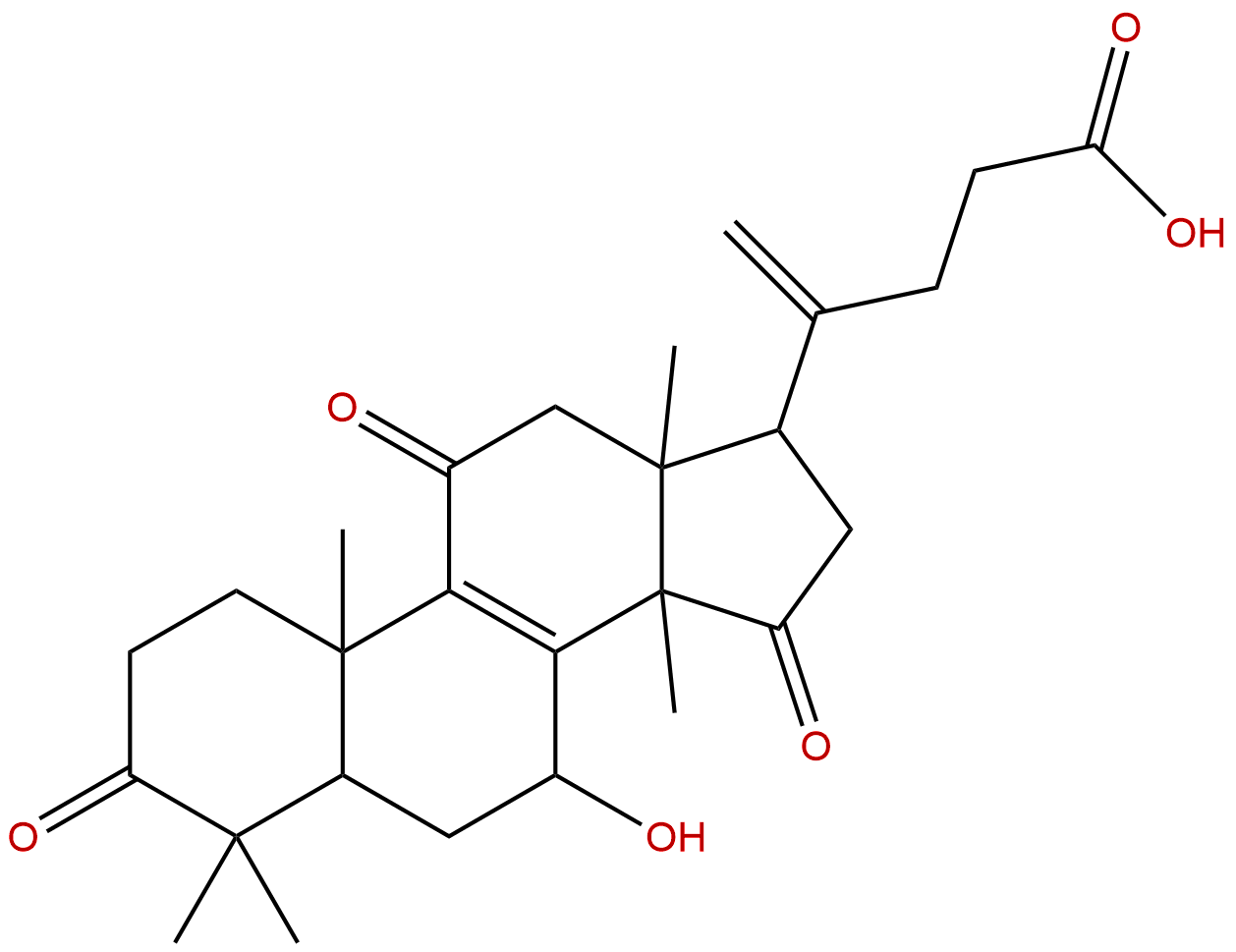
20 (21) - Dehydroganoderic acid A: potential molecule of anti breast cancer from Ganoderma lucidum
1. Overview
20 (21) - Dehydrolucidian acid A (20 (21) -) is a traditional medicinal fungus derived from Ganoderma lucidum(Ganoderma lucidum)The natural compounds obtained from the separation belong to the 11 oxo steroid class. Its CAS number is 852936-69-7, molecular formula is C27H36O6, and molecular weight is 456.5790 g/mol. As one of the many bioactive components in Ganoderma lucidum, this compound has attracted the attention of natural product pharmacology and tumor pharmacology researchers in recent years due to its potential anti-tumor activity, especially its application prospect in the field of breast cancer. Current research has preliminarily revealed that it may exert biological effects by acting on multiple key targets related to cell proliferation and apoptosis, such as BCL2, ESR1, PGR, HER2, BAX. Although its research is still at an early stage, 20 (21) - dehydroganisic acid A has become one of the important candidate molecules for exploring new lead compounds against breast cancer, combined with its clear plant origin and preliminary pharmacological data. This article will systematically elaborate on its chemical structure, origin, pharmacological mechanism, drug evaluation, and research prospects.
2. Chemical structure and physicochemical properties
20 (21) - The molecular structure of dehydrogibberellic acid A belongs to highly oxidized steroid skeleton derivatives. The SMILES string (C=C (CCC (=O) O) C1CC (=O) C2 (C) C3=C (C (=O) CC12C) C1 (C) CCC (=O) C (C) C1CC3O) reveals its core structural features: multiple carbonyl groups (C=O), hydroxyl groups (- OH), and a terminal carboxyl group (- COOH) are connected to the parent nucleus of a polycyclic steroid, and there is a dehydrogenation (double bond) structure at position 20 (21) of the side chain, which is also the origin of its name "dehydrogenation". This structure endows the molecule with a certain polarity and reactivity.
From the perspective of pharmacological parameters, its molecular weight (MW) is 456.58 g/mol, slightly higher than conventional small molecule drugs (usually<500 Da), but still within an acceptable range. The topological polar surface area (TPSA) is 108.74 Å ², reflecting the higher polarity brought by multiple oxygen atoms in the molecule, which may affect its transmembrane permeability. The lipid water partition coefficient LogP is 2.50 and LogD is -0.04; The LogP value indicates that the molecule has a certain degree of lipophilicity, while the LogD (distribution coefficient measured at a specific pH) is negative, suggesting that under physiological pH conditions, its carboxyl group may undergo ionization, enhancing the overall hydrophilicity of the molecule. This may seem contradictory to the measured low water solubility (0.0422, usually measured in mg/mL or mol/L, indicating poor solubility), but in reality, it may be due to the tight packing of molecules in a crystalline state or the presence of strong intermolecular forces, resulting in slow dissolution kinetics. The permeability of Caco-2 cells is 3.85 (usually measured in units of × 10 ⁻⁶ cm/s), which is moderate and suggests that it may have limited oral absorption potential. The blood-brain barrier (BBB) penetration is evaluated as' low ', which is consistent with its higher TPSA and possible ionization state, meaning it may not easily enter the central nervous system. This can sometimes reduce the risk of central side effects for drugs primarily targeting peripheral tumors. The plasma protein binding rate (PPB) is as high as 84.36%, indicating that most drugs bind to proteins in the blood, which may affect their free concentration and efficacy. Overall, its physical and chemical properties exhibit typical characteristics of multipole natural products: medium molecular weight, strong polarity, poor solubility, and high protein binding rate, which are the key points to be focused on in subsequent structural optimization.
3. Plant sources and traditional applications
20 (21) - The only natural source of dehydrogibberellic acid A is Ganoderma lucidum, also known as Ganoderma lucidum or Ruicao, which belongs to the Ganoderma family. Lingzhi has a history of over two thousand years of application in traditional East Asian medicine, especially in traditional Chinese medicine, and is known as the "immortal herb" or "elixir of life". In the "Shennong Bencao Jing", Ganoderma lucidum is listed as a top-grade herb, which is recorded to have the effects of "nourishing the heart and qi, calming the essence and soul, strengthening the muscles and bones, and improving color". It is commonly used to replenish qi and calm the mind, relieve cough and asthma, and prolong life. Modern pharmacological research has confirmed that Ganoderma lucidum contains various bioactive components such as triterpenoids (such as ganoderic acid), polysaccharides, sterols, nucleosides, etc. These components collectively endow Ganoderma lucidum with various pharmacological effects such as immune regulation, anti-tumor, antioxidant, anti-inflammatory, hepatoprotective, sedative, etc.
Ganoderma triterpenoids are one of its main active ingredients, and 20 (21) - dehydrogibberellic acid A is a specific member of this class of compounds. It is usually extracted from the fruiting body or mycelium of Ganoderma lucidum using organic solvents such as methanol and ethanol, and then separated and purified by chromatographic techniques. Traditionally, Ganoderma lucidum is often taken by boiling it in water or soaking it in wine, but the amount of triterpenoids extracted in this way is limited because triterpenoids have poor water solubility. The improvement of modern extraction technology has increased the yield of such components, laying the foundation for their in-depth research. The leap from traditional "strengthening the body and consolidating the foundation" to modern anti-tumor research reflects the classic path of mining active molecules from natural products.
4. Pharmacological activity and mechanism of action
At present, the pharmacological research on 20 (21) - dehydroganisic acid A mainly focuses on its anti-tumor potential, especially for breast cancer. The database information shows that the compound is associated with five key targets: BCL2, ESR1, PGR, HER2, and BAX. These targets do not exist in isolation, but constitute a network closely related to the occurrence and development of breast cancer.
Target analysis and mechanism of action speculation:
-
ESR1 (estrogen receptor alpha) and PGR (progesterone receptor)These two are key drivers of hormone receptor positive (HR+) breast cancer. When estrogen combines with ESR1, it can activate downstream signal pathways and promote the proliferation of breast cancer cells. About 70% of breast cancer belongs to HR+type. 20 (21) - Dehydroganoderic acid A has been labeled as related to ESR1 and PGR, suggesting that it may act as an estrogen receptor modulator to inhibit the estrogen signal pathway through competitive binding or allosteric regulation, thereby inhibiting the growth of HR+breast cancer cells. Its steroid like structure may help it bind to nuclear receptors.
-
HER2 (human epidermal growth factor receptor 2)HER2 overexpression is a marker of another type of invasive breast cancer (HER2+type), which is associated with poor prognosis. HER2 activates downstream survival and proliferation promoting pathways such as PI3K/Akt and MAPK. The association between the compound and HER2 target suggests that it may directly or indirectly inhibit the tyrosine kinase activity of HER2 or interfere with its dimerization, blocking its downstream signaling.
-
BCL2 (B-cell lymphoma 2) and BAX This pair of targets directly regulates cell apoptosis (programmed cell death). BCL2 is an important anti apoptotic protein that is overexpressed in various cancers and helps cancer cells evade apoptosis. On the contrary, BAX is a pro apoptotic protein. The occurrence of tumors is often accompanied by an imbalance in the BCL2/BAX ratio (high BCL2). 20 (21) - Dihydrogibberellic acid A is simultaneously associated with these two targets, which may indicate that it has a dual regulatory effect:Downregulate the expression or inhibit the function of BCL2 At the same time Upregulation or activation of BAX So as to reshape the balance of apoptosis and promote breast cancer cells to apoptosis. This characteristic of simultaneously acting on survival promoting and apoptosis promoting targets may result in synergistic anti-tumor effects.
Integration of mechanisms of action and association with diseases:
In breast cancer cells, the network composed of the above targets is extremely active. 20 (21) - Dihydrogibberellic acid A may pass through Multi target, multi pathway The way it works:
- For HR+breast cancer Inhibiting hormone dependent growth by interfering with ESR1/PGR signals.
- For HER2+breast cancer By inhibiting the HER2 pathway and blocking its potent pro proliferative signal.
- Broad spectrum pro apoptotic effect It may be one of its core mechanisms to induce apoptosis of different subtypes of breast cancer cells by regulating the BCL2/BAX axis.
This multi-target mode of action is consistent with the characteristics of many natural products and may help overcome the resistance problem that single target drugs are prone to. However, it needs to be emphasized that the current target information mostly comes from database prediction or preliminary combination experiments. Its exact interaction mode (excitation, antagonism, allosteric regulation), action intensity (IC50/Ki value) and specific effects in different breast cancer cell lines and animal models still need a lot of in-depth biochemical and cell biological research to verify and clarify. In particular, whether it is selective for certain subtypes of breast cancer is an important direction for future research.
5. Evaluation of drug properties
Based on the provided pharmacological parameters, we can use standards such as Lipinski's Rule of Five to preliminarily evaluate the potential of 20 (21) - dehydroquercetin A as an oral medication:
- Molecular weight (MW)456.58<500, in compliance with the rules.
- Lipid water partition coefficient (LogP)2.50<5, in compliance with the rules.
- Hydrogen bond donor (HBD)From the structural formula, it can be inferred that it should contain carboxyl and hydroxyl groups, with a possible quantity of 3-4 (accurate calculation is required), usually requiring ≤ 5, which may meet the requirement.
- Hydrogen bond acceptor (HBA)The molecule contains multiple carbonyl and hydroxyl oxygen groups, with a possible quantity of 6-7 (accurate calculation is required), usually requiring ≤ 10, in accordance with the rules.
- Number of rotatable keys The steroid skeleton has strong rigidity, but the side chains have some flexibility, and the quantity needs to be calculated, usually requiring ≤ 10.
From these five aspects alone, 20 (21) - dehydroquercetin A basically conforms to Lipinski's rule and has the preliminary structural basis to become an oral drug. However, drug evaluation goes far beyond this:
- Solubility and permeability Its extremely low water solubility (0.0422) is the primary obstacle to the development of its oral formulations. Although Caco-2 has decent permeability (3.85), its "low solubility" may severely limit its absorption (bioavailability) in the gastrointestinal tract. This belongs to the typical "BCS Class II" (low solubility and high permeability) or "BCS Class IV" (low solubility and low permeability) characteristics. Formulation strategies (such as nanocrystals, solid dispersions, liposomes) or prodrug modifications (such as esterifying carboxyl groups to enhance lipid solubility) may be necessary.
- Metabolism and toxicity The Ames test (0.0) and chromosome aberration (none) results were negative, indicating that it has no genetic toxicity. HERG inhibition (no) indicates a lower risk of cardiac toxicity. No skin or respiratory sensitization, no phototoxicity. These are positive signals. However, serum markers (Ser_LK positive, GGT/AST/ALT negative) suggest that attention should be paid to their possible impact on alkaline phosphatase, and further in vivo experiments are needed to confirm their liver safety.
- Pharmacokinetic prediction High plasma protein binding rate (84.36%) can reduce free drug concentration, which may require higher doses to achieve effective blood drug concentration, but may also prolong half-life. BBB has low penetrability, which is unfavorable for the treatment of brain metastatic breast cancer, but reduces the risk of central nervous side effects.
Summary 20 (21) - Dihydrogibberellic acid A has a basic drug like skeleton and good preliminary safety, but its Poor water solubility and high protein binding rate are its main shortcomings This severely restricts its bioavailability and in vivo efficacy. Before pushing it towards drug development, it must be done through Pharmaceutical chemical modification (structural optimization) or advanced formulation technology To improve its solubility and pharmacokinetic properties.
6. Research Status and Application Prospects
At present, there are relatively few public research literature on 20 (21) - dehydrogibberellic acid A, and its activity data mostly comes from screening databases and preliminary in vitro experiments. This indicates that it is still in Early stages of drug discovery(Lead compound identification and validation period). Most of the known information focuses on its source, structure, prediction target and association with breast cancer.
Current research focus Should include:
1. Target validation and in-depth investigation of mechanisms At the cellular and molecular levels, confirm its direct effects on targets such as BCL2, ESR1, HER2, determine binding constants, and elucidate the specific signaling pathways involved in downregulation/upregulation of these target proteins (such as Akt, MAPK, Caspase cascade reactions, etc.).
2. In vitro activity evaluation: The anti proliferation (MTT/CCK-8), pro apoptosis (Annexin V/PI flow, Caspase-3 activation), cell cycle arrest and other effects were systematically evaluated in a variety of breast cancer cell lines (MCF-7, T47D, SK-BR-3, MDA-MB-231, etc.), and IC50 values were calculated.
3. Preliminary in vivo pharmacodynamics To establish a mouse model of transplanted breast cancer, evaluate its anti-tumor effect in vivo, preliminary toxicity and pharmacokinetic characteristics, and verify the translatability of its activity in vitro.
4. structural optimization Based on its pharmacological weakness (solubility), carry out reasonable structural modifications. For example, esterification or amidation of its carboxyl group can be used to prepare prodrugs, or hydrophilic groups can be introduced to improve solubility, while monitoring changes in activity and searching for derivatives with better activity and drug properties.
Application Prospects:
- As a new lead compound against breast cancer If its multi target anti breast cancer activity is firmly confirmed in subsequent studies, it is expected to be developed into a new candidate drug that may fight against multiple subtypes of breast cancer, especially for patients resistant to existing targeted drugs.
- As a component of combination therapy Its potential pro apoptotic (BCL2/BAX) effect can be combined with chemotherapy drugs or other targeted drugs to enhance therapeutic efficacy.
- Markers for quality control of Ganoderma lucidum As a specific triterpenoid acid in Ganoderma lucidum, its content can be used to evaluate the quality of different Ganoderma lucidum varieties or products.
- Tool molecules A chemical biology tool used to study the interaction between steroid derivatives and nuclear receptors (ESR1/PGR) and apoptosis targets.
In conclusion, 20 (21) - dehydroganisic acid A is a natural molecule found in the traditional food and drug homologous fungi and has a clear prediction of anti breast cancer targets. It serves as a bridge from traditional wisdom to modern precision medicine. Although the road ahead is long and requires overcoming multiple challenges such as solubility, mechanism validation, and in vivo efficacy, its unique chemical structure and potential multi-target mechanism of action make it worthy of continuous attention and investment in the field of anti-tumor natural product drug development. Future research requires close collaboration between pharmacists, chemists, and biologists in order to transform this potential 'natural gift' into practical drugs that benefit patients.