Introduction/Overview
Natural products, especially bioactive molecules derived from plants, have always been an important treasure trove for the discovery and development of new drugs. Among numerous naturally occurring compounds with unique structures, diterpenoid alkaloids have attracted much attention for their complex polycyclic frameworks and significant physiological activities. Aconitum plants, as important herbs in traditional Chinese medicine for "returning yang, rescuing reverse, dispelling wind and dampness", mainly derive their efficacy and toxicity from the C19 diterpenoid alkaloids they contain. Hypaconine, as one of the key hydrolysis products of aconitine alkaloids during metabolism or processing in vivo, is an important intermediate that connects highly toxic diester alkaloids (such as aconitine and hypaconitine) with low toxicity amine alcohol alkaloids. Its CAS number is 63238-68-6, chemical formula is C24H39NO8, and molecular weight is 469.58.
Compared to its parent ester compound Hypaconitine, Hypaconitine has significantly reduced toxicity due to ester bond hydrolysis, but its biological activity spectrum has not completely disappeared. Instead, it exhibits pharmacological properties worth further exploration, especially in pain relief and cardiac activity. Research has shown that aconitine not only retains some central and peripheral analgesic effects, but its cardiac effects are also more complex, possibly involving regulation of ion channels. With the development of modern pharmacology and molecular biology techniques, the understanding of the targets of aconitine action has expanded from traditional sodium channel blockade to the regulation network of multiple targets such as transient receptor potential (TRP) channels, endogenous cannabinoid system, opioid receptors, and inflammatory mediator synthase. This provides a new opportunity for the development of new drug strategies that preserve efficacy and reduce toxicity.
This article aims to systematically review the chemical structure, plant origin, pharmacological activity, molecular mechanism of action, pharmacological characteristics, and clinical application prospects of aconitine, in order to provide comprehensive scientific references for the in-depth research and potential drug development of this compound.
Chemical structure and physicochemical properties
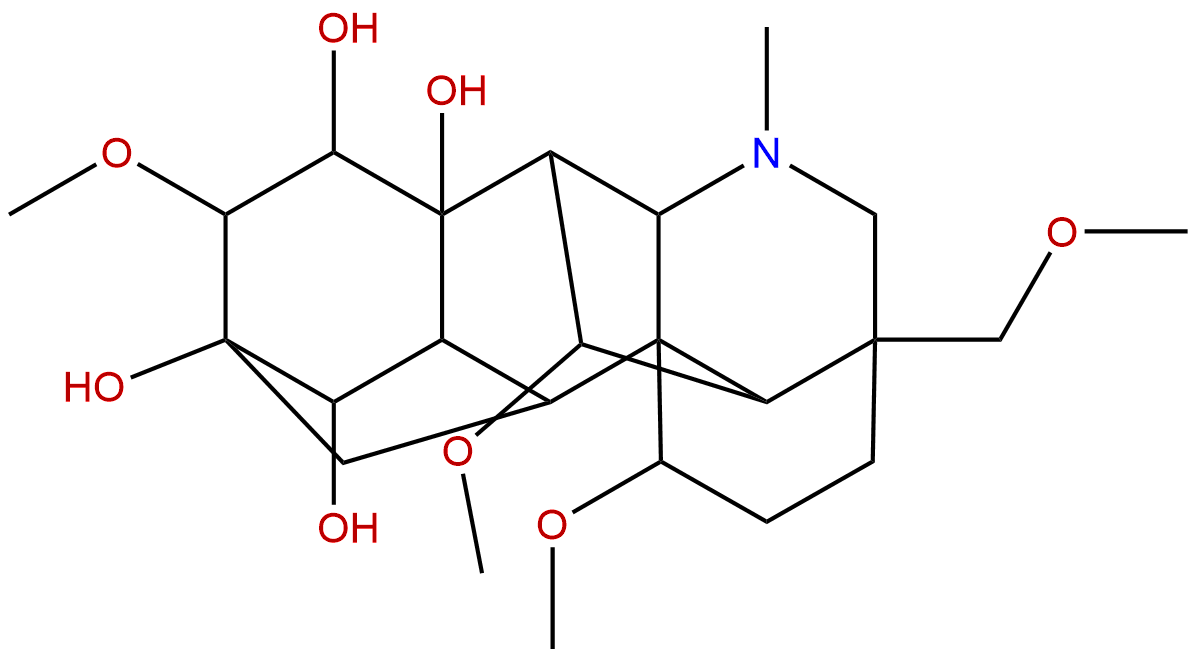
Aconitine is a typical C19 diterpenoid alkaloid, and its skeleton belongs to the aconane type. Its basic structure consists of a highly modified tetracyclic diterpene skeleton (composed of a five membered nitrogen heterocyclic ring, two six membered rings, and one seven membered ring fused together) and multiple oxygen-containing functional groups.
1. Structural features:
- Mother nucleus and substituent: Its chemical structure can be regarded as the product of hydrolysis of Hypaconitine at positions C8 (acetoxy) and C14 (benzoyloxy). Therefore, aconitine is hydroxyl (- OH) at the C8 position and also hydroxyl (- OH) at the C14 position, while retaining the hydroxyl groups at the C1 and C16 positions and the methoxy group at the C18 position. This structural change transforms it from a diester alkaloid to an amino alcohol alkaloid.
- Functional groups and classification: The molecule contains one tertiary amino group (nitrogen heterocycle), one secondary alcohol (C8-OH), three tertiary alcohols (C1, C14, C16-OH), and one methoxy group, and can therefore be classified as tetra alcohols, tertiary alcohols, secondary alcohols, and tertiary amino compounds. Its complex polycyclic system and ether bonds also make it an organic heterocyclic compound and polyether.
- Stereochemistry: The aconitine skeleton has multiple chiral centers, and the absolute configuration of aconitine is crucial for its biological activity. Its three-dimensional configuration is usually consistent with the parent aconitine, but the spatial hindrance decreases after hydrolysis, which may affect its binding mode with target proteins.
2. Physical and chemical properties:
According to the provided pharmacological parameters:
- Molecular weight and solubility: The molecular weight is 469.5750. The calculated LogP value is 0.7290, indicating that the compound has moderate lipophilicity but is not highly lipophilic. The topologically polar surface area (TPSA) is as high as 121.08 Å ², mainly attributed to the strong polarity brought by multiple hydroxyl and ether oxygen atoms in the molecule. The theoretical water solubility value is 2.5841 (usually measured in mg/mL or logS), combined with its TPSA and LogP values, it is speculated that it has a certain solubility in water, but may be lower than fully hydrophilic molecules. This "amphiphilic" characteristic has a significant impact on its absorption and distribution in organisms.
- Acidity and alkalinity: The tertiary nitrogen atom (pKa~8-9) in the molecule can be partially protonated at physiological pH, allowing it to exist in a cationic form, which facilitates its interaction with acidic residues in the cell membrane or certain ion channels.
- Stability As an amine alcohol alkaloid, aconitine has better chemical stability than its ester precursor. The hydrolysis of ester bonds eliminates an unstable site that is easily metabolized by esterases in the body, but its multiple hydroxyl groups may make it sensitive to oxidation.
Plant sources and extraction methods
1. Plant source:
The main source of aconitine is from plants in the Aconitum genus of the Ranunculaceae family. It was originally from aconite The sub roots of Aconitum carmichaeli Debx. and its native plants monkshood Isolation and identification in Aconitum carmichaeli. In addition, it may also exist in other medicinal or toxic plants of the same genus, such as monkshood(Aconitum kusnezoffii)、Short stemmed Aconitum(Aconitum brachypodum) and others. In plants, aconitine is usually not the main primary secondary metabolite, but accumulates as a hydrolysis product of diester alkaloids (such as aconitine, neoaconitine, and aconitine) during the later stages of plant growth, post harvest processing, or processing.
2. Extraction and Separation Methods:
Traditionally, the extraction of Aconitum alkaloids mainly uses solvent extraction method.
- Extraction process: Usually, the dried roots and stems of Aconitum plants are crushed and moistened with alkaline aqueous solutions (such as ammonia water or sodium carbonate solution) to exist in the form of free alkaloids. Then, reflux extraction or percolation extraction is performed using organic solvents such as chloroform, dichloromethane, ether, or ethyl acetate. Alkaline aqueous solution helps to convert alkaloid salts into free state and improve the extraction efficiency of organic solvents.
- Separation and purification: The obtained crude extract has extremely complex components and is difficult to separate. Conventional separation methods include:
- PH gradient extraction: By utilizing the subtle differences in alkalinity of alkaloids and their different structural derivatives, distribution and preliminary grouping are carried out in acid water/organic solvent two-phase systems with different pH.
- Column chromatography: It is a key step in the separation and purification of aconitine. Silica gel column chromatography is commonly used, with gradient elution using mixed solvent systems such as chloroform methanol ammonia water. Reverse phase silica gel (such as C18) column chromatography is also widely used, commonly in methanol water or acetonitrile water systems.
- Preparation type high-performance liquid chromatography: It is crucial to obtain high-purity aconitine monomers in the end. Usually, a reverse phase C18 chromatography column is used, with acetonitrile/water (containing a small amount of buffer salts such as potassium dihydrogen phosphate or triethylamine) as the mobile phase for preparation.
- Generation during the processing: One of the core purposes of processing traditional Chinese medicine aconite (such as steaming, boiling, soaking, etc.) is to promote the hydrolysis of highly toxic diester aconitine alkaloids into less toxic amine alcohol alkaloids (aconitine, neoaconitine, and hypaconitine). Therefore, the relative content of aconitine extracted from processed aconite will significantly increase, which is also an important way to obtain this compound.
Pharmacological activity research
Although the pharmacological activity of aconitine is not as extensive as its parent ester compounds, its potential value has been revealed in multiple aspects, especially in terms of analgesic and cardiac effects.
1. Analgesic activity:
This is one of the most extensively studied activities of aconitine. A large number of in vivo experiments have shown that aconitine, when injected intraperitoneally, subcutaneously, or orally, exhibits significant analgesic effects in acute and chronic pain models such as the hot plate method, tail flick method, acetic acid writhing method, and formalin induced pain in mice. Its characteristics include:
- Strength and toxicity window: Its analgesic efficacy is usually lower than that of strong opioid drugs such as morphine, but significantly higher than that of nonsteroidal anti-inflammatory drugs. More importantly, its therapeutic index (LD50/ED50) is much higher than that of the diester type of aconitine, indicating that its analgesic effect is safer.
- Function nature: Research suggests that its analgesic effect has both central and peripheral mechanisms. In the formalin test, it can inhibit the second phase of pain (inflammatory pain), indicating its anti-inflammatory and analgesic properties.
2. Cardiac activity:
Aconitum alkaloids are known for their dual effects of "strengthening the heart" and "inducing arrhythmia". As a hydrolysis product, aconitine has a more complex and mild cardiac activity.
- Negative frequency and negative muscle strength effects: In ex vivo heart experiments (such as guinea pig atria and rat hearts), aconitine typically exhibits concentration dependent bradycardia (negative frequency) and reduced myocardial contractility (negative muscle strength), which is different from the cardiotonic effects of aconitine.
- Antiarrhythmic potential: There are research reports that aconitine has shown a certain protective effect in certain experimental arrhythmia models (such as aconitine induced arrhythmia), and its mechanism may be related to its stabilizing effect on sodium channels, but more evidence is still needed in this regard.
- Ion channel influence: It is a regulator of various myocardial ion channels, especially with a blocking effect on voltage-gated sodium channels (Nav), which may be the basis of its anti arrhythmic and cardiac inhibitory effects.
3. Anti inflammatory and immune regulatory activity:
Some studies have shown that aconitine has anti-inflammatory effects in inflammation models such as carrageenan induced foot swelling and cotton ball granuloma in rats. The mechanism may be related to the inhibition of the production of inflammatory mediators such as prostaglandins and cytokines.
4. Other activities:
Scattered reports also involve the local anesthetic and neuroprotective effects of aconitine, but the research is not yet systematic.
Mechanism of action and molecular targets
Modern molecular pharmacology research has gradually revealed the molecular basis of the multi-target effects of aconitine, especially around its core analgesic activity, forming a complex target network.
1. Pain related targets:
- Transient receptor potential channel:
- TRPV1 (Capsaicin Receptor): TRPV1 is a key sensor mediating thermal pain and inflammatory pain. Research has shown that aconitine may be an antagonist or modulator of TRPV1, which reduces the excitability of nociceptive sensory neurons by inhibiting calcium influx, thereby producing analgesic effects.
- TRPA1: This channel is involved in cold pain and mechanical pain sensitization. The regulation of aconitine may contribute to its broad-spectrum analgesic effect.
- Endogenous cannabinoid system:
- CNR1 (CB1 receptor): Activating the central CB1 receptor can produce potent analgesia. Aconitine may directly or indirectly (by inhibiting endogenous cannabinoid degradation) affect the CB1 receptor signaling pathway, providing a possible mechanism for its non opioid central analgesia.
- Opioid receptor system:
- OPRM1 (μ receptor), OPRD1 (δ receptor), OPRK1 (κ receptor): Traditionally, it is believed that the analgesic effect of aconitine alkaloids is not closely related to the opioid system. However, recent studies have suggested that the analgesic effect of aconitine alkaloids can be partially antagonized by naloxone, indicating that it may partially stimulate opioid receptors, especially delta and kappa receptors, which helps explain the central analgesic components.
- Inflammatory mediator synthase:
- PTGS1/PTGS2 (cyclooxygenase-1/2): Aconitum alkaloids may exert anti-inflammatory and analgesic effects by inhibiting the expression or activity of COX-2, reducing the production of pain inducing inflammatory mediators such as prostaglandin E2.
- Monoamine neurotransmitter system:
- SLC6A4 (5-hydroxytryptamine transporter, SERT): The mechanism of many antidepressant analgesics is to inhibit 5-HT reuptake, increase the concentration of 5-HT in synaptic cleft, and activate the descending inhibitory pathway. Aconitum alkaloids may have similar SERT inhibitory activity.
- DRD2 (dopamine D2 receptor): The dopamine system plays a complex role in pain modulation, and the activation of D2 receptors typically has anti nociceptive effects. Aconitum alkaloids may participate in analgesia as modulators of D2 receptors.
2. Cardiac activity related targets:
- Voltage gated sodium channels (Nav1.5, etc.): Aconitum alkaloids have a use dependent blocking effect on myocardial fast sodium channels, reducing the rate of action potential phase 0 rise and slowing down conduction, which can explain their anti arrhythmic and negative inotropic effects.
- Other ion channels: It may also have a certain impact on L-type calcium channels (Cav1.2), delayed rectifier potassium channels, etc., jointly determining their net cardiac effects.
3. Function characteristics:
The mechanism of action of aconitine shows the characteristics of "multi-component, multi-target, and micro regulation". It is not a potent agonist or antagonist with extremely high affinity for a specific target, but rather regulates multiple targets related to pain transmission and inflammation at moderate intensity, synergistically producing an overall analgesic effect while potentially avoiding serious side effects such as opioid addiction and respiratory depression caused by potent single target drugs.
Evaluation of drug properties and pharmacokinetics
Based on the provided parameters and existing research, the preliminary evaluation of the pharmacological properties of aconitine is as follows:
1. Analysis of generic drug parameters:
- Molecular weight (469.58): Approaching the upper limit of Lipinski's "Five Rules" (500), but still within an acceptable range.
- LogP (0.73): The ideal LogP value is usually between 1-3. A LogP value of 0.73 indicates low lipophilicity, which may affect its transmembrane passive diffusion absorption.
- TPSA (121.08 Ų): Higher than the threshold typically considered easy to penetrate the blood-brain barrier (~60-70 Å ²), this is due to Low blood-brain barrier permeability The prediction matches. This means that the central analgesic effect may not rely entirely on direct entry into the brain, but rather works through peripheral or areas with incomplete blood-brain barriers (such as area postrema).
- Water solubility: Theoretical values indicate a certain degree of water solubility, which is beneficial for formulation development (such as injections), but oral bioavailability may be limited by permeability.
- Security Warning:
- HERG inhibition: The prediction is' no ', which is a positive signal indicating a low risk of causing QT interval prolongation and apical torsion ventricular tachycardia in the heart, but experimental verification is needed.
- Ames test (0.3): This value usually represents the mutagenicity risk prediction score, with 0.3 belonging to the lower risk category, indicating a low potential risk of genetic toxicity, but still requiring confirmation through in vitro and in vivo experiments.
2. Pharmacokinetic characteristics:
There is relatively little pharmacokinetic research on aconitine, and most of it is based on its understanding as a metabolite of aconitine.
- Absorption: After oral administration, due to its high polarity, gastrointestinal absorption may be moderate or poor. In compound Chinese medicine that coexists with other alkaloids after processing, other components may affect its absorption.
- Distribution: The predicted blood-brain barrier permeability is low and mainly distributed in peripheral tissues. The plasma protein binding rate is unknown.
- Metabolism: As an amine alcohol alkaloid, its metabolic pathway may further involve oxidation and binding reactions of hydroxyl groups (such as glucuronidation and sulfation). It is one of the main detoxifying metabolites of aconitine and aconitine in human and animal bodies.
- Excretion: It is speculated that its polar metabolites are mainly excreted through the kidneys.
3. Challenges and optimization directions for drug development:
The main challenge lies in balancing its activity and pharmacokinetic properties. Optimization strategies may include:
- Pre drug design: Esterification or etherification modification of its hydroxyl group is used to prepare prodrugs with higher lipid solubility, in order to improve oral absorption and brain entry ability, and then hydrolyze back to the active form in vivo.
- Simplification and Modification of Structure: Simplify the complex skeleton, optimize LogP and TPSA, and improve drug properties while retaining the core pharmacophore.
- New drug delivery system: Develop delivery systems such as nanoliposomes and microemulsions to improve their bioavailability or achieve targeted delivery.
Clinical application prospects and prospects
The clinical application prospects of aconitine are based on its unique pharmacological characteristics of low toxicity and retained activity.
1. Potential therapeutic areas:
- Chronic pain management: This is the most promising direction. For neuropathic pain, inflammatory arthritis pain, cancer pain, etc., existing drugs (such as opioids and gabapentin) have problems with addiction, tolerance, and central side effects. The multi-target, non strong opioid mechanism of aconitine may provide a new analgesic option with a different spectrum of side effects, especially suitable for patients who are sensitive to opioid drugs or require long-term medication.
- Adjuvant analgesia and compound preparations: As one of the active ingredients of traditional Chinese medicine Fuzi, aconitine works synergistically with other alkaloids and non alkaloid components in classic formulas (such as Fuzi Tang and Aconitum Decoction) for the treatment of rheumatoid arthritis and joint pain. Thoroughly studying its compatibility rules can guide the development of safer and more effective modern Chinese herbal compound analgesic preparations.
- Intervention for arrhythmia: Extreme caution is required. Although it has sodium channel blocking activity, its comprehensive cardiac effects are complex, and the treatment window needs to be precisely defined. Perhaps there is a potential for developing antiarrhythmic drugs in specific types of arrhythmias, such as certain sodium channel dependent tachyarrhythmias, after rigorous structural optimization and safety evaluation.
2. Future research directions:
- Target validation and signal pathway mapping: By utilizing techniques such as gene knockout, selective antagonists, molecular docking, and point mutations, the direct interactions and functional consequences with targets such as TRPV1, CB1, and opioid receptors are accurately validated, and their cellular signaling networks are plotted.
- Systematic pharmacokinetics and metabolomics research: Comprehensively elucidate its ADME process in animals and humans, identify its active metabolites, and provide a basis for dosage form design and clinical administration plans.
- Security re evaluation: Although the toxicity has decreased, a systematic preclinical safety evaluation (GLP toxicology) is still needed, especially for long-term toxicity, reproductive toxicity, and fine effects on cardiac electrophysiology.
- Structure based rational drug design: Using aconitine as the lead compound, a new analgesic molecule with stronger activity, higher selectivity, and better pharmacokinetic properties was developed through computer-aided drug design and synthetic chemistry.
Conclusion
As a key amine alcohol product derived from highly toxic diester alkaloids in Aconitum plants, aconitine has successfully achieved significant reduction in toxicity and preservation of some important pharmacological activities. Its analgesic effect is achieved through the synergistic action of multiple targets such as TRP channels, endogenous cannabinoid system, opioid receptors, and inflammatory mediator synthase, demonstrating a unique mechanism different from classical analgesics. Moderate molecular weight, low hERG inhibition risk, and mutagenicity risk prediction provide a preliminary basis for its drug development, while high polarity and low blood-brain barrier permeability indicate the direction for subsequent chemical optimization.
The aconitine derived from the processing and detoxification wisdom of traditional Chinese medicine not only provides scientific annotations for understanding the functional substance basis and safety of traditional Chinese medicines such as aconite, but also serves as a valuable natural lead compound, providing inspiration for the development of new, multi-target, and low dependence analgesics. In the future, through interdisciplinary and in-depth research, especially the precise analysis of target mechanisms and rational drug design based on structure, aconitine is expected to transform from an active ingredient in traditional Chinese medicine into an important cornerstone in modern drug development, and play a greater value in pain treatment and other fields. The research process once again proves that delving into the chemical and pharmacological connotations of natural products is an inexhaustible source of innovative drug discovery.