


Product name: Hypaconitine
Synonym name: Deoxymesaconitine; Japaconitine B1; Japaconitine C; Japaconitine C1
Catalogue No.: BP0750
Cas No.: 6900-87-4
Formula: C33H45NO10
Mol Weight: 615.72
Botanical Source: Alkaloid from Aconitum senanense, Aconitum carmichaeli, Aconitum koreanum, Aconitum bullatifolium var. homotrichum, Aconitum callianthum, Aconitum ibukiense, Aconitum tortuosum, Aconitum hakusanense and many other Aconitum spp. (Ranunculaceae)
Physical Description: White powder
Type of Compound: Alkaloids
Purity: 95%~99%
Analysis Method: HPLC-DAD or/and HPLC-ELSD
Identification Method: Mass, NMR
Packing: Brown vial or HDPE plastic bottle
Storage: Store in a well closed container, protected from air and light. Put into refrigerate or freeze for long term storage.
Whenever possible, you should prepare and use solutions on the same day. However, if you need to make up stock solutions in advance, we recommend that you store the solution as aliquots in tightly sealed vials at -20℃. Generally, these will be useable for up to two weeks.
The product could be supplied from milligrams to grams, up to kilograms
Inquire for bulk scale.
Descriptions:
Hypaconitine (HA), an active and highly toxic constituent derived from Aconitum species, is widely used to treat rheumatism, the hepatic cytochrome P450-catalyzed metabolism of HA. [1]
Hypaconitine, aconitine (AC) and mesaconitine(MA) are aconitum alkaloids, have highly toxic, however, their hydrolysates are considerably less toxic; the intracellular amounts in the presence of inhibitors, P-gp and BCRP were involved in the transport of AC, MA and HA; and MRP2 might transport AC, MA, and HA.[2]
Hypaconitine and aconitine produce neuromuscular blockade by reducing the evoked quantal release, the mechanism of this effect was attributed mainly to blocking of the nerve compound action potential.[3]
Hypaconitine induces QT prolongation, mediated through inhibition of KCNH2 (hERG) potassium channels in conscious dogs.[4]
Hypaconitine can inhibit CaM expression and Cx43 (Ser368) phosphorylation, and liquiritin can interfere with this kind of effect by synergistically inhibiting CaM expression and by antagonizing Cx43 (Ser368) dephosphorylation induced by hypaconitine.[5]
References:
[1] Ye L, Wang T, Yang C, et al. Toxicol Lett, 2011, 204(1):81-91.
[2] Ling Y, Yang X, Zhen Y, et al. Toxicol Lett, 2013, 216(2-3):86-99.
[3] Muroi M, Kimura I, Kimura M. Neuropharmacology, 1990, 29(6):567-72.
[4] Xie S, Ying J, Liu A, et al. J Ethnopharmacol, 2015, 166:375-9.
[5] Yi M, Peng W, Chen X, et al. J Pharm Pharmacol, 2012, 64(11):1654-8.
[6] Zheng H S, Feng N P. Chinese Journal of Pharmaceutical Analysis, 2005, 25(1):34-6.
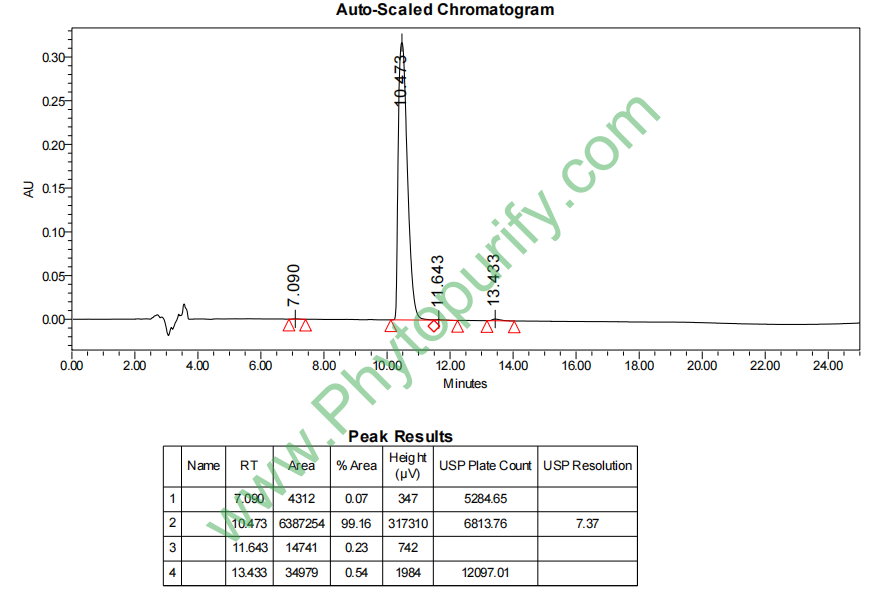
HPLC of Hypaconitine
Storage conditions:Short-term storage at 2~8℃, long-term storage at -20 ~ -80℃
133.2200
2.2792
2.1706
.1061
.9171
5.0569
Low
70.3322
7.1659
No
No
Yes
No
No
No
0.6
Yes
No
Yes
Yes
Hypaconitine is a typical aconitine alkaloid, mainly found in plants of the Aconitum genus, especially Aconitum carmichaelii. As one of the main active ingredients of traditional Chinese medicine Fuzi, aconitine has received widespread attention in the field of natural product pharmacology in recent years due to its significant biological activity and complex pharmacological mechanism of action. Aconitine not only exhibits strong neuromuscular blocking effects, but also has the ability to inhibit tumor cell epithelial mesenchymal transition (EMT) and regulate various ion channels, especially the significant inhibition of cardiac potassium channel KCNH2 (hERG) current, indicating its potential risk of cardiac toxicity. In addition, the activity of aconitine on analgesic related targets also provides new possibilities for its clinical application. This article provides a systematic review of the chemical structure and physicochemical properties, plant sources and extraction methods, pharmacological activity and mechanism of action, pharmacological evaluation, pharmacokinetic characteristics, and clinical application prospects of aconitine. The aim is to provide a theoretical basis and reference for subsequent drug development and clinical research.
The molecular formula of aconitine is C34H47NO11, with a molecular weight of 615.72 and a CAS number of 6900-87-4. Its molecular structure belongs to the typical dihydroaconitine class, containing a complex polycyclic skeleton and multiple ester groups. The structure contains multiple chiral centers, giving it a high degree of stereochemical complexity. The LogP value of aconitine is 2.2792, indicating moderate lipid solubility and facilitating membrane penetration; The TPSA (topological polar surface area) is 133.22 Å ², indicating its high polarity, which may affect its oral absorption and blood-brain barrier penetration ability. The low water solubility (0.1061 mg/mL) to some extent limits its solubility and bioavailability in aqueous systems. The low permeability of the blood-brain barrier suggests its limited distribution in the central nervous system, which may reduce central nervous system toxicity and side effects. It is worth noting that although aconitine exhibits inhibitory activity on hERG channels, the pharmacological parameters indicate that its hERG inhibition is "no", which may be related to experimental conditions or dosage and requires further in-depth research. The Ames mutagenicity test result is 0.6, indicating a low risk of genetic toxicity.
Aconitum carmichaelii Debx. is mainly derived from the roots of Aconitum carmichaelii Debx. plants. Fuzi, as a traditional Chinese medicinal herb, is widely used in the treatment of diseases such as rheumatism, cold dampness, and rheumatism. The content of aconitine in Aconitum is relatively high, and it is one of its main bioactive components.
The methods for extracting aconitine mainly include solvent extraction, column chromatography separation, and high-performance liquid chromatography (HPLC) purification. Generally, ethanol or methanol is used as the extraction solvent to obtain crude extract through reflux extraction, followed by separation and purification using acid-base separation, silica gel column chromatography, or C18 reverse phase column chromatography. In recent years, the application of ultrasound assisted extraction and microwave-assisted extraction techniques has improved the extraction efficiency and purity of aconitine. During the extraction process, it is necessary to strictly control the temperature and pH value to prevent hydrolysis and structural damage of aconitine.
As a neuromuscular blocking agent, aconitine can inhibit the transmission of nerve impulses and exert muscle relaxation effects by regulating ion channels at the neuromuscular junction. Its mechanism of action involves the regulation of sodium channels, blocking the transmission of neural excitation, and exhibiting a strong muscle relaxation effect. This characteristic makes aconitine potentially valuable in anesthesia and muscle spasm related diseases.
Aconitine exhibits a strong inhibitory effect on the potassium channel KCNH2 (hERG) current in the heart, with an IC50 of 8.1 nM. The hERG channel plays a critical role in the repolarization process of cardiac action potentials, and its inhibition can lead to prolonged repolarization and induce arrhythmias such as torsades de Pointes, indicating the potential risk of cardiac toxicity associated with Aconitine. Therefore, in its pharmacological activity research and clinical application, cardiac safety assessment is particularly important.
Aconitine effectively blocks epithelial mesenchymal transition (EMT) induced by transforming growth factor beta 1 (TGF - β 1) in human lung adenocarcinoma A549 cells by inhibiting nuclear translocation of nuclear factor kappa B (NF - κ B). EMT is a key process for tumor cell invasion and metastasis, and the mechanism of action of aconitine provides a theoretical basis for its anti-tumor potential. In addition, aconitine exhibits anti proliferative and pro apoptotic effects in various tumor cell lines, demonstrating a wide range of anticancer activities.
Studies on the analgesic effects of aconitine have shown that its action involves multiple targets, including TRPV1 (transient receptor potential vanillic acid subtype 1), CNR1 (cannabinoid receptor 1), OPRD1 (delta opioid receptor), PTGS1 and PTGS2 (cyclooxygenase 1 and 2), TRPA1 (transient receptor potential vanillic acid subtype A1), SLC6A4 (serotonin transporter), OPRM1 (μ - opioid receptor), OPRK1 (κ - opioid receptor), and DRD2 (dopamine D2 receptor). Through multi-target synergistic regulation, aconitine can effectively alleviate inflammation and neuropathic pain, demonstrating good analgesic potential.
The pharmacological mechanism of aconitine is complex, involving multiple molecular targets and signaling pathways:
KCNH2 (hERG) channel inhibition Aconitum alkaloids bind to hERG channels with high affinity, inhibiting their current and affecting cardiac action potential repolarization, leading to cardiac toxicity.
Inhibition of NF - κ B signaling pathway Aconitine blocks the translocation of NF - κ B from the cytoplasm to the nucleus, inhibits the EMT process induced by TGF - β 1, and prevents the migration and invasion of tumor cells.
Mechanism of neuromuscular blockade By regulating sodium and possibly potassium channels, inhibiting nerve impulse transmission, and exerting muscle relaxation effects.
Multi target analgesia mechanism Aconitine regulates TRPV1 and TRPA1 plasma channels and inhibits the release of inflammatory mediators; Regulating central and peripheral pain transmission by activating or inhibiting opioid receptors (OPRM1, OPRD1, OPRK1) and cannabinoid receptors (CNR1); Regulating the neurotransmitter system involving serotonin transporter protein (SLC6A4) and dopamine D2 receptor (DRD2) to enhance analgesic effects.
The synergistic effect of these multiple targets enables aconitine to exhibit unique pharmacological activities in pain relief, anti-tumor, and neuromuscular blockade.
The pharmacological evaluation of aconitine shows that it has certain advantages and challenges:
Molecular weight and physicochemical properties The molecular weight is 615.72, slightly higher than the ideal drug range, but moderate LogP (2.2792) and high TPSA (133.22) indicate a certain balance between cell membrane penetration and polarity.
Water solubility Low water solubility (0.1061 mg/mL) may limit oral absorption and bioavailability, and solubility needs to be improved through formulation optimization.
Blood-brain barrier permeability Low permeability reduces the risk of central nervous system toxicity, but may limit its effect on central targets.
Cardiac safety Although strong inhibition of hERG channels was observed in vitro, hERG inhibition was "no" in the pharmacological parameters, indicating the need for further in vivo safety evaluation, especially cardiac toxicity monitoring.
Genotoxicity The Ames test result is 0.6, indicating that the genetic toxicity risk of aconitine is low and meets safety requirements.
In terms of pharmacokinetics, aconitine has oral activity, indicating that it can be effectively absorbed in the gastrointestinal tract. However, the specific bioavailability, half-life, metabolic pathways, and excretion characteristics still need to be systematically studied. Preliminary data suggests that it may be metabolized through the liver, involving the CYP450 enzyme system, and the activity and toxicity of metabolites need further clarification.
Aconitum alkaloids have shown broad prospects in clinical applications due to their multi-target and multi mechanism pharmacological activities
Development of analgesic drugs Aconitine provides a new analgesic strategy for chronic pain, neuropathic pain, and inflammatory pain by regulating multiple pain related targets. Its oral activity and multi-target action advantages have the potential to be developed into a new type of analgesic drug, especially suitable for complex pain management.
Antitumor therapy By inhibiting EMT and tumor cell migration, aconitine has anti metastatic potential. In the future, it can be combined with existing chemotherapy drugs to enhance anti-tumor effects, reduce tumor recurrence and metastasis.
Neuromuscular Blockers In anesthesia and muscle spasm treatment, the neuromuscular blocking effect of aconitine can provide a new option for clinical practice, especially in scenarios that require short-term muscle relaxation.
Security challenges Cardiotoxicity is the main obstacle to the clinical application of aconitine. In the future, it is necessary to reduce the risk of adverse cardiac reactions and improve safety through structural modification, dosage form improvement, and combination therapy strategies.
Pharmacokinetic optimization In response to its low water solubility and poor blood-brain barrier permeability, the development of modern drug delivery systems such as nanomaterials and liposome carriers will help improve its bioavailability and targeting.
In summary, as a natural product with multiple pharmacological activities, aconitine has great potential for development, but its cardiac toxicity and pharmacokinetic properties still need further research and optimization.
As an important member of the aconitine class of natural products, aconitine has become an important object of study in natural product pharmacology due to its complex chemical structure and diverse pharmacological effects. It exhibits significant biological activity in the fields of neuromuscular blockade, analgesia, and anti-tumor, revealing rich mechanisms of action and multi-target regulatory networks. However, challenges in terms of cardiac toxicity and drug development have limited its widespread clinical application. In the future, by combining modern medicinal chemistry, pharmacology, and formulation methods, the structure and administration mode of aconitine will be optimized, and its safety and pharmacokinetic characteristics will be thoroughly elucidated, laying a solid foundation for its transformation into clinical drugs. We look forward to the greater role of aconitine in the development of natural product drugs, promoting the modernization of traditional Chinese medicine and providing more innovative choices for clinical treatment.
