| Catalog No | Package | Original Price | Price | Inventory | Quantity | Operating |
|---|---|---|---|---|---|---|
| BP1864-5mg | 5mg | $250.00 | Sign in |
|


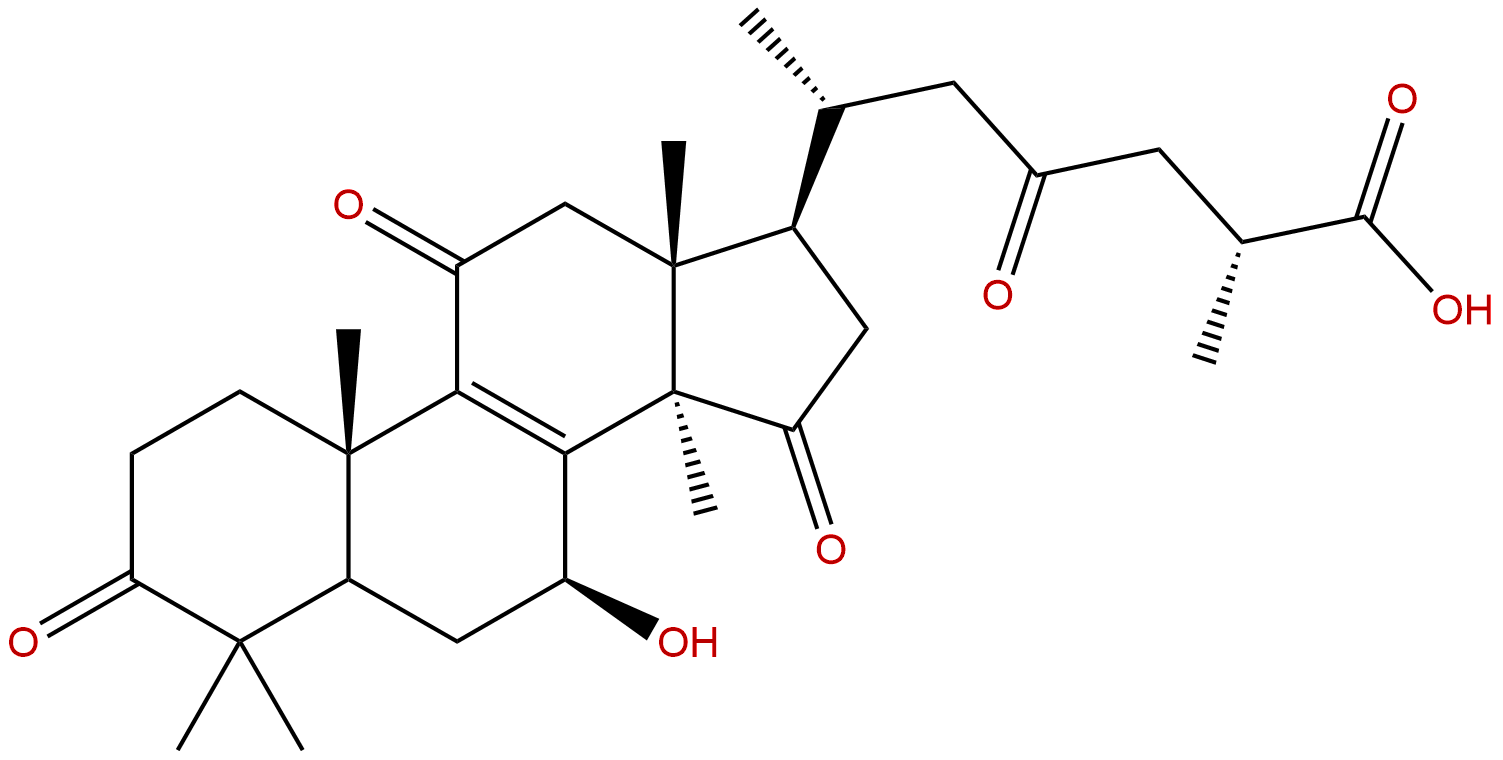
Product Name: Ganoderic acid C1
Synonym name:
Catalogue No.: BP1864
Cas No.: 95311-97-0
Formula: C30H42O7
Mol Weight: 514.659
Botanical Source: Ganoderma lucidum
Purity: 95%~99%
Analysis Method: HPLC-DAD or/and HPLC-ELSD
Identification Method: Mass, NMR
Packing: Brown vial or HDPE plastic bottle
Can be supplied from milligrams to grams.
For Reference Standard and R&D, Not for Human Use Directly.
Inquire for bulk scale.
Storage conditions:Short-term storage at 2~8℃, long-term storage at -20 ~ -80℃
125.8100
2.9865
.6236
.0137
2.3239
5.2970
Low
85.7729
5.1214
No
No
No
No
No
No
0.0
No
No
No
No
Ganoderma lucidum(Ganoderma lucidum)Also known as Ruizhi or Chizhi, as the "upper medicine" in traditional Chinese medicine, it has a history of more than two thousand years of application. Its medicinal value is recorded in the "Shennong Bencao Jing" as "eating for a long time makes the body light and not old, prolonging the life of immortals". Modern pharmacological research has confirmed that Ganoderma lucidum contains various bioactive components, including polysaccharides, triterpenoids, nucleotides, sterols, etc. Among them, triterpenoids are considered the core material basis for Ganoderma lucidum to exert pharmacological effects such as anti-tumor, anti-inflammatory, and immune regulation.
Ganoderma acids are the most important class of triterpenoids in Ganoderma lucidum, and over 130 Ganoderma acid compounds have been isolated and identified. Ganoderic acid C1 (GA-C1), as a representative member, was first isolated from Ganoderma lucidum fruiting bodies in 1988. Its chemical structure is a tetracyclic triterpenoid compound with a lanostane skeleton, with a molecular formula of C ∝₀ H ₄₂ O ₇ and a molecular weight of 514.6590.
In recent years, with the continuous deepening of research on ganoderic acid C1, its anti-tumor activity, especially its inhibitory effect on prostate cancer, has attracted widespread attention. Research has shown that GA-C1 can inhibit tumor cell proliferation, induce apoptosis, inhibit metastasis, and exhibit good anti-inflammatory activity by regulating multiple key signaling molecules such as BCL2, STAT3, and MMP2. In addition, its pharmacological parameters such as LogP of 2.9865, TPSA of 125.8100, low water solubility but low blood-brain barrier permeability, no risk of hERG inhibition, and negative Ames test provide important basis for its development as a candidate drug.
This article will systematically review the research progress of Ganoderma lucidum acid C1 from the aspects of chemical structure and physicochemical properties, plant sources and extraction methods, pharmacological activity research, mechanism of action and molecular targets, drug evaluation and pharmacokinetics, clinical application prospects and prospects, in order to provide reference for the in-depth research and development of this natural product.
Lingzhi acid C1 belongs to the tetracyclic triterpenoid class, and its basic skeleton is lanostane type structure. This structure consists of four rings: A, B, C, and D. Ring A is a six membered ring, ring B is a six membered ring, ring C is a six membered ring, and ring D is a five membered ring. There is a side chain connected at position C-17, which contains functional groups such as carboxyl and hydroxyl.
The chemical structure of GA-C1 contains multiple active functional groups: C-3 is a β - hydroxyl group, C-7 is a carbonyl group, C-11 is a β - hydroxyl group, C-15 is an α - hydroxyl group, and C-23 is a carboxyl group. The presence of these functional groups endows GA-C1 with unique chemical and biological activities. Especially the carboxyl group at position C-23, it has weak acidity and can interact with various biomolecules.
According to the results of computational chemistry and experimental measurements, the main physicochemical properties of Ganoderma lucidum acid C1 are as follows:
These physicochemical parameters indicate that GA-C1 has good lipid solubility, which is beneficial for interacting with targets in the cell membrane and lipid environment. However, its extremely low water solubility and high TPSA value suggest the need for appropriate formulation techniques (such as nanoemulsions, liposomes, cyclodextrin inclusion complexes, etc.) in drug development to improve its solubility and bioavailability.
Lingzhi acid C1 mainly comes from fungi of the Ganoderma genus in the Polyporus family, including Ganoderma lucidum(Ganoderma lucidum)And Zizhi(Ganoderma sinense)Wait. The content of GA-C1 in Ganoderma lucidum from different sources varies greatly, with higher levels in fruiting bodies than in mycelium and spore powder. Research has shown that the content of GA-C1 in wild Ganoderma lucidum is usually higher than that in artificially cultivated varieties, which may be related to factors such as growth environment, substrate composition, and harvesting time.
The content of ganoderic acid C1 in Ganoderma lucidum is influenced by various factors, such as strain type, culture conditions, harvesting period, drying method, etc. Generally speaking, Ganoderma lucidum fruiting bodies are harvested at maturity (when the edge of the cap begins to turn red) and have a higher GA-C1 content. In addition, Ganoderma lucidum cultivated with segmented wood contains more abundant triterpenoids than those cultivated with substitute materials.
The extraction methods of Ganoderma lucidum acid C1 mainly include traditional solvent extraction, ultrasound assisted extraction, microwave-assisted extraction, supercritical fluid extraction, etc.
Traditional solvent extraction method It is the most commonly used method. Due to the weak acidity of GA-C1, ethanol or methanol is usually used as the extraction solvent, and sometimes a small amount of acid (such as hydrochloric acid) is added to improve the extraction efficiency. The typical extraction process is to crush the dried Ganoderma lucidum fruiting body to 40-60 mesh, reflux extract 2-3 times with 80% ethanol at 60-70 ℃ for 2-3 hours each time, combine the extracts, and concentrate under reduced pressure to obtain the extract.
Ultrasonic assisted extraction method By utilizing the cavitation and mechanical effects of ultrasound, extraction efficiency can be significantly improved and extraction time can be shortened. Research has shown that under the conditions of ultrasound power of 300W, temperature of 50 ℃, and time of 30 minutes, the extraction rate of GA-C1 can be increased by 30% -50% compared to traditional reflux extraction.
Microwave assisted extraction method By utilizing the penetrability and selective heating properties of microwaves, the cell wall structure can be rapidly disrupted, promoting the release of target compounds. This method has the advantages of short extraction time, low solvent dosage, and high extraction rate.
Supercritical fluid extraction method Using CO ₂ as the extraction medium, the solubility can be changed by adjusting the pressure and temperature. This method has the advantages of high selectivity, no solvent residue, and environmental friendliness, but the equipment cost is high and not suitable for large-scale production.
The crude extract after extraction needs to be separated and purified by chromatography technology. Common methods include silica gel column chromatography, ODS reverse phase column chromatography, and preparative high-performance liquid chromatography (pre HPLC). The typical separation process is as follows: the crude extract is subjected to silica gel column chromatography, followed by chloroform methanol gradient elution, and the fraction containing GA-C1 is collected; Further elute with methanol water (70:30) using ODS column chromatography; Finally, GA-C1 pure product with a purity greater than 98% was obtained through preparative HPLC purification.
The inhibitory effect of GA-C1 on prostate cancer cells is one of its most studied pharmacological activities. Research has shown that GA-C1 can significantly inhibit the proliferation of androgen dependent (LNCaP) and androgen independent (PC-3, DU145) prostate cancer cells, with IC ₅₀ values ranging from 10-30 μ M. It is worth noting that GA-C1 has low toxicity to normal prostate epithelial cells (RWPE-1) and exhibits certain selectivity.
In terms of inducing apoptosis, GA-C1 treatment can lead to typical morphological changes in prostate cancer cells, including cell shrinkage, chromatin condensation, DNA fragmentation, etc. Flow cytometry analysis showed that GA-C1 can increase the proportion of Annexin V positive cells in a dose-dependent manner and activate caspase-3 and caspase-9, indicating that it induces apoptosis through the mitochondrial pathway.
In addition, GA-C1 can also inhibit the migration and invasion ability of prostate cancer cells. Transwell and scratch experiments showed that GA-C1 treatment significantly reduced the number of migrating and invading cells. Gelatinase spectrum analysis showed that GA-C1 can inhibit the activity of MMP-2 and MMP-9, which is closely related to its anti metastatic effect.
Besides prostate cancer, GA-C1 also exhibits inhibitory effects on various other tumor cells. Research shows that GA-C1 can inhibit the proliferation of breast cancer (MCF-7, MDA-MB-231), lung cancer (A549), liver cancer (HepG2), colon cancer (HT-29) and other cells, and the IC ₀ value is within the range of 15-40 μ M. There are differences in the sensitivity of different tumor cells to GA-C1, which may be related to cell type, gene expression profile, and signaling pathway status.
The anti-inflammatory activity of GA-C1 was first discovered during its isolation and identification. Research has shown that GA-C1 can significantly inhibit the production of TNF - α by mouse macrophages RAW264.7 stimulated by lipopolysaccharide (LPS), with an IC ₅₀ of approximately 5 μ M. Further mechanistic studies have found that GA-C1 reduces the expression of pro-inflammatory factors such as TNF - α, IL-6, and IL-1 β by inhibiting the activation of the NF - κ B signaling pathway.
In addition, GA-C1 can inhibit the expression of cyclooxygenase-2 (COX-2) and inducible nitric oxide synthase (iNOS), reduce the production of prostaglandin E ₂ (PGE ₂) and nitric oxide (NO). These anti-inflammatory activities may be closely related to their anti-tumor effects, as chronic inflammation is considered an important promoting factor in the occurrence and development of various tumors.
GA-C1 has a bidirectional regulatory effect on the immune system. At low concentrations (1-5 μ M), GA-C1 can enhance the phagocytic activity of macrophages and the killing activity of natural killer (NK) cells, promote T lymphocyte proliferation and cytokine secretion. However, at high concentrations (>20 μ M), GA-C1 exhibits immunosuppressive effects, which may be related to its induction of immune cell apoptosis.
Preliminary studies have shown that GA-C1 also has pharmacological activities such as antioxidant, antiviral, and hepatoprotective effects. GA-C1 can clear free radicals, inhibit lipid peroxidation, and protect liver cells from oxidative damage. In addition, GA-C1 has a certain inhibitory effect on the replication of hepatitis B virus (HBV), but its antiviral mechanism is not yet clear.
Based on existing research, the role of GA-C1 in prostate cancer involves multiple molecular targets and signaling pathways, mainly including:
BCL2 (B-cell lymphoma 2)BCL2 is a key protein that regulates the mitochondrial apoptosis pathway. GA-C1 treatment can downregulate the expression of anti apoptotic protein BCL2 in prostate cancer cells, while upregulating the expression of pro apoptotic protein BAX, resulting in an increase in the BAX/BCL2 ratio, promoting cytochrome c release and caspase cascade activation.
STAT3 (Signal Transduction and Transcription Activating Factor 3)STAT3 is a core transcription factor in the JAK/STAT signaling pathway and is often in a continuously activated state in prostate cancer. GA-C1 can inhibit the phosphorylation of STAT3 (Tyr705 site), block its nuclear translocation and transcriptional activity, thereby downregulating the expression of its target genes (such as Cyclin D1, Survivor, VEGF, etc.).
MMP2 (Matrix Metalloproteinase 2)MMP2 is a key enzyme that degrades the extracellular matrix and is closely related to tumor invasion and metastasis. GA-C1 suppresses the migration and invasion of prostate cancer cells by inhibiting the MAPK/ERK signaling pathway, reducing the expression and activity of MMP2.
ESR2 (estrogen receptor beta)ESR2 has anti-cancer effects in prostate cancer. Research has shown that GA-C1 can upregulate the expression of ESR2, activate its downstream signaling pathways, inhibit cell proliferation, and induce differentiation.
ABCB1 (P-glycoprotein)ABCB1 is a multidrug resistance related protein, and its overexpression is an important cause of chemotherapy resistance. GA-C1 can inhibit the expression and function of ABCB1, increase the accumulation of chemotherapy drugs in cells, and reverse drug resistance.
PRKCA (protein kinase C alpha)PRKCA is involved in regulating cell proliferation, differentiation, and apoptosis. GA-C1 can inhibit the activity of PRKCA, block its downstream signaling, and thus inhibit tumor cell growth.
NFE2L2 (Nuclear Factor E2 Related Factor 2)NFE2L2 is a key transcription factor in antioxidant stress response. GA-C1 can activate the NFE2L2/ARE signaling pathway, induce the expression of antioxidant enzymes such as HO-1 and NQO1, and protect normal cells from oxidative damage.
CASP1(caspase-1)CASP1 is a key effector molecule for inflammasome activation and is involved in cell pyroptosis. Research has shown that GA-C1 can activate CASP1 and induce pyroptosis in prostate cancer cells, which is a programmed cell death mode different from apoptosis.
The effect of GA-C1 on prostate cancer cells is not achieved through a single target, but through the regulation of a cross network of multiple signaling pathways to exert a comprehensive effect. The main pathways involved include:
The multi-target mode of action of GA-C1 is an important feature that distinguishes it from traditional single target chemotherapy drugs. This mode of action has the following advantages: firstly, it can simultaneously inhibit multiple survival and proliferation signaling pathways of tumor cells, improving anti-tumor efficacy; Secondly, reduce the risk of drug resistance caused by single target mutations; Thirdly, it has relatively low toxicity to normal cells and good safety.
Based on computational chemistry and experimental data, a systematic evaluation of the pharmacological properties of GA-C1 is conducted
Lipinski's Five Rules The molecular weight of GA-C1 is 514.66 Da (>500), the LogP is 2.9865 (<5), the number of hydrogen bond donors is 4 (<5), and the number of hydrogen bond acceptors is 7 (>10). This compound violates the two conditions of molecular weight and hydrogen bond receptor number in Lipinski's rule, suggesting that its oral bioavailability may be low.
Veber rules The TPSA of GA-C1 is 125.81 Å ² (>140 Å ²) and the number of rotatable bonds is 4 (<10), which meets the requirements of the Veber rule for rotatable bonds. However, the TPSA is relatively high and may affect oral absorption.
Water solubility GA-C1 has extremely low water solubility (0.0137 mg/mL) and belongs to Class IV drugs in the BCS classification (low solubility, low permeability), which poses a significant challenge for its oral administration.
safety evaluation The low blood-brain barrier permeability of GA-C1 suggests a lower risk of central nervous system side effects. A negative hERG inhibition test indicates a low risk of cardiac toxicity. Ames test negative, no mutagenicity. These security parameters provide favorable conditions for the further development of GA-C1.
At present, there is limited in vivo research data on the pharmacokinetics of GA-C1, but based on its physicochemical properties and preliminary research results, the following characteristics can be inferred:
absorb Due to poor water solubility and high molecular weight, the oral absorption of GA-C1 may be poor. Research has shown that after oral administration, the blood concentration of triterpenoids in Ganoderma lucidum is usually low, and their bioavailability is less than 5%. The use of liposome, nanoemulsion, phospholipid complex and other formulation technologies can significantly improve its oral absorption.
distribution The LogP of GA-C1 is 2.9865, indicating that it has a certain degree of lipophilicity and can bind to plasma proteins (especially albumin), distributed to organs with abundant blood flow such as the liver, kidneys, and lungs. Due to the low permeability of the blood-brain barrier, the distribution of GA-C1 in the central nervous system is limited.
Metabolism GA-C1 is mainly metabolized by the liver and may involve oxidation reactions mediated by the CYP450 enzyme system (especially CYP3A4) and binding reactions mediated by glucuronosyltransferase. Metabolites may be excreted into the intestine through bile and partially reabsorbed through the enterohepatic circulation.
excretion GA-C1 and its metabolites are mainly excreted through bile and feces, with a small amount excreted through urine. Its half-life may be relatively long, which is consistent with the typical pharmacokinetic characteristics of triterpenoids.
The following formulation strategies can be adopted to improve the shortcomings of GA-C1 drug properties:
Prostate cancer is one of the most common malignant tumors in men, with over 1.4 million new cases worldwide each year. At present, the treatment methods for prostate cancer include surgical resection, radiation therapy, endocrine therapy, and chemotherapy, but the treatment effect for advanced and castration resistant prostate cancer (CRPC) is still not ideal, and new treatment strategies are urgently needed.
The multi-target effect of GA-C1 on prostate cancer endows it with unique therapeutic potential. Firstly, GA-C1 can simultaneously inhibit the growth of androgen dependent and non androgen dependent prostate cancer cells, which is particularly important for the treatment of CRPC. Secondly, GA-C1 can reverse multidrug resistance and enhance the sensitivity of chemotherapy drugs, and is expected to be used in combination with existing chemotherapy drugs such as docetaxel and cabataside. Thirdly, the anti-inflammatory and immunomodulatory activities of GA-C1 may help improve the tumor microenvironment and enhance the anti-tumor immune response.
Based on the mechanism of action of GA-C1, the following combination therapy regimens are worth exploring:
Although GA-C1 has shown great potential in the treatment of prostate cancer, there are still many challenges from laboratory research to clinical application:
The issue of bioavailability The low oral bioavailability of GA-C1 is the main obstacle to its clinical application. Efficient formulation techniques or delivery routes (such as nano formulations, transdermal administration, etc.) need to be developed to improve its pharmacokinetic characteristics.
In vivo efficacy verification At present, the anti-tumor activity of GA-C1 is mainly based on in vitro cell experiments, and more in vivo animal model studies are needed to verify its efficacy and safety. Especially, it is necessary to establish prostate cancer xenograft models and transgenic mouse models, and systematically evaluate the in vivo anti-tumor activity of GA-C1.
Toxicity evaluation Although GA-C1 has low toxicity to normal cells at the cellular level, comprehensive toxicological studies are still needed, including acute toxicity, chronic toxicity, reproductive toxicity, etc., to evaluate its safety.
structural optimization Based on the chemical structure of GA-C1, its solubility and activity can be improved through structural modifications (such as introducing hydrophilic groups, changing functional group positions, etc.), and derivatives with better drug properties can be developed.
preclinical research Before entering clinical trials, comprehensive preclinical studies such as pharmacodynamics, pharmacokinetics, toxicology, etc. need to be completed, and a quality control and standardization system should be established.
Lingzhi acid C1, as an important member of Ganoderma triterpenoids, has shown broad application prospects in the field of anti prostate cancer research due to its unique chemical structure and multi-target pharmacological activity. This article systematically reviews the research progress on the chemical structure and physicochemical properties, plant sources and extraction methods, pharmacological activity, mechanism of action, and drug evaluation of GA-C1. It reveals its mechanism of inhibiting prostate cancer cell proliferation, inducing apoptosis, and inhibiting metastasis by regulating multiple molecular targets such as BCL2, STAT3, MMP2, ESR2, ABCB1, PRKCA, NFE2L2, and CASP1.
The pharmacological parameters of GA-C1 show that it has good safety characteristics (low blood-brain barrier permeability, no risk of hERG inhibition, no mutagenicity), but poor water solubility and low oral bioavailability are the main obstacles to its clinical translation. Future research should focus on developing efficient formulation technologies, conducting systematic in vivo pharmacological and toxicological studies, optimizing structures, and designing derivatives to promote the conversion of GA-C1 from natural products to candidate drugs.
With the continuous deepening of research on GA-C1, especially the comprehensive elucidation of its mechanism of action and breakthroughs in formulation technology, this natural compound is expected to provide new treatment options for prostate cancer patients, and also provide an important example for discovering innovative drugs from traditional Chinese medicine.
Batch can search by a CAS number,one per line
