


Synonym name:
Catalogue No.: BP0626
Cas No.: 33390-42-0
Formula: C23H24O6
Mol Weight: 396.439
Botanical Source: the fruits of Garcinia mangostana (mangosteen)
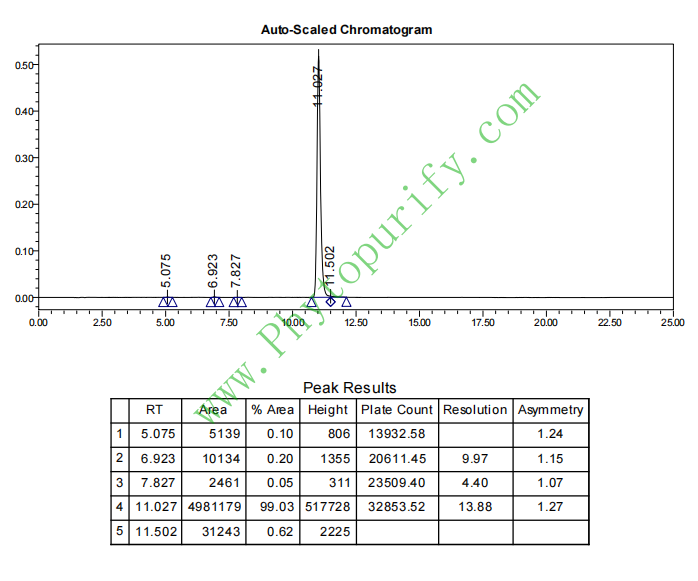
Purity: 95%~99%
Analysis Method: HPLC-DAD or/and HPLC-ELSD
Identification Method: Mass, NMR
Packing: Brown vial or HDPE plastic bottle
Can be supplied from milligrams to grams.
For Reference Standard and R&D, Not for Human Use Directly.
Inquire for bulk scale.
HPLC of Gartanin
Storage conditions:Short-term storage at 2~8℃, long-term storage at -20 ~ -80℃
111.1300
4.6043
4.5362
.0441
3.4154
4.7101
Low
90.7312
3.2270
Yes
No
Yes
No
Yes
Yes
0.6
Yes
Yes
Yes
No
Natural products have always been an important treasure trove for innovative drug discovery, among which flavonoids have attracted much attention due to their wide range of biological activities. Gartanin (CAS number: 33390-42-0) is a natural anthraquinone flavonoid compound derived from the skin of the tropical fruit Garcinia mangostana L. In recent years, with the modern scientific interpretation of the traditional medicinal value of mangosteen, Gartanin has gradually emerged from numerous active ingredients and become a new star in pharmacological research. Early research revealed its fundamental antioxidant and anti-inflammatory properties, while deeper exploration revealed its significant potential in multiple fields such as anti-tumor, neuroprotective, and antifungal effects. Especially in the field of tumor research, Gartanin has shown multiple effects such as inducing cell cycle arrest, promoting autophagy, inhibiting migration and invasion in various cancer cell lines such as glioma and colon cancer, suggesting that it may become a candidate molecule for multi-target and multi-path intervention in anti-cancer. This article aims to systematically review the chemical properties, plant sources, pharmacological activities, molecular mechanisms of action, pharmacological evaluation, and clinical application prospects of Gartanin, in order to provide comprehensive academic references for the in-depth development and transformation research of this natural product.
The chemical name of Gartanin is 1,3,6,7-tetrahydroxy-2,8-di (3-methylbut-2-enyl) -9H-hexane-9-one, with a molecular formula of C23H24O6 and a molecular weight of 396.4390. Its core structure is anthraquinone, which is a tricyclic system composed of three fused benzene rings, one of which is a pyranone ring. Gartanin is substituted with hydroxyl groups at positions 1, 3, 6, and 7 of the mother nucleus, endowing it with strong hydrogen bond donor ability and potential antioxidant activity; And at positions 2 and 8, an isoprene group (3-methylbut-2-enyl) is connected, which significantly increases the hydrophobicity of the molecule.
These structural features directly determine their physicochemical properties. The calculated lipid water partition coefficient (LogP) is 4.6043, indicating that Gartanin has high lipophilicity. The topological polar surface area (TPSA) is 111.13 Å ², reflecting the proportion of polar hydroxyl groups in its molecule. Its water solubility is relatively low, about 0.0441 mg/mL, mainly due to the hydrophobic isoprene groups and rigid aromatic planar structure. A higher LogP value and lower water solubility mean that the dissolution, absorption, and distribution of Gartanin in living organisms may face challenges, often requiring the use of formulation technologies such as nanodelivery systems, solid dispersions, etc. to improve its bioavailability. Its molecular weight is less than 500, which meets the basic requirements of the five rules for generic drugs, but strong hydrophobicity is a key parameter that needs to be optimized.
Gartanin is mainly derived from the skin (outer skin) of the Caryophylla plant in the genus Caryophyllaceae. Mangkhut peel has long been used in traditional Southeast Asian medicine to treat abdominal pain, diarrhea, infections, wound healing, etc. Modern research has confirmed that it is rich in various bioactive oxygen species such as anthraquinone, with the highest content of α - hesperetin, and Gartanin being one of its important homologs.
The extraction of Gartanin from mangosteen peel usually follows the conventional process of natural product separation. Firstly, organic solvents (such as methanol, ethanol, ethyl acetate, or mixed solvents of different proportions) are used to extract or ultrasound assisted extraction of dried and crushed fruit peels, in order to maximize the extraction of anthraquinone components from the crude extract. Subsequently, purification was carried out through a series of chromatographic separation technologies, such as silica gel column chromatography, Sephadex LH-20 column chromatography and high performance liquid chromatography (HPLC) preparation. The optimization of extraction process focuses on solvent type, concentration, temperature, time, and solid-liquid ratio, aiming to improve the yield and purity of Gartanin. In recent years, some green extraction techniques such as supercritical fluid extraction (SFE) have also been applied to reduce the use of organic solvents and improve selectivity. It should be noted that the content of Gartanin in plants is affected by the place of origin, harvest season, and storage conditions. Standardized planting and extraction processes are key to ensuring its controllable quality as an active pharmaceutical ingredient.
A large number of in vitro and partially in vivo studies have revealed the extensive and significant pharmacological activities of Gartanin.
Antitumor activity This is the most in-depth area of research for Gartanin. It exhibits strong proliferation inhibition and pro apoptotic effects in various human cancer cell lines.
Neuroprotective activity The antioxidant and anti-inflammatory properties of Gartanin make it promising in neurodegenerative disease models. Research has shown that it can alleviate oxidative stress-induced neuronal damage and inhibit neuroinflammation mediated by excessive activation of microglia, suggesting its potential value in interventions for diseases such as Alzheimer's and Parkinson's disease.
Anti inflammatory and antioxidant activity As a polyhydroxyanthraquinone, Gartanin can directly scavenge free radicals (such as DPPH and ABTS) and upregulate the intracellular antioxidant defense system (such as the Nrf2/ARE pathway). In various inflammatory cell models, such as macrophages, it can effectively inhibit the production of nitric oxide (NO), prostaglandin E2 (PGE2), and pro-inflammatory cytokines (such as TNF - α, IL-6) induced by lipopolysaccharides (LPS).
Antifungal and antibacterial activity Gartanin has a certain inhibitory effect on various pathogenic fungi (such as Candida albicans) and bacteria, and its mechanism may be related to the destruction of microbial cell membrane integrity or interference with their metabolism.
Other activities Preliminary studies also suggest that Gartanin may have metabolic regulatory activities such as anti obesity and improving insulin resistance.
The anti-cancer effect of Gartanin, especially in colon cancer, involves a complex multi-target and multi pathway network, which is consistent with the characteristics of its natural product "multi-target". Based on the provided target information, its mechanism of action can be summarized as follows:
Inducing apoptosis and regulating Bcl-2 family proteins Gartanin can downregulate the expression of anti apoptotic proteins Bcl-2 and Mcl-1, and may also affect pro apoptotic proteins, thereby disrupting mitochondrial membrane potential, promoting cytochrome C release, activating caspase cascade reactions, and ultimately leading to cell apoptosis.
Inhibition of survival and inflammatory signaling pathways:
Regulating energy metabolism and autophagy By activating AMPK (PRKAA1) - the energy receptor of cells, Gartanin can inhibit the mTOR signaling pathway, inducing protective autophagy and exerting anticancer effects in metabolic reprogramming.
Affects drug efflux and resistance The potential regulatory effect of Gartanin on ABCB1 (P-glycoprotein, an important multidrug resistance protein) suggests its potential as a chemotherapy sensitizer to reverse multidrug resistance in tumors.
Interference with other key targets:
In summary, Gartanin synergistically acts on multiple targets and pathways mentioned above, forming a networked pharmacological effect that collectively leads to tumor cell cycle arrest, autophagy activation, apoptosis induction, and decreased migration and invasion ability.
Despite the significant pharmacological activity of Gartanin, its drug likeness still faces challenges and requires systematic evaluation and optimization.
Physicochemical and ADME properties:
Preliminary Safety Assessment:
Current Status of Pharmacokinetic (PK) Research The publicly available pharmacokinetic research data on the Gartanin system is relatively limited. Existing research has mostly focused on its overall behavior in mangosteen extracts. The absolute bioavailability, half-life (t1/2), apparent volume of distribution (Vd), clearance rate (CL) and other key PK parameters of single Gartanin in animals urgently need to be clarified. Its oral bioavailability is expected to be lower due to first pass effects and low solubility.
The diverse pharmacological effects of Gartanin have brought potential application prospects in multiple therapeutic fields, but there are still many obstacles to overcome on the road to transformation.
Potential application directions:
Challenges faced and future research directions:
As an important oxanthrone compound in mangosteen, Gartanin has demonstrated remarkable pharmacological potential in anti-tumor (especially colon cancer), neuroprotective, anti-inflammatory and other fields due to its unique chemical structure and multi-target mechanism of action. It synergistically induces cancer cell death and inhibits its malignant behavior by regulating multiple key signaling nodes such as AMPK, STAT3, NF - κ B, Bcl-2 family, etc. However, its inherent low water solubility and incompletely elucidated pharmacokinetic properties are currently the main bottlenecks facing drug conversion. Future research should focus on optimizing its physicochemical properties through medicinal chemistry and pharmacy methods, using advanced disease models to deeply validate its in vivo efficacy, and systematically evaluating its safety. With the advancement of these studies, Gartanin is expected to gradually develop from a potential natural active molecule into an innovative drug candidate or valuable lead compound for treating major human diseases, especially malignant tumors, fully demonstrating the research and development value from traditional medicinal plants to modern innovative drugs.
