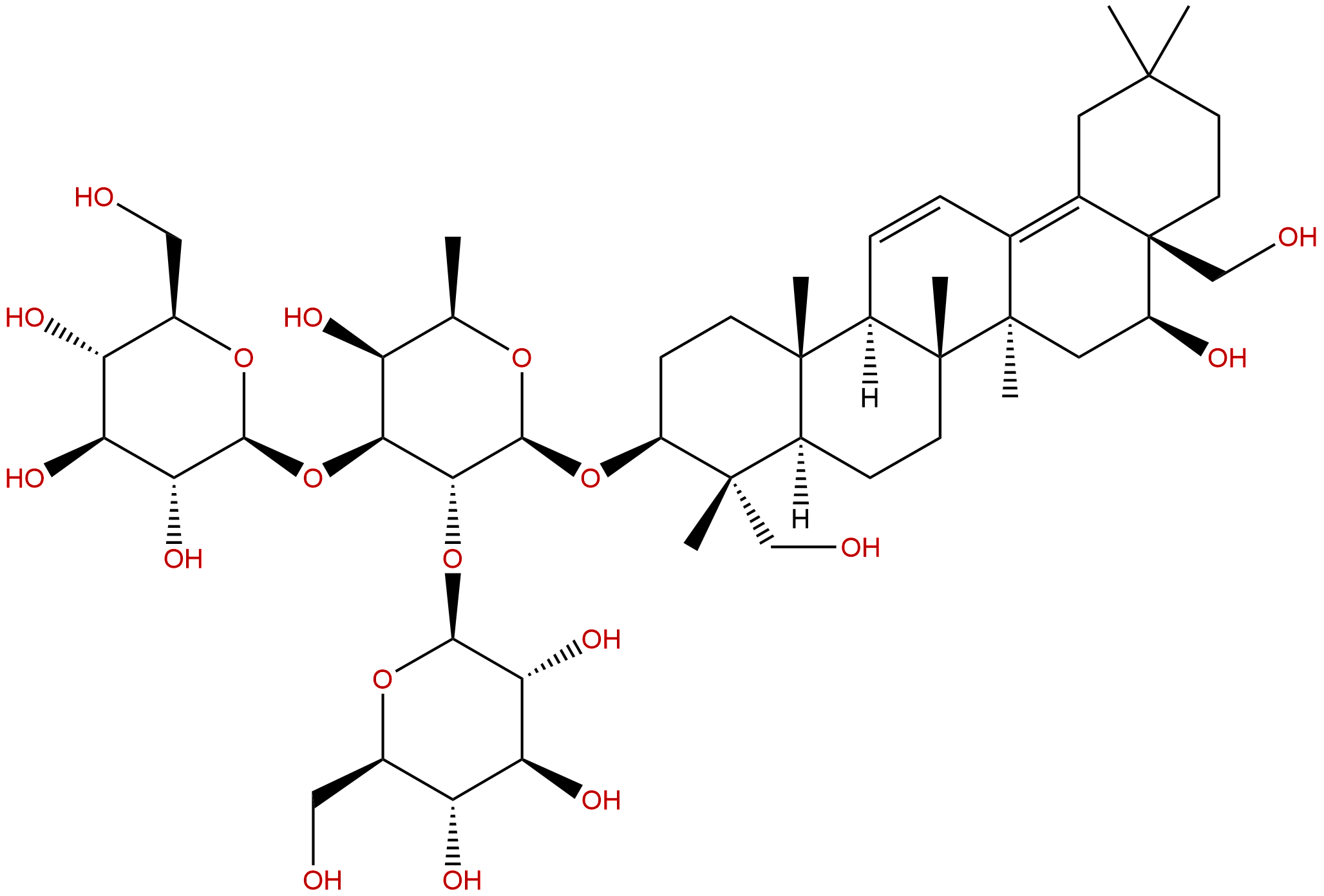


Product name: Buddlejasaponin IVb
Synonym name:
Catalogue No.: BP3090
Cas No.: 152580-79-5
Formula: C48H78O18
Mol Weight: 943.134
Botanical Source:
Physical Description: Powder
Type of Compound: Triterpenoids
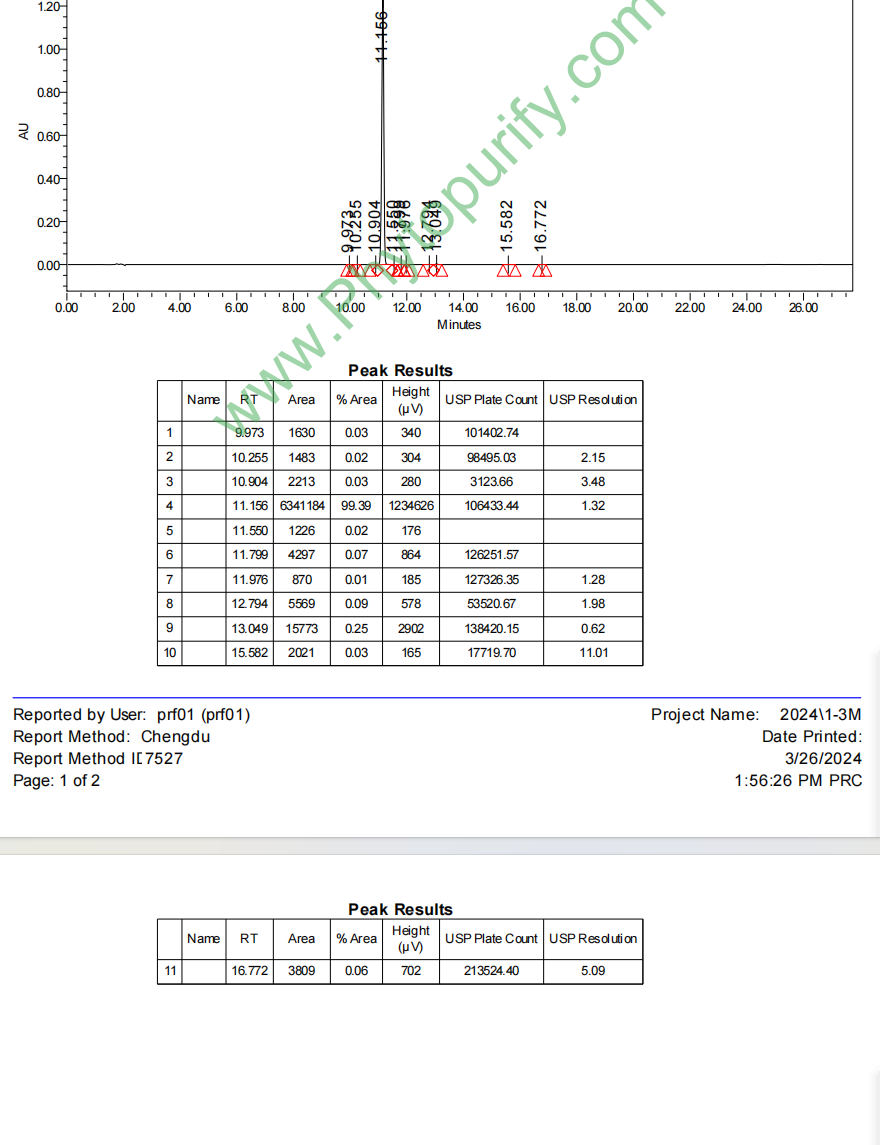
Purity: 95%~99%
Analysis Method: HPLC-DAD or/and HPLC-ELSD
Identification Method: Mass, NMR
Packing: Brown vial or HDPE plastic bottle
The product could be supplied from milligrams to grams. Inquire for bulk scale.
We provide solution to improve the water-solubility of compounds, thereby facilitating the variety of activity tests and clinic uses.
For Reference Standard and R&D, Not for Human Use Directly.
Description:
Buddlejasaponin IVb(200 uM) can shorten thrombin time (TT) by 20.6 %, suggests that it has hemostasis efficacy.
References:
Nat Prod Res. 2016;30(9):1001-8.
A new triterpenoid saponin from Clinopodium chinense (Benth.) O. Kuntze.
A new triterpene saponin, 3β,16β,23α,28β,30β-pentahydroxyl-olean-11,13(18)-dien-3β-yl-[β-D-glucopyranosyl-(1→2)]-[β-D-glucopyranosyl-(1→3)]-β-D-fucopyranoside, was named Clinoposaponin D (1), together with six known triterpene saponins, Buddlejasaponin IVb (2), buddlejasaponin IVa (3), buddlejasaponin IV (4), clinopodisides D (5), 11α,16β,23,28-Tetrahydroxyolean-12-en-3β-yl-[β-D-glucopyranosyl-(1→2)]-[β-D-glucopyranosyl-(1→3)]-β-D-fucopyranoside (6) and prosaikogenin A (7), and two known triterpenes, saikogenin A (8) and saikogenin F (9) were isolated from Clinopodium chinense (Benth.) O. Kuntze.
METHODS AND RESULTS:
Their structures were elucidated on the basis of 1D, 2D NMR and MS analysis. Meanwhile, the effects of all compounds on rabbit platelet aggregation and thrombin time (TT) were investigated in vitro. Compounds 4 and 7 had significant promoting effects on platelet aggregation with EC50 value at 53.4 and 12.2 μM, respectively. In addition, the highest concentration (200 μM) of compounds 2 and 9 shortened TT by 20.6 and 25.1%, respectively.
HPLC of Buddlejasaponin IVb
Storage conditions:Short-term storage at 2~8℃, long-term storage at -20 ~ -80℃
298.1400
1.9725
1.9726
.1220
.4799
.4535
Low
65.6663
6.5261
No
No
No
No
No
No
0.0
Yes
No
Yes
Yes
In the field of natural product medicinal chemistry and pharmacology research, triterpenoid saponins have always been an important source of drug discovery due to their extensive and significant biological activities. Among them, Buddlejasaponin IVb, also commonly known as blood flow cutting saponin A, has attracted much attention in recent years as an active ingredient isolated from traditional hemostatic herbs due to its clear hemostatic effect. The CAS number of this compound is 152580-79-5, and its core pharmacological effect is to significantly shorten clotting time, demonstrating potential value in the treatment of hemorrhagic diseases. Hemostasis is a complex physiological process involving the precise balance of blood vessels, platelets, and coagulation/anticoagulation/fibrinolysis systems, whose imbalance can lead to bleeding or thrombotic diseases. The discovery of drunken fish grass saponin IVb provides a new chemical entity and research entry point for intervening in the coagulation cascade reaction at the molecular level. This article aims to provide a systematic review of the chemical structure, plant origin, pharmacological activity, mechanism of action, medicinal properties, and clinical application prospects of drunken fish grass saponin IVb, in order to provide comprehensive academic references for the in-depth research and development of this compound.
Drunken fish grass saponin IVb is an oleane type pentacyclic triterpenoid saponin. Its molecular formula is C ₄₈ H ₇₈ O ₁₈, and its molecular weight is 943.1340. Its basic skeleton is oleanolic acid, which is usually connected with sugar chains at C-3 and C-28 positions, forming a double sugar chain saponin structure, which is a key structural feature for its biological activity. The specific sugar composition, connection position, and order are the key differences between it and other similar compounds of drunken fish grass saponins (such as drunken fish grass saponin IVa). The hydrophilic glycosylation and hydrophobic triterpenoid core in its structure jointly determine its unique physicochemical properties.
According to the provided pharmacological parameters, the theoretical lipid water partition coefficient (LogP) of Drunken Fish Grass Saponin IVb is 1.9725, indicating that it has a certain lipophilicity but is not highly lipophilic. Its topological polar surface area (TPSA) is as high as 298.1400 Å ², which is mainly attributed to the abundant oxygen atoms on multiple hydroxyl groups and sugar chains in the molecule, indicating that it has more hydrogen bond donor and acceptor sites and strong molecular polarity. This characteristic is also consistent with its water solubility data (0.1220 mg/mL), indicating that it is a compound that is slightly soluble in water. In the classification of biopharmaceuticals, molecules with high TPSA and moderate LogP often face membrane permeability challenges. In addition, preliminary computer simulation predictions indicate that its ability to penetrate the blood-brain barrier is relatively low, which to some extent limits its potential application in central nervous system bleeding, but may also reduce the risk of central nervous system side effects. Importantly, in the early safety warning screening, the compound did not exhibit hERG potassium channel inhibitory activity (hERG inhibition: No), and the Ames test result was 0.0, indicating a low risk of mutagenicity and laying a good safety foundation for subsequent development.
Drunken fish grass saponin IVb mainly comes from plants in the family Lamiaceae, genus Cymbidium Wind Wheel Vegetables(Clinopodium chinense (Benth.) O. Kuntze), Its dry aboveground part is often referred to as "cutting off blood flow" in folk and traditional Chinese medicine preparations, and is a famous hemostatic herb. In addition, within the same genus of plants and the genus Cymbidium(Buddleja)Some species have also been found, but the main and characteristic source is the wind turbine vegetable.
Its extraction and separation usually follow the conventional process of natural product chemistry. Firstly, grind the dried medicinal herbs of the wind turbine vegetable and use a medium polarity solvent (such as 70% -95% ethanol or methanol) for heating reflux or ultrasound assisted extraction to fully extract the saponin components. The extract is concentrated under reduced pressure to obtain a paste. Subsequently, utilizing the solubility characteristics of saponins, the method of water suspension followed by n-butanol extraction is commonly used for preliminary enrichment to obtain the n-butanol fraction. Further purification relies on various chromatographic techniques. Usually, macroporous adsorption resins (such as D101 and AB-8) are used for column chromatography, and gradient elution is performed using ethanol water systems of different concentrations to preliminarily separate saponin groups of different polarities. After obtaining a fraction rich in target saponins, fine separation and preparation are carried out using silica gel column chromatography, reverse phase silica gel column chromatography (such as ODS, using methanol water or acetonitrile water as mobile phase), and high performance liquid chromatography (HPLC). Modern technologies such as high-speed countercurrent chromatography (HSCCC) have also been applied to the separation and purification of such saponins due to their efficient liquid-liquid partitioning and separation capabilities. Through nuclear magnetic resonance (NMR), mass spectrometry (MS), and comparison with literature data, the obtained compound can be identified as drunken fish grass saponin IVb.
The core pharmacological activity of drunken fish grass saponin IVb is hemostasis Numerous in vitro and in vivo experiments have confirmed its efficient and rapid procoagulant effect.
1. Internal hemostatic model In classic experiments such as mouse tail bleeding model and rat liver trauma bleeding model, drunken fish grass saponin IVb can significantly shorten bleeding time (BT) and coagulation time (CT) in a dose-dependent manner. Its hemostatic effect is equivalent to or better than positive control drugs such as Yunnan Baiyao and phenethylamine.
2. In vitro coagulation experiment By measuring activated partial thromboplastin time (APTT), prothrombin time (PT), and thrombin time (TT), we can explore their effects on the coagulation pathway. Research has shown that saponins IVb from drunken fish grass can significantly shorten APTT and PT, while having a relatively small effect on TT. This suggests that it mainly acts through a common pathway or upstream factor that affects both endogenous and exogenous coagulation pathways, rather than directly affecting the final conversion step from fibrinogen to fibrin.
3. Effects on blood vessels and platelets In addition to affecting coagulation factors, some studies suggest that this saponin may have a certain vasoconstrictive effect and promote platelet aggregation, synergistically promoting hemostasis from multiple links.
4. Other potential activities In addition to its main activity of hemostasis, based on the commonality of triterpenoid saponins, preliminary studies have explored the anti-inflammatory, antioxidant, and anti-tumor activities of drunken fish grass saponin IVb. However, these studies are still in their early stages, and its efficacy and mechanism are far less clear than its hemostatic effect.
The hemostatic mechanism of drunken fish grass saponin IVb involves the regulation of multiple key targets in the coagulation anticoagulation fibrinolysis system. According to the provided target information, its molecular action network mainly focuses on the following aspects:
In summary, drunken fish grass saponin IVb works synergistically through multi-target and networked mechanisms: on the one hand, it positively enhances the coagulation cascade reaction (activating F2, F7, F9, F10), and on the other hand, it negatively inhibits anticoagulation (possibly inhibiting PROC) and fibrinolysis (upregulating SERPINE1) systems, while also promoting platelet function (via VWF), thus constructing an efficient and three-dimensional hemostatic network. This multi-target characteristic is the molecular basis for its potent hemostatic effect.
Although the pharmacological activity of drunken fish grass saponin IVb is clear, its druggability still faces some challenges, which is a common problem among most saponin compounds.
The clinical application prospects of drunken fish grass saponin IVb mainly revolve around its excellent hemostatic activity, but it also needs to face its challenges.
Development direction:
Potential indications:
Challenges and Future Research Focus:
Drunken fish grass saponin IVb (blood flow cutting saponin A) is a triterpenoid saponin with clear and potent hemostatic activity isolated from the traditional hemostatic Chinese medicine Fenglun vegetable. Its unique chemical structure, through multi-target regulation of coagulation, anticoagulation, and fibrinolysis systems, forms a networked mechanism for synergistic hemostasis, reflecting the complexity advantage of natural products with multi-component and multi-target effects. Despite facing challenges such as poor oral absorption in terms of drug properties, its excellent activity, low baseline toxicity risk, and clear background of traditional Chinese medicine applications make it a highly promising candidate compound for developing new hemostatic drugs. Future research should focus on overcoming pharmaceutical bottlenecks, deepening understanding of mechanisms, and advancing systematic preclinical and clinical evaluations. With the continuous advancement of modern pharmaceutical technology and research, the active ingredient of drunken fish grass saponin IVb is expected to be successfully transformed from a traditional Chinese medicine into a modern hemostatic drug with clear ingredients, clear mechanisms, and reliable efficacy, providing a new option for the treatment of hemorrhagic diseases and also serving as a model for the modernization of traditional Chinese medicine and the development of innovative natural product drugs.
