


Product name: Asperosaponin VI
Synonym name: Akebia saponin D
Catalogue No.: BP0207
Cas No.: 39524-08-8
Formula: C47H76O18
Mol Weight: 929.107
Botanical Source: Present in Akebia quinata, Lonicera nigra, Patrinia and Phytolacca spp.
Physical Description: Powder
Type of Compound: Triterpenoids
Purity: 95%~99%
Analysis Method: HPLC-DAD or/and HPLC-ELSD
Identification Method: Mass, NMR
Packing: Brown vial or HDPE plastic bottle
Storage: Store in a well closed container, protected from air and light. Put into refrigerate or freeze for long term storage.
Whenever possible, you should prepare and use solutions on the same day. However, if you need to make up stock solutions in advance, we recommend that you store the solution as aliquots in tightly sealed vials at -20℃. Generally, these will be useable for up to two weeks.
The product could be supplied from milligrams to grams, up to kilograms
Inquire for bulk scale.
Descriptions:
Asperosaponin VI (ASA VI) is a kind of saponin in the medicinal herb Dipsacus asper Wall which has long been used as an antiosteoporosis drug, exhibits a significant induction of proliferation, differentiation and mineralization in MC3T3-E1 and primary osteoblastic cells, it may induce osteoblast maturation and differentiation, and then increase bone formation via increasing BMP-2 synthesis, and activating p38 and ERK1/2.[1]
Asperosaponin VI, a triterpene saponin isolated from Dipsacus asper Wall, plays protective roles on acute myocardial infarction in rats.[2]
Asperosaponin VI has protective effect against hypoxia-induced cardiomyocytes apoptosis probably by activating the PI3K/Akt and CREB pathways.[3]
References:
[1] Yinbo Niu ?, Yuhua Li ?, Huang H, et al. Phytothe Res , 2011, 25(11):1700-6.
[2] Li C, Liu Z J, Li G, et al. Eur J Pharmacol, 2010, 217(Pt 23):4123-31.
[3] Li C, Tian J, Li G, et al. Eur J Pharmacol, 2010, 649(1-3):100-7.
[4] Shan X, Wang J, Wu A. China Pharmacist, 2013, 16(03):388-90.
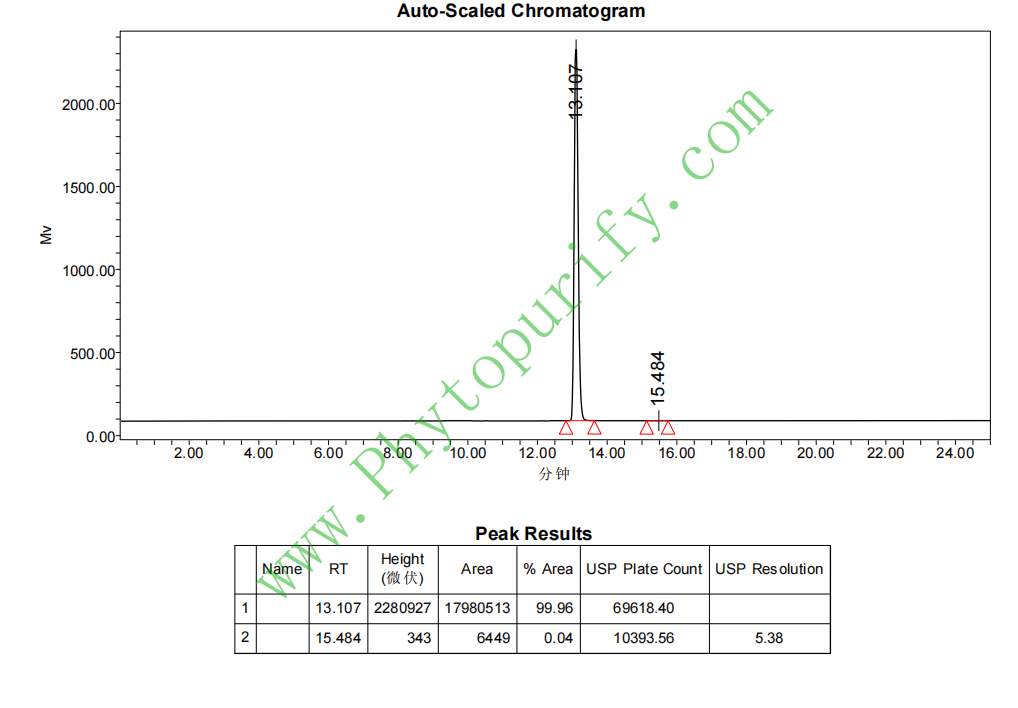
HPLC of Asperosaponin VI
Storage conditions:Short-term storage at 2~8℃, long-term storage at -20 ~ -80℃
Asperosaponin VI (CAS number: 39524-08-8) is an important triterpenoid saponin component isolated from the traditional Chinese medicine Dipsacus asper Wall. ex Henry. Chuanxuduan, as a commonly used herb in traditional Chinese medicine for nourishing the liver and kidneys, strengthening muscles and bones, has always been used to treat diseases such as osteoporosis, rheumatoid arthritis, and traumatic injuries. In recent years, with the development of modern pharmacology and molecular biology techniques, Chuanxuduan saponin VI has attracted much attention due to its multi-target and multi pathway pharmacological activities, especially in the areas of bone metabolism regulation, myocardial protection, antidepressant, and wound healing promotion, showing significant biological effects. The purpose of this article is to systematically review the chemical structure and physicochemical properties, plant sources and extraction methods, pharmacological activity and mechanism of action, pharmacological evaluation and pharmacokinetic characteristics of Chuanxuduan saponin VI, explore its clinical application potential and future research directions, and provide reference for the field of natural product pharmacology.
Chuanxuduan Saponin VI belongs to the triterpenoid saponin class, with a molecular formula of C42H68O18 and a molecular weight of 896.10. Its structural core is a pentacyclic triterpenoid skeleton, connecting multiple sugar residues to form a typical saponin structure. The LogP value of Chuanxuduan saponin VI is about -3.0, indicating its strong hydrophilicity. The TPSA (topological polar surface area) is as high as 304.72 Å ², and the number of hydrogen bond acceptors is as high as 18, demonstrating strong polarity and hydrogen bonding ability. These physicochemical properties suggest that the absorption of the compound in vivo may be limited, and its polar structure is conducive to stable binding with various biomolecule targets.
Chuanxuduan saponin VI is not easily able to penetrate the blood-brain barrier (BBB), which is closely related to its high polarity and large molecular weight. In terms of safety, Chuanxuduan saponin VI did not show hepatotoxicity, cardiotoxicity, or hERG channel inhibition, and the Ames mutagenicity test was negative, indicating its good safety and suitability for further drug development.
Saponin VI of Panax notoginseng mainly exists in the roots of Panax notoginseng. Panax notoginseng is a perennial herbaceous plant of the Lonicera family, widely distributed in central southern and southwestern China. Its root has been a traditional Chinese medicine since ancient times, with functions such as nourishing the liver and kidneys, strengthening muscles and bones, and dispelling wind and dampness.
The extraction of saponins VI from Chuanxuduan is usually carried out by water extraction and alcohol precipitation method. The specific steps include: crushing the dried Chuanxuduan roots, refluxing with water or 70% -80% ethanol for extraction, concentrating the filtrate, and adding ethanol precipitation to remove impurities. Subsequently, high-purity Chuanxuduan saponin VI was obtained through multi-stage column chromatography (such as silica gel column, reverse phase C18 column) separation and purification. In recent years, modern technologies such as ultrasound assisted extraction and microwave-assisted extraction have also been applied to improve extraction efficiency and purity. In addition, high-performance liquid chromatography (HPLC) combined with mass spectrometry (LC-MS) is widely used for qualitative and quantitative analysis.
The research on Chuanxuduan saponin VI in the field of bone metabolism is the most in-depth. Multiple in vitro and in vivo experiments have shown that Chuanxuduan saponin VI can significantly promote the differentiation of osteoblasts (such as MC3T3-E1 cell line), enhance alkaline phosphatase (ALP) activity and mineralization ability. Its mechanism of action mainly activates the signaling pathway mediated by bone morphogenetic protein-2 (BMP-2), further activating the p38 and ERK1/2 MAPK pathways, promoting the expression of osteogenic related genes such as Runx2, Osterix and other key transcription factors, thereby promoting bone formation.
In addition, Chuanxuduan saponin VI showed significant bone protective effects in animal models of osteoporosis, which can increase bone density, improve bone microstructure, inhibit bone resorption, and demonstrate good anti osteoporosis potential.
Research on Chuanxuduan Saponin VI in the cardiovascular field has shown that it has a significant protective effect on hypoxia induced cardiomyocyte apoptosis. Mechanistically, Chuanxuduan saponin VI promotes the transmission of cell survival signals by activating the PI3K/Akt signaling pathway, while activating the cAMP response element binding protein (CREB) pathway to inhibit the expression of apoptosis related proteins, alleviate hypoxia reperfusion injury, and protect myocardial cell function.
Chuanxuduan saponin VI has a certain central nervous system regulatory effect, especially exhibiting antidepressant activity. Animal model studies have shown that Chuanxuduan saponin VI can regulate neurotransmitter levels and improve depressive like behavior. Its mechanism of action may involve regulating the neuroendocrine axis and anti-inflammatory effects, reducing neuroinflammation, and promoting neuroprotection.
Chuanxuduan saponin VI has also shown potential in wound repair. In vitro experiments have shown that it can promote fibroblast proliferation and migration, accelerate wound closure. Mechanistically, it may be related to its promotion of extracellular matrix synthesis and regulation of local inflammatory response, which helps accelerate tissue regeneration and repair.
In addition to the main activities mentioned above, Chuanxuduan saponin VI has also been reported to have regulatory effects on targets related to hyperglycemia, such as EHMT2, AMPK, SGLT2, etc., indicating its potential application in metabolic diseases. However, related research is still in the preliminary stage and further verification is needed.
The multi-target mechanism of action of Chuanxuduan saponin VI reflects its complex pharmacological network regulation characteristics.
BMP-2/p38 and ERK1/2 signaling pathways Chuanxuduan Saponin VI induces BMP-2 expression, activates downstream p38 and ERK1/2 MAPK pathways, promotes osteoblast differentiation and mineralization processes, upregulates key transcription factors Runx2 and Osterix expression, and enhances bone formation.
PI3K/Akt and CREB pathways In cardiomyocyte protection, Chuanxuduan saponin VI activates PI3K/Akt signaling, promotes cell survival, and inhibits the expression of apoptotic proteins; Simultaneously activate CREB, regulate the expression of anti apoptotic genes, and alleviate hypoxia damage.
Metabolic related targets Chuanxuduan saponin VI may regulate high blood glucose related targets, such as AMPK (energy metabolism regulator), SGLT2 (sodium glucose cotransporter 2), EHMT2 (histone methyltransferase), etc., suggesting its potential role in glucose metabolism and insulin sensitivity regulation.
Neuroprotective and antidepressant mechanisms Chuanxuduan Saponin VI may exert antidepressant effects by regulating the neurotransmitter system and inflammatory factors, improving the neural environment.
Mechanisms related to wound healing Promote fibroblast proliferation and migration, regulate extracellular matrix synthesis, regulate local inflammatory response, and promote tissue repair.
The regulation of these diverse signaling pathways and targets reflects the extensive pharmacological activity of Chuanxuduan saponin VI in various disease models.
The pharmacological evaluation of Chuanxuduan Saponin VI shows that it has good safety and has not shown hepatotoxicity, cardiotoxicity, or hERG channel inhibition. Moreover, the Ames mutagenicity test is negative, indicating a low risk of genetic toxicity. However, due to its large molecular weight (896.10 Da), high polarity (LogP about -3.0), and high TPSA (304.72 Å ²), the oral bioavailability of Chuanxuduan saponin VI may be limited, with poor in vivo absorption and difficulty in penetrating the blood-brain barrier.
At present, there is limited research on the pharmacokinetics of Chuanxuduan saponin VI. Preliminary animal experiments have shown that the compound is widely distributed in the body, mainly metabolized through the liver, and its excretion pathway is not yet clear. Further research is needed on its metabolites and metabolic enzyme system to clarify its in vivo kinetic characteristics and potential drug interaction risks.
To improve the bioavailability of Chuanxuduan saponin VI, future strategies such as nanocarriers, liposome encapsulation, or structural modification can be considered to optimize its pharmacokinetic properties.
As the main active ingredient of Chuanxuduan, Chuanxuduan saponin VI exhibits broad clinical application potential due to its multiple pharmacological activities such as promoting osteogenesis, myocardial protection, antidepressant, and wound healing.
Osteoporosis and fracture repair The effect of Chuanxuduan saponin VI on promoting osteoblast differentiation and bone formation provides a new therapeutic approach for osteoporosis and fracture healing. In the future, it can be developed as a bone metabolism regulator or bone repair adjuvant drug.
cardiovascular disease Its protective effect on hypoxic myocardial cells suggests potential application value in myocardial protection after ischemic heart disease and myocardial infarction.
Neuropsychiatric disorders The antidepressant activity provides the possibility for the adjunctive treatment of depression and related neurological and psychiatric disorders with Chuanxuduan saponin VI.
Wound Healing The role of promoting wound healing makes it promising for development in the treatment of wounds and skin diseases.
However, the clinical translation of Chuanxuduan saponin VI still faces many challenges, including low bioavailability, complex in vivo metabolism, and lack of systematic clinical trial data. Future research should focus on:
Systematic study on pharmacokinetics and pharmacodynamics Clarify its internal behavior and dose-response relationship.
Structural optimization and formulation development Enhance oral absorption and targeted delivery capabilities.
Multi center, randomized, double-blind clinical trial Verify its safety and effectiveness.
In depth analysis of multi-target mechanism of action To provide a theoretical basis for precise treatment.
Combination therapy strategy Explore synergistic effects with existing drugs and expand their application scope.
Chuanxuduan saponin VI, as an important active triterpenoid saponin in Chuanxuduan, has shown significant therapeutic potential in bone metabolism regulation, myocardial protection, antidepressant treatment, and wound healing due to its multi-target and multi pathway pharmacological activities. Its good safety lays the foundation for subsequent drug development. However, due to poor pharmacokinetic properties and lack of systematic clinical data, further in-depth research is needed for the clinical application of Chuanxuduan saponin VI. In the future, through structural optimization, formulation innovation, and clinical validation, it is expected that Chuanxuduan Saponin VI will be developed into a new natural medicine, providing effective natural product pharmacological solutions for the treatment of related diseases.
