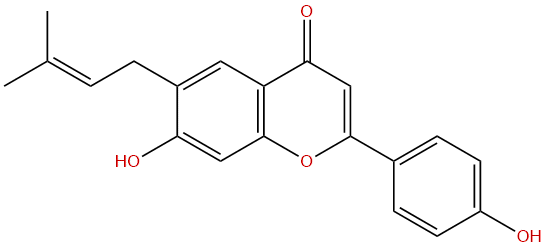


Product name: Licoflavone A
Synonym name:
Catalogue No.: BP4006
Cas No.: 61153-77-3
Formula: C20H18O4
Mol Weight: 322.36
Botanical Source: Radix Glycyrrhizae
Physical Description:
Type of Compound: Flavonoids
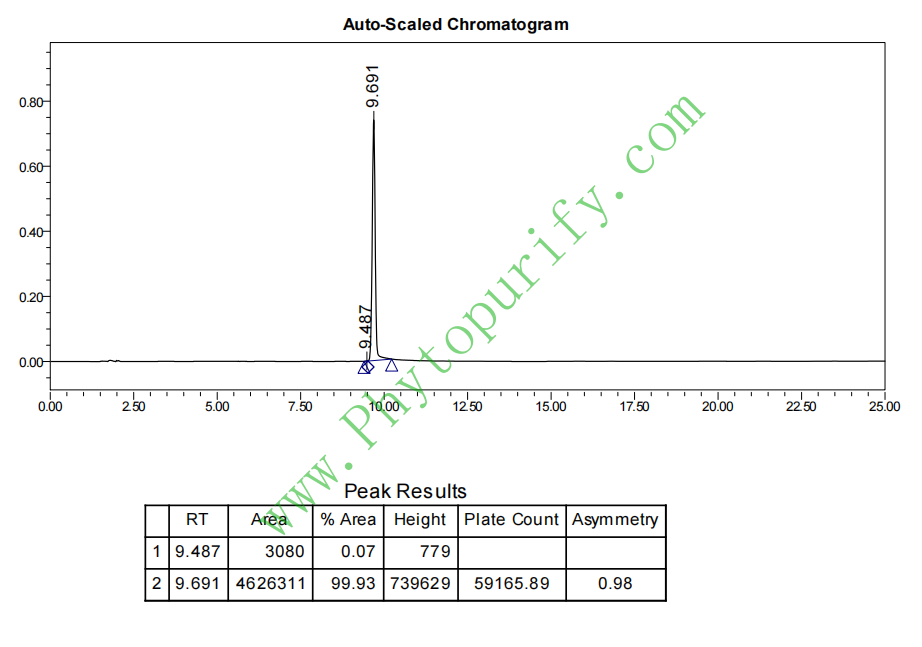
Purity: 95%~99%
Analysis Method: HPLC-DAD or/and HPLC-ELSD
Identification Method: Mass, NMR
Packing: Brown vial or HDPE plastic bottle
Storage: Store in a well closed container, protected from air and light. Put into refrigerate or freeze for long term storage.
Whenever possible, you should prepare and use solutions on the same day. However, if you need to make up stock solutions in advance, we recommend that you store the solution as aliquots in tightly sealed vials at -20℃. Generally, these will be useable for up to two weeks.
The product could be supplied from milligrams to grams
Inquire for bulk scale.
For Reference Standard and R&D, Not for Human Use Directly.
HPLC of Licoflavone A
Storage conditions:Short-term storage at 2~8℃, long-term storage at -20 ~ -80℃
70.6700
3.7166
3.6413
.0131
1.8751
10.0841
Low
92.9305
2.4852
Yes
No
Yes
No
Yes
Yes
0.6
Yes
Yes
Yes
Yes
Natural products, as an important source of drug discovery, play an irreplaceable role in the long history of human fight against diseases. Flavonoids, as a class of secondary metabolites widely present in the plant kingdom, have attracted much attention due to their structural diversity and extensive biological activities. Licorice(Glycyrrhiza species), As one of the oldest herbs in traditional medicine, its roots and rhizomes are rich in various active ingredients, including triterpenoid saponins (such as glycyrrhizic acid) and flavonoids. In recent years, with the continuous deepening of research on the chemical composition and pharmacological effects of licorice, a series of flavonoid monomers with significant biological activity have been isolated and identified. Among them, licoflavone A has gradually become a research hotspot in the field of natural product pharmacology due to its unique pharmacological activity spectrum, especially its inhibitory effect on protein tyrosine phosphatase 1B (PTP1B).
Licorice flavonoid A, chemically named 5,7,4 '- trihydroxy-6,8-diisoprenyl flavonoid, is a typical isoprenyl flavonoid. Its structural feature lies in the introduction of two isopentenyl side chains on the A ring of the flavonoid parent nucleus. This structural modification not only increases the lipophilicity of the molecule, but also endows it with unique biological activity that distinguishes it from other flavonoid compounds. Early research mainly focused on its traditional pharmacological effects such as anti-inflammatory and antioxidant effects. However, in recent years, with the deepening of research on metabolic diseases and inflammation related signaling pathways, the potential of licorice flavonoids A in regulating glucose and lipid metabolism, inhibiting inflammatory responses, and regulating immune responses has been gradually revealed. Especially, as a PTP1B inhibitor, it provides a new molecular leader for the treatment of type 2 diabetes and obesity. In addition, its regulatory effect on key inflammatory signaling pathways such as STAT3 and NF - κ B also demonstrates great potential in the development of anti-inflammatory drugs.
This article aims to systematically review the research progress of licorice flavonoid A, and conduct in-depth analysis from multiple dimensions such as its chemical structure and physicochemical properties, plant sources and extraction methods, pharmacological activity, mechanism of action, drug evaluation, and clinical application prospects, in order to provide comprehensive and systematic references for the subsequent research and development of this natural product.
Licoflavone A belongs to the flavonoid subclass of flavonoids. Its chemical structure is based on the classical 2-phenylchromenone (C6-C3-C6) skeleton. Specifically, its parent nucleus is 5,7,4 '- trihydroxyflavone, a derivative of apigenin. Its unique structural feature is that the C-6 and C-8 positions of the flavonoid A ring are respectively connected to an isopentenyl (3,3-dimethylallyl) side chain. The presence of these two isopentenyl groups is a key structural element that distinguishes licorice flavonoid A from other common flavonoids such as apigenin and luteolin. The introduction of isopentenyl significantly enhances the lipophilicity of the molecule, which may be related to its ability to better embed into cell membranes or bind to certain hydrophobic protein pockets, thereby affecting its bioavailability and target binding ability.
From the perspective of physical and chemical properties, the molecular formula of licorice flavonoids A is C ₂₅ H ₂₆ O ₆, with a molecular weight of 322.3600 g/mol. Its lipid water partition coefficient (LogP) is 3.7166, indicating that the compound has moderate lipophilicity and is theoretically easy to penetrate biological membranes, but it may also lead to poor water solubility. Its topological polar surface area (TPSA) is 70.6700 Å ², which is within the reasonable range commonly considered for oral drugs (<140 Å ²), indicating its potential for oral absorption. However, its water solubility (0.0131 mg/mL) is extremely low, which constitutes one of the main obstacles in its drug development. Low water solubility may lead to poor dissolution in the gastrointestinal tract, thereby affecting oral bioavailability. In addition, the predictive model shows that its blood-brain barrier (BBB) penetration ability is "low", indicating that the compound mainly acts on peripheral tissues, while the risk of central nervous system side effects is relatively low. The prediction result of hERG inhibition is' no ', indicating a low risk of inducing QT interval prolongation and arrhythmia in the heart, which is a favorable safety signal. The predicted value of Ames test is 0.6, which is in the critical range, indicating that its potential genetic toxicity risk needs to be rigorously verified through subsequent experiments.
Overall, the chemical structure of licorice flavonoids A endows it with unique physicochemical properties: the moderate lipophilicity brought by the isopentenyl group is conducive to target binding, but the extremely low water solubility is the main shortcoming in its pharmacokinetic properties. Future drug chemical modifications, such as introducing hydrophilic groups or preparing prodrugs, nano formulations, etc., may be key strategies to improve their drug properties.
Licorice flavonoids A mainly come from the Fabaceae family of licorice genus(Glycyrrhiza)The roots and rhizomes of plants. Common types of licorice include Ural licorice(G. uralensis)Swelling fruit licorice(G. inflata)He Guangguo Licorice(G. glabra)These are also the main medicinal licorice varieties included in the Chinese Pharmacopoeia. Research has shown that the content of licorice flavonoids A is relatively high in swollen licorice and is one of its characteristic components. In addition to licorice plants, there are also reports of other leguminous plants such as Astragalus(Astragalus)It was isolated from the middle, but licorice is still its main source.
The extraction of licorice flavonoids A usually follows the classic process of natural product chemistry, which mainly includes three steps: extraction, separation, and purification. Due to the moderate polarity of licorice flavonoids A, commonly used extraction solvents are ethanol, methanol, or their aqueous solutions. Traditional extraction methods include:
The crude extract obtained from extraction usually requires further separation and purification to obtain high-purity licorice flavonoids A. Common separation and purification techniques include:
In recent years, with the promotion of green chemistry concepts, some new extraction technologies, such as deep eutectic solvent extraction and supercritical fluid extraction, have also been applied to the extraction research of licorice flavonoids, aiming to improve extraction efficiency, reduce the use of organic solvents, and protect the environment. However, these methods are currently mostly in the laboratory research stage, and further exploration is needed for large-scale industrial applications.
Licorice flavonoids A exhibit various pharmacological activities, with research mainly focused on anti-inflammatory, metabolic regulation, and anti-tumor fields.
Inflammation is a defensive response of the body to injury and infection, but excessive or persistent inflammation is a core pathological link in various chronic diseases such as arthritis, cardiovascular disease, and neurodegenerative diseases. Licorice flavonoids A exhibit significant inhibitory effects in various inflammatory models.
One of the most notable pharmacological activities of licorice flavonoids A is its inhibitory effect on protein tyrosine phosphatase 1B (PTP1B). PTP1B is a negative regulator of insulin and leptin signaling pathways. Its overexpression or increased activity will lead to insulin resistance and leptin resistance, and it is an important therapeutic target for type 2 diabetes and obesity.
The pharmacological activity of licorice flavonoids A is the result of the combined action of multiple targets and pathways. Based on existing research, its core mechanism of action can be summarized as the regulation of key signaling pathways and enzymes.
As mentioned earlier, PTP1B is a key direct target of licorice flavonoids A. PTP1B negatively regulates insulin signaling by dephosphorylating tyrosine residues of insulin receptor (IR) and insulin receptor substrate (IRS). Licorice flavonoids A inhibit the phosphatase activity of PTP1B by binding to its active or allosteric sites, thereby maintaining the phosphorylation status of IR and IRS and enhancing the activation of downstream PI3K/Akt signaling pathways. This promotes the translocation of glucose transporter 4 (GLUT4) to the cell membrane, increases glucose uptake, and inhibits gluconeogenesis. Meanwhile, inhibition of PTP1B in the leptin signaling pathway can enhance JAK2/STAT3 signaling, improve leptin resistance, thereby suppressing appetite and increasing energy expenditure.
NF - κ B and STAT3 are core transcription factors that connect inflammation with tumors and metabolic diseases.
NLRP3 inflammasome is a multi protein complex, and its activation is a key step in the mature secretion of IL-1 β and IL-18. Licorice flavonoids A have been reported to inhibit the assembly of NLRP3 inflammasomes, which may be related to their inhibition of upstream signaling (such as ROS production, potassium ion efflux) or direct interaction with NLRP3 protein. By inhibiting the activation of CASP1, the release of IL-1 β and IL-18 was reduced, thereby alleviating the inflammatory response.
TRPV1 and TRPA1 are non selective cation channels expressed on sensory neurons and are important molecules for sensing pain, heat, and chemical stimuli. Licorice flavonoids A have been found to act as antagonists or modulators of TRPV1 and TRPA1, inhibiting calcium influx and neuronal excitation caused by agonists such as capsaicin and mustard oil, thereby exerting analgesic effects. This mechanism provides a molecular basis for its application in pain management.
Despite the remarkable pharmacological activity of licorice flavonoids A, their pharmacological development faces significant challenges, mainly reflected in their pharmacokinetic (ADME) properties.
As mentioned earlier, the water solubility of licorice flavonoids A is extremely low (0.0131 mg/mL), which severely limits its dissolution in the gastrointestinal tract, resulting in poor oral absorption and low bioavailability. Its LogP value is 3.7166, indicating strong lipophilicity and theoretically easy permeability through biofilms, but low water solubility becomes the rate limiting step for its absorption. The prediction model shows that it has moderate Caco-2 cell permeability, but the actual oral bioavailability may be much lower than the ideal value. This is the biggest obstacle to its development as an oral medication.
Due to its lipophilicity, licorice flavonoids A may be widely distributed in tissues in the body, especially in the liver, lungs, and adipose tissue. Its binding rate with plasma proteins may be high. It is predicted that its blood-brain barrier penetration ability is low, which to some extent limits its application in central nervous system diseases, but also reduces the risk of central neurotoxicity. Licorice flavonoids A, as flavonoids, mainly undergo phase II metabolic reactions in the body, such as glucuronidation and sulfation. These metabolites usually have increased water solubility, but their activity may decrease or disappear. In addition, CYP450 enzyme mediated phase I metabolism (such as hydroxylation and demethylation) may also occur. These metabolic processes significantly affect their in vivo exposure and duration of pharmacological activity.
Preliminary toxicity predictions indicate that licorice flavonoids A have a low risk of inhibiting hERG potassium channels, suggesting a lower risk of cardiac toxicity. However, the predicted value of Ames test (0.6) is in the critical range, indicating that there may be a certain genetic toxicity risk, which needs to be rigorously verified through standard bacterial reverse mutation test (Ames test) and in vitro micronucleus test. In addition, data on long-term toxicity and reproductive toxicity are still lacking.
Given the above challenges, structural modification or formulation modification of licorice flavonoid A is a key direction for optimizing its pharmacological properties.
Licorice flavonoids A, with its unique pharmacological activity spectrum, have shown potential clinical application prospects in multiple therapeutic fields.
As a PTP1B inhibitor, glycyrrhizin A has a clear application potential in the treatment of type 2 diabetes and obesity. Compared with existing PTP1B inhibitors such as Trodusquemine, licorice flavonoids A, as a natural product, may have better safety. However, its activity intensity (IC ₅₀=54.5 μ M) is not sufficient to directly become a candidate drug, and it needs to be used as a lead compound for structural optimization to obtain derivatives with stronger activity, higher selectivity, and better pharmacokinetic properties. In addition, its dual effects of improving insulin resistance and regulating lipid metabolism give it unique advantages in the treatment of metabolic syndrome.
Licorice flavonoids A exhibit broad-spectrum anti-inflammatory activity by inhibiting multiple inflammatory pathways such as NF - κ B, STAT3, and NLRP3 inflammasomes. This makes it potentially valuable in the treatment of various acute and chronic inflammatory diseases such as rheumatoid arthritis, inflammatory bowel disease, acute lung injury, hepatitis, etc. Especially its regulatory effect on TRPV1/TRPA1 provides new ideas for its treatment of inflammatory pain and neuropathic pain.
The anti-tumor activity of licorice flavonoids A, especially its inhibition of the STAT3 pathway and chemotherapy sensitization, makes it a promising candidate drug for adjuvant therapy of tumors. It can be used in combination with conventional chemotherapy drugs to improve efficacy through synergistic effects, and may reduce the dosage and toxic side effects of chemotherapy drugs. However, its anti-tumor effect in vivo, optimal administration regimen, and interactions with other drugs still require further research.
Future research should focus on the following aspects:
Licorice flavonoid A, as an important isopentenyl flavonoid in licorice, has become a remarkable research object in the field of natural product pharmacology due to its unique chemical structure and multifaceted pharmacological activities. From inhibiting PTP1B to improving metabolism, regulating the NF - κ B/STAT3 pathway to exert anti-inflammatory effects, and then regulating the TRP channel to produce analgesic effects, licorice flavonoid A exhibits a complex network of multi-target and multi pathway effects. The evaluation of its pharmacological properties revealed challenges such as low water solubility and potential genetic toxicity, but also pointed out the direction for optimization through structural modification and dosage form modification.
Although the road from laboratory discovery to clinical application is still long and challenging, licorice flavonoid A undoubtedly provides a valuable natural lead structure for the development of new drugs for the treatment of metabolic diseases, inflammatory diseases, and tumors. Future research requires the interdisciplinary integration of chemistry, biology, pharmacy, and medicine to deeply reveal their mechanisms of action, optimize their pharmacokinetic properties, and systematically evaluate their safety and efficacy. We have reason to believe that with the continuous deepening of research, licorice flavonoids A and its derivatives are expected to contribute to human health in the future.
