


Product name: Sophocarpine
Synonym name: 13,14-Didehydromatridin-15-one, 9CI
Catalogue No.: BP1325
Cas No.: 6483-15-4
Formula: C15H22N2O
Mol Weight: 246.354
Botanical Source: Macleaya cordata (Willd.) R. Br.
Physical Description:
Type of Compound: Alkaloids
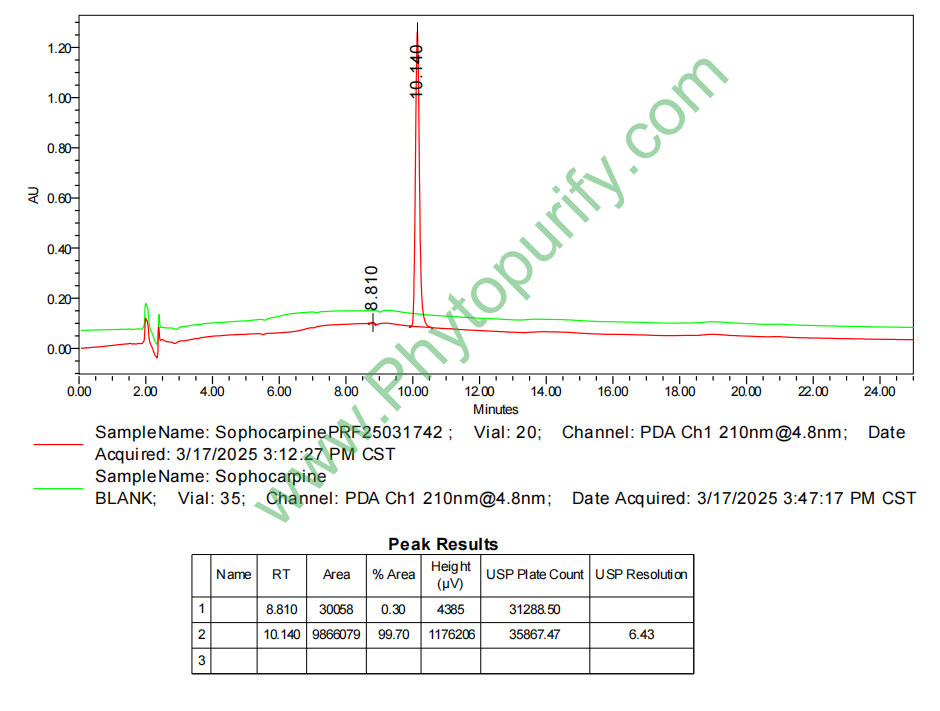
Purity: 95%~99%
Analysis Method: HPLC-DAD or/and HPLC-ELSD
Identification Method: Mass, NMR
Packing: Brown vial or HDPE plastic bottle
Storage: Store in a well closed container, protected from air and light. Put into refrigerate or freeze for long term storage.
Whenever possible, you should prepare and use solutions on the same day. However, if you need to make up stock solutions in advance, we recommend that you store the solution as aliquots in tightly sealed vials at -20℃. Generally, these will be useable for up to two weeks.
The product could be supplied from milligrams to grams
Inquire for bulk scale.
Chengdu Biopurify Phytochemicals Ltd. is a leading company in the research, development, manufacture and marketing of High Quality Phytochemicals and Extracts(especially Active Ingredients from Traditional Chinese Medicine,TCM), Natural Active Pharmaceutical Ingredients worldwide.
The main services:
A. Supply active ingredients and reference standards of TCM, from mgs to kgs scale
B. Custom extraction and purification, target Herb Active Ingredients
C. Custom synthesis and semi-synthesis for Natural Active Ingredients
D. CR(contract research), CM(contract manufacture) and PD(process development) services from lab scale, pilot scale to commercial scale(GMP is also available)
E. TCM compounds library for drug screen,more than 3000 compounds available, many of them are rare and unique.
HPLC of Sophocarpine
Storage conditions:Short-term storage at 2~8℃, long-term storage at -20 ~ -80℃
23.5500
1.3838
-.2769
8.2916
3.0444
9.7207
High
25.0332
4.1082
No
Yes
Yes
No
Yes
No
0.6
Yes
No
Yes
Yes
Natural products, as an important source of drug discovery, play an irreplaceable role in the history of human disease treatment. Among them, alkaloid compounds have always been a hot topic in medicinal chemistry and pharmacology research due to their structural diversity and significant biological activity. Sophocarpine, a tetracyclic quinoline alkaloid derived from traditional medicinal plants, has attracted much attention in recent years due to its extensive and profound pharmacological activities. Its CAS number is 6483-15-4, originally isolated from leguminous plants such as Sophora flavescens Ait. Modern pharmacological research has revealed that sophocarpine not only has traditional anti-inflammatory and antiviral effects, but also shows great potential in the field of anti-tumor treatment. Its core mechanism lies in its ability to act as a PTEN activator and effectively inhibit key signaling pathways closely related to cell proliferation, survival, invasion, and inflammatory response, such as PI3K/Akt, MEK/ERK, NF - κ B. Through the synergistic effect of multiple targets and pathways, sophocarpine has shown clear therapeutic effects in various malignant tumor models such as glioblastoma, colorectal cancer, liver cancer, as well as inflammatory diseases and chemotherapy induced cardiac injury models (such as doxorubicin). This article aims to systematically review the chemical properties, plant sources, pharmacological activities, molecular mechanisms of action, medicinal properties, and clinical application prospects of sophocarpine, in order to provide comprehensive scientific references for the in-depth development and transformation research of this natural product.
The molecular formula of sophocarpine is C15H22N2O, with a molecular weight of 246.3540. Its chemical structure belongs to the class of matrine alkaloids, which is a four ring system (quinoline pyridine skeleton) composed of quinoline ring and pyridine ring fused together, and its D ring is a lactam structure. This rigid structure is the foundation of its biological activity.
From the analysis of physicochemical parameters related to drug properties, the lipid water partition coefficient (LogP) of sophocarpine is 1.3838, indicating that it has moderate lipophilicity and is conducive to transmembrane transport. Its topological polar surface area (TPSA) is relatively low, at 23.55 Å ², which usually indicates good membrane permeability. The calculated water solubility value is 8.2916 mg/L, indicating that it belongs to the category of slightly soluble to poorly soluble compounds. This may be a limiting factor for its oral bioavailability and a difficult point to overcome in formulation research. It is worth noting that the prediction shows that sophocarpine has a high blood-brain barrier permeability, which provides an important material basis for its application in the treatment of central nervous system diseases such as glioblastoma. In terms of early safety indicators, the hERG inhibition prediction of sophocarpine is negative, indicating a low risk of causing QT interval prolongation in the heart; The Ames test result is 0.6, indicating a low risk of mutagenicity and providing preliminary positive signals for its safety evaluation.
Sophora flavescens Ait. and Sophora alopecuroides L. are the most abundant in Sophora flavescens Ait. and Sophora alopecuroides L. These plants are commonly used in traditional Chinese medicine theory for clearing heat and dampness, killing insects and diuresis. Modern research has confirmed that their various alkaloid components are the material basis for their pharmacological effects.
The extraction of sophocarpine from plant materials usually follows the general extraction process for alkaloids. Classic methods include solvent extraction: often using acidic water (such as dilute hydrochloric acid, dilute sulfuric acid) or alcohol solvents (such as ethanol, methanol) for extraction or reflux extraction, utilizing the characteristics of alkaloids and acid salts soluble in water or free bases soluble in organic solvents for preliminary enrichment. Subsequently, the alkaloid salts are converted back to the free state by alkalization (such as ammonia water, sodium hydroxide), and then extracted and purified using organic solvents (such as chloroform, ethyl acetate). Modern extraction techniques such as ultrasound assisted extraction, microwave-assisted extraction, and supercritical fluid extraction have also been applied to improve extraction efficiency and reduce solvent consumption. After obtaining the crude extract, further separation and purification methods such as column chromatography (such as silica gel column, alumina column), preparative high-performance liquid chromatography (HPLC), or high-speed countercurrent chromatography (HSCCC) are required to obtain high-purity sophocarpine monomer for research. The optimization of extraction process is crucial for ensuring the stable supply of sophocarpine and subsequent research.
A large number of in vitro and in vivo studies have confirmed that sophocarpine has various pharmacological activities, mainly reflected in anti-tumor, anti-inflammatory, antioxidant, and organ protection aspects.
1. Antitumor activity: Sophocarpine exhibits significant growth inhibition and pro apoptotic effects on various human cancer cell lines. In liver cancer research, sophocarpine can effectively inhibit the proliferation of HepG2, SMMC-7721 and other cells, induce cell cycle arrest in G0/G1 phase or G2/M phase, and activate mitochondrial apoptosis pathway. In colorectal cancer, gastric cancer, lung cancer, breast cancer and glioblastoma models, sophocarpine also showed the ability to inhibit cell proliferation, migration, invasion and induce apoptosis. Its anti-tumor effect has multi-target characteristics, not only targeting tumor cells themselves, but also interfering with tumor angiogenesis and cutting off tumor nutrition supply by inhibiting the secretion of vascular endothelial growth factor (VEGF).
2. Anti inflammatory and antioxidant activity: In macrophage or animal inflammation models induced by inflammatory stimuli such as lipopolysaccharide (LPS), sophocarpine can significantly reduce the production of inflammatory mediators such as nitric oxide (NO), prostaglandin E2 (PGE2), tumor necrosis factor - α (TNF - α), and interleukin-6 (IL-6). Its antioxidant effect is reflected in clearing free radicals, enhancing the activity of endogenous antioxidant enzymes such as superoxide dismutase (SOD), and reducing the levels of oxidative stress markers such as malondialdehyde (MDA). These effects collectively form the protective basis for inflammation related diseases (such as colitis, arthritis) and oxidative stress damage.
3. Cardiac protective effect: Although anthracycline chemotherapy drugs such as doxorubicin (DOX) are effective, their cardiac toxicity limits their clinical application. Research has found that sophocarpine can effectively alleviate DOX induced myocardial cell damage and animal cardiac dysfunction. Its protective mechanism is closely related to inhibiting myocardial cell apoptosis, reducing inflammatory response and oxidative stress, providing new ideas for the development of chemotherapy assisted cardiac protective agents.
The pharmacological effects of sophocarpine stem from its precise regulation of multiple key signaling pathways within cells, and its mechanism of action network is shown in the following figure:
flowchart TD
    A[槐果碱 Sophocarpine] --> B[上调 PTEN 表达]

    B --> C1[抑制 PI3K/Akt 通路]
    B --> C2[抑制 MEK/ERK 通路]
    A --> C3[抑制 NF-κB 通路活化]
    A --> C4[抑制 p38/JNK 磷酸化]
    A --> D[激活 Nrf2/HO-1 通路]

    C1 --> E1[细胞周期阻滞<br>(如 Cyclin D1↓)]
    C1 --> E2[诱导细胞凋亡<br>(如 Bcl-2↓, Bax↑, Caspase-3↑)]

    C2 --> F[抑制 VEGF 分泌]
    F --> G[抑制肿瘤细胞迁移与血管新生]

    C3 --> H1[降低炎症因子表达<br>(如 iNOS↓, COX-2↓, TNF-α↓, IL-6↓)]
    C4 --> H1

    D --> I[增强抗氧化防御<br>(如 SOD↑, MDA↓)]

    E1 & E2 & G & H1 & I --> J[综合效应:<br>抗肿瘤 / 抗炎 / 抗氧化 / 器官保护]
Specifically, its molecular mechanism can be divided into the following core aspects:
1. Regulating the PI3K/Akt/mTOR pathway: PI3K/Akt is a core pathway that regulates cell survival, proliferation, and metabolism, and is often overactivated in cancer. Sophocarpine passes through Upregulation of PTEN (phosphatase and tensin homolog) The expression of PTEN, as the main negative regulator of PI3K, can dephosphorylate PIP3, thereby Inhibition of phosphorylation activation of PI3K and its downstream Akt The inhibited Akt further affects its downstream targets, such as mTOR, GSK-3 β, and FOXO, ultimately leading to downregulation of cell cycle proteins (such as Cyclin D1), upregulation of pro apoptotic proteins (such as Bax), and downregulation of anti apoptotic proteins (such as Bcl-2, Mcl-1), triggering Cell cycle arrest and mitochondrial pathway induced apoptosis In liver cancer, its effect on targets such as PIK3CA and BCL2 is closely related to this pathway.
2. Inhibit the Ras/Raf/MEK/ERK pathway: This pathway mainly regulates cell proliferation and differentiation. Sophocarpine can Inhibition of phosphorylation of MEK and ERK Block the abnormal activation of this pathway. This not only directly inhibits tumor cell proliferation, but also leads to Reduced VEGF secretion Thereby weakening the migration ability of tumor cells and tumor angiogenesis.
3. Intervention of NF - κ B inflammatory pathway: NF - κ B is the main switch of inflammatory response. Sophocarpine can Inhibition of I κ B α degradation and p65 nuclear translocation Thereby blocking the transcriptional activity of NF - κ B. This directly leads to a decrease in the expression of a series of pro-inflammatory factors and enzymes, including INOS (inducible nitric oxide synthase), COX-2 (cyclooxygenase-2), TNF - α, and IL-6 Wait. Inhibition of COX-2 (PTGS2) also has anti-inflammatory and anti-tumor significance in cancers such as liver cancer.
4. Regulating MAPK family signaling: In addition to ERK, sophocarpine can also Inhibition of phosphorylation of stress-related p38 and JNK MAPK pathways These two pathways are closely related to cellular stress, apoptosis, and inflammation, and their inhibition helps alleviate inflammatory response and cell damage.
5. Activate the Nrf2/HO-1 antioxidant pathway: Faced with oxidative stress, sophocarpine can promote the transfer of nuclear factor E2 related factor 2 (Nrf2) from the cytoplasm to the nucleus, activating downstream antioxidant genes, such as Heme oxygenase-1 (HO-1)Upregulation of HO-1 can effectively eliminate reactive oxygen species and exert strong cell protective effects, which is one of the key mechanisms for its antioxidant and reduction of DOX cardiac toxicity.
6. Affects other tumor related targets: The study also showed that sophocarpine can downregulate liver cancer and other cells STAT3 Phosphorylation (inhibition of its transcriptional activity), affecting MMP-9 The expression of matrix metalloproteinase-9 inhibits invasion and has an impact on EGFR、TERT Waiting for targets also has a certain regulatory effect. It pairs TOP1 The possible role of topoisomerase I suggests that it may interfere with DNA replication.
Although sophocarpine has shown good pharmacological activity in preclinical studies, its pharmacological properties still require systematic evaluation. As stated in the physical and chemical properties section, its low water solubility is the main challenge affecting its oral absorption and bioavailability. Future formulation development may consider using strategies such as nanocrystals, liposomes, cyclodextrin inclusion complexes, solid dispersions, etc. to improve their dissolution and solubility.
In terms of pharmacokinetics, existing animal studies (mainly in rats) have shown that sophocarpine is rapidly absorbed after oral administration, but its absolute bioavailability may be limited, which is related to its solubility and first pass effect. It is widely distributed in the body, and due to its high lipid solubility and small TPSA, it can quickly distribute to various tissues, including entering the central nervous system through the blood-brain barrier, which is consistent with its anti brain tumor activity. Sophocarpine is mainly metabolized in the liver through the cytochrome P450 enzyme system (such as CYP3A4), and its metabolites need further clarification. The main excretion pathways may be the kidneys and bile. At present, the pharmacokinetic parameters of it in the human body are still blank, and systematic clinical pharmacokinetic studies are needed.
The preliminary data of safety evaluation (such as hERG and Ames prediction) is optimistic, but comprehensive preclinical safety evaluation, including acute toxicity, long-term toxicity, reproductive toxicity, etc., still needs to be further developed to clarify its treatment window.
The multi-target and multi pathway properties of sophocarpine make it have broad development prospects in various disease fields
1. Anti tumor therapy: Especially for tumors that are insensitive to conventional chemotherapy or prone to recurrence, such as glioblastoma, liver cancer, colorectal cancer, etc. It can be used as a single drug or in combination with existing chemotherapy drugs such as 5-fluorouracil, cisplatin, and doxorubicin, which may produce synergistic effects, reduce drug resistance, or alleviate toxic side effects. Its anti angiogenic and anti migratory properties also suggest its potential in inhibiting tumor metastasis.
2. Adjuvant treatment for inflammatory diseases: Such as ulcerative colitis, rheumatoid arthritis, asthma, etc. The anti-inflammatory effects exerted through the NF - κ B and MAPK pathways may provide new treatment options for these chronic diseases.
3. Protective agents against chemotherapy induced cardiac toxicity: As an adjuvant drug for chemotherapy drugs such as doxorubicin, it utilizes its antioxidant and anti apoptotic properties to protect myocardial cells, improve the safety of chemotherapy, and enhance patient tolerance.
However, pushing sophocarpine into clinical practice still faces many challenges: ① The issue of bioavailability Urgently need to be solved through a new drug delivery system; ② The mechanism of action network is extremely complex The cross dialogue and primary secondary relationships between various pathways need to be further clarified in specific disease models; ③ Need to complete the standard Preclinical safety and efficacy evaluation And ultimately passed clinical trial Verify its efficacy and safety in the human body; ④ Explore it structural optimization The possibility of improving its pharmacokinetic properties while retaining its activity through chemical modification.
Sophocarpine, as a natural alkaloid derived from traditional medicinal plants, has shown new vitality in modern pharmacological research due to its unique chemical structure and multi-target pharmacological mechanism. It exhibits comprehensive therapeutic potential in anti-tumor, anti-inflammatory, antioxidant, and organ protection by upregulating PTEN, inhibiting key signaling axes such as PI3K/Akt, MEK/ERK, NF - κ B, and activating the Nrf2 antioxidant defense system. Although there are challenges in drug development, especially in terms of water solubility, its good blood-brain barrier permeability and preliminary safety predictions have laid a positive foundation for its subsequent development. Future research should focus on using modern pharmaceutical technologies to improve its delivery efficiency, clarify its precise network of action in specific disease contexts, and actively promote standardized preclinical and clinical studies. The deep development of sophocarpine is not only expected to provide new candidate drugs for cancer and inflammatory diseases, but also a beneficial exploration for promoting the modernization of traditional Chinese medicine and the creation of new natural product drugs.
