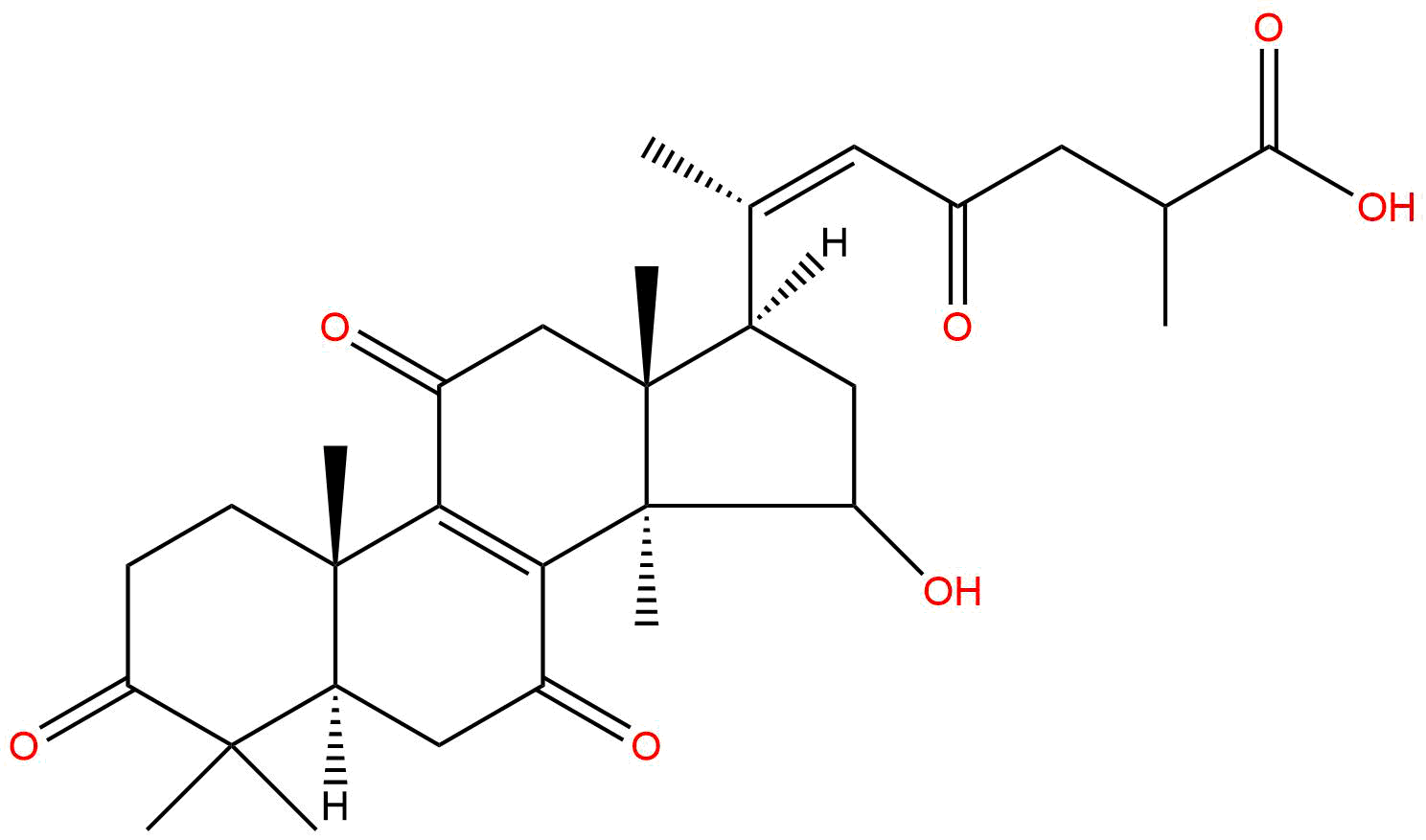


Product name: Ganoderenic acid G
Synonym name: 1494686-25-7
Catalogue No.: BP2169
Cas No.: 120481-73-4
Formula: C30H40O7
Mol Weight: 512.643
Botanical Source:
Type of Compound:
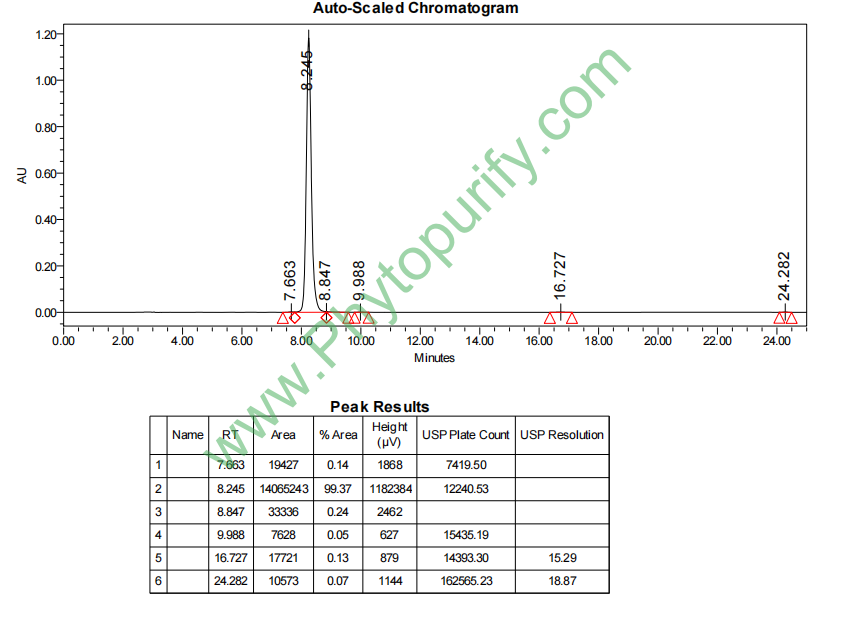
Purity: 95%~99%
Analysis Method: HPLC-DAD or/and HPLC-ELSD
Identification Method: Mass, NMR
Packing: Brown vial or HDPE plastic bottle
Storage: Store in a well closed container, protected from air and light. Put into refrigerate or freeze for long term storage.
Whenever possible, you should prepare and use solutions on the same day. However, if you need to make up stock solutions in advance, we recommend that you store the solution as aliquots in tightly sealed vials at -20℃. Generally, these will be useable for up to two weeks.
The product could be supplied from milligrams to grams
Inquire for bulk scale.
For Reference Standard and R&D, Not for Human Use Directly.
HPLC of Ganoderenic acid G
Storage conditions:Short-term storage at 2~8℃, long-term storage at -20 ~ -80℃
125.8100
2.9104
.4617
.0171
2.3043
5.5229
Low
84.9798
5.1355
No
No
Yes
No
No
No
0.0
Yes
Yes
No
Yes
Multiple myeloma (MM), as a malignant hematological tumor originating from plasma cells, remains a major challenge in clinical treatment to this day. Although new therapies such as proteasome inhibitors, immunomodulators, and monoclonal antibodies have significantly improved patient prognosis, issues such as drug resistance, recurrence, and severe side effects remain prominent. Therefore, exploring candidate drugs with novel structures, unique mechanisms of action, and low toxicity from natural products has always been an important direction in the development of anti-tumor drugs. Ganoderma lucidum(Ganoderma lucidum)As a rare fungus with thousands of years of medicinal history, its anti-tumor activity has attracted much attention. The triterpenoids in Ganoderma lucidum are one of its main active ingredients, with rich chemical diversity and extensive biological activity. Ganoderma lucidum acid G, as a member of the triterpenoid family of Ganoderma lucidum, has a CAS number of 120481-73-4. In recent years, studies have found that ganoderic acid G exhibits significant inhibitory activity against multiple myeloma cells in vitro and in vivo models. Its effects involve inducing apoptosis, blocking the cell cycle, inhibiting migration and invasion, and exerting its effects by regulating key signaling pathways such as BCL2, STAT3, AKT1, NF - κ B. This article aims to systematically review the chemical structure, plant origin, pharmacological activity, molecular mechanism of action, pharmacological characteristics, and clinical application potential of ganoderic acid G, in order to provide new scientific basis for the deep development of this natural product and the treatment strategy of multiple myeloma.
Ganoderma lucidum acid G belongs to highly oxidized lanostane triterpenoids. Its molecular formula is C ∝₀ H ₄₀ O ₇, and its molecular weight is 512.6430. Its core structure is a tetracyclic triterpenoid skeleton (A/B/C/D ring) and has a five membered lactone ring (E ring), which is a characteristic structure of many ganoderic acid compounds with significant biological activity. Its structural characteristics include a carbonyl or hydroxyl group at C-3, a carbonyl group at C-7, a hydroxyl group at C-11, a double bond at C-12, a hydroxyl group at C-15, a carbonyl group at C-23, a methyl group at C-24, a hydroxyl group at C-25, and a carboxylic acid group at C-26. These abundant oxygen-containing functional groups (hydroxyl, carbonyl, carboxyl) endow them with specific physicochemical properties and biological activities.
From the analysis of parameters related to drug properties, the lipid water partition coefficient (LogP) of ganoderic acid G is 2.9104, indicating that it has moderate lipophilicity and is beneficial for penetrating cell membranes. However, excessively high LogP may also affect water solubility. Its topological polar surface area (TPSA) is 125.81 Å ², reflecting the presence of multiple polar groups in the molecule, which is usually related to the ability of hydrogen bond donors/acceptors, but can also affect membrane permeability. The predicted value of its water solubility is relatively low, about 0.0171 mg/mL, which suggests that in the development of formulations, it may be necessary to improve its solubility and bioavailability through techniques such as salt formation, micronization, cyclodextrin inclusion or nanoformulation. In terms of preliminary safety prediction, the compound has no significant inhibitory risk on hERG potassium channels (predicted as' no '), which reduces its potential risk of inducing QT interval prolongation and apical torsion type ventricular tachycardia. The predicted result of Ames test is 0.0, indicating that it may not have direct genetic toxicity, providing preliminary positive signals for subsequent safety evaluation. In addition, its blood-brain barrier permeability is predicted to be "low", which is not a major obstacle for the treatment of diseases mainly located in the bone marrow and blood system such as multiple myeloma, but may actually reduce central nervous system side effects.
Ganoderma lucidum acid G mainly comes from fungi of the Ganoderma genus in the family Polyporus, especially Ganoderma lucidum(Ganoderma lucidum)And Zizhi(Ganoderma sinense). Its content is significantly affected by the strain, growth conditions (such as temperature, humidity, light), growth stage (fruiting body, mycelium, spores), and extraction site (fruiting body, spore powder). Usually, the content of fat soluble extracts in Ganoderma lucidum fruiting bodies is relatively high.
The conventional method for extracting triterpenoids from Ganoderma lucidum includes organic solvent extraction. Common solvents include methanol, ethanol, chloroform, ethyl acetate, etc. The typical extraction process is as follows: dry and crushed Ganoderma lucidum fruiting bodies or mycelium are heated and refluxed with high concentration ethanol (such as 95%) or extracted several times with ultrasound assistance. The extracted liquids are combined and concentrated under reduced pressure to obtain crude total triterpenoids. Due to the complex composition and high structural similarity of triterpenoids in Ganoderma lucidum, further separation and purification are key to obtaining high-purity Ganoderma lucidum acid G.
The separation and purification technology mainly relies on chromatography. Normal phase silica gel column chromatography is commonly used for preliminary separation, with different ratios of petroleum ether ethyl acetate or chloroform methanol gradient elution to separate the crude extract into several fractions. The fraction rich in the target compound is further purified by reverse phase high performance liquid chromatography (RP-HPLC, commonly using C18 column with methanol water or acetonitrile water as mobile phase) to obtain high-purity ganoderic acid G monomer. Modern separation techniques such as high-speed countercurrent chromatography (HSCCC) are increasingly being used for the preparation and separation of triterpenoids in Ganoderma lucidum due to their advantages of irreversible adsorption and high recovery rate. In addition, regulating the metabolic pathways of Ganoderma lucidum mycelium through fungal fermentation engineering technology to increase the yield of target triterpenoids is a potential strategy to solve the problem of limited natural sources.
Numerous in vitro and in vivo pharmacological studies have confirmed that ganoderic acid G has clear and strong anti-tumor activity against multiple myeloma cells.
1. In vitro anti-tumor activity:
Research has shown that ganoderic acid G can dose - and time-dependent inhibit the proliferation of multiple myeloma cell lines (such as RPMI 8226, U266, MM.1S, etc.), with a half maximal inhibitory concentration (IC ₅₀) typically at the micromolar (μ M) level, exhibiting strong cytotoxicity. Its function is not limited to inhibiting proliferation, but can also effectively induce tumor cell apoptosis. After treatment with ganoderic acid G, cells exhibited typical morphological changes of apoptosis, such as chromatin agglutination, nuclear fragmentation, and formation of apoptotic bodies; Flow cytometry analysis revealed a significant increase in the proportion of Annexin V+/PI+cells and a decrease in mitochondrial membrane potential. In addition, ganoderic acid G can also block the cell cycle process, usually blocking cells in the G0/G1 or G2/M phase, preventing them from entering the DNA synthesis and mitotic stages, thereby inhibiting the unlimited proliferation of tumor cells. In terms of invasion and metastasis, ganoderic acid G can downregulate the expression of matrix metalloproteinases (MMPs) and inhibit the migration and invasion ability of multiple myeloma cells.
2. In vivo anti-tumor activity:
In the xenograft models of multiple myeloma constructed in nude mice or SCID mice, intraperitoneal injection or gavage of ganoderic acid G can significantly inhibit the growth of transplanted tumors, manifested as a significant reduction in tumor volume and weight, and showed a dose-dependent effect. Importantly, at effective doses, the experimental animals did not show significant weight loss or severe pathological damage to major organs such as the heart, liver, and kidneys, indicating a good therapeutic window and relatively low systemic toxicity. In vivo studies have also observed that treatment with ganoderic acid G can promote cell apoptosis in tumor tissues and inhibit tumor angiogenesis.
3. Other pharmacological activities:
In addition to its core anti multiple myeloma activity, some studies also suggest that ganoderic acid G may have auxiliary activities such as anti-inflammatory and immune regulation, which may indirectly contribute to its anti-tumor effect, such as enhancing immune surveillance function by regulating the tumor microenvironment.
The anti multiple myeloma effect of Ganoderma lucidum acid G is not achieved through a single target, but through the synergistic action of multiple targets and pathways. Its molecular mechanism network is complex and precise, mainly involving the following key targets and signaling pathways:
1. Inducing endogenous mitochondrial apoptosis pathway: This is one of its core mechanisms of action. Ganoderma lucidum acid G can significantly downregulate the expression of anti apoptotic proteins BCL2 and BCL2L1 (Bcl xL), while possibly upregulating the expression of pro apoptotic proteins such as BAX, disrupting the balance of BCL2 family proteins. This leads to an increase in mitochondrial outer membrane permeability, with cytochrome C released from mitochondria into the cytoplasm, which in turn activates caspase-9 and effector caspase-3/7, ultimately triggering cell apoptosis. This pathway is regulated by the TP53 (p53) protein, and studies have shown that ganoderic acid G may stabilize and activate p53, thereby positively regulating this apoptotic pathway.
2. Inhibition of survival signaling pathway:
- PI3K/AKT/mTOR pathway: AKT1 is a key kinase for cell survival and proliferation. Ganoderma lucidum acid G can inhibit the phosphorylation (activation) of AKT1, thereby blocking its downstream signals such as mTOR and pro survival transcription factors, leading to hindered protein synthesis and decreased cell survival ability.
- JAK/STAT3 pathway: STAT3 is an important transcription factor that is continuously activated in multiple myeloma, promoting cell proliferation, survival, and inhibiting immune response. Ganoderma lucidum acid G can effectively inhibit the tyrosine phosphorylation of STAT3, prevent its dimerization, nuclear translocation, and binding to DNA, thereby downregulating the expression of its target genes (such as BCL2, MCL1, Cyclin D1).
- NF - κ B pathway: NF - κ B is a core regulatory factor for inflammation and cell survival. Ganoderma lucidum acid G can inhibit the activity of I κ B kinase (IKK), prevent the degradation of I κ B α, thereby inhibiting the nuclear translocation and transcriptional activity of NF - κ B complexes (such as RELA/p65 and NFKB1/p50), and reducing the expression of pro-inflammatory and pro survival genes.
3. Interference with DNA metabolism and cell cycle:
Ganoderma lucidum acid G has been confirmed to be an inhibitor of topoisomerase I (TOP1). It can stably bind to the TOP1-DNA complex, preventing the reconnection after DNA breakage, leading to the accumulation of DNA damage and triggering the DNA damage response, causing cell cycle checkpoint activation (such as p53 dependent G1/S blockade) and apoptosis.
4. Regulating the protein kinase C and MAPK pathways:
Protein kinase C alpha (PRKCA) and extracellular signal regulated kinase (MAPK1/ERK2) are involved in cell proliferation, differentiation, and stress response. Ganoderma lucidum acid G may regulate the activity of these kinases, affect downstream transcription factors and cell cycle proteins, and synergistically promote cell cycle arrest and growth inhibition.
In summary, ganoderic acid G targets multiple key nodes such as BCL2, STAT3, AKT1, TOP1, and NF - κ B simultaneously, forming a multidimensional network that strikes multiple myeloma cells. This helps overcome drug resistance caused by single target mutations or bypass activation.
Based on its physicochemical properties and preliminary biological activity data, a comprehensive evaluation of the pharmacological properties of Ganoderma lucidum acid G is conducted
Advantage:
1. Clear activity, multi-target effect: In vitro and in vivo activity confirmation for multiple myeloma, and the mechanism of action involves multiple core pathways, with a low potential risk of drug resistance.
2. Preliminary safety is good: Predict no hERG inhibition and genotoxicity risk, in vivo experiments show that toxicity is controllable at therapeutic doses.
3. Novel structure: As a natural product, its unique lanostane lactone structure provides a good starting point for pharmaceutical chemical optimization.
Challenge and optimization direction:
1. Solubility and permeability: Lower water solubility and moderate LogP values may limit its oral absorption and in vivo distribution. Future research needs to systematically evaluate its solubility and permeability at different pH levels (such as the Caco-2 model), and explore appropriate routes of administration (such as intravenous nanoformulations, oral solid dispersions, or prodrug strategies).
2. Pharmacokinetic properties unknown: At present, there is still a blank in the systematic pharmacokinetic studies of ganoderic acid G, including absorption, distribution, metabolism, excretion, and ADME. It is necessary to clarify its oral bioavailability, plasma protein binding rate, tissue distribution characteristics (especially concentration in bone marrow), metabolic stability (whether it is easily metabolized by liver microsomal enzymes), as well as the main metabolites and excretion pathways. These pieces of information are crucial for determining the dosing regimen.
3. Metabolism and drug interactions: It is necessary to investigate whether it is a substrate, inducer, or inhibitor of cytochrome P450 enzyme (CYP) to evaluate potential drug drug interaction risks, especially the possibility of combination therapy with commonly used drugs in clinical practice for multiple myeloma.
4. Formulation development: Given its poor water solubility, developing a stable and scalable formulation process is a key step in pushing it into clinical practice. New delivery systems such as liposomes, polymer micelles, and nanocrystals are expected to improve their solubility, enhance targeting, and reduce systemic toxicity.
As a natural candidate drug for the treatment of multiple myeloma, ganoderic acid G has broad clinical application prospects, but the road ahead is long and needs to be continuously promoted from the following aspects:
1. Combination therapy strategy: Given its multi-target nature, the combination of ganoderic acid G with existing standard therapeutic drugs such as bortezomib, lenalidomide, and daratumumab is highly attractive. Research can focus on: ① synergistically inducing endoplasmic reticulum stress and apoptosis with proteasome inhibitors; ② Combined with immunomodulators, dual inhibition of IKZF1/IKZF3 and STAT3 pathways; ③ Combined with Venetoclax targeting BCL2, it may produce a stronger pro apoptotic effect. Exploring synergistic effects, overcoming drug resistance, and reducing individual doses to minimize toxic side effects are important research directions.
2. Structural optimization and derivative development: Using ganoderic acid G as the lead compound, structural modification was carried out through medicinal chemical methods to improve its medicinal properties. Optimization directions include: improving water solubility (such as introducing polar groups, preparing water-soluble salts), enhancing metabolic stability (such as blocking easily metabolized sites), improving selectivity and affinity for specific targets, and reducing potential toxicity. The study of structure-activity relationships will guide the synthesis of a series of derivatives and screen for candidate molecules with better activity and properties.
3. In depth study of the mechanism of action: Using chemical biology methods such as affinity fishing and proteomics to identify protein targets directly affected by it, and drawing more accurate interaction networks. Meanwhile, studying its impact on the tumor microenvironment (such as bone marrow stromal cells and immune cells) and elucidating its immunomodulatory function in anti-tumor treatment.
4. Preclinical development and translation: After completing the pharmacodynamic, pharmacokinetic, and toxicological (GLP) evaluations of the system, it is necessary to prepare active pharmaceutical ingredients and formulations that meet pharmaceutical standards, apply for clinical trial approvals, and gradually advance Phase I (safety, tolerability, pharmacokinetics), Phase II (efficacy exploration), and Phase III (confirmatory) clinical trials.
5. Expand indications: Based on its broad signaling pathways (STAT3, AKT, NF - κ B, etc.), the therapeutic potential of ganoderic acid G and its optimized derivatives may not be limited to multiple myeloma, and its therapeutic effects on other hematological tumors (such as lymphoma, leukemia) or solid tumors can be explored.
Ganoderma lucidum acid G, as an active triterpenoid derived from the traditional medicinal fungus Ganoderma lucidum, has become a valuable candidate molecule in the field of natural anti-tumor drug development due to its unique chemical structure and clear multi-target pharmacological activity against multiple myeloma. It demonstrates the potential to overcome tumor heterogeneity and drug resistance by synergistically regulating multiple key pathways such as apoptosis, survival signaling, DNA metabolism, and cell cycle. Despite facing challenges in drug formulation such as solubility and pharmacokinetics, modern pharmaceutical chemistry, pharmacology, and pharmacology techniques provide powerful tools for addressing these issues. In the future, through in-depth mechanism elucidation, rational structural optimization, scientific formulation development, and rigorous clinical translation research, Ganoderma lucidum acid G is expected to move from the laboratory to clinical practice, providing a new and unique treatment option for multiple myeloma patients, and also setting an example for exploring modern innovative drugs from the treasure trove of traditional Chinese medicine. The research and development process will once again confirm that in-depth exploration of the scientific connotation of natural products is an inexhaustible source for discovering new drug leads and new strategies for disease treatment.
