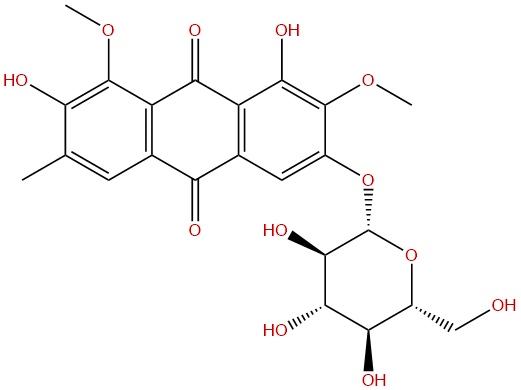


Product name: Aurantio-obtusin β-D-glucoside
Synonym name:
Catalogue No.: BP4013
Cas No.: 129025-96-3
Formula: C23H24O12
Mol Weight: 492.433
Botanical Source:
Physical Description:
Type of Compound: Anthraquinones
Purity: 95%~99%
Analysis Method: HPLC-DAD or/and HPLC-ELSD
Identification Method: Mass, NMR
Packing: Brown vial or HDPE plastic bottle
Storage: Store in a well closed container, protected from air and light. Put into refrigerate or freeze for long term storage.
Whenever possible, you should prepare and use solutions on the same day. However, if you need to make up stock solutions in advance, we recommend that you store the solution as aliquots in tightly sealed vials at -20℃. Generally, these will be useable for up to two weeks.
The product could be supplied from milligrams to grams
Inquire for bulk scale.
For Reference Standard and R&D, Not for Human Use Directly.
Storage conditions:Short-term storage at 2~8℃, long-term storage at -20 ~ -80℃
Aurantio-obtusin β - D-glucoside (CAS number: 129025-96-3) is a naturally occurring β - D-glucosylated dihydroxyanthraquinone compound, mainly distributed in traditional Chinese medicine such as Cassia obtusifolia L. As a glycoside derivative of Aurantio obtusin, it forms a glycosidic bond with β - D-glucose through a 6-position hydroxyl group, endowing it with unique physicochemical properties and biological activity. In recent years, with the deepening development of natural product pharmacology, hesperetin 6-O-glucoside has become a hot topic in natural antioxidant research due to its significant antioxidant activity and potential multi-target regulatory effects. This compound not only exhibits excellent free radical scavenging ability in vitro, but also regulates various signaling pathways related to oxidative stress, demonstrating broad pharmacological application potential.
This article aims to provide a systematic review of the chemical structure and physicochemical properties, plant sources and extraction methods, pharmacological activity and mechanism of action, pharmacological evaluation, pharmacokinetic characteristics, as well as the prospects and challenges in clinical application of orange cassia tin-6-O-glucoside. It is expected to provide theoretical basis and reference for the in-depth research and drug development of this natural product.
Citrus auranti-6-O-glucoside is a glycoside derivative of anthraquinone natural products. Its basic skeleton is dihydroxyanthraquinone, and the 6th hydroxyl group is connected to β - D-glucose through a glycosidic bond. The molecular formula is C23H24O12, with a molecular weight of 492.4330 Da. Its structural characteristics combine the biological activity of anthraquinone compounds with the water solubility advantage of glycosides.
In terms of physical and chemical properties, the LogP value of this compound is 0.5959, indicating that it has good hydrophilicity and moderate lipid solubility, which is conducive to in vivo distribution and cell membrane penetration. The polar surface area (TPSA) is 192.44 Å ², and a higher TPSA value reflects its strong polarity, which may affect its transmembrane absorption ability. The water solubility is 1.6852, indicating that the compound has good solubility in water, which is beneficial for formulation development and in vivo absorption. The low permeability of the blood-brain barrier suggests that its function is mainly limited to peripheral tissues. The hERG channel inhibition experiment result was negative, indicating that the compound has a low risk of cardiac toxicity. The Ames test value is 1.2, indicating a low risk of genotoxicity and a good safety basis.
In summary, the chemical structure of hesperetin 6-O-glucoside endows it with good water solubility and safety, laying the foundation for its use as a drug candidate molecule.
Orange yellow cassisinin-6-O-glucoside is mainly present in Cassia obtusifolia L. and its related species. Cassia seed is the seed of the legume plant Cassia genus, widely used in traditional Chinese medicine for the treatment of diseases such as clearing the liver and improving vision, moistening the intestines and promoting bowel movements. This plant is rich in various anthraquinone compounds, among which quercetin and its glycoside derivatives are one of its main active ingredients.
The commonly used methods for extracting hesperetin 6-O-glucoside include solvent extraction, column chromatography separation, and high-performance liquid chromatography (HPLC) purification. Generally, ethanol or methanol aqueous solution is used as the extraction agent, and ultrasonic assisted extraction or reflux extraction is used to improve the extraction efficiency. The extract was concentrated, separated, and subjected to silica gel column chromatography or reverse phase C18 column separation, and finally purified by HPLC to obtain high-purity hesperetin-6-O-glucoside. In recent years, supercritical fluid extraction and molecular imprinting techniques have also been attempted to be applied to the efficient extraction and purification of this compound, improving the selectivity and yield of extraction.
In addition, the identification methods mainly rely on mass spectrometry (MS), nuclear magnetic resonance (NMR), and ultraviolet visible spectroscopy (UV Vis) techniques to ensure the accuracy of the structure and the reliability of purity.
The pharmacological activity research of hesperetin 6-O-glucoside focuses on its antioxidant, anti-inflammatory, and cell protective effects, especially in the field of antioxidant activity. In vitro experiments have shown that the compound can effectively scavenge various free radicals, such as DPPH, ABTS, and superoxide anion free radicals, demonstrating significant free radical scavenging ability.
In cell models, hesperetin 6-O-glucoside can alleviate cell damage caused by oxidative stress, promote the expression and activity of antioxidant enzymes such as superoxide dismutase (SOD), catalase (CAT), and glutathione peroxidase (GPX), and enhance the antioxidant defense ability of cells. In addition, the compound has a regulatory effect on inflammatory factors such as matrix metalloproteinases (MMP1, MMP3), inhibits inflammatory responses, and reduces tissue damage.
In animal experiments, hesperetin 6-O-glucoside has shown potential to protect the liver, heart, and nervous system, alleviate tissue damage in oxidative stress-related disease models, and improve functional indicators. These studies show that it has potential therapeutic value in antioxidant related diseases such as atherosclerosis, diabetes complications and neurodegenerative diseases.
The antioxidant mechanism of quercetin 6-O-glucoside involves multiple signaling pathways and key molecular targets. Its main targets include tyrosinase (TYR), matrix metalloproteinases 1 and 3 (MMP1, MMP3), nuclear factor erythroid 2-related factor 2 (NFE2L2/NRF2), superoxide dismutase 1 and 2 (SOD1, SOD2), catalase (CAT), glutathione peroxidase 1 (GPX1), and heme oxygenase 1 (HMOX1).
Activation of NRF2 signaling pathway
Orange cassia acid-6-O-glucoside can activate NRF2 transcription factors, promote their nuclear translocation, enhance the expression of downstream antioxidant enzyme genes such as SOD1, CAT, GPX1, and HMOX1, thereby enhancing cellular antioxidant capacity and reducing oxidative stress damage.
Inhibition of matrix metalloproteinase activity
By regulating the expression of MMP1 and MMP3, hesperetin 6-O-glucoside inhibits extracellular matrix degradation, slows down tissue inflammation and fibrosis processes, and protects tissue structural integrity.
Free radical scavenging and enzyme activity regulation
This compound directly scavenges free radicals while promoting the activity of antioxidant enzymes such as SOD1, SOD2, and CAT, synergistically exerting antioxidant effects and maintaining cellular redox homeostasis.
Tyrosinase (TYR) regulation
By regulating TYR activity, hesperetin 6-O-glucoside may affect melanin biosynthesis, indicating its potential application value in skin protection and pigment related diseases.
In summary, the orange cassia acid-6-O-glucoside exerts significant antioxidant and cell protective functions through multi-target and multi pathway synergistic effects.
From the perspective of medicinal properties, Cassinosyl-6-O-glucoside has ideal medicinal properties. The molecular weight of 492.4330 Da is within the suitable range for drug molecules, and the LogP value of 0.5959 indicates good water lipid balance, which is beneficial for in vivo distribution. Although a higher TPSA (192.44 Å ²) may limit its oral absorption, its good water solubility (1.6852) is helpful for formulation development.
The low permeability of the blood-brain barrier suggests that it mainly acts on peripheral tissues, reducing the risk of central nervous system side effects. HERG channel inhibition is negative, reducing the risk of cardiac toxicity. The Ames test results show that its genotoxicity risk is low and its safety is good.
Pharmacokinetic studies are still in the preliminary stage, and existing data shows that the oral absorption of this compound is limited. In vivo metabolism is mainly carried out through the liver enzyme system, and the glucosinolate portion may be hydrolyzed by intestinal microbiota, releasing the nucleus of quercetin, which is further metabolized. Its half-life is moderate, and its excretion pathways are mainly through the kidneys and bile. Further systematic ADME (absorption, distribution, metabolism, excretion) research and toxicological evaluation are needed in the future to improve its pharmacological data.
Orange Cassinosyl-6-O-glucoside, with its excellent antioxidant and multi-target regulatory properties, has shown broad clinical application prospects in various oxidative stress-related diseases. Its potential indications include but are not limited to:
In addition, the good safety of hesperetin 6-O-glucoside provides favorable conditions for its clinical translation. Future research should focus on in-depth analysis of its pharmacological substance basis, formulation optimization, preclinical toxicology and pharmacokinetic system evaluation, as well as conducting clinical trials to verify its efficacy and safety.
Combining modern drug design concepts and utilizing structural modification and nanocarrier technology to enhance its bioavailability and targeting will further promote its clinical application process.
As a natural product with unique structure and significant antioxidant activity, Orange Cassinosyl-6-O-glucoside has shown extensive pharmacological application potential due to its multi-target regulatory mechanism and good drug properties. The current research results have laid a solid foundation for its use as a natural antioxidant and potential drug candidate molecule. However, the pharmacokinetics, toxicology, and clinical evaluation of the system still need to be further deepened to achieve its effective translation from laboratory to clinical use.
In the future, by combining modern pharmacology, medicinal chemistry, and pharmaceutical technology, hesperetin 6-O-glucoside is expected to become an important natural drug resource in the treatment of antioxidant related diseases, promoting the development and innovation of natural product pharmacology.
