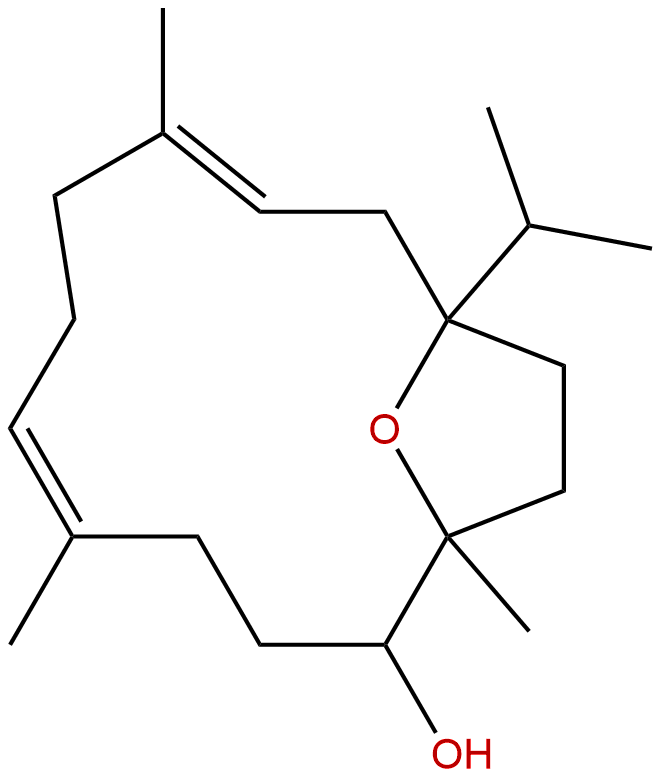


Product name: Incensole
Synonym name:
Catalogue No.: BP1716
Cas No.: 22419-74-5
Formula: C20H34O2
Mol Weight: 306.49
Botanical Source: Boswellia carteri and Boswellia serrata (Indian olibanum)
Physical Description: Oil
Type of Compound:
Purity: 95%~99%
Analysis Method: HPLC-DAD or/and HPLC-ELSD
Identification Method: Mass, NMR
Packing: Brown vial or HDPE plastic bottle
The product could be supplied from milligrams to grams. Inquire for bulk scale.
We provide solution to improve the water-solubility of compounds, thereby facilitating the variety of activity tests and clinic uses.
For Reference Standard and R&D, Not for Human Use Directly.
Description:
Incensole has a protective or stimulating effect on β-cells of the rat pancreas, it also can increase the insulin secretion, which evidenced by a significant increase both in body weight and in liver glycogen.
References:
Planta Med 2015; 81 - PB3
Hypoglycemic and hypolipidemic activities of incensole from Olibanum on streptozotocin diabetic rats[Reference: WebLink]
Incensole is a macrocyclic diterpene with a wide spectrum of bioactivities. It was isolated from the oleogum resin of Boswellia carterii Birdwood.
METHODS AND RESULTS:
This study discusses for the first time the potential hypoglycemic and hypolipidemic effects of Incensole on diabetic rats. Biochemical and histochemical studies completed and confirmed our findings. Diabetes was induced in rats by streptozotocin (STZ, 40 mg/kg), which is a selective β-cells destructor. Incensole was administered daily to diabetic rats at 5 and 10 mg/kg for thirty days. Several parameters were measured including body weight, blood glucose level, lipid profile and plasma enzymes (SGPT, SGOT and ALP). All studies were performed in comparison with the standard drug "Glibenclamide". Results showed that Incensole is effective in lowering the blood-glucose level in the experimental rat model (201.7 ± 9.236) compared to the disease control group (588.8 ± 11.43).
CONCLUSIONS:
Biochemical and histopathological studies proved that Incensole has a protective or stimulating effect on β-cells of the rat pancreas. It also increased the insulin secretion; evidenced by a significant increase both in body weight and in liver glycogen.
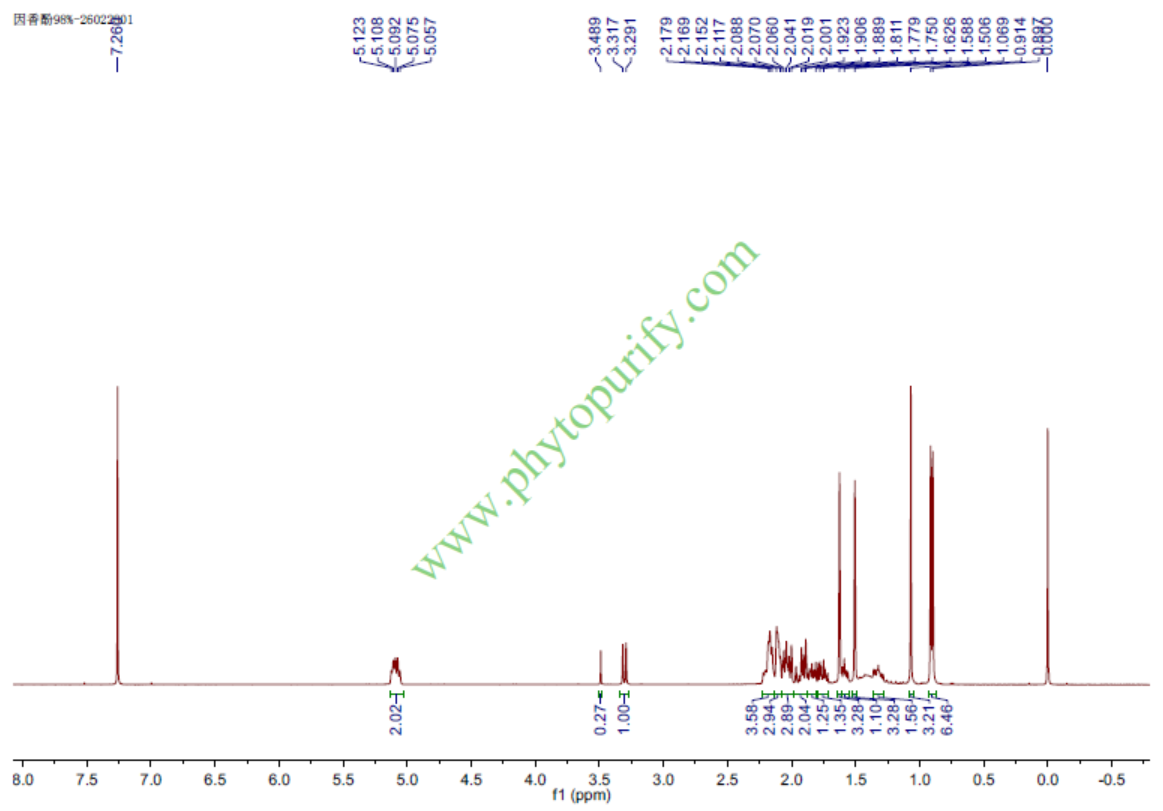
HNMR of Incensole
Storage conditions:Short-term storage at 2~8℃, long-term storage at -20 ~ -80℃
29.4600
4.8901
4.8901
.0078
6.2410
3.0482
High
85.6129
5.3984
No
Yes
No
No
No
No
0.0
Yes
No
Yes
Yes
Natural products have long been an important source of innovative drug discovery, among which terpenoids have attracted much attention due to their structural diversity and wide range of biological activities. Incensole, a unique 14 membered ring diterpenoid compound, initially attracted scholars' interest due to its presence in frankincense resin with a long religious and cultural history. In recent years, with the deepening of modern pharmacological research, phenol has transformed from a cultural symbol to a lead compound with clear biological activity. Research has shown that fenugreek not only exhibits significant anti-inflammatory potential, especially in skin inflammation models, but also demonstrates unique antidepressant and anti anxiety activities due to its ability to cross the blood-brain barrier and regulate ion channel function in the central nervous system. The characteristic of "treating both body and mind", which simultaneously acts on the peripheral inflammatory system and central emotional regulation system, makes it an attractive application prospect in the treatment of chronic inflammatory diseases accompanied by emotional disorders, such as specific types of dermatitis. This article aims to provide a systematic review of the chemical properties, plant sources, pharmacological activities, molecular mechanisms of action, pharmacological characteristics, and clinical translational potential of phenolic compounds, in order to provide a comprehensive academic perspective for the in-depth research and development of this compound.
The chemical name of phenol is (1R, 2S, 4aS, 8aS) -1,2,4a, 5,6,8a-hexahydro-4,7-dimethyl-1- (1-methylethyl) -2-naphthol, and its CAS number is 22419-74-5. Its molecular formula is C20H34O and its molecular weight is 306.49 g/mol. Structurally, the core of phenolic compounds is a 14 membered carbon ring diterpene skeleton composed of three isoprene units, characterized by the presence of substituents such as hydroxyl, methyl, and isopropyl groups connected to the ring system. This medium-sized ring structure gives it a certain degree of conformational flexibility, which is crucial for its interaction with biological targets.
Its physical and chemical properties significantly affect its bioavailability and distribution. The lipid water partition coefficient (LogP) of phenol is 4.89, indicating its high lipophilicity. This characteristic is consistent with its almost insoluble property in water (with a water solubility of about 0.0078 mg/mL), but it is beneficial for its penetration of cell membranes and the blood-brain barrier. Its topological polar surface area (TPSA) is relatively low, only 29.46 Å ², further confirming its characteristics of low molecular polarity and strong lipid solubility. High lipid solubility and low TPSA are key predictive parameters for molecules to efficiently penetrate the blood-brain barrier (BBB), which is consistent with the description of "blood-brain barrier penetration: high" in literature reports and drug parameters. In addition, preliminary pharmacological risk assessment showed that coumarin did not exhibit mutagenicity in the Ames test (result 0.0) and had no significant inhibitory effect on hERG potassium channels, suggesting that it may have lower risks of cardiac and genetic toxicity, laying the foundation for its further development.
Incense phenols mainly come from the resin of Boswellia plants in the olive family (Burseraceae), especially species such as Boswellia careri and Boswellia sacra. The aromatic resin produced by these plants, namely frankincense, has been widely used in religious rituals, spices, and traditional medicine throughout history.
The extraction of phenolic compounds from frankincense resin usually involves organic solvent extraction combined with chromatographic separation technology. Primary extraction often uses volatile organic solvents such as n-hexane, dichloromethane, or ethanol to extract lipophilic components from crushed resins through Soxhlet extraction or cold soaking, resulting in crude extracts rich in terpenes and volatile oils. Subsequently, column chromatography technology is required for separation and purification, often using silica gel column chromatography with solvent systems of different polarities (such as n-hexane/ethyl acetate gradient elution) for preliminary separation. Due to the relatively low content of phenol in the crude extract and its coexistence with other diterpenes with similar structures (such as phenol acetate), further purification using high-performance liquid chromatography (HPLC) or preparative thin layer chromatography (PTLC) is often required to obtain high-purity phenol monomers. In recent years, supercritical CO2 extraction technology has also been attempted for the extraction of active ingredients from frankincense due to its green, efficient, and selectively adjustable characteristics. It is expected to improve the extraction efficiency of phenolic compounds and reduce organic solvent residues.
Numerous in vitro and in vivo studies have confirmed that fenugreek has multiple pharmacological activities, among which anti-inflammatory and neuroprotective/regulatory activities are the most prominent.
anti-inflammatory activity The anti-inflammatory effect of coumarin has been validated in various models. In cell models, it can significantly inhibit the production of nitric oxide (NO) and prostaglandin E2 (PGE2) by macrophages induced by stimuli such as lipopolysaccharide (LPS). In animal models, phenol has shown inhibitory effects on both acute and chronic inflammation. For example, in the mouse ear xylene induced inflammation model, local application of indophenol can alleviate edema; In the rat paw swelling model induced by carrageenan, it also showed dose-dependent anti-inflammatory effects. Of particular concern is its potential application in skin inflammation, as studies have shown that coumarin can improve experimental dermatitis symptoms induced by sodium dodecyl sulfate or allergens, including redness, thickening, and inflammatory cell infiltration.
Antidepressant and anti anxiety activity This is one of the most remarkable activities of phenolic compounds. Behavioral pharmacology experiments have shown that in forced swimming and tail suspension experiments in mice, the administration of coumarin can significantly shorten immobility time and exhibit antidepressant like effects. In the elevated cross maze and open/dark box experiments, the fact that coumarin can increase the exploration time and activity of experimental animals in open arms or open boxes suggests its anti anxiety effect. These effects are related to their ability to quickly cross the blood-brain barrier and directly affect the central nervous system.
Neuroprotective effect In addition to regulating emotions, research also suggests that phenol may have neuroprotective potential. In some cell damage models, it exhibits the ability to reduce neuronal apoptosis and counteract oxidative stress. Its anti-inflammatory effect may also indirectly participate in alleviating neuroinflammation, which is an important pathological link in various neurodegenerative diseases such as Alzheimer's disease.
Other activities There are also preliminary research reports that coumarin may have antibacterial and weak cytotoxic activity, but the strength and mechanism of these activities still need to be further explored.
The pharmacological effects of coumarin stem from its regulation of multiple molecular targets and signaling pathways, and its mechanism of action is complex, involving both peripheral and central systems.
Anti inflammatory mechanism and targets The anti-inflammatory effect of coumarin, especially in dermatitis related models, is mainly achieved by regulating key inflammatory signaling pathways such as nuclear factor kappa B (NF - κ B) and signal transduction and transcriptional activation factor 3 (STAT3).
Mechanism of antidepressant/anti anxiety effects The mechanism of action of coumarin on the central nervous system is different from traditional monoamine antidepressants. The key mechanism is considered to be Activate TRPV3 ion channels in the brain TRPV3 is a temperature sensitive cation channel widely expressed in skin keratinocytes and specific regions of the central nervous system, such as the cortex and hippocampus. Research has shown that as a selective agonist of TRPV3, the activation of coumarin can lead to calcium influx, triggering a series of downstream signaling events that may ultimately promote the expression of brain-derived neurotrophic factor (BDNF) or regulate the neurotransmitter system, resulting in rapid emotional improvement effects. This mechanism provides new ideas for the development of faster acting antidepressant/anxiety drugs.
Although phenol has shown good biological activity, its pharmacological properties still need to be systematically evaluated.
Absorption, distribution, metabolism, excretion (ADME):
Challenges and optimization directions in drug development:
The unique dual action mechanism of coumarin has depicted broad and specific prospects for its clinical application.
Potential therapeutic areas:
Future research directions and challenges:
Due to its dual pharmacological properties of simultaneously acting on peripheral inflammatory pathways and central ion channels, coumarin, a 14 membered cyclic diterpenoid compound derived from ancient frankincense resin, has transformed from a traditional aromatic substance into a highly attractive modern drug lead molecule. Its clear activity in anti-inflammatory (especially targeting multiple targets such as STAT3 and NF - κ B) and antidepressant/anxiety (through activation of TRPV3) provides new ideas for the treatment of complex diseases with psychosomatic interactions. Although it faces challenges in terms of drug solubility, such as poor water solubility, these challenges are expected to be overcome through the comprehensive application of modern medicinal chemistry, pharmacy, and pharmacology technologies. In the future, the in-depth mechanism research, structural optimization, dosage form innovation, and final clinical translation of phenolic compounds may not only give rise to a new class of therapeutic drugs, but also further enrich our understanding of the complex biological effect network of natural products, demonstrating the eternal charm of exploring modern therapeutic value from traditional wisdom.
