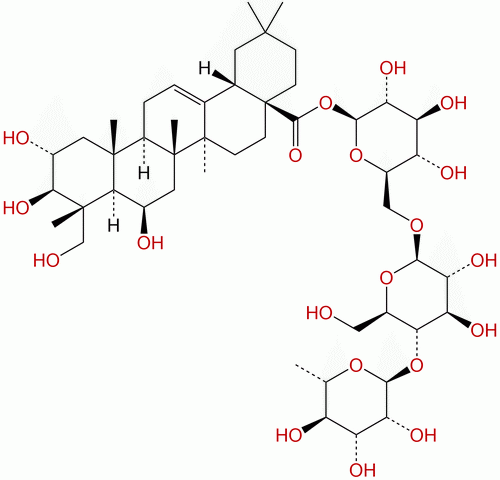


Product name: Asiaticoside B
Synonym name: Terminoloside
Catalogue No.: BP3860
Cas No.: 125265-68-1
Formula: C48H78O20
Mol Weight: 975.132
Botanical Source:
Physical Description:
Type of Compound:
Purity: 95%~99%
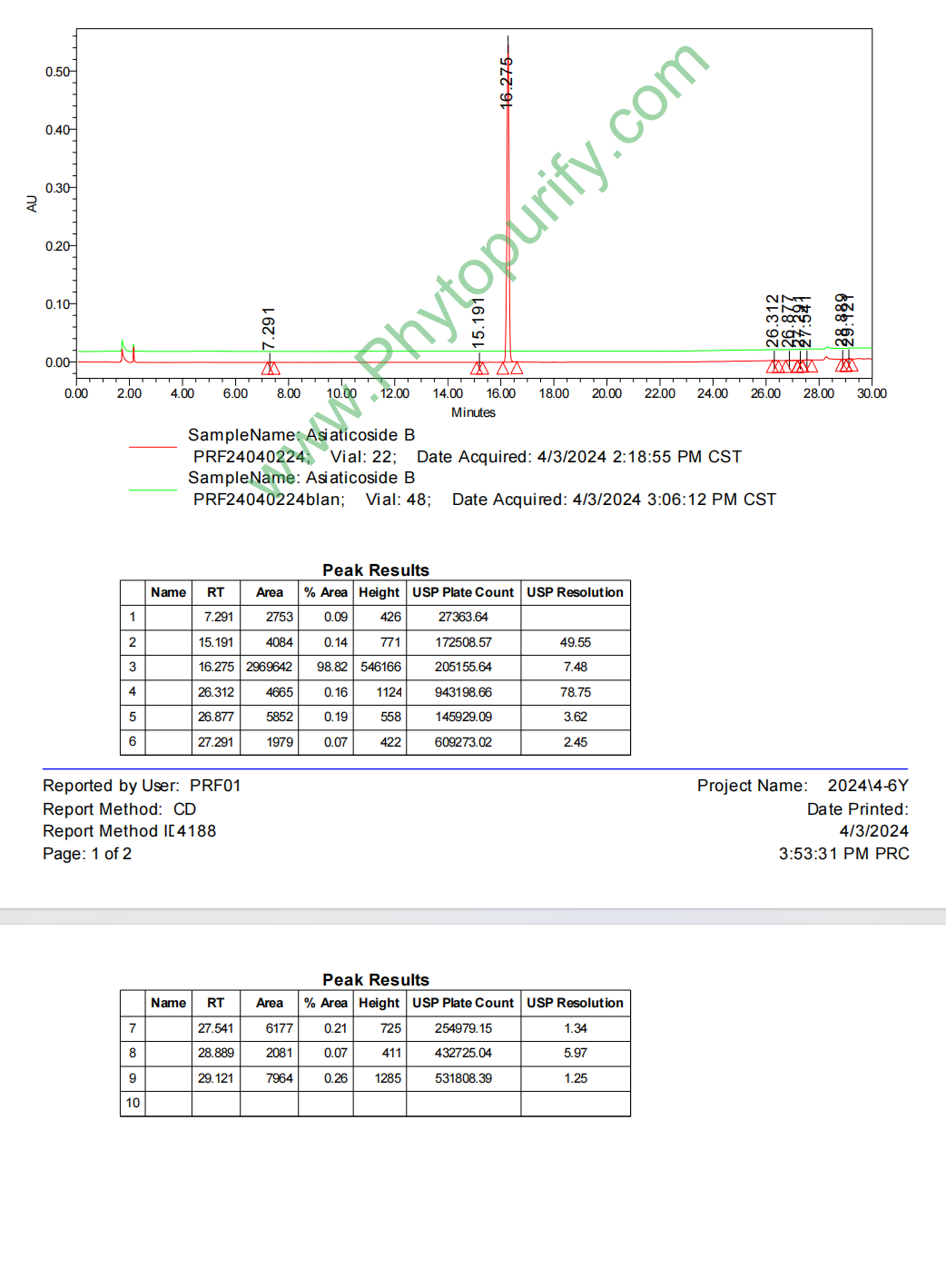
Analysis Method: HPLC-DAD or/and HPLC-ELSD
Identification Method: Mass, NMR
Packing: Brown vial or HDPE plastic bottle
The product could be supplied from milligrams to grams
Inquire for bulk scale.
For Reference Standard and R&D, Not for Human Use Directly.
HPLC of Asiaticoside B
Storage conditions:Short-term storage at 2~8℃, long-term storage at -20 ~ -80℃
335.4400
1.5277
1.5278
.2871
.5494
.3149
Low
62.8206
6.5748
No
No
No
No
No
No
0.0
Yes
No
No
No
Natural products, as an important source of drug discovery, play an irreplaceable role in the long history of human fight against diseases. In recent years, with the rapid development of modern separation and analysis techniques and molecular pharmacology, the exploration of lead compounds with unique biological activity from traditional medicinal plants has become a hot topic in the research and development of new drugs. Snow grass(Centella asiatica (L.) Urb.), As a medicinal plant with a long history of application in traditional Asian medicine, it is known as the "elixir of immortality" and "wisdom herb". Its effects in promoting wound healing, improving cognitive function, and anti-inflammatory have been widely recorded. The pharmacological activity of centella asiatica is mainly attributed to its rich characteristic chemical components - pentacyclic triterpenoid saponins, among which Asiaticoside and Madecassoside are the most extensively studied representative components.
Asiaticoside B, as another important 9,19-cycloartane type triterpenoid glycoside in centella asiatica, has gradually entered the field of researchers in recent years. Similar in structure to Asiaticoside A but with slight differences in sugar chain composition, Asiaticoside B exhibits a unique and broad spectrum of pharmacological activities. Early research mainly focused on its role in promoting wound healing and tissue repair, which is highly consistent with the traditional application of centella asiatica. However, with the deepening of research, the potential of Asiaticoside B in anti-tumor, neuroprotective and other fields has gradually been revealed. Specifically, asiaticoside B can effectively induce hepatoma cells and breast cancer cells to produce cytotoxicity, showing potential anti-tumor activity. Meanwhile, in a neurodegenerative disease model, centella asiatica glycoside B can significantly alleviate 6-hydroxydopamine (6-OHDA) - induced neuronal damage, suggesting its potential application value in the treatment of Parkinson's disease (PD). These findings greatly expand people's understanding of the pharmacological effects of Asiaticoside B, transforming it from a traditional wound healing promoter to a multifunctional natural product with multi-target and multi pathway regulatory potential.
This article aims to systematically review the research progress of Asiaticoside B, covering its chemical structure and physicochemical properties, plant sources and extraction methods, pharmacological activity, mechanism of action and molecular targets, pharmacological evaluation and pharmacokinetic characteristics, as well as its clinical application prospects. By comprehensively reviewing existing research results, this article aims to provide scientific basis for the in-depth development and utilization of Asiaticoside B, and explore its potential and challenges as a candidate drug for treating skin injuries, malignant tumors, and neurodegenerative diseases.
Asiaticoside B is a complex natural glycoside compound. Its chemical structure parent nucleus is 9,19-cycloaltane type triterpenes, which is a relatively special skeleton type in triterpenoid compounds. Its characteristic is the formation of a ternary ring (cyclopropane ring) between C-9 and C-19, giving this type of compound a unique spatial configuration and biological activity. The aglycone of Asiatic acid B is Asiatic acid, which has a hydroxyl group at positions C-2, C-3, and C-23, as well as a carboxyl group at position C-28. The sugar chain is connected to the carboxyl group at position C-28 through ester bonds, consisting of two glucose molecules and one rhamnose molecule. The connection sequence is: β - D-glucopyranosyl - (1 → 4) - β - D-glucopyranosyl - (1 → 6) - β - D-glucopyranosyl - (1 → 4) - α - L-glucopyranosyl. This specific sugar chain composition and connection method is the key to distinguishing between centella asiatica glycoside B and its structural analogues (such as centella asiatica glycoside A, whose sugar chain is trisaccharide).
From the perspective of physical and chemical properties, the molecular formula of Asiaticoside B is C ₄₈ H ₇₈ O ₂₀, with a molecular weight of up to 975.1320 g/mol, making it a macromolecular compound. Its high molecular weight and abundant polar groups (hydroxyl and sugar) determine its physicochemical properties. The calculated lipid water partition coefficient (LogP) is 1.5277, indicating a certain degree of lipophilicity, but overall leaning towards hydrophilicity. The Topological Polar Surface Area (TPSA) is as high as 335.4400 Å ², far exceeding the recommended upper limit of 140 Å ² for oral medications, indicating poor transmembrane permeability, especially difficulty in penetrating the blood-brain barrier. The water solubility data (0.2871 mg/mL) also confirms its limited solubility in water, which may affect its bioavailability. In addition, the prediction of pharmacological parameters showed that Asiaticoside B had no inhibitory activity on hERG potassium channels (hERG inhibition: no), and the Ames test result was 0.0, indicating a low risk of genetic toxicity. Overall, Asiaticoside B exhibits typical physicochemical characteristics of natural saponin compounds, including high molecular weight, high polarity, moderate water solubility, and poor membrane permeability. These properties not only provide advantages in exerting certain local or extracellular effects, but also pose challenges for systemic absorption and targeted delivery after oral administration.
Centella asiatica glycoside B is mainly derived from the genus Centella in the Apiaceae family(Centella)Plant Snow Grass(Centella asiatica (L.) Urb.)。 This plant is widely distributed in tropical and subtropical regions such as Asia, Africa, and South America. In China, it is mainly produced in provinces south of the Yangtze River Basin, such as Zhejiang, Jiangxi, Hunan, Guangdong, Guangxi, etc. The whole plant of centella asiatica can be used as medicine, among which the leaves and stems are the main enriched parts of centella asiatica glycoside B. It is worth noting that the content and composition ratio of triterpenoid saponins in centella asiatica are influenced by various factors, including plant variety, growth environment, harvesting season, processing method, etc. For example, in snow grass samples from different geographical sources, there may be significant differences in the relative content of snow grass glycoside B, snow grass glycoside A, hydroxyl snow grass glycoside, and other components. Therefore, establishing stable and controllable sources of raw materials and standardized extraction processes is crucial for ensuring the research and development of Asiaticoside B.
Traditional methods for extracting Asiaticoside B often use solvent extraction, taking advantage of its solubility in alcohols such as methanol and ethanol. Dry snow grass powder is usually extracted by heating reflux or cold soaking with a certain concentration of ethanol (such as 70% -95%), and the extract is concentrated. Then, different polar solvents such as petroleum ether, ethyl acetate, n-butanol are sequentially used for liquid-liquid extraction to remove lipid soluble impurities and water-soluble impurities such as sugars. Snow grass glycoside B is mainly enriched in the n-butanol extraction layer. However, traditional methods have disadvantages such as low extraction efficiency, high solvent consumption, long time consumption, and incomplete removal of impurities.
To improve extraction efficiency and purity, modern extraction techniques are widely used in the preparation of Asiaticoside B. For example, ultrasound assisted extraction (UAE) utilizes the cavitation effect of ultrasound to destroy plant cell walls, accelerate the dissolution of active ingredients, significantly shorten extraction time, and improve yield. Microwave assisted extraction (MAE) utilizes microwave penetration and selective heating to rapidly increase intracellular temperature and pressure, thereby promoting the release of target components. In addition, Enzyme Assisted Extraction (EAE) has shown promising application prospects by degrading plant cell walls through cellulase, pectinase, and other enzymes, reducing mass transfer resistance.
The crude extract after extraction needs further separation and purification to obtain high purity asiaticoside B. The classic separation methods include silica gel column chromatography, ODS reverse phase column chromatography, Sephadex LH-20 gel column chromatography, etc. In recent years, efficient separation techniques such as high-performance liquid chromatography (HPLC) and high-speed countercurrent chromatography (HSCCC) have also been used for the purification of Asiaticoside B, which can achieve rapid and high-purity separation. For example, by using preparative HPLC with acetonitrile water or methanol water as the mobile phase, it is possible to effectively separate Asiaticoside B from its structural analogues (such as Asiaticoside A). Establishing an integrated process that integrates efficient extraction and rapid purification is key to meeting the future pharmacological research and potential industrialization needs of Asiaticoside B.
In recent years, significant progress has been made in the pharmacological activity research of Asiaticoside B, and its scope of action has expanded from traditional skin repair to multiple fields such as anti-tumor and neuroprotection.
1. Skin repair and wound healing
This is the most classic research direction of centella asiatica glycoside B. Multiple in vitro and in vivo experiments have confirmed that asiaticoside B can promote fibroblast proliferation and migration, and stimulate the synthesis and deposition of collagen, especially type I and III collagen. In animal skin injury models, local application of centella asiatica glycoside B can significantly accelerate wound closure, increase the formation of new granulation tissue, and improve the quality of scar tissue. Its mechanism of action involves the regulation of various growth factors and matrix metalloproteinases (MMPs). Research has shown that centella asiatica glycoside B can upregulate the expression of transforming growth factor - β 1 (TGFB1), vascular endothelial growth factor A (VEGFA), basic fibroblast growth factor (FGF2), and epidermal growth factor receptor (EGFR), thereby promoting angiogenesis, cell proliferation, and tissue remodeling. Meanwhile, it can also regulate the activity of matrix metalloproteinases (such as MMP1, MMP2, MMP9), balance the synthesis and degradation of extracellular matrix, which is crucial for avoiding excessive scar formation. In addition, the regulation of collagen genes (such as COL3A1, COL4A1) and integrin β 1 (ITGB1) is also involved in their promotion of skin repair.
2. Antitumor activity
The potential of Asiaticoside B in anti-tumor therapy has been a research hotspot in recent years. In vitro cell experiments showed that asiaticoside B had significant cytotoxic effects on a variety of cancer cell lines, especially on liver cancer cells (such as HepG2, Huh7) and breast cancer cells (such as MCF-7, MDA MB-231) in a dose-dependent and time-dependent manner. Its anti-tumor mechanism is relatively complex, mainly including:
- Inducing cell apoptosis Asiaticoside B can induce cancer cell apoptosis by activating the mitochondrial apoptosis pathway (endogenous pathway) and the death receptor pathway (exogenous pathway). Specifically, it manifests as: reducing mitochondrial membrane potential, promoting cytochrome c release, activating Caspase-9 and Caspase-3; Upregulate the expression of pro apoptotic proteins Bax and Bad, and downregulate the expression of anti apoptotic proteins Bcl-2 and Bcl xL.
- Inducing cell cycle arrest: It was found that asiaticoside B can block hepatoma cells or breast cancer cells in G0/G1 phase or G2/M phase, thereby inhibiting cell proliferation. This may be related to regulating the expression of cyclins and cyclin dependent kinases (CDKs) in cells.
- Inhibit cell migration and invasion Asiaticoside B can significantly inhibit the migration and invasion ability of cancer cells, which may be related to its downregulation of the expression and activity of matrix metalloproteinases (such as MMP-2, MMP-9), thereby inhibiting the metastatic potential of tumors.
- Induce autophagy In certain cancer cells, it has been found that asiaticoside B can induce autophagic cell death, which adds a new dimension to its anti-tumor mechanism.
3. Neuroprotective effect
The protective effect of Asiaticoside B in neurodegenerative diseases, especially in Parkinson's disease (PD) models, has attracted much attention. 6-Hydroxydopamine (6-OHDA) is a commonly used neurotoxin that can specifically damage dopaminergic neurons and mimic the pathological features of Parkinson's disease. Research has confirmed that pretreatment with Asiaticoside B can significantly alleviate 6-OHDA induced neuronal cell damage (such as SH-SY5Y cells) and improve cell survival rate. Its neuroprotective mechanisms may include:
- anti-oxidative stress The toxic effects of 6-OHDA are partly due to its induced oxidative stress. Asiaticoside B can enhance the activity of endogenous antioxidant enzymes in cells, such as superoxide dismutase (SOD) and glutathione peroxidase (GSH Px), while reducing the levels of reactive oxygen species (ROS) and malondialdehyde (MDA), thereby alleviating oxidative damage.
- anti-apoptotic Similar to its anti-tumor mechanism, Asiaticoside B can also inhibit 6-OHDA induced apoptosis in nerve cells by regulating Bcl-2 family proteins and Caspase activity.
- Protecting mitochondrial function Asiaticoside B can stabilize mitochondrial membrane potential, improve mitochondrial dysfunction, and reduce ATP depletion caused by 6-OHDA.
- Regulating neurotrophic factors Studies have shown that centella asiatica glycoside B may promote neuronal survival and functional maintenance by upregulating the expression of neurotrophic factors such as brain-derived neurotrophic factor (BDNF).
The pharmacological activity of Asiaticoside B is the comprehensive result of its interaction with multiple molecular targets and regulation of multiple signaling pathways. A deep understanding of its mechanism of action is crucial for developing it into targeted drugs.
1. Molecular targets and pathways related to skin repair
In the process of skin repair, the target network of Asiaticoside B mainly revolves around promoting cell proliferation, migration, angiogenesis, and extracellular matrix remodeling.
- TGF - β/Smad pathway TGF - β 1 is a core regulatory factor for wound healing. Asiaticoside B can upregulate the expression of TGFB1, thereby activating the phosphorylation of downstream Smad2/3 proteins, promoting the transformation of fibroblasts into myofibroblasts, and stimulating the synthesis of type I and III collagen proteins (COL1A1, COL3A1) and fibronectin.
- EGFR/MAPK pathway Asiaticoside B can activate epidermal growth factor receptor (EGFR), thereby initiating downstream Ras/Raf/MEK/ERK and PI3K/Akt signaling cascades. The activation of the ERK pathway is closely related to cell proliferation and migration, while the activation of the Akt pathway has anti apoptotic and pro cell survival effects.
- VEGF/VEGFR pathway By upregulating the expression of VEGFA, Asiaticoside B can promote the proliferation of endothelial cells and the formation of tubular structures, accelerate angiogenesis in wound areas, and provide necessary oxygen and nutrition for tissue repair.
- MMPs/TIMPs balance The regulation of matrix metalloproteinases (MMP1, MMP2, MMP9) by centella asiatica glycoside B exhibits duality. Moderately upregulating MMPs activity during the early stages of wound healing can help clear damaged extracellular matrix and provide space for the growth of new tissue; In the later stage of remodeling, upregulation of matrix metalloproteinase tissue inhibitors (TIMPs) or downregulation of MMP activity are used to prevent excessive degradation, promote orderly collagen deposition, and scar maturation.
2. Anti tumor related molecular targets and pathways
The anti-tumor effect of centella asiatica glycoside B involves multiple signaling pathways related to cell survival, proliferation, apoptosis, and metastasis.
- PI3K/Akt/mTOR pathway This pathway is abnormally activated in various cancers and is a key pathway that promotes cell survival and proliferation. Asiaticoside B can inhibit the phosphorylation of PI3K and Akt, thereby blocking their downstream effects, including activating mTOR and inhibiting the pro apoptotic protein Bad. Inhibition of this pathway is an important mechanism by which asiaticoside B induces apoptosis and autophagy in cancer cells.
- MAPK pathway The regulation of the MAPK pathway (including ERK, JNK, p38) by Asiaticoside B is cell type dependent. In liver cancer and breast cancer cells, it can usually activate JNK and p38, which are often associated with stress response and apoptosis induction; Simultaneously inhibiting the activity of ERK, thereby blocking proliferation signals.
- NF - κ B pathway Nuclear factor kappa B (NF - κ B) is a key transcription factor that regulates inflammation, cell survival, and tumor progression. Centella asiatica glycoside B can inhibit the phosphorylation and degradation of I κ B α, thereby preventing the nuclear translocation of NF - κ B, downregulating the expression of its target genes (such as Bcl-2, MMP-9, VEGF), and exerting anti-inflammatory, pro apoptotic, and anti metastatic effects.
- Wnt/β - catenin pathway The abnormal activation of this pathway is related to the occurrence and development of various tumors. Asiaticoside B has been found to inhibit the nuclear translocation of β - catenin, downregulate the expression of its target genes (such as Cyclin D1 and c-Myc), and induce cell cycle arrest.
3. Molecular targets and pathways related to neuroprotection
In the Parkinson's disease model, the neuroprotective effect of Asiaticoside B mainly targets oxidative stress, mitochondrial dysfunction, and apoptosis.
- Nrf2/ARE pathway Nuclear factor E2 related factor 2 (Nrf2) is a core regulatory factor of the cellular antioxidant defense system. Snow grass glycoside B can activate Nrf2, promoting its dissociation from Keap1 and translocation into the nucleus, binding to antioxidant response elements (ARE), initiating the transcription of downstream antioxidant enzymes (such as HO-1, NQO1, SOD, GSH Px), thereby enhancing the cell's ability to resist oxidative stress.
- PI3K/Akt pathway Contrary to its effect in tumor cells, in nerve cells, asiaticoside B can promote cell survival by activating the PI3K/Akt pathway. Activated Akt can phosphorylate and inhibit pro apoptotic proteins Bad and Caspase-9, while activating mTOR to promote protein synthesis and cell growth.
- Mitochondrial protection mechanism Asiaticoside B can directly act on mitochondria by maintaining mitochondrial membrane potential, inhibiting the opening of mitochondrial permeability transition pores (mPTP), and reducing the release of cytochrome c, thereby blocking the initiation of mitochondrial apoptosis pathway.
To promote the clinical application of Asiaticoside B from the laboratory, a systematic evaluation of its drug like and pharmacokinetic (ADME) properties is necessary. As mentioned earlier, the molecular weight (975.13 Da) and TPSA (335.44 Å ²) of Asiaticoside B far exceed the traditional "Lipinski Five Rules" oral drug standards (MW<500, TPSA<140 Å ²), indicating that its oral bioavailability may be extremely low. Its LogP value is 1.53, indicating strong hydrophilicity and unfavorable for passive transmembrane diffusion. Although the water solubility (0.2871 mg/mL) is not extremely poor, it is also not ideal. These physical and chemical properties together constitute the main obstacles to its medicinal properties.
At present, there is relatively limited in vivo research data on the pharmacokinetics of Asiaticoside B, but it can be inferred from the research results of its structural analogues (such as Asiaticoside). After oral administration, the absorption of Asiaticoside B in the gastrointestinal tract may be poor, mainly due to its large molecules and high polarity, which make it difficult to penetrate the intestinal epithelial cell membrane. In addition, it may also be metabolized by the gut microbiota and digestive enzymes, such as the gradual hydrolysis of sugar chain components to produce secondary glycosides or aglycones (oxalic acid). Glycosides, due to their smaller molecular weight and enhanced lipid solubility, may have better absorption than the original drug. Therefore, after oral administration of Asiaticoside B, its exposure form in the body may be a mixture of the prototype drug and multiple metabolites, and its efficacy may be the result of the synergistic effect of these components. Intravenous injection or local administration may be a more effective route of administration to avoid absorption barriers. Its blood-brain barrier penetration ability is predicted to be "low", which is consistent with its high molecular weight and polarity. For Parkinson's disease treatment that requires central targeting, this is a major challenge that needs to be overcome.
In terms of toxicology, preliminary pharmacological parameter predictions indicate that it has no hERG inhibitory activity (low risk of cardiac toxicity), and the Ames test is negative (low risk of genetic toxicity), providing preliminary positive signals for its safety. However, comprehensive toxicological evaluation, including acute toxicity, long-term toxicity, reproductive toxicity, etc., remains an indispensable part of future research. In order to improve the pharmacological properties of Asiaticoside B, the following strategies can be considered in future pharmaceutical chemistry and pharmacy research: 1) designing prodrugs to enhance lipid solubility and membrane permeability by modifying their polar groups (such as hydroxyl and carboxyl groups); 2) Develop new drug delivery systems, such as liposomes, nanoparticles, phospholipid complexes, etc., to improve their solubility, stability, and targeting; 3) Explore non oral routes of administration, such as transdermal, nasal, or injectable administration.
As a natural product derived from traditional medicinal plants, centella asiatica glycoside B has shown promising clinical application prospects in multiple disease fields due to its multi-target and multi pathway pharmacological activities.
1. In the field of skin repair and beauty
This is the most direct and mature potential application direction of centella asiatica glycoside B. Based on its role in promoting wound healing, anti-inflammatory, antioxidant and regulating collagen metabolism, asiaticoside B is expected to be developed into a new topical drug or dressing for treating refractory wounds such as burns, wounds, surgical incisions, diabetes foot ulcers, etc. In addition, its potential in inhibiting scar formation and improving skin photoaging also makes it have broad application prospects in the fields of cosmetics and medical beauty, such as as as an active ingredient in anti wrinkle, repair, and whitening products.
2. Anti tumor field
Centella asiaticoside B has significant toxic effects on liver cancer and breast cancer cells, providing a basis for its use as an anti-tumor candidate drug. However, its low oral bioavailability and potential systemic toxicity are key issues that need to be addressed. Future research directions may include: 1) developing local drug delivery formulations (such as intratumoral injection, transdermal delivery) for the treatment of skin cancer or superficial tumors; 2) Using it as a chemotherapy sensitizer in combination with existing chemotherapy drugs to reduce the dosage and toxic side effects of chemotherapy drugs; 3) Improve its targeting and bioavailability to tumor tissues through structural modification or nano delivery systems.
3. In the field of neurodegenerative diseases
The neuroprotective effect of Asiaticoside B in Parkinson's disease models is encouraging. Although its ability to penetrate the blood-brain barrier is limited, effective central delivery may be achieved through nasal administration or the development of nanocarriers capable of crossing the blood-brain barrier. In addition, its antioxidant and anti-inflammatory mechanisms also suggest that it may have a protective effect in other neurodegenerative diseases such as Alzheimer's disease (AD) and Huntington's disease. In the future, more in vivo pharmacological studies are needed, especially the use of animal models that are closer to clinical practice (such as transgenic PD mouse models), to verify their efficacy.
Challenges and Prospects
Despite the bright prospects, the clinical translation of Asiaticoside B still faces many challenges. The primary challenge is its poor pharmacokinetic properties, especially low oral bioavailability and low blood-brain barrier penetration. Secondly, although its pharmacological mechanism is broad, its specificity is not strong, which may lead to off target effects. In addition, the industrial production of large-scale and high-purity centella asiatica glycoside B is also a bottleneck restricting its development. Future research should focus on: 1) using medicinal chemistry methods to optimize structures and search for derivatives with better activity and drug properties; 2) Develop advanced drug delivery systems to achieve targeted, efficient, and controllable release; 3) Using systems pharmacology and network pharmacology methods to more comprehensively reveal its target network and molecular mechanisms of action; 4) Conduct systematic and standardized preclinical toxicology and pharmacokinetic studies to lay the foundation for clinical trials.
Centella asiatica glycoside B, a 9,19-cycloartane triterpenoid glycoside derived from the ancient medicinal plant Centella asiatica, is undergoing a profound transformation from traditional empirical medicine to modern evidence-based medicine. This article systematically reviews its research progress in chemistry, pharmacy, pharmacology, and drug evaluation, and clearly outlines its profile as a "multifunctional natural product". The pharmacological activity spectrum of asiaticoside B has been continuously expanded and deepened from the classic application of promoting skin repair, to the new anti-tumor discovery of inducing cytotoxicity of liver cancer and breast cancer, and to the neuroprotective potential of reducing 6-OHDA induced nerve injury. Its mechanism of action involves precise regulation of multiple key signaling pathways such as TGF - β, EGFR, PI3K/Akt, Nrf2, NF - κ B, as well as multiple molecular targets such as MMPs and Bcl-2 family, reflecting the unique advantages of natural product multi-target and multi pathway integrated regulation.
However, we must also be aware of the huge gap between laboratory discoveries and clinical applications. The inherent physicochemical property defects of Asiaticoside B, such as high molecular weight, high polarity, and low permeability, are the main challenges facing its drug development, severely restricting its systemic bioavailability and central targeting ability after oral administration. Therefore, future research should not only focus on discovering new pharmacological activities, but also shift more towards how to overcome these obstacles. Through the modification of drug chemical structures, the development of novel drug delivery systems (such as nanocarriers and prodrug strategies), and the exploration of non oral delivery routes (such as transdermal and nasal administration), it is expected to break through its application bottlenecks. At the same time, utilizing modern omics techniques and bioinformatics methods to elucidate its precise mechanism of action in complex disease networks will provide theoretical guidance for precise applications.
In summary, Asiaticoside B is a natural product lead compound with great research and development value. Despite the numerous challenges ahead, with its unique chemical structure and extensive pharmacological activity, particularly in the fields of skin repair, anti-tumor, and neuroprotection, we have reason to believe that through continuous interdisciplinary efforts, Asiaticoside B or its optimized derivatives have the potential to be transformed into innovative drugs that benefit human health. The in-depth study of it is not only a modern interpretation of traditional medicine wisdom, but also a hopeful exploration in the field of natural product drug discovery.
