


Synonym name: Madecassol; Blastostimulina; Centelase; Emdecassol; Marticassol
Catalogue No.: BP0204
Cas No.: 16830-15-2
Formula: C48H78O19
Mol Weight: 959.133
Botanical Source: Centella asiatica (Asiatic pennywort) and Hydrocotyle asiatica
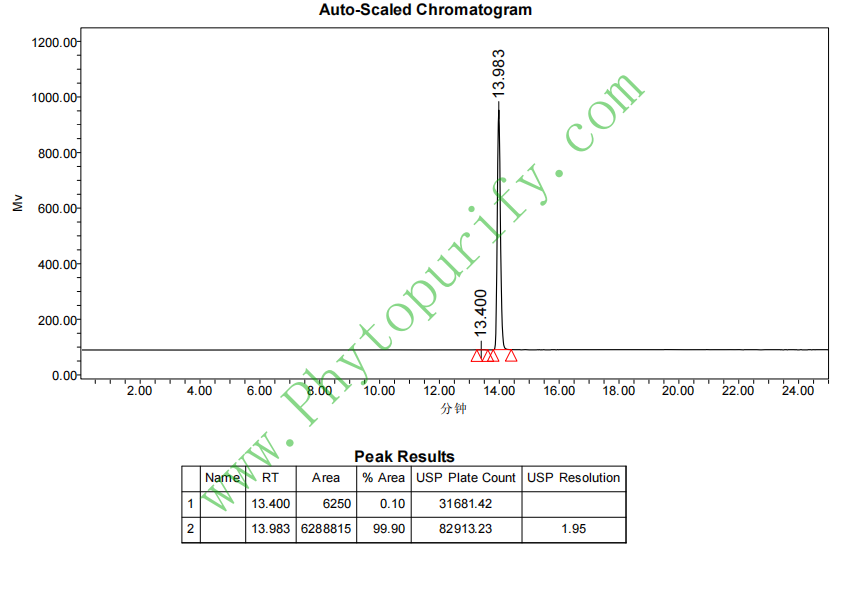
Purity: 95%~99%
Analysis Method: HPLC-DAD or/and HPLC-ELSD
Identification Method: Mass, NMR
Packing: Brown vial or HDPE plastic bottle
Can be supplied from milligrams to grams.
For Reference Standard and R&D, Not for Human Use Directly.
Inquire for bulk scale.
Storage conditions:Short-term storage at 2~8℃, long-term storage at -20 ~ -80℃
315.2100
1.9367
1.9365
.1723
.5551
.6692
Low
72.1976
6.5022
Yes
No
No
No
No
No
0.0
Yes
No
No
Yes
Asiaticoside (CAS number: 16830-15-2) is a major active triterpenoid saponin component isolated from the traditional medicinal plant Asiaticoside. Snow grass has a long history of application in traditional Asian medicine systems, often used to promote wound healing, treat skin diseases, and fight inflammation. Modern pharmacological studies reveal that asiaticoside exhibits a wide range of biological activities, including significant anti fibrosis, anti-oxidation, anti-inflammatory, anti ulcer and promoting wound repair, which makes it show great potential in many therapeutic fields such as skin scar, diabetes complications, neurodegenerative diseases, etc. Especially its key role in regulating the transforming growth factor - β (TGF - β)/Smad signaling pathway provides a molecular basis for the treatment of diseases with abnormal fibrosis as the core. In recent years, with a deeper understanding of the pathogenesis of metabolic diseases such as hyperglycemia and its complications, the potential efficacy of centella asiatica glycosides in regulating blood glucose homeostasis, improving insulin resistance, and protecting target organs has also received increasing attention. This article aims to systematically review the chemical properties, plant sources, pharmacological activities, molecular mechanisms of action, pharmacological evaluation, and clinical application prospects of centella asiatica glycoside, in order to provide comprehensive scientific references for the in-depth research and development of this natural product.
The chemical name of centella asiatica glycoside is 2,3,23-trihydroxyole-2-en-28-acid O-6-deoxy - α - L-mannosyl - (1 → 4) - O - β - D-glucopyranosyl - (1 → 6) - β - D-glucopyranoside. Its molecular formula is C48H78O19 and its molecular weight is 959.1330. Structurally, it belongs to the pentacyclic triterpenoid saponins, with oleanane type triterpenoid glycosides (asiatic acid) as the core, connected to a trisaccharide chain consisting of glucose, glucose, and xylose at the C-28 carboxyl group. This unique glycosylation structure is crucial for its water solubility and biological activity.
The physicochemical property data shows that the calculated lipid water partition coefficient (LogP) is 1.9367, indicating that the compound has a certain degree of lipophilicity, but not high lipophilicity. The topologically polar surface area (TPSA) is as high as 315.2100 Å ², which is mainly attributed to the abundant hydroxyl and sugar structures in the molecule, indicating that it has more hydrogen bond donor and acceptor sites. The water solubility value is 0.1723, belonging to the category of slightly soluble to poorly soluble, which poses a challenge to the development of its formulations. Preliminary predictions of drug efficacy suggest that its blood-brain barrier permeability is low, which to some extent limits its direct effects on central nervous system diseases, but may also reduce the risk of central side effects. In addition, the risk of hERG inhibition is "no", and the Ames test result is 0.0, indicating that it may have lower risks of cardiac and genetic toxicity, and its safety characteristics are relatively favorable.
Centella asiatica glycoside mainly comes from the dried whole plant of the Umbelliferae family plant Centella asiatica. Snow grass is widely distributed in tropical and subtropical regions around the world, including China, India, Sri Lanka, Madagascar, and other places, with abundant resources. As a medicinal plant, it is recorded in Ayurvedic medicine and traditional Chinese medicine.
The extraction and separation of centella asiatica glycoside are usually carried out using solvent extraction combined with various chromatographic purification techniques. The conventional process is as follows: first, the dried centella asiatica medicinal material is crushed, and heated reflux extraction or ultrasound assisted extraction is performed using methanol, ethanol, or ethanol water mixed solvents to effectively extract saponin components. The extract is concentrated under reduced pressure to obtain a paste. Subsequently, the extract is usually defatted with petroleum ether or ethyl acetate to remove weakly polar impurities such as chlorophyll and oil, while the water or alcohol layer is rich in saponins. Further enrichment is carried out by macroporous adsorption resin column chromatography, often using a water ethanol gradient elution. Asiaticoside usually appears in the moderately polar elution site. Finally, techniques such as silica gel column chromatography, reverse phase silica gel column chromatography (such as C18), and preparative high-performance liquid chromatography were used for repeated separation and purification to obtain high-purity centella asiatica monomers. Modern extraction techniques such as microwave-assisted extraction and supercritical fluid extraction have also been applied in research aimed at improving extraction efficiency and reducing solvent consumption.
Centella asiatica glycoside has diverse and significant pharmacological activities, and its research has expanded from traditional skin repair to multiple systemic disease fields.
Anti fibrosis and promotion of wound healing This is the most classic and extensively studied activity of centella asiatica glycoside. It can significantly inhibit the excessive proliferation of fibroblasts in lesions such as keloids and hypertrophic scars, reduce the excessive synthesis and deposition of collagen (especially type I and III collagen), and promote the orderly arrangement of collagen fibers. In animal skin injury models, centella asiatica glycoside can accelerate epithelial regeneration, granulation tissue formation, and angiogenesis, thereby promoting wound healing and reducing scar formation.
Antioxidant and anti-inflammatory properties Centella asiatica glycoside can effectively eliminate free radicals such as DPPH and superoxide anions, enhance the activity of endogenous antioxidant enzymes such as superoxide dismutase (SOD) and glutathione peroxidase (GSH Px), reduce malondialdehyde (MDA) levels, and alleviate oxidative stress damage. Its anti-inflammatory effect is manifested by inhibiting the production of pro-inflammatory mediators such as tumor necrosis factor - α (TNF - α), interleukin-1 β (IL-1 β), IL-6, and prostaglandin E2 (PGE2), as well as downregulating the expression of inducible nitric oxide synthase (iNOS) and cyclooxygenase-2 (COX-2), which are closely related to the inhibition of inflammatory signaling pathways such as nuclear factor kappa B (NF - κ B).
Neuroprotective and Anti Alzheimer's Disease Potential Centella asiatica glycoside can improve cognitive dysfunction in various animal models. Its mechanism involves antioxidant, anti-inflammatory, inhibition of β - amyloid (A β) aggregation, reduction of tau protein hyperphosphorylation, and promotion of synaptic growth and neuronal survival. This is related to the regulation of targets such as APP and BACE1 that will be mentioned in the following text.
Potential effects on hyperglycemia and its complications The research shows that asiaticoside can reduce blood sugar, improve insulin sensitivity and reduce insulin resistance in diabetes animal models. In addition, it has protective effects on diabetes nephropathy, diabetes retinopathy, diabetes skin ulcer and other complications, which are inseparable from its anti-inflammatory, antioxidant and anti fibrosis properties.
Other activities Including anti ulcer (enhancing gastric mucosal defense factors), anti depression, anti anxiety, anti-tumor (inducing apoptosis, inhibiting proliferation), and protecting cardiovascular and cerebrovascular systems.
The multiple pharmacological activities of centella asiatica stem from its regulation of multiple key signaling pathways and molecular targets.
Core pathway: TGF - β/Smad signaling pathway In its anti fibrotic effect, centella asiatica glycoside has been proven to be a highly effective inhibitor of the TGF - β/Smad pathway. The specific mechanism includes:Upregulation of inhibitory Smad7 protein expression Smad7, as a negative feedback regulator, can bind to TGF - β receptor type I (TGF - β RI), prevent Smad2/3 phosphorylation of receptor activation, and promote receptor ubiquitination degradation. Therefore, centella asiatica glycoside activates Smad7, thereby Inhibition of the activity and expression of TGF - β RI and TGF - β RII Ultimately, it blocks the phosphorylation and nuclear translocation of Smad2/3, as well as the transcription of downstream pro fibrotic genes such as collagen and plasminogen activator inhibitor-1. This mechanism is the core of its treatment for skin scars and organ fibrosis.
Target network associated with hyperglycemia Regarding hyperglycemia, centella asiatica glycoside may act on a complex target network:
Other important pathways: Also includes PI3K/Akt(Promote cell survival and glucose metabolism)MAPK(Regulating proliferation and inflammation)Nrf2/ARE(Activate antioxidant defense system) and Wnt/β-catenin(Participate in wound healing and tissue regeneration) and other pathways.
Despite the wide pharmacological activity of centella asiatica glycoside, its medicinal properties still face some challenges.
pharmacokinetics Centella asiatica glycoside is a highly polar molecule with generally low oral bioavailability. Animal studies have shown that its oral absorption is poor, possibly due to low intestinal permeability and/or hydrolysis by gut microbiota (glycosylation is hydrolyzed into aglycone asiatic acid). After absorption, centella asiatica glycoside is widely distributed in the body, but its blood-brain barrier permeability is low, consistent with predictions. Its main metabolic pathways may be hydrolysis and glucuronidation/sulfation combined. The excretion pathway may mainly be through bile and feces, with less excretion by the kidneys. Its aglycone, oxalic acid, may be one of its important active forms in vivo.
Challenges and Strategies in Drug Development:
1. Solubility and permeability Moderate LogP and high TPSA result in poor solubility and membrane permeability, affecting oral absorption. The strategy includes developing prodrugs (such as esterification modification), using absorption enhancers, or preparing them into nano formulations (such as liposomes, nanoparticles, micelles), cyclodextrin inclusion complexes, etc., to improve solubility and biofilm permeability.
2. Formulation selection: In view of its excellent local skin effect, topical dosage forms (such as cream, gel, microneedle patch) are the most mature and successful development direction at present, which can directly act on the target site and avoid the short board of systemic pharmacokinetics. For indications requiring systemic administration (such as diabetes and neurodegenerative diseases), it is necessary to focus on the delivery system for oral or injection administration.
3. safety The existing data suggests that it has good safety, but the systemic toxicity of long-term, high-dose use still needs to be systematically evaluated. Its low hERG inhibition and Ames negative results are its advantages.
The clinical application prospects of centella asiatica glycoside are broad, but it needs to be explored in stages and fields.
Recent prospects (in the field of external skin applications)Based on solid anti fibrotic evidence, centella asiatica glycoside and its formulations (often combined with centella asiatica) are effective in Prevention and treatment of hypertrophic scars, keloids, post burn scars, and postoperative scars It has been widely applied and continuously optimized in various aspects. In Chronic difficult to heal wounds(such as diabetes foot ulcer, venous ulcer)Atopic dermatitis, psoriasis In inflammatory skin diseases, its topical preparations have also shown good potential. This is the field closest to marketization and deep clinical validation.
Mid term prospects (systemic diseases):
Long term outlook and research directions:
As a natural triterpenoid saponin derived from traditional herbs, centella asiatica glycoside exhibits remarkable pharmacological activities in anti fibrosis, antioxidant, anti-inflammatory, and metabolic regulation due to its unique multi-target and multi pathway mechanism of action. From inhibiting the TGF - β/Smad signaling pathway to regulating multiple targets related to hyperglycemia and complications, such as AMPK, SGLT2, BACE1, etc., the molecular level action profile is becoming increasingly clear. Despite the challenges of low oral bioavailability in drug formulation, these obstacles are gradually being overcome through advanced drug delivery technologies and dosage form improvements. At present, it has established an important position in the field of skin scar management, and has great potential in the application of systemic diseases such as diabetes, organ fibrosis, neurodegenerative diseases. In the future, through deepening mechanism research, innovating drug chemistry and formulation design, and conducting standardized clinical research, centella asiatica glycoside is expected to be successfully transformed from an excellent natural active molecule into an innovative drug for treating various major diseases, fully reflecting the sustained value of natural products in modern drug development.
