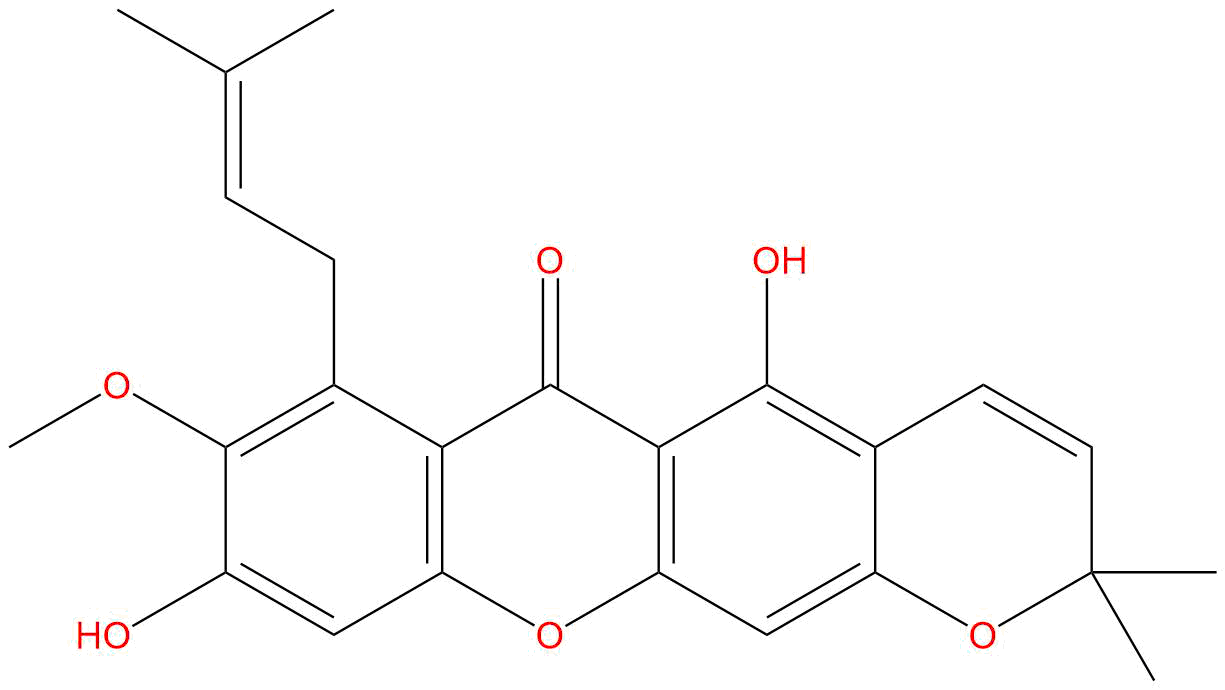


Product name: 9-Hydroxycalabaxanthone
Synonym name: Xanthone I
Catalogue No.: SBP01854
Cas No.: 35349-68-9
Formula: C24H24O6
Mol Weight: 408.45
Botanical Source:
Type of Compound: Xanthones
Purity: 95%~99%
Analysis Method: HPLC-DAD or/and HPLC-ELSD
Identification Method: Mass, NMR
Packing: Brown vial or HDPE plastic bottle
Storage: Store in a well closed container, protected from air and light. Put into refrigerate or freeze for long term storage.
Whenever possible, you should prepare and use solutions on the same day. However, if you need to make up stock solutions in advance, we recommend that you store the solution as aliquots in tightly sealed vials at -20℃. Generally, these will be useable for up to two weeks.
The product could be supplied from milligrams to grams
Inquire for bulk scale.
For Reference Standard and R&D, Not for Human Use Directly.
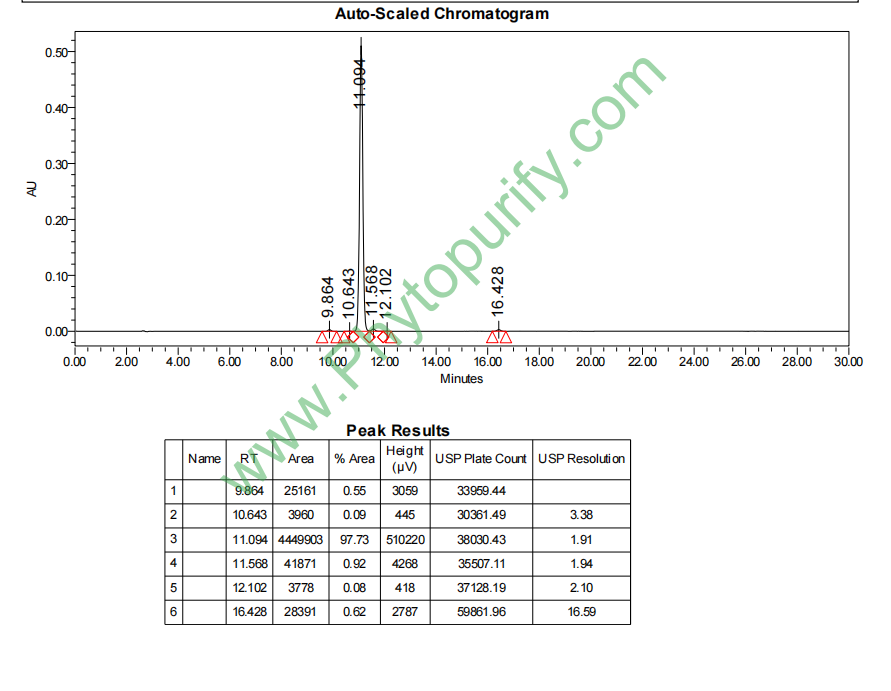
HPLC of 9-Hydroxycalabaxanthone
Storage conditions:Short-term storage at 2~8℃, long-term storage at -20 ~ -80℃
89.1300
4.7423
4.6404
.0075
5.5298
9.7974
Low
91.9708
3.3058
No
No
Yes
No
Yes
Yes
0.6
No
Yes
Yes
Yes
Natural products, as an important source of drug discovery, have played an irreplaceable role in the long history of human struggle against diseases. Among them, Xanthone compounds have always been a hot topic in natural product chemistry and pharmacology research due to their structural diversity and wide range of biological activities. The basic skeleton of anthraquinone is composed of two benzene rings fused together through a γ - pyranone ring. This unique planar tricyclic structure endows it with the potential to interact with various biological targets. Tenghuang genus(Garcinia)Plants, especially mangosteen(Garcinia mangostana L.), Known for its rich content of anthraquinone compounds, it is known as the "treasure trove of anthraquinone compounds". The compounds such as α - mangostin isolated from the skin of mangosteen have been widely studied, exhibiting various pharmacological activities such as anti-inflammatory, antioxidant, and anti-tumor effects.
In this context, 9-Hydroxycalabazanthone (CAS number: 35349-68-9), also known as Xanthone I, as a natural anthraquinone isolated from mangosteen, is gradually attracting the attention of researchers. Early research revealed its quorum sensing inhibition, antibacterial, and antimalarial activities, particularly against Plasmodium falciparum(Plasmodium falciparum)Exhibiting a micromolar level inhibitory effect (IC ₅₀=1.2-1.5 μ M). However, as research deepens, the potential of 9-Hydroxycalabazanthone in the field of anti-tumor treatment becomes increasingly prominent. Existing evidence suggests that this compound can inhibit tumor cell proliferation, induce apoptosis, resist angiogenesis, and reverse drug resistance by regulating multiple key signaling pathways and molecular targets, such as MCL1, BCL2, STAT3, MMP2, TOP1, HIF1A, TOP2A, MAPK1, ESR1, and CYP19A1. This multi-target characteristic makes it uniquely advantageous in dealing with complex diseases, especially malignant tumors with high heterogeneity and drug resistance.
This article aims to provide a systematic review of the research progress of 9-Hydroxycalaboxone, covering its chemical structure and physicochemical properties, plant sources and extraction methods, pharmacological activity, mechanism of action, drug evaluation, and clinical application prospects, in order to provide comprehensive scientific basis for the in-depth development and utilization of this natural product.
The chemical structure of 9-Hydroxycalabazanthone belongs to the typical isopentenyl anthraquinone. Its core skeleton is 1,3,6,7-tetrahydroxyanthraquinone, which is connected to an isopentenyl (3,3-dimethylallyl) side chain at positions C-2 and C-8, respectively. This structural feature, which is the combination of multiple phenolic hydroxyl groups and hydrophobic isopentenyl side chains, is a common feature of many naturally occurring anthraquinone compounds with strong biological activity. Phenolic hydroxyl groups endow molecules with certain polarity and the ability to form hydrogen bonds, which are key functional groups for their interaction with target proteins; The isopentenyl side chain increases the lipophilicity of the molecule, facilitating its crossing of biological membranes and binding to membrane receptors or intracellular hydrophobic pockets.
The molecular formula of this compound is C ₂₄ H ₂₄ O ₆, with a molecular weight of 408.45 Da. Its physicochemical properties are crucial for predicting its drug properties. According to the results of the computational chemistry simulation, the lipid water partition coefficient (LogP) of 9-Hydroxycalaboxone is 4.74, indicating its strong lipid solubility, which is consistent with its structural characteristics of containing two isopentenyl side chains. Although a higher LogP value is beneficial for membrane permeability, it may also lead to poor water solubility. The predicted value of its water solubility is only 0.0075 mg/mL, which may become a key bottleneck limiting its bioavailability and administration method in practical applications. The topological polar surface area (TPSA) is 89.13 Å ², which is slightly higher than the recommended threshold for oral drugs (<140 Å ²), but still within an acceptable range, suggesting that it may have some oral absorption potential, but the degree of absorption may be limited. In addition, the predicted results show that its blood-brain barrier penetration ability is low, which means that the potential of this compound in the treatment of central nervous system diseases may be limited, but it also reduces the risk of central nervous system related toxic side effects. The predicted result of hERG inhibition is' no ', which is a positive signal indicating a low likelihood of severe cardiac toxicity such as prolonged QT interval in the heart. The Ames test predicted a value of 0.6, indicating a potential genetic toxicity risk, which needs to be given special attention and validation in subsequent toxicological evaluations.
The main plant source of 9-Hydroxycalaboxone is the genus Tenghuang, with the most well-known being the mountain bamboo(Garcinia mangostana L.)。 Mangkhut is native to Southeast Asia, and its fruit is known as the "queen of fruits". The flesh is edible, while the skin is often used in traditional medicine to treat various diseases such as infections, inflammation, and diarrhea. Modern chemical research has shown that the skin of mangosteen is an enriched site for anthraquinone compounds, and over 50 types of anthraquinone have been isolated and identified from it, among which 9-Hydroxycalabazanthone is one. In addition, this compound is also present in other plants of the Tenghuang genus, such as Garcinia cambogia、Garcinia cova Wait, but the content is usually low.
The extraction of 9-Hydroxycalaboxone from plant materials typically follows the classic process of natural product chemistry. Firstly, crush the dried mangosteen peel and extract it using organic solvents. Due to the moderate polarity of the target compound, commonly used extraction solvents include methanol, ethanol, acetone, or their mixed solvents with water. To improve extraction efficiency and selectivity, techniques such as heating reflux, ultrasound assisted extraction, or microwave-assisted extraction can be used. The crude extract is obtained by filtering and concentrating the extract under reduced pressure.
Subsequently, the crude extract needs to be purified through a series of chromatographic separation techniques. Liquid liquid extraction is a commonly used enrichment method as the first step. For example, the crude extract is suspended in water and sequentially extracted with solvents such as petroleum ether, ethyl acetate, and n-butanol to separate the components of different polarities. 9-Hydroxycalabazanthone is usually enriched in ethyl acetate or petroleum ether extraction layers due to its lipophilicity. Further separation and purification mainly rely on silica gel column chromatography, using solvent systems such as petroleum ether ethyl acetate or chloroform methanol in different ratios for gradient elution. In addition, Sephadex LH-20 gel column chromatography is often used for further separation based on molecular size. High performance liquid chromatography (HPLC) or preparative thin layer chromatography (PTLC) are effective methods for achieving final purification of highly structurally similar anthraquinone homologues. The isolated compound was structurally identified using techniques such as nuclear magnetic resonance spectroscopy (NMR), mass spectrometry (MS), and ultraviolet visible spectroscopy (UV Vis). After comparison with known literature data, it was ultimately confirmed to be 9-Hydroxycalaboxone.
The pharmacological activity research of 9-Hydroxycalabazanthone covers two major fields: anti infection and anti-tumor, among which anti-tumor activity has become a research focus in recent years.
1. Anti infective activity
Early research revealed the antibacterial and antimalarial potential of 9-Hydroxycalabazanthone. In terms of antibacterial activity, the compound exhibits inhibitory effects on various bacteria, but its mechanism of action is not traditional bactericidal or bacteriostatic, but rather by interfering with the Quorum Sensing (QS) system of bacteria. QS is a chemical communication mechanism between bacteria that regulates group behavior such as biofilm formation and expression of virulence factors. 9-Hydroxycalaboxone can inhibit Pseudomonas aeruginosa(Pseudomonas aeruginosa)Waiting for the QS system of pathogenic bacteria to reduce their pathogenicity and ability to form drug resistance without directly killing them provides a new approach for developing novel anti infective drugs.
In terms of antimalarial effects, 9-Hydroxycalaboxone is effective against Plasmodium falciparum(P. falciparum)Exhibiting significant inhibitory activity, with IC ₅₀ values ranging from 1.2-1.5 μ M. This activity level is comparable to some clinically used antimalarial drugs, demonstrating its potential as an antimalarial lead compound. However, the specific molecular targets and mechanisms of its anti malarial effect are currently unclear and require further research.
2. Antitumor activity
In recent years, significant progress has been made in the study of the anti-tumor activity of 9-Hydroxycalabazanthone. A large number of in vitro cell experiments have shown that this compound has broad-spectrum proliferation inhibitory effects on a variety of human tumor cell lines, including but not limited to breast cancer, lung cancer, colon cancer, liver cancer, prostate cancer and melanoma. Its mechanism of action is complex and involves multiple levels:
The pharmacological activity of 9-Hydroxycalabazanthone, especially its anti-tumor activity, is not derived from its action on a single target, but is achieved through a network regulation mode of "multi-target, multi pathway". This mode of action is a significant feature that distinguishes it from many highly selective, single target drugs, and it may also be advantageous in dealing with complex diseases. Based on existing research, the key molecular targets and signaling pathways can be summarized as follows:
Apoptotic regulatory network The core targets include MCL1 and BCL2. MCL1 and BCL2 are key anti apoptotic proteins in the mitochondrial apoptosis pathway, highly expressed in many tumor cells, and are important causes of chemotherapy resistance. 9-Hydroxycalaboxone disrupts the balance between pro apoptotic and anti apoptotic forces in cells by downregulating the levels of MCL1 and BCL2 proteins, making it easier for cells to enter the apoptotic program. Meanwhile, inhibition of STAT3 is also involved in this process, as STAT3 is an important transcriptional activator of MCL1 and BCL2.
Extracellular matrix remodeling and metastasis The key target is MMP2. Tumor metastasis is the main cause of death in cancer patients. MMP2 breaks down the basement membrane and extracellular matrix, paving the way for tumor cell invasion and migration. 9-Hydroxycalaboxone effectively inhibits tumor metastasis by suppressing upstream signals such as MAPK1 (ERK2), reducing transcription and zymogen activation of MMP2.
Tumor microenvironment and angiogenesis The core target is HIF1A. Within solid tumors, rapid growth leads to insufficient oxygen supply, creating a hypoxic microenvironment. HIF1A is stably expressed in this environment and drives a series of adaptive responses, including promoting angiogenesis. 9-Hydroxycalaboxone inhibits the protein expression or transcriptional activity of HIF1A, cutting off the production of downstream factors such as VEGF, thereby suppressing tumor angiogenesis, improving the tumor microenvironment, and inhibiting tumor growth.
DNA damage and replication stress The key targets are TOP1 and TOP2A. Topoisomerase is responsible for solving topological problems in DNA replication and transcription processes. 9-Hydroxycalaboxone can be used as a topoisomerase toxin to stabilize enzyme DNA complexes, leading to DNA strand breaks, replication fork arrest, and cell death. This mechanism is an important source of its direct cytotoxicity.
Endocrine signal interference The key targets are ESR1 and CYP19A1. In breast cancer, estrogen combines with ESR1 to promote cell proliferation. 9-Hydroxycalaboxone can competitively bind to ESR1 and exert anti estrogenic effects. At the same time, it can also inhibit the activity of CYP19A1 (aromatase), reduce the conversion of testosterone to estrogen, and thus lower the level of estrogen in the body. This dual endocrine regulation mechanism has potential application value in the treatment of ER positive breast cancer.
In summary, 9-Hydroxycalabazanthone forms a synergistic anti-tumor network by simultaneously acting on multiple key processes such as apoptosis, metastasis, angiogenesis, DNA damage repair, and endocrine signaling. This multi-target mode of action may lead to a wider spectrum of anti-tumor activity and lower incidence of drug resistance, while also increasing the complexity of its toxicological evaluation.
The evaluation of drug properties is a crucial step in pushing natural products from laboratory discoveries to clinical applications. Based on the physical and chemical properties and preliminary pharmacological data described earlier, a systematic evaluation of the pharmacological properties of 9-Hydroxycalabazanthone was conducted.
1. Analysis of drug properties
According to Lipinski's "Rule of Five", the molecular weight of 9-Hydroxycalaboxone (408.45 Da) is slightly higher than the threshold of 500 Da, and the LogP value (4.74) also exceeds the threshold of 5. This indicates that it may face challenges in oral absorption and does not conform to the typical characteristics of traditional oral medications. However, many successful natural product drugs, such as paclitaxel and cyclosporine, have also broken through the "five rules", so this is not an absolute rejection criterion. Its TPSA (89.13 Å ²) and the number of hydrogen bond donors/acceptors (phenolic hydroxyl groups) are within an acceptable range. Overall, the class of 9-Hydroxycalaboxone is moderate and falls within the scope of the "beyond Rule of Five". Its development may require consideration of non oral administration routes or the use of drug delivery systems.
2. Pharmacokinetic characteristics
At present, there is very limited research data on the pharmacokinetics of 9-Hydroxycalabazanthone in vivo, and most predictions are based on computational models. Its extremely low water solubility (0.0075 mg/mL) is the biggest pharmacokinetic barrier, which will seriously affect its bioavailability after oral absorption. Although high LogP values are beneficial for membrane permeability, they may also lead to their widespread distribution in the body and easy metabolism by liver metabolic enzymes (such as CYP450 enzyme system), resulting in first pass effects. In addition, its potential high protein binding rate may also limit the concentration of free drugs. The prediction result of low blood-brain barrier penetration ability, although limiting its application in brain diseases, also reduces the risk of central neurotoxicity. The low risk of hERG inhibition is a favorable safety signal. However, the positive predictive result of the Ames test (0.6) is a highly alert signal that must be rigorously validated through in vitro and in vivo genotoxicity experiments.
3. Challenges and Strategies Faced
The main challenges for the commercialization of 9-Hydroxycalabazanthone are:a) Poor water solubility;b) Potential genetic toxicity;c) Pharmacokinetic properties unknown。
Possible solutions to these challenges include:
- Drug delivery system Modern drug delivery technologies such as liposomes, nanoparticles, cyclodextrin inclusion complexes, and phospholipid complexes can significantly improve the solubility, stability, and bioavailability of poorly soluble drugs.
- Prodrug design Introducing water-soluble groups such as phosphate esters and amino acid esters onto the phenolic hydroxyl groups of molecules to make prodrugs, which can be released after enzymatic hydrolysis or hydrolysis in vivo, can effectively improve their water solubility and oral absorption.
- Structural modification On the basis of retaining the core pharmacophore, reasonable chemical modifications should be made to the isopentenyl side chain or phenolic hydroxyl group to optimize its LogP, water solubility, metabolic stability, and reduce potential toxicity.
- Optimization of administration route Due to the difficulty of oral absorption, non oral routes such as intravenous injection, transdermal administration, or inhalation administration can be prioritized to bypass the absorption barrier.
Despite the challenging path towards commercialization of 9-Hydroxycalabazanthone, its unique pharmacological activity and multi-target mechanism of action paint a broad prospect for its clinical application.
1. Potential applications in the field of anti-tumor therapy
Given its broad-spectrum anti-tumor activity and unique mechanism of action, the most promising application of 9-Hydroxycalabazanthone is in tumor therapy. Its multi-target properties make it particularly suitable for:
- combination therapy When used in combination with traditional chemotherapy drugs (such as cisplatin, paclitaxel) or targeted drugs, it may produce synergistic effects and reduce the dosage and toxic side effects of a single drug. For example, its inhibition of MCL1 and BCL2 may reverse the resistance of certain tumors to chemotherapy drugs.
- Treat specific subtypes of tumors Its dual inhibitory effects on ESR1 and CYP19A1 make it of great value in the treatment of ER positive breast cancer, especially in patients resistant to tamoxifen or aromatase inhibitors.
- Anti tumor metastasis and recurrence By inhibiting MMP2 and HIF1A, this compound may effectively suppress tumor invasion, metastasis, and angiogenesis, which is crucial for preventing postoperative recurrence and metastasis.
2. Potential applications in the field of anti infection
Its unique quorum sensing inhibition mechanism provides a new strategy for addressing the increasingly severe problem of bacterial resistance. Unlike traditional antibiotics, QS inhibitors do not directly kill bacteria, making them less prone to selective pressure and potentially slowing down the development of drug resistance. 9-Hydroxycalaboxone can be used as an "anti virulence factor" drug, in combination with existing antibiotics, for the treatment of chronic and refractory infections caused by Pseudomonas aeruginosa and other bacteria.
3. Future research directions
In order to promote the clinical translation of 9-Hydroxycalabazanthone, future research should focus on the following aspects:
- In depth pharmacokinetic research Conduct systematic pharmacokinetic experiments in vivo to clarify its absorption, distribution, metabolism, and excretion (ADME) characteristics in animals, identify its main metabolites and metabolic enzymes.
- Comprehensive toxicological evaluation Conduct acute and chronic toxicity experiments, especially in vitro and in vivo validation of potential genetic toxicity suggested by Ames tests, to evaluate their safety window.
- Fine analysis of the mechanism of action Using chemical biology methods such as drug affinity reaction target stability techniques, thermal proteomics analysis, etc., directly identify its direct targets in cells and elucidate the molecular details of its binding to each target.
- Research on Structural Optimization and Structure Performance Relationship Systematically synthesize a series of structurally similar compounds, study the effects of isopentenyl side chain length, position, and phenolic hydroxyl substitution mode on activity and drug formation, and search for candidate compounds with higher activity, lower toxicity, and better pharmacokinetic properties.
- Development of drug delivery system Design and prepare nano formulations suitable for 9-Hydroxycalabazanthone to enhance its water solubility, targeting, and therapeutic efficacy.
9-Hydroxycalabazanthone, as a natural anthraquinone derived from mangosteen, has shown significant research value and development potential in the fields of anti-tumor and anti infection due to its unique chemical structure and multi-target pharmacological activity. It exerts multiple effects by regulating a series of key targets such as MCL1, BCL2, STAT3, MMP2, TOP1, HIF1A, ESR1, CYP19A1, etc., synergistically inducing apoptosis, inhibiting proliferation, anti metastasis, anti angiogenesis, and regulating endocrine signals. However, its poor water solubility and potential genetic toxicity are the main obstacles to its commercialization.
In the future, research on 9-Hydroxycalabazanthone should go beyond simple activity screening and shift towards systematic studies guided by clinical translation. By combining modern medicinal chemistry, pharmacokinetics, toxicology, and nanomedicine delivery technologies, it is expected to overcome its inherent shortcomings and develop it into a new class of candidate drugs with independent intellectual property rights. The in-depth exploration of such natural products not only provides new weapons for humanity to overcome major diseases such as cancer and drug-resistant bacterial infections, but also once again confirms the eternal value of nature as the best source of inspiration for drug discovery.
