| Catalog No | Package | Original Price | Price | Inventory | Quantity | Operating |
|---|---|---|---|---|---|---|
| BP0620-5mg | 5mg | $420.00 | Sign in |
|


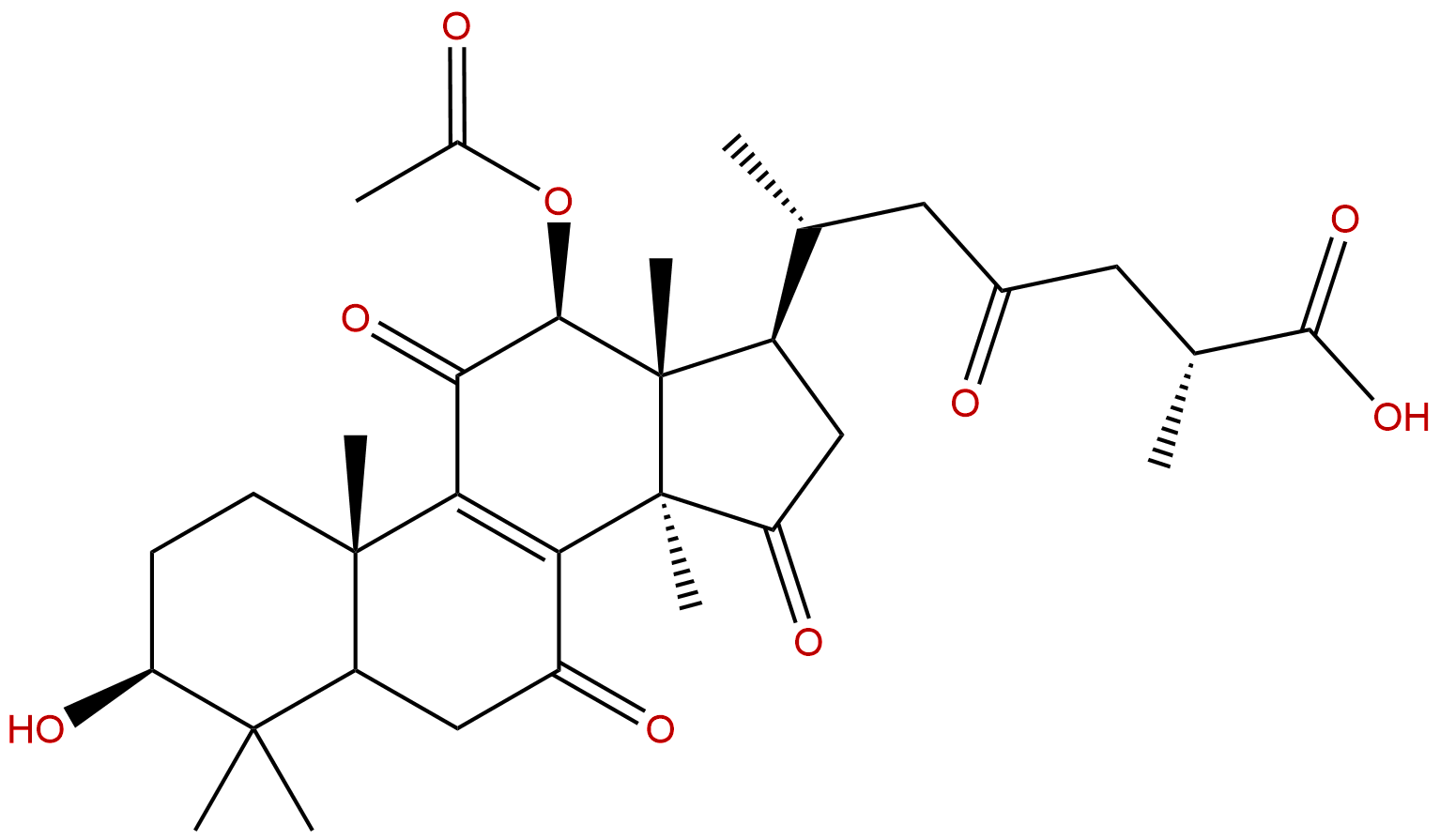
Product name: Ganoderic Acid H
Synonym name: Ganoderic acid C
Catalogue No.: BP0620
Cas No.: 98665-19-1
Formula: C32H44O9
Mol Weight: 572.695
Botanical Source: From Ganoderma lucidum (reishi)
Physical Description: Powder
Type of Compound: Triterpenoids
Purity: 95%~99%
Analysis Method: HPLC-DAD or/and HPLC-ELSD
Identification Method: Mass, NMR
Packing: Brown vial or HDPE plastic bottle
Storage: Store in a well closed container, protected from air and light. Put into refrigerate or freeze for long term storage.
Whenever possible, you should prepare and use solutions on the same day. However, if you need to make up stock solutions in advance, we recommend that you store the solution as aliquots in tightly sealed vials at -20℃. Generally, these will be useable for up to two weeks.
The product could be supplied from milligrams to grams, up to kilograms
Inquire for bulk scale.
Descriptions:
Ganoderic acid H( GA-H )and ganoderic acid A(GA-A ) suppress growth (cell proliferation and colony formation) and invasive behavior (adhesion, migration and invasion) of MDA-MB-231 cells; they mediate their biological effects through the inhibition of transcription factors AP-1 and NF-kappaB, resulting in the down-regulation of expression of Cdk4 and the suppression of secretion of uPA, respectively; furthermore, the activity of ganoderic acids is linked to the hydroxylation in the position 7 and 15 (GA-A) and 3 (GA-H) in their triterpene lanostane structure; so hydroxylated triterpenes from G. lucidum could be promising natural agents for the therapy of invasive breast cancers.[1]
References:
[1] Jiang J, Grieb B, Thyagarajan A, et al. Int J Mol Med, 2008, 21(5):577-84.
[2] Wang X M, Guan S H, Liu R X, et al. Journal of Shenyang Pharmaceutical University, 2007, 24(07):407-9.
Storage conditions:Short-term storage at 2~8℃, long-term storage at -20 ~ -80℃
Ganoderma lucidum(Ganoderma lucidum)As a traditional Chinese medicinal herb, it has always been known as the "fairy grass" due to its wide pharmacological activity and significant health benefits. Among them, ganoderic acid H, as an important lanolin type triterpenoid compound in Ganoderma lucidum, has attracted much attention in recent years due to its multi-target and multi mechanism biological activity. Ganoderic acid H not only shows significant anti-tumor activity, especially in the growth inhibition and invasion inhibition of breast cancer cells, but also has a variety of biological functions such as immune regulation. This article will systematically review the chemical structure and physicochemical properties, plant sources and extraction methods, pharmacological activity and mechanism of action, pharmacological evaluation and pharmacokinetic characteristics of ganoderic acid H, and explore its clinical application prospects and future research directions, aiming to provide theoretical basis and practical guidance for the drug development of this natural product.
Lingzhi acid H (CAS number: 98665-19-1) belongs to the lanolin type triterpenoid compound, with a molecular formula of C30H48O7 and a molecular weight of 572.6950. Its structural core is a pentacyclic lanolane skeleton with multiple hydroxyl and carboxyl functional groups, endowing it with high polarity and biological activity. In terms of physicochemical properties, the LogP value of ganoderic acid H is 2.8683, indicating its moderate lipid solubility, which is beneficial for membrane penetration. However, its water solubility is relatively low (0.0152), which may limit its dispersibility and bioavailability in aqueous environments. Its topological polar surface area (TPSA) is 152.1100, indicating its strong polarity and hydrogen bonding ability, which is of great significance for its binding with biomolecule targets. Lingzhi acid H does not have the ability to penetrate the blood-brain barrier. The hERG channel inhibition test is negative, and the Ames mutagenicity test result is 0, indicating its high safety and low risk of toxic side effects.
Lingzhi acid H mainly comes from the fruiting body and mycelium of Ganoderma lucidum. Lingzhi, as a fungus of the genus Lingzhi in the family Polyporus, is widely distributed in temperate and subtropical regions of Asia. The content of triterpenoids is significantly affected by factors such as variety, cultivation environment, harvesting time, and processing technology. The extraction of ganoderic acid H is usually carried out using organic solvent extraction method, with commonly used solvents including ethanol, methanol, and ethyl acetate. The extraction process generally includes steps such as drying and crushing, solvent extraction, concentration, separation and purification. In recent years, supercritical CO2 extraction and ultrasound assisted extraction techniques have gradually been applied to the extraction process of ganoderic acid H to improve extraction efficiency and purity. In terms of purification, methods such as silica gel column chromatography and reverse phase high performance liquid chromatography (RP-HPLC) are often used to ensure the acquisition of high-purity ganoderic acid H samples for pharmacological research.
The pharmacological activities of ganoderic acid H mainly focus on anti-tumor and immune regulation aspects. A large number of in vitro cell experiments show that Ganoderic acid H can significantly inhibit the proliferation and migration of breast cancer cells, induce cell apoptosis, and block the process of cell cycle. In addition, ganoderic acid H has regulatory effects on various immune related targets, promoting the recovery and balance of immune function in the body.
Lingzhi acid H inhibits the growth and invasion ability of tumor cells by regulating multiple signaling pathways. Especially in the breast cancer model, Ganoderic acid H shows obvious cytotoxicity, which can reduce the proliferation rate and invasion and migration ability of tumor cells. Its anti-tumor mechanism involves the inhibition of transcription factors AP-1 and NF - κ B, which in turn downregulates the expression of tumor promoting genes and blocks the transmission of intracellular growth promoting signals.
Lingzhi acid H has multiple regulatory effects on the immune system, which can regulate key immune related targets such as TLR4, STAT3, IL2, NFKB1, TGFB1, CTLA4, STAT4, IL10, FOXP3, and IFNG, regulate the activity of immune cells and cytokine secretion, and promote immune balance. Its immune regulatory effect helps to enhance the body's disease resistance, inhibit tumor immune escape, and improve inflammatory response.
The mechanism of action of ganoderic acid H is mainly achieved by regulating the intracellular signal transduction network and transcription factor activity.
AP-1 and NF - κ B are important transcription factors that regulate cell proliferation, differentiation, apoptosis, and immune response. Lingzhi acid H can inhibit the activation of these two signaling pathways, reduce the expression of pro-inflammatory cytokines and pro tumor genes, thereby inhibiting the growth and invasion of tumor cells. The specific mechanism includes blocking the phosphorylation and degradation of I κ B α, inhibiting the nuclear translocation of p65 subunit, and reducing the DNA binding activity of AP-1 complex.
The pharmacological evaluation of ganoderic acid H shows that it has certain potential for drug development. Although the molecular weight of 572.6950 is slightly higher than the ideal range of small molecule drugs, it is within a reasonable range in natural products. The LogP value of 2.8683 indicates moderate lipid solubility, which is beneficial for cell membrane penetration. A higher TPSA (152.1100) indicates strong polarity, which may affect oral absorption and bioavailability. The low water solubility (0.0152) is a major challenge in the development of its formulations, and it is necessary to improve solubility and bioavailability through formulation modification or nanocarrier technology.
The low penetration ability of the blood-brain barrier suggests that ganoderic acid H mainly acts on peripheral tissues, reducing the risk of central nervous system toxicity. The hERG channel inhibition experiment was negative, indicating a low risk of cardiac toxicity. The Ames test result is 0, indicating that it has no mutagenicity and good safety.
At present, there is limited research on the pharmacokinetics of ganoderic acid H. Preliminary data indicate that its oral absorption is slow, it is widely distributed in the body, and its metabolism is mainly through the liver enzyme system. The excretion pathway still needs further study. In the future, the in vivo dynamics, metabolic pathways, and toxicological evaluation should be strengthened to lay the foundation for clinical development.
Lingzhi acid H has broad clinical application prospects due to its significant anti-tumor and immune regulatory effects. Breast cancer is a high incidence malignant tumor for women in the world. The existing treatment methods have problems of drug resistance and side effects. Ganoderic acid H, as a natural product, provides a new treatment idea. It can effectively inhibit tumor cell proliferation and metastasis through multi-target and multi mechanism synergistic effects, while regulating the immune status of the tumor microenvironment, enhancing anti-tumor immune response, and has potential adjuvant therapeutic value.
In addition, ganoderic acid H has shown good regulatory potential in immune related diseases such as autoimmune diseases, chronic inflammation, and immune dysfunction. In the future, modern drug delivery systems such as nanocarriers and liposomes can be combined to improve their pharmacokinetic properties, enhance in vivo stability and targeting.
Preclinical research should further expand the spectrum of action of ganoderic acid H, systematically evaluate its safety and effective dosage, conduct animal models and early clinical trials to verify its clinical efficacy and safety. By combining molecular docking and structural optimization, we aim to develop derivatives or analogues of ganoderic acid H to enhance their efficacy and drug properties, and promote their clinical translation.
Lingzhi acid H, as an important triterpenoid natural product in Ganoderma lucidum, has shown broad application prospects in the fields of anti-tumor and immune regulation due to its unique chemical structure and multi-target pharmacological activity. It exerts synergistic anti-cancer and immune regulatory effects by inhibiting the AP-1 and NF - κ B signaling pathways, regulating various immune related targets. Although there are certain limitations in its water solubility and pharmacokinetic properties, it is expected to overcome these obstacles and achieve clinical application through modern drug development techniques and in-depth mechanism research. In the future, systematic research and clinical development of ganoderic acid H will provide important examples for natural product drug innovation, promoting the modernization of traditional Chinese medicine and the development of precision therapy.
