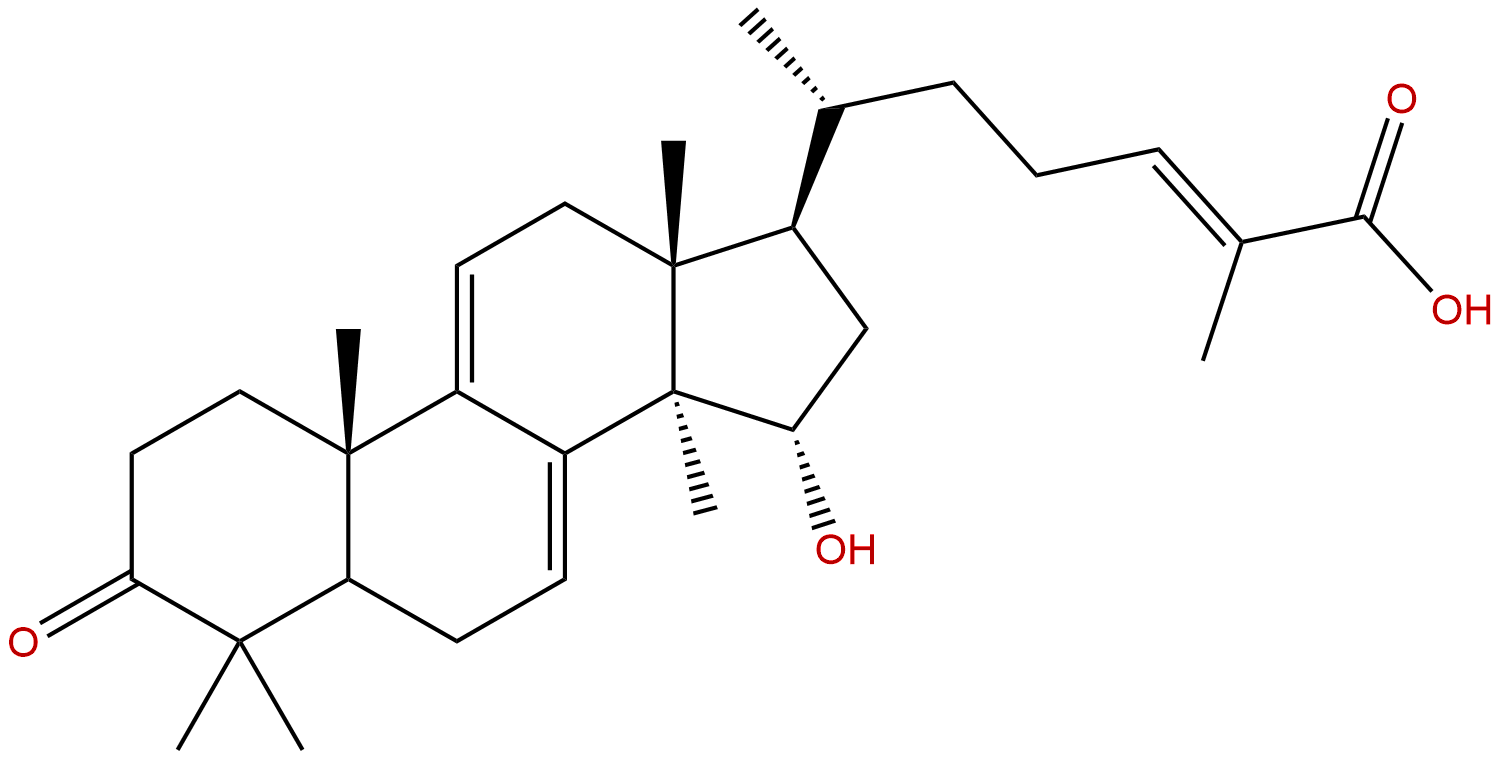


Product name: Ganoderic acid TR
Synonym name:
Catalogue No.: BPF2235
Cas No.: 862893-75-2
Formula: C30H44O4
Mol Weight: 468.678
Botanical Source:
Physical Description: Powder
Type of Compound: Triterpenoids
Purity: 95%~99%
Analysis Method: HPLC-DAD or/and HPLC-ELSD
Identification Method: Mass, NMR
Packing: Brown vial or HDPE plastic bottle
The product could be supplied from milligrams to grams. Inquire for bulk scale.
We provide solution to improve the water-solubility of compounds, thereby facilitating the variety of activity tests and clinic uses.
For Reference Standard and R&D, Not for Human Use Directly.
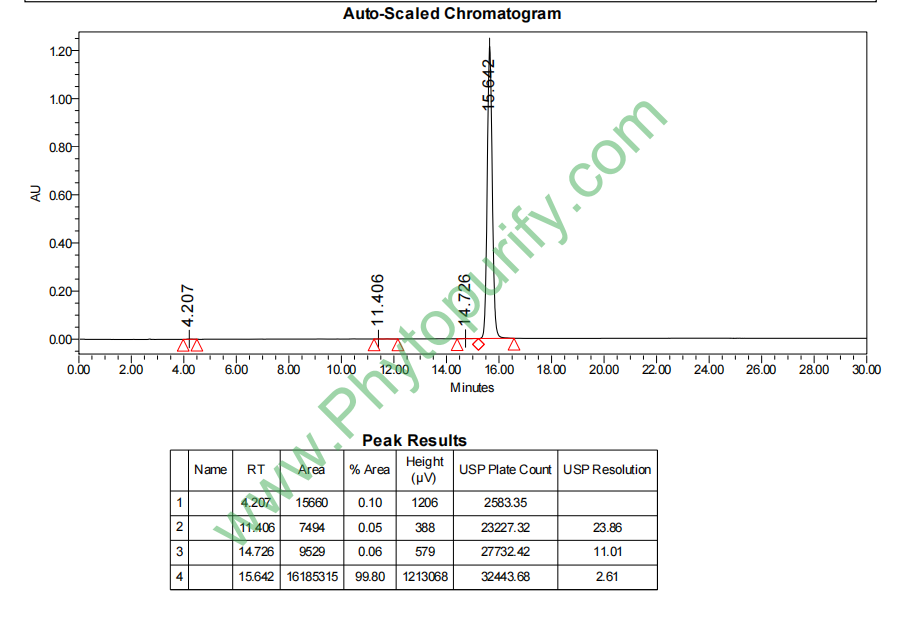
HPLC of Ganoderic acid TR
Storage conditions:Short-term storage at 2~8℃, long-term storage at -20 ~ -80℃
74.6000
5.6155
2.9231
.0107
3.8309
5.7670
Low
91.1711
5.0100
No
Yes
Yes
No
No
No
0.0
No
No
Yes
Yes
Natural products, as an important source of drug discovery, play an irreplaceable role in the long history of human struggle against diseases. Ganoderma lucidum(Ganoderma lucidum)As a traditional and precious Chinese medicinal herb, it is known as the "fairy grass" and its medicinal value has a history of thousands of years in East Asia. Modern pharmacological research has confirmed that Ganoderma lucidum is rich in various active ingredients, including polysaccharides, triterpenoids, nucleotides, sterols, etc., and has various biological activities such as immune regulation, anti-tumor, anti-inflammatory, antioxidant, antiviral, etc. Among them, ganoderic acids, as an important class of lanostane triterpenoids in Ganoderma lucidum, have attracted much attention due to their structural diversity and significant pharmacological activity.
Ganoderic acid TR (GA-TR) is a triterpenoid compound with unique biological activity isolated and identified from Ganoderma lucidum fruiting bodies or mycelium in recent years. Its chemical structure belongs to highly oxidized lanostane triterpenes, with a complex molecular skeleton containing multiple chiral centers and functional groups. The initial research focused on its anti-tumor activity and found that GA-TR can induce tumor cell apoptosis, inhibit metastasis, and reverse drug resistance by regulating multiple signaling pathways such as MCL1, BCL2, STAT3, MMP2, etc. However, more notably, subsequent studies have found that GA-TR exhibits broad-spectrum anti influenza virus neuraminidase (NA) inhibitory activity, with IC50 values of 10.9 μ M and 4.6 μ M for H5N1 and H1N1 subtypes of influenza virus NA, respectively. This discovery makes it a potential lead compound in the field of anti influenza drug development.
Influenza viruses, especially influenza A viruses (such as H1N1, H5N1, H7N9, etc.), have always been a major threat to global public health due to their high mutation rates and cross species transmission capabilities. Neuraminidase is an important glycoprotein on the surface of influenza virus, responsible for cleaving sialic acid receptors on the host cell surface, promoting the release and diffusion of progeny virus particles. The neuraminidase inhibitors currently used in clinical practice, such as oseltamivir and zanamivir, are first-line drugs for treating influenza. However, the continuous emergence of drug-resistant virus strains, such as oseltamivir resistant H1N1 virus, seriously weakens the efficacy of existing drugs, and there is an urgent need to develop new NA inhibitors with novel chemical frameworks and mechanisms of action. As a naturally occurring NA inhibitor, GA-TR's unique chemical structure provides a new approach to overcome existing drug resistance.
However, the pharmacological properties of GA-TR face significant challenges. Its high molecular weight (468.68 Da), high lipid solubility (LogP 5.62), and extremely poor water solubility (0.0107 mg/mL) severely limit its oral bioavailability and in vivo distribution due to its physicochemical properties. In addition, preliminary studies have shown that GA-TR has certain cytotoxicity and weak activity against oseltamivir resistant virus strains and influenza B virus. Therefore, a comprehensive and systematic review of the chemical, biological, and pharmacological properties of GA-TR, in-depth exploration of its mechanism of action, and objective evaluation of its pharmacological properties are of great significance for guiding its subsequent structural optimization, derivative development, and clinical translation. This article will provide a comprehensive review of Ganoderma lucidum acid TR from the aspects of chemical structure, plant origin, pharmacological activity, mechanism of action, medicinal evaluation, and clinical application prospects.
The chemical name of Ganoderma lucidum acid TR is (3 β, 7 β, 15 α, 20E) -3,7,15-trihydroxy-11,23-dioxolanostane-8,20 (22) - diene-26-acid, with a molecular formula of C30H44O5 and a molecular weight of 468.6780 g/mol. Structurally, GA-TR belongs to the typical lanostane type tetracyclic triterpenoid, with a core skeleton consisting of four rings A, B, C, and D, and side chains. Similar to many other ganoderic acids, the skeleton of GA-TR is highly oxidized, with hydroxyl groups (- OH) at C-3, C-7, and C-15 positions, carbonyl groups (=O) at C-11 and C-23 positions, and a double bond at C-20 (22) position. The presence of this multifunctional group endows GA-TR with rich chemical reactivity and potential for interaction with biological targets.
The physicochemical properties are the key factors determining whether a compound can become a drug. The lipid water partition coefficient (LogP) of GA-TR is 5.6155, indicating that it has extremely high lipid solubility and tends to be distributed in lipid environments. This characteristic is beneficial for its penetration through cell membranes, but on the other hand, it also results in extremely low solubility in water (0.0107 mg/mL). The extremely poor water solubility is the primary drug barrier faced by GA-TR, severely limiting its dissolution and absorption after oral administration. The polar surface area (TPSA) is 74.60 Å ², which is at a moderate level, indicating that it may have some potential for oral absorption. However, combined with its high LogP and low solubility, the actual oral bioavailability may be very low.
In terms of drug safety, early computer prediction models (such as Ames test) showed a mutagenic risk of 0.0 for GA-TR, indicating its low genetic toxicity. At the same time, the risk assessment of hERG (human Ether - à - go Related Gene) potassium channel inhibition is' no ', indicating a low risk of causing QT interval prolongation and arrhythmia in the heart. These preliminary safety evaluation results are relatively positive, providing favorable conditions for subsequent development. However, the blood-brain barrier (BBB) permeability is predicted to be "low", which means that GA-TR may have difficulty entering the central nervous system, which is a disadvantage for treating central nervous system diseases, but may be an advantage for treating peripheral diseases such as influenza, liver cancer, etc., which can reduce central nervous system side effects.
Lingzhi acid TR mainly comes from the porous fungal family Ganoderma lucidum(Ganoderma lucidum)The fruiting body, mycelium, and spore powder. Lingzhi is widely distributed worldwide, especially in East Asia (China, Japan, South Korea) where it has a long history of cultivation and medicinal use. There are significant differences in the composition and content of triterpenoids in Ganoderma lucidum from different regions, varieties (such as Ganoderma lucidum and Ganoderma lucidum), growth stages, and cultivation methods (wild, artificial cultivation, deep fermentation). Generally speaking, mature Ganoderma lucidum fruiting bodies have a higher content of triterpenoids, and GA-TR, as one of the trace or moderate components, is greatly affected by the strain, culture conditions, and harvesting time.
The traditional extraction method mainly uses organic solvent extraction. Due to the high lipid solubility of GA-TR, organic solvents with moderate polarity such as ethanol, methanol, and ethyl acetate are usually used as extraction media. The commonly used process includes: crushing the dried fruiting body or mycelium of Ganoderma lucidum, repeatedly soaking or refluxing with a certain concentration of ethanol (such as 70% -95%) at room temperature or heating conditions, combining the extraction liquids, and concentrating under reduced pressure to obtain the extract. Subsequently, the extract was preliminarily separated using liquid-liquid extraction method (such as sequentially extracting with petroleum ether, ethyl acetate, and n-butanol), and GA-TR is usually enriched in the ethyl acetate extraction layer. To obtain high-purity GA-TR, it is necessary to combine various modern chromatographic separation techniques. Silica gel column chromatography is the most commonly used preliminary separation method, which can remove a large amount of impurities through gradient elution (such as chloroform methanol system). Subsequently, the GA-TR monomer with high purity was further refined by reversed-phase silica gel column chromatography (such as ODS column, methanol water system), Sephadex gel column chromatography (LH-20) and preparative high performance liquid chromatography (Pre HPLC).
In recent years, in order to overcome the disadvantages of low efficiency, high solvent consumption, and long cycle of traditional extraction methods, some new extraction techniques have also been applied to the extraction of triterpenoids from Ganoderma lucidum, such as ultrasonic assisted extraction, microwave-assisted extraction, and supercritical fluid extraction (especially supercritical CO ₂ extraction). These technologies can achieve higher extraction rates in a shorter time and at lower temperatures by disrupting cell walls and enhancing mass transfer efficiency, and are more conducive to maintaining the stability of active ingredients. For the extraction of GA-TR, ultrasound assisted extraction combined with ethanol solvent has been proven to be an efficient and environmentally friendly method. In addition, with the development of biotechnology, the use of Ganoderma lucidum mycelium deep fermentation combined with in-situ extraction or metabolic engineering regulation is expected to achieve large-scale production of GA-TR, thereby solving the problems of low natural content and limited sources.
The most notable pharmacological activity of GA-TR is its role as a broad-spectrum inhibitor of influenza virus neuraminidase (NA). Neuraminidase is an essential key enzyme in the lifecycle of influenza viruses, responsible for cleaving sialic acid receptors on the surface of host cells, releasing newly assembled virus particles from infected cells, and promoting the spread of the virus in the respiratory mucosa. Inhibiting NA activity can effectively block the spread and infection of viruses.
Research has shown that GA-TR exhibits inhibitory activity against various subtypes of influenza virus NA. Specifically, its IC50 values for the NA of highly pathogenic avian influenza virus H5N1 and human influenza virus H1N1 are 10.9 μ M and 4.6 μ M, respectively. Although this activity level is weaker than the first-line clinical drug Oseltamivir (which typically has an IC50 of nM for H1N1 NA), it still holds significant lead compound value due to its unique natural product backbone. More importantly, GA-TR also showed some inhibitory activity against oseltamivir resistant H1N1 virus strains, although the activity was weak. This suggests that GA-TR and oseltamivir may have differences in their binding sites with NA, or have different inhibitory mechanisms, providing the possibility for developing novel NA inhibitors to overcome drug resistance. However, its activity against influenza B virus is also weak, indicating that its antiviral spectrum still needs to be expanded.
Before discovering its antiviral activity, the anti-tumor effect of GA-TR was the focus of its research. A large number of in vitro experiments have confirmed that GA-TR can inhibit proliferation and induce apoptosis in a variety of human tumor cell lines, including liver cancer, lung cancer, breast cancer, prostate cancer, colorectal cancer, etc.
The anti-tumor mechanism of GA-TR is multi-target and multi pathway. It can activate the mitochondrial apoptosis pathway by downregulating the expression of anti apoptotic proteins MCL1 and BCL2, while upregulating the expression of pro apoptotic proteins such as Bax. In addition, GA-TR can also inhibit the phosphorylation of the STAT3 signaling pathway, which is a key transcription factor that is continuously activated in various tumors, promoting cell proliferation, survival, and angiogenesis. By inhibiting STAT3, GA-TR can downregulate the expression of downstream target genes such as Cyclin D1, Survivor, VEGF, etc. GA-TR has also been found to inhibit the activity of matrix metalloproteinase MMP2, thereby reducing the invasion and metastasis ability of tumor cells. In addition, it also has a certain inhibitory effect on topoisomerases TOP1 and TOP2A, which may interfere with the DNA replication and transcription processes of tumor cells. The regulation of HIF1A may affect the adaptability of tumors in low oxygen environments. The multi-target properties of GA-TR make it potentially advantageous in anti-tumor therapy and may not easily develop drug resistance.
In addition to antiviral and anti-tumor activities, ganoderic acid compounds generally have anti-inflammatory and immunomodulatory activities, and GA-TR may also have similar effects. For example, it may reduce the production of inflammatory factors such as TNF - α and IL-6 by inhibiting signaling pathways such as MAPK1. In addition, its potential effects on estrogen receptor ESR1 and aromatase CYP19A1 suggest that it may play a role in hormone related diseases (such as breast cancer and endometrial cancer). However, there are relatively few specific research reports on GA-TR in these areas, and further in-depth exploration is needed.
The mechanism by which GA-TR inhibits influenza virus NA has not been fully elucidated, but based on its chemical structure and the mode of action of known NA inhibitors such as oseltamivir and zanamivir, some hypotheses can be proposed. The active site of NA is a highly conserved 'pocket' containing multiple key amino acid residues (such as Arg118, Arg152, Arg292, Glu119, Glu227, Asp151, etc.), which are responsible for binding with substrate sialic acid and catalyzing hydrolysis reactions. Oseltamivir and other drugs competitively inhibit NA by simulating the transition state of sialic acid and forming strong electrostatic and hydrogen bonding interactions with these key residues.
As a triterpenoid compound with a structure distinct from sialic acid analogues, GA-TR's inhibitory mechanism may not be simply competitive inhibition. Its large four ring skeleton and multiple polar functional groups (hydroxyl, carbonyl, carboxyl) may enable it to embed into hydrophobic pockets near the NA active site, while its polar groups form hydrogen bonds or electrostatic interactions with amino acid residues at the edge of the active site, thereby changing the conformation of the active site and hindering the entry of substrates or the release of products. GA-TR still retains partial activity against oseltamivir resistant virus strains (such as H274Y mutation), supporting the hypothesis that its binding site does not completely overlap with oseltamivir. The H274Y mutation leads to an increase in steric hindrance at the entrance of the active site, which affects the binding of oseltamivir, but may not affect the binding of GA-TR. However, its NA activity against influenza B virus is weak, indicating differences in its binding patterns with different subtypes of NA. In the future, molecular docking, molecular dynamics simulations, and crystal structure analysis of NA GA-TR complexes are needed to accurately elucidate their inhibition mechanisms.
The anti-tumor activity of GA-TR involves multiple signaling pathways and molecular targets, exhibiting characteristics of network regulation.
Drug efficacy evaluation is a key bridge connecting active compounds with clinical candidate drugs. Although GA-TR has unique pharmacological activity, its drug development faces significant challenges.
1. Defects in physical and chemical properties As mentioned earlier, the most prominent issues with GA-TR are poor water solubility (0.0107 mg/mL) and excessive fat solubility (LogP 5.62). This directly leads to difficulty in dissolving and absorbing it in the gastrointestinal tract after oral administration, resulting in extremely low bioavailability. Even with injection administration, its low solubility in aqueous media limits the development of formulations.
2. Pharmacokinetic characteristics At present, there are few detailed research reports on the pharmacokinetics of GA-TR in vivo, but based on its physicochemical properties, it can be reasonably inferred that it has poor oral absorption, high plasma protein binding rate (due to its high lipid solubility), large distribution volume, and may mainly be distributed in blood flow rich and lipid rich tissues such as the liver and lungs. In terms of metabolism, multiple hydroxyl and carbonyl groups in its structure are potential sites for phase I metabolism (oxidation, reduction) and phase II metabolism (glucuronidation, sulfation), which may lead to rapid metabolic clearance in the body. The main excretion pathway may be bile excretion.
3. Toxicity issues Preliminary studies have shown that GA-TR has certain cytotoxicity, which limits its therapeutic window. Although the Ames test and hERG prediction results are good, the cytotoxicity suggests that it may also have a certain killing effect on normal cells, especially at higher concentrations. This toxicity may be related to its non-specific embedding in the cell membrane or interference with certain key cellular functions. In addition, its weaker activity against oseltamivir resistant virus strains also means that higher doses are needed to achieve therapeutic effects, which may exacerbate toxicity issues.
4. Strategies for improving drug properties Given the above issues, it is almost impossible to directly develop GA-TR as an oral medication. The future research focus should be on structural modification and dosage form innovation.
Although the prospects of GA-TR as a clinical drug are not optimistic, its unique chemical framework and pharmacological activity provide valuable insights and directions for future drug development.
1. Value as a lead compound for anti influenza drugs The greatest value of GA-TR lies in its role as a lead compound for novel anti influenza virus NA inhibitors. Its different chemical framework from existing drugs (oseltamivir) provides a new starting point for overcoming the increasingly serious problem of drug resistance. By systematically studying the structure-activity relationship of GA-TR, it is expected to discover derivatives with stronger inhibitory activity, lower toxicity, and better pharmacokinetic properties against multiple influenza virus subtypes (including drug-resistant strains). In the future, "me better" or "first in class" drugs based on GA-TR skeleton are worth looking forward to.
2. Potential applications in the field of anti-tumor therapy The multi-target anti-tumor mechanism of GA-TR gives it unique advantages in tumor therapy. Although its own pharmacological properties are poor, its mechanism of action (such as inhibiting STAT3 and MCL1) is a popular target in tumor therapy. Therefore, GA-TR can serve as a tool molecule for studying the biological functions of these targets, or as a template for designing novel small molecule inhibitors targeting these pathways. In addition, if the toxicity problem can be solved through structural modification, GA-TR derivatives may have potential in combination therapy (with chemotherapy drugs, targeted drugs, or immune checkpoint inhibitors).
3. Challenges and Future Directions Faced:
As a unique triterpenoid compound in Ganoderma lucidum, ganoderic acid TR demonstrates the enormous potential of natural products in the treatment of complex diseases. It is both a broad-spectrum influenza virus neuraminidase inhibitor and a multi-target anti-tumor active molecule. Its discovery provides a new chemical space and lead structure for the development of anti influenza drugs, especially for overcoming the resistance of existing drugs. However, GA-TR also faces severe pharmaceutical challenges such as poor water solubility and cytotoxicity, which makes it difficult to directly enter clinical applications.
The research process of GA-TR is a typical epitome of natural product drug development: from discovering activity, elucidating mechanisms, to evaluating drug properties, every step is full of opportunities and challenges. In the future, the research focus of GA-TR will no longer be on developing it as a drug in itself, but on its unique molecular skeleton, through the cross fusion of modern medicinal chemistry, chemical biology, and nanomedicine delivery technology, for in-depth structural optimization and dosage form innovation. We have reason to believe that through continuous exploration of natural products such as ganoderic acid TR, humans will be able to gain more enlightenment and ultimately develop safe and effective new drugs, contributing to the fight against major diseases such as influenza and tumors.
