


Synonym name: 4-Hydroxypsoralen
Catalogue No.: BP0257
Cas No.: 486-60-2
Formula: C11H6O4
Mol Weight: 202.165
Botanical Source: bergamot oil (Citrus bergamia). Also from various other Citrus spp., Ficus religiosa and Ficus infectoria
Purity: 95%~99%
Analysis Method: HPLC-DAD or/and HPLC-ELSD
Identification Method: Mass, NMR
Packing: Brown vial or HDPE plastic bottle
Can be supplied from milligrams to grams.
For Reference Standard and R&D, Not for Human Use Directly.
Inquire for bulk scale.
HPLC of Bergaptol
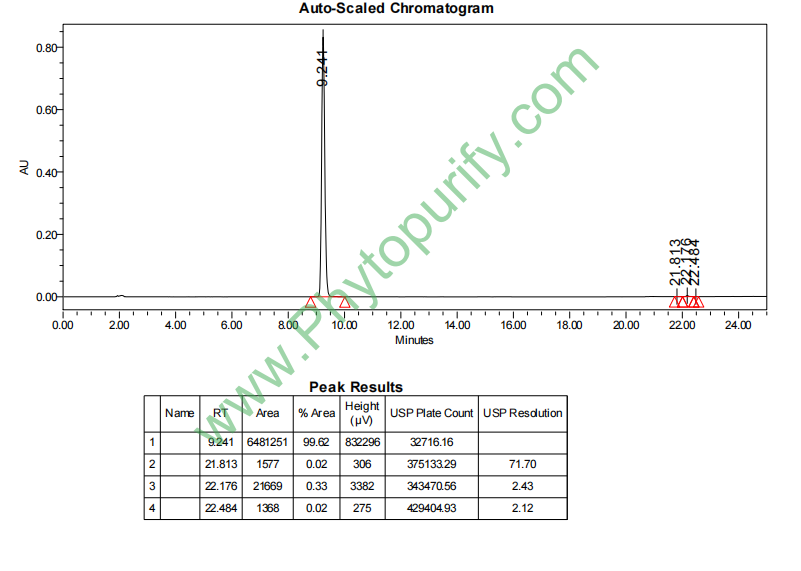
Storage conditions:Short-term storage at 2~8℃, long-term storage at -20 ~ -80℃
Bergaptol (CAS number: 486-60-2) is a naturally occurring furan coumarin compound widely distributed in various citrus plants, especially in the higher content of Citrus medica var. sarcodactyls. As an important natural product, bergamot has attracted widespread attention in pharmacology and natural medicine research in recent years due to its unique chemical structure and diverse biological activities. The latest research shows that bergamot not only inhibits the debenzylation of cytochrome P450 enzyme CYP3A4 (IC50 of approximately 24.92 μ M), but also exhibits significant anti proliferative and anticancer activities. In addition, its potential role in antioxidant damage also provides a theoretical basis for its clinical application.
This article aims to systematically review the chemical structure and physicochemical properties, plant sources and extraction methods, pharmacological activity and mechanism of action, pharmacological evaluation and pharmacokinetic characteristics of bergamot, and explore its future clinical application prospects and challenges, in order to provide reference and inspiration for related research.
The chemical name of bergamot is 7-hydroxyfuran coumarin, with a molecular formula of C10H6O4 and a molecular weight of 206.16. Its structural feature is the fusion of furan ring and coumarin skeleton, and the presence of 7-hydroxyl group endows it with strong polarity and biological activity. The molecular structure contains four hydrogen bond acceptors, which greatly affect its binding ability with biomolecules.
In terms of physical and chemical properties, the LogP value of bergamot is 1.74, indicating that it has moderate lipid solubility, which is conducive to cell membrane penetration but not excessively hydrophobic, and is suitable for oral absorption. The topological polar surface area (TPSA) is 69.09 Å ², which meets the polarity requirements of most drug molecules and is beneficial for their bioavailability. According to existing data, the blood-brain barrier permeability of bergamot is relatively low, suggesting that its role in the central nervous system may be limited. Hepatotoxicity and cardiotoxicity are not yet clear, and the hERG channel inhibition experiment results are negative, indicating preliminary good cardiac safety, but further systematic evaluation is still needed.
Phlorophenol is mainly found in citrus plants, especially in fruits and peels such as bergamot, orange, and grapefruit, where it is abundant. The traditional Chinese medicinal herb bergamot is widely used, and its medicinal value is partly attributed to the presence of bergamot and its related derivatives.
There are various methods for extracting bergamot, including solvent extraction, ultrasound assisted extraction, and supercritical fluid extraction. Generally, ethanol or methanol is used as the extraction solvent, and the extraction efficiency is improved by optimizing the extraction time, temperature, and solvent concentration. The extraction solution undergoes purification steps such as liquid-liquid distribution and column chromatography to obtain high-purity bergamot. In recent years, green extraction techniques such as ultrasound assisted extraction and microwave-assisted extraction have been applied to the extraction of bergamot, significantly improving yield and purity, and better meeting the requirements of environmental friendliness and sustainable development.
As a hydroxyl containing furan coumarin, bergamot exhibits excellent antioxidant activity. It can eliminate free radicals and alleviate oxidative stress damage to cells. Related in vitro experiments have shown that bergamot can activate intracellular antioxidant enzyme systems such as superoxide dismutase (SOD1, SOD2), catalase (CAT), and glutathione peroxidase (GPX1), thereby reducing reactive oxygen species (ROS) levels and protecting cells from oxidative damage.
In recent years, the anti-cancer potential of bergamot has gradually been revealed. Many in vitro cell experiments have shown that bergamot can inhibit the proliferation of a variety of cancer cell lines, including liver cancer, breast cancer and colorectal cancer cells. Its mechanism of action may involve inducing cell cycle arrest, promoting apoptosis, and inhibiting tumor cell migration and invasion. In addition, bergamot exerts a synergistic anti-cancer effect by regulating the activity of cytochrome P450 enzyme CYP3A4, affecting drug metabolism and changes in the tumor microenvironment.
Foshoufen also exhibits multiple pharmacological effects such as anti-inflammatory, antibacterial, and neuroprotective effects. Its anti-inflammatory effect is mainly achieved by inhibiting the expression of inflammatory factors and activating signaling pathways. The neuroprotective effect may be related to its antioxidant and regulation of cell apoptosis, indicating its potential application value in neurodegenerative diseases.
The pharmacological effects of bergamot are closely related to its regulation of multiple molecular targets. Its antioxidant effect is mainly achieved by activating the NFE2L2 (NRF2) signaling pathway. NRF2, as a key transcription factor in cells, regulates the expression of various antioxidant and detoxifying enzymes, such as SOD1, SOD2, CAT, GPX1, and HMOX1 (heme oxygenase-1), enhancing the ability of cells to resist oxidative stress.
In terms of anti-cancer mechanisms, bergamot inhibits the debenzylation of CYP3A4 enzyme, affecting the activity of drug metabolizing enzymes and potentially altering the sensitivity of tumor cells to drugs. In addition, bergamot can regulate cell cycle related proteins and apoptosis signaling pathways, such as p53, Bcl-2 family proteins, and caspase enzyme system, inducing cancer cell apoptosis and blocking its proliferation.
Its anti-inflammatory and neuroprotective mechanisms involve the inhibition of the NF - κ B signaling pathway and the reduction of ROS generation, alleviating inflammatory responses and cell damage. Overall, bergamot achieves its diverse biological effects through multi-target and multi pathway synergistic effects.
The pharmacological parameters of bergamot indicate that it has good drug potential. The molecular weight of 206.16, LogP1.74, and TPSA69.09 all comply with Lipinski's rules, indicating good oral bioavailability. The number of hydrogen bond acceptors is 4, which facilitates the binding of molecules to targets.
The low permeability of the blood-brain barrier limits its direct application in central nervous system diseases, but reduces the risk of central side effects. There is no clear data on hepatotoxicity and cardiotoxicity, and negative hERG inhibition suggests good cardiac safety, but further in vivo toxicological studies are needed for validation.
In terms of pharmacokinetics, existing research is relatively limited. It is speculated that bergamot is well absorbed after oral administration, but its metabolic pathway and half-life in vivo have not been systematically reported. Given its inhibitory effect on CYP3A4, there may be a risk of drug interactions, which requires special attention in subsequent research.
As a natural product, bergamot has shown broad clinical application prospects due to its diverse pharmacological activities and good medicinal properties. Its antioxidant and anticancer effects make it an ideal candidate molecule for developing new anti-tumor drugs. Especially in the adjuvant treatment of malignant tumors such as liver cancer and breast cancer, bergamot is expected to improve the therapeutic effect and reduce side effects by regulating oxidative stress and drug metabolic enzyme activities.
In addition, the potential of bergamot in anti-inflammatory and neuroprotective fields is also worth exploring, and it is expected to be used in the treatment of chronic inflammatory diseases and neurodegenerative diseases in the future. With the advancement of green extraction technology and pharmaceutical formulation processes, the industrialization and clinical translation of bergamot will become more feasible.
However, clinical research on bergamot is still in its infancy, and there is a lack of systematic pharmacokinetic, toxicological, and clinical safety evaluations. In the future, research on its metabolic mechanism, drug interactions, and long-term safety should be strengthened, while exploring its combination strategies with other drugs to promote its clinical application.
As a natural product with unique structure and multiple biological activities, bergamot has shown great potential for applications in antioxidant, anticancer, and anti-inflammatory fields. It achieves multi-target and multi mechanism pharmacological effects by regulating the NRF2 signaling pathway and CYP3A4 enzyme activity. The drug has good pharmacological parameters and has the foundation for further development as a drug.
Future research should focus on its pharmacokinetic characteristics, toxicological safety evaluation, and clinical efficacy verification, promoting the transition of bergamot from laboratory to clinical application. With the deepening understanding of the pharmacological mechanisms of natural products, bergamot is expected to become an important research object and a new choice for clinical treatment in the field of natural product pharmacology.
